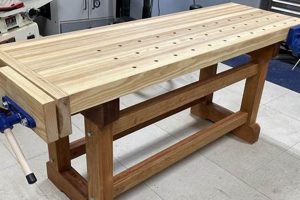
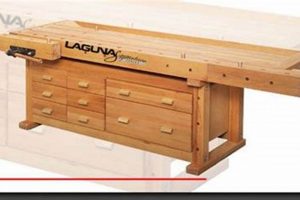
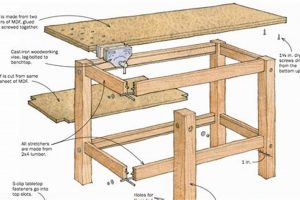
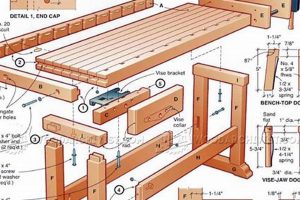
The act of constructing a sturdy, reliable surface specifically designed for woodworking tasks is fundamental to the craft. This involves selecting appropriate materials, employing accurate joinery techniques, and ensuring a stable, level platform for securing workpieces. For example, a craftsman might meticulously assemble a frame from hardwood and attach a thick, flat top, incorporating features like vises and dog holes for enhanced functionality.
A well-built foundation of this type provides numerous advantages. It allows for precise execution of cuts, joinery, and finishing operations. Furthermore, it reduces strain on the body by providing an ergonomically sound workspace. Historically, this type of construction dates back centuries, with variations reflecting regional woodworking traditions and available resources. The presence of a solid work surface contributes directly to the quality and efficiency of woodworking projects.
Subsequent discussion will detail specific design considerations, essential tools and materials, and step-by-step instructions to guide the successful creation of such a woodworking structure. Considerations include choosing the right dimensions, incorporating storage, and employing appropriate finishing techniques to ensure longevity and durability.
Essential Considerations for Workbench Construction
The following are critical points to consider to maximize the functionality and longevity of the assembled woodworking surface.
Tip 1: Material Selection. Prioritize hardwood such as maple, beech, or oak for the benchtop and frame. These species offer superior durability and resistance to deformation under heavy use. Softwoods are generally unsuitable due to their susceptibility to dents and warping.
Tip 2: Joinery Integrity. Employ robust joinery techniques, such as mortise and tenon joints or dovetails, to ensure the frame’s structural stability. Screws and glue alone may not provide sufficient long-term strength to withstand the stresses of woodworking operations.
Tip 3: Benchtop Flatness. A perfectly flat benchtop is essential for accurate work. Employ a hand plane or flattening service to achieve a level surface after assembly. Minor imperfections can compromise precision during critical operations.
Tip 4: Vise Placement and Type. Consider the placement and type of vises carefully. A face vise and a tail vise offer versatility for securing workpieces of various sizes and shapes. Ensure the vises are robust and operate smoothly.
Tip 5: Dog Hole Integration. Incorporate dog holes along the length and width of the benchtop. These allow for flexible clamping options when used in conjunction with bench dogs and other workholding accessories.
Tip 6: Base Stability. The base must be heavy and stable to prevent movement during rigorous woodworking tasks. A wide stance and strategically placed stretchers contribute significantly to overall stability.
Tip 7: Surface Finishing. Apply a durable finish, such as a few coats of boiled linseed oil or a polyurethane varnish, to protect the benchtop from moisture and abrasion. Avoid excessively glossy finishes, as they can reduce friction and make workpieces prone to slipping.
Careful attention to these factors will result in a durable and versatile workbench that will serve as the cornerstone of any woodworking endeavor.
The subsequent section will outline specific project plans and advanced techniques for optimizing workbench design.
1. Material Selection

Material selection is a foundational consideration in the construction of any woodworking bench. The choice of materials dictates the bench’s structural integrity, its resistance to wear and tear, and ultimately, its longevity. Informed decisions regarding material selection are, therefore, paramount to creating a reliable and functional workbench.
- Hardwood Density and Stability
The selection of dense hardwoods, such as maple, beech, or oak, is crucial for the workbench top. These materials offer superior resistance to dents, scratches, and warping, which are inevitable consequences of regular woodworking activities. Their density also provides a stable surface for accurate work. In contrast, softwoods are generally unsuitable due to their greater susceptibility to damage and deformation.
- Frame Material and Joinery Compatibility
The material used for the bench frame must be compatible with the chosen joinery methods. Hardwoods are generally preferred for the frame as well, as they allow for the creation of strong and durable joints, such as mortise and tenon or dovetail joints. The frame’s structural integrity is vital for maintaining the bench’s overall stability and preventing racking or movement during use.
- Moisture Content and Acclimation
The moisture content of the wood is a significant factor affecting its dimensional stability. Wood with a high moisture content is prone to shrinkage and warping as it dries. Therefore, it is essential to use properly dried lumber and allow it to acclimate to the workshop environment before construction. This reduces the likelihood of movement and distortion after the bench is assembled.
- Material Cost and Availability
While hardwood offers superior performance, material cost and availability must also be considered. Less expensive and more readily available options, such as construction-grade lumber, may be suitable for certain components of the bench, particularly the base, provided that they are adequately reinforced and stabilized. Balancing performance requirements with budgetary constraints is an important aspect of material selection.
The careful consideration of these facets of material selection directly contributes to the functionality and lifespan of the woodworking bench. By prioritizing durable, stable, and appropriately acclimated materials, the craftsman ensures a reliable and effective work surface for years to come. Furthermore, proper material selection can significantly improve the precision and efficiency of woodworking tasks performed on the bench.
2. Joinery Strength

Joinery strength is a critical determinant in the overall performance and longevity of any woodworking bench. The method used to connect the individual components directly influences the bench’s ability to withstand the stresses inherent in woodworking tasks. Weak or improperly executed joinery will inevitably lead to instability, racking, and ultimately, failure of the structure. Conversely, robust and well-fitted joinery provides a solid, dependable platform for all types of woodworking operations. As an example, a bench constructed with loosely fitted mortise and tenon joints will exhibit unacceptable movement during planing or sawing, compromising precision and potentially leading to inaccurate results. The selection and execution of appropriate joinery techniques are, therefore, fundamental to crafting a functional and durable woodworking bench.
The specific type of joinery employed should be carefully matched to the demands of the bench’s design and intended use. High-stress areas, such as the legs and stretchers, require particularly strong joints. Mortise and tenon joints, dovetails, and robust lap joints are commonly used in these locations due to their superior strength and resistance to racking forces. Simpler joinery methods, such as screws and glue, may be suitable for less critical areas, but should always be used in conjunction with well-fitted components to maximize their effectiveness. A practical application of understanding joinery strength is evident in the selection of through tenons for connecting the legs to the benchtop; this joint not only provides exceptional strength but also offers a visually appealing design element, illustrating how function and aesthetics can be harmoniously integrated.
In summary, joinery strength is an indispensable element in the construction of a quality woodworking bench. The consequences of neglecting this aspect can range from minor inconveniences to catastrophic structural failures. By prioritizing robust joinery techniques and ensuring careful execution, woodworkers can create a stable, reliable, and long-lasting bench that will serve as a cornerstone of their craft for years to come. Understanding the interplay between different joinery methods and their specific applications allows for the creation of a workbench that is not only functional but also a testament to the woodworker’s skill and craftsmanship.
3. Surface Flatness
Surface flatness is a paramount consideration when constructing a woodworking bench, functioning as a foundational element upon which the accuracy and precision of subsequent woodworking operations are predicated. A surface deviating from true flatness introduces inaccuracies, compromising the ability to create true and square workpieces. Consequently, efforts invested in precise cutting, joinery, and assembly are rendered less effective if the reference surfacethe benchtopis not itself flat. For instance, attempting to plane a long board on an uneven benchtop will inevitably result in a board that is not uniformly flat, regardless of the skill of the operator.
The impact of surface flatness extends beyond individual tasks, influencing the overall quality of projects. In cabinetmaking, where components must fit together with tight tolerances, even slight deviations from flatness can accumulate, leading to misaligned drawers, doors, and panels. Similarly, in instrument making, where precision is critical for tonal accuracy, an unflat surface can hinder the accurate assembly of soundboards and other components. Achieving and maintaining flatness requires careful material selection, robust construction techniques, and periodic maintenance to address any warping or distortion that may occur over time. Strategies can include the use of laminated bench tops or implementing a leveling process such as planing.
In conclusion, surface flatness is an indispensable attribute of a woodworking bench, directly affecting the accuracy and efficiency of woodworking tasks. Failure to prioritize flatness undermines the precision of work and can compromise the structural integrity of projects. The investment of time and resources into achieving and maintaining a flat benchtop represents a critical step in ensuring the successful outcome of woodworking endeavors. Proper implementation translates to enhanced accuracy, improved project quality, and a more enjoyable woodworking experience.
4. Vise Integration

The integration of vises is a crucial element in workbench construction, fundamentally altering its functionality and versatility. Vises provide a secure means of holding workpieces, enabling a woodworker to apply force and precision to various operations. The absence of adequately integrated vises limits the range of tasks that can be performed effectively on the bench, essentially reducing its utility to a simple work surface. Conversely, a properly equipped bench with strategically placed vises dramatically expands its capabilities, allowing for intricate joinery, shaping, and assembly processes. For instance, a face vise secures a board on edge for dovetailing, while a tail vise, in conjunction with bench dogs, clamps long boards flat for planing. This exemplifies the indispensable role vises play in converting a basic structure into a comprehensive woodworking station.
Different vise types cater to specific needs. A metal-jawed vise offers robust clamping power for heavy-duty tasks, while a wooden-jawed vise provides a gentler hold for delicate workpieces. The positioning of vises along the benchtop is equally important. A face vise is typically located near the front left corner for right-handed users, allowing for easy access and leverage. A tail vise is often integrated into the end of the bench, providing a long clamping surface for larger pieces. The height of the vises must also be carefully considered to ensure comfortable and ergonomic operation. The integration of specific vises often dictates aspects of the making a woodworking bench like adding thickness or reinforcement to certain areas where vises will be mounted, as these areas will be under high amounts of stress during regular use.
In conclusion, vise integration is not merely an optional add-on, but an integral component of the workbench design. The thoughtful selection, placement, and installation of vises directly influence the bench’s functionality and the woodworker’s ability to execute a wide range of tasks with precision and efficiency. Challenges in vise integration often arise from inadequate planning during the design phase or insufficient reinforcement of the bench structure. Addressing these challenges proactively is essential for creating a truly versatile and effective woodworking bench. The connection between the two is undeniably intertwined, a functional necessity.
5. Base Stability
Base stability is a non-negotiable requirement in woodworking bench construction. The stability of the base directly impacts the bench’s ability to withstand forces generated during various woodworking operations. An unstable base introduces unwanted movement, compromising accuracy and potentially leading to unsafe working conditions. For example, attempting to hand-plane a large panel on a bench with a wobbly base results in uneven planing and increased physical exertion, rendering the task inefficient and potentially dangerous. Furthermore, accurate joinery relies on a stable platform; any movement during marking or cutting operations diminishes the precision of the resulting joints. The base effectively forms the foundation for all tasks performed on the bench.
Several factors contribute to base stability. These include the design of the leg structure, the use of stretchers to resist racking forces, and the overall weight of the bench. A wider stance provides greater resistance to tipping, while strategically placed stretchers prevent the legs from splaying outwards under load. The use of dense materials, such as hardwood or a combination of hardwood and softwood, increases the bench’s overall mass, further enhancing its stability. The method of connecting the legs to the benchtop also plays a crucial role. Robust joinery, such as mortise and tenon joints, ensures a solid and durable connection that minimizes movement. The base, therefore, is not merely a support structure; it’s an integral part of the bench’s overall performance.
In conclusion, base stability is a defining characteristic of a functional woodworking bench. It directly influences the accuracy, safety, and efficiency of woodworking operations. While various design choices and construction techniques can enhance base stability, the underlying principle remains constant: a stable base is essential for creating a reliable and effective work surface. A well-designed and constructed base not only provides a solid foundation but also contributes to the long-term durability and usability of the entire bench.
Frequently Asked Questions
The following section addresses common inquiries regarding the design, materials, and construction of a woodworking bench, providing concise and informative answers to assist in the building process.
Question 1: What is the optimal height for a woodworking bench?
The ideal bench height is typically determined by individual stature. A generally accepted guideline is to position the benchtop at a height that allows for comfortable planing without requiring excessive bending or reaching. A common method for determining this height involves standing upright with arms hanging loosely; the benchtop should be approximately level with the wrists.
Question 2: Which type of wood is best suited for a workbench top?
Hardwoods, such as maple, beech, or oak, are generally preferred for workbench tops due to their density, durability, and resistance to wear. These species provide a stable and robust surface capable of withstanding the rigors of woodworking activities. Softwoods are typically unsuitable due to their susceptibility to dents and deformation.
Question 3: Is a vise essential for a woodworking bench?
While not strictly mandatory, a vise significantly enhances the functionality of a woodworking bench. Vises provide a secure means of clamping workpieces, enabling a wide range of operations, including sawing, planing, and joinery. The type and placement of vises should be carefully considered based on individual woodworking needs.
Question 4: What is the purpose of dog holes in a workbench?
Dog holes, typically drilled in a grid pattern across the benchtop, provide versatile clamping options when used in conjunction with bench dogs and other workholding accessories. They allow for secure positioning of workpieces of various shapes and sizes, facilitating efficient and accurate woodworking operations.
Question 5: How can a woodworking bench be kept flat and true over time?
Maintaining a flat and true workbench surface requires careful construction and periodic maintenance. The use of stable materials, robust joinery, and a durable finish can help to prevent warping and distortion. Periodic flattening with a hand plane or other suitable tool may be necessary to correct any minor imperfections that develop over time.
Question 6: What is the ideal weight for a stable woodworking bench?
The optimal weight of a woodworking bench is dependent on its size and intended use. Generally, a heavier bench provides greater stability and resistance to movement during woodworking operations. A bench weighing between 200 and 300 pounds is typically sufficient for most applications.
The preceding answers provide a foundation for understanding key aspects of woodworking bench construction. Further research and experimentation are encouraged to tailor the bench to specific individual needs and preferences.
The next section will explore advanced techniques for customizing woodworking benches.
Conclusion
The preceding exploration has detailed the essential considerations inherent in making a woodworking bench. Emphasis has been placed on material selection, joinery strength, surface flatness, vise integration, and base stability as critical determinants of functionality and longevity. These factors, when properly addressed, result in a reliable platform for precision woodworking tasks, enhancing both efficiency and accuracy.
The construction of a robust woodworking surface represents a fundamental investment in the craft. The principles outlined herein serve as a guide for creating a tool that endures, facilitating generations of skilled woodworking. Continual refinement and adaptation of these principles, based on individual needs and experiences, remain essential for optimizing the woodworking environment.