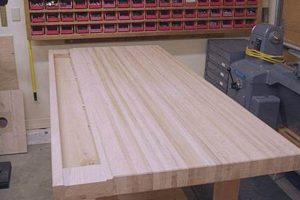
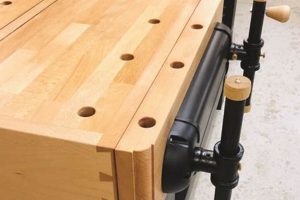
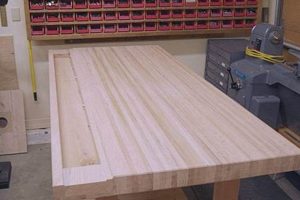
A dedicated workspace serves as a cornerstone for many woodworking endeavors. This specific type of bench, characterized by its robust construction and versatile functionality, provides a stable platform for a wide array of tasks. Such tasks might include joinery, carving, assembly, and finishing. Its design often incorporates features like integrated vises and dog holes, facilitating secure clamping and manipulation of materials.
The advantages of utilizing a well-designed workbench of this nature are numerous. It enhances precision by minimizing movement during detailed work. It promotes safety by providing a secure and stable environment. Furthermore, it optimizes workflow by keeping tools and materials organized and readily accessible. Historically, these benches have been integral to skilled craftsmanship, passed down through generations and adapted to evolving techniques and materials.
With a foundational understanding of this essential piece of equipment established, the following sections will delve into specific aspects. These areas of exploration include design considerations, material selection, construction techniques, and methods for maintaining optimal performance over time. The emphasis will be on providing practical knowledge applicable to both aspiring and experienced woodworkers.
Workbench Optimization Strategies
This section offers practical guidance for maximizing the utility and lifespan of a dedicated woodworking bench. Implementing these strategies can enhance both the efficiency and enjoyment of woodworking projects.
Tip 1: Prioritize Stability. A workbench must resist movement during rigorous tasks. Ensure a solid foundation by leveling the feet and, if necessary, securing it to the floor. Increased mass and a wide stance contribute significantly to stability.
Tip 2: Optimize Vise Placement. The location of vises is crucial for efficient clamping. A face vise should be flush with the benchtop to prevent interference with workpieces. A tail vise, ideally paired with dog holes, expands clamping versatility.
Tip 3: Employ Dog Hole Systems Effectively. Strategically placed dog holes, in conjunction with bench dogs and other clamping accessories, facilitate secure workpiece retention for planing, sawing, and other operations. Consistent spacing and alignment are essential for optimal performance.
Tip 4: Maintain a Level Surface. Over time, a workbench surface can become uneven. Periodically check for flatness using a straightedge and hand plane to correct any deviations. A level surface ensures accurate joinery and consistent results.
Tip 5: Organize Tool Storage. Implement a tool storage system that keeps essential tools readily accessible. Consider incorporating drawers, shelves, or a tool well into the workbench design. Dedicated storage reduces clutter and improves workflow.
Tip 6: Protect the Surface. Apply a durable finish to the workbench surface to resist moisture and prevent damage from spills or accidental impacts. Regular cleaning and waxing further extend the life of the finish.
Tip 7: Adapt to Project Needs. A truly versatile workbench can be adapted to accommodate specific project requirements. Consider adding accessories such as a planing stop, a sharpening station, or a dedicated finishing area. These adaptations enhance functionality and productivity.
Adhering to these recommendations fosters a safer, more productive, and ultimately more rewarding woodworking experience. A well-maintained and optimized workbench is an invaluable asset for any woodworker, regardless of skill level.
The subsequent sections will explore advanced woodworking techniques and project ideas that further leverage the capabilities of a dedicated workbench.
1. Solid Construction

Solid construction is not merely a desirable attribute, but a foundational requirement for effective bench woodworking. The bench serves as the stable platform upon which all operations are performed. Instability compromises precision, introduces safety hazards, and diminishes the overall quality of the final product. A bench exhibiting flexure or racking under load directly translates to inaccuracies in joinery, uneven surfaces in planing, and challenges in assembly. The cause-and-effect relationship is linear: deficient structural integrity begets compromised workmanship.
Examples of solid construction in bench design include robust joinery, such as mortise-and-tenon joints reinforced with wedges, and the strategic use of thick, dimensionally stable timbers. Traditional workbenches often employed these techniques, resulting in structures that have endured for generations. Conversely, benches constructed with inferior materials or inadequate joinery are prone to failure, necessitating frequent repairs or eventual replacement. Consider a bench built with poorly fitted dovetail joints; under the stress of planing a large surface, these joints will loosen, leading to movement and a lack of support. This necessitates halting the work to repair the bench, wasting valuable time and resources.
In summary, the link between robust construction and successful “jack bench woodworking” is inextricable. The stability of the workbench directly impacts the accuracy and efficiency of all woodworking tasks. Understanding this relationship allows woodworkers to prioritize structural integrity in bench selection or construction, ultimately leading to enhanced craftsmanship and reduced potential for injury or project failure. Neglecting this fundamental aspect undermines the entire woodworking process.
2. Vise Integration

Vise integration is a critical determinant of a workbench’s utility in “jack bench woodworking.” The vise serves as a primary work-holding mechanism, facilitating a range of operations from detailed carving to the assembly of large components. A well-integrated vise system enhances precision, efficiency, and safety, while a poorly designed system can impede progress and compromise the quality of the finished product.
- Jaw Alignment and Clamping Force
The vise jaws must align perfectly to ensure even clamping pressure across the workpiece. Uneven pressure can damage delicate materials or allow movement during rigorous tasks like planing or sawing. Vises with adjustable mechanisms allow for fine-tuning to compensate for wear or slight misalignments. A robust clamping force is essential for securing workpieces firmly, preventing slippage and maintaining accuracy.
- Vise Placement and Accessibility
The position of the vise on the workbench is crucial for accessibility and versatility. A face vise, typically mounted on the front of the bench, should be flush with the benchtop to avoid interference with longer workpieces. A tail vise, integrated into the end of the bench, offers additional clamping options, particularly when used in conjunction with bench dogs. The spacing between vises and other work-holding fixtures should be carefully considered to accommodate a variety of project sizes and shapes.
- Vise Material and Construction
The materials used in vise construction directly impact its durability and performance. Cast iron vises are known for their strength and rigidity, while wooden vises offer a traditional aesthetic and can be easier to repair. The quality of the vise’s mechanism, including the screw, guide rods, and jaw faces, determines its smoothness of operation and long-term reliability. A vise with hardened steel components will resist wear and maintain its clamping force over time.
- Vise Versatility and Adaptability
A versatile vise system allows for a wide range of clamping configurations. Some vises feature quick-release mechanisms for rapid adjustments, while others offer swivel bases or interchangeable jaws for specialized tasks. Adaptable vises can be modified with custom jaws or accessories to accommodate unique project requirements. A well-designed vise system enhances the overall functionality of the workbench and expands the possibilities for “jack bench woodworking.”
In conclusion, the effectiveness of “jack bench woodworking” is significantly influenced by the quality and integration of the vise system. Careful consideration of jaw alignment, vise placement, material construction, and versatility is essential for maximizing the bench’s potential. A well-chosen and properly integrated vise system becomes an indispensable tool for any serious woodworker, enabling precise, efficient, and safe execution of a wide range of projects.
3. Work Holding
The effectiveness of “jack bench woodworking” is directly proportional to the efficacy of its work-holding methods. Securely anchoring a workpiece allows for precise and safe execution of joinery, shaping, and finishing tasks. Deficiencies in work-holding lead to inaccuracies, potential injury, and compromised project outcomes. The following explores critical facets of work-holding as they relate to the woodworking bench.
- Bench Dogs and Dog Holes
Bench dogs, typically metal or wooden pegs, inserted into strategically placed dog holes provide a versatile method for securing workpieces. When used in conjunction with a vise, bench dogs prevent movement during planing or sawing operations. The precise placement and alignment of dog holes are crucial for effective work-holding across a range of workpiece sizes and shapes. Improperly aligned dog holes negate their intended function and introduce the risk of slippage.
- Vises: Face, Tail, and Leg
Vises exert clamping force to hold workpieces securely against the bench. A face vise, mounted on the front apron, provides a stable grip for edge work. A tail vise, integrated into the bench end, expands clamping options, particularly when paired with bench dogs. Leg vises, offering high clamping force and minimal racking, are suitable for heavy-duty tasks. The choice of vise depends on the specific needs of the woodworker and the nature of the project.
- Clamping Accessories
Beyond integrated vises, a range of clamping accessories enhances work-holding capabilities. Hand screws, bar clamps, and pipe clamps provide auxiliary clamping force for complex assemblies or irregularly shaped workpieces. Specialty clamps, such as miter clamps or edge clamps, are designed for specific joinery applications. Proper selection and application of clamping accessories are essential for achieving secure and accurate work-holding.
- Surface Friction and Non-Slip Pads
In addition to mechanical clamping methods, surface friction plays a crucial role in preventing workpiece movement. Applying non-slip pads or coatings to the benchtop and vise jaws increases friction, reducing the likelihood of slippage during delicate operations. This is particularly important when working with smooth or angled surfaces. The selection of appropriate friction-enhancing materials contributes to overall work-holding stability.
In conclusion, robust work-holding is an indispensable element of successful “jack bench woodworking”. These multifaceted approaches, ranging from bench dogs to specialized clamping accessories, collectively ensure the stability and precision required for high-quality woodworking. Mastery of work-holding techniques enables efficient and safe execution of a wide range of woodworking tasks, ultimately enhancing the overall quality and craftsmanship of the finished product.
4. Surface Flatness

Surface flatness is not merely a cosmetic attribute, but a fundamental requirement for precision in “jack bench woodworking.” The workbench serves as a reference plane upon which material is registered, measured, and shaped. Deviations from flatness introduce errors that propagate throughout the woodworking process, compromising accuracy and necessitating corrective measures.
- Impact on Joinery Accuracy
Joinery, such as dovetails or mortise-and-tenons, requires precise alignment of mating surfaces. A non-flat workbench surface introduces inaccuracies when laying out joinery lines, leading to gaps, misalignments, and compromised structural integrity. Even slight deviations can accumulate, resulting in significant errors in the final assembly. For example, if a board is being planed flat on a non-flat surface, the resulting board will conform to the unevenness of the bench, hindering accurate joinery later on.
- Influence on Planing and Surfacing
Planing and surfacing operations rely on a consistent reference plane to achieve uniform thickness and flatness. An uneven workbench surface causes the plane to follow the contours of the bench, resulting in uneven material removal and a surface that is not truly flat. This is particularly critical when preparing stock for fine woodworking. For instance, attempting to flatten a wide panel on an unlevel bench will produce a surface that mimics the bench’s unevenness, making it impossible to achieve a truly flat result.
- Effect on Assembly and Glue-Ups
During assembly and glue-ups, a flat workbench surface ensures that components align correctly and that clamping pressure is distributed evenly. An uneven surface can cause components to shift during clamping, resulting in misaligned joints and compromised bond strength. This is particularly important when assembling large or complex structures. A table assembled on an uneven surface might have legs that are not level, or a frame that is not square.
- Consequences for Measurement and Layout
Accurate measurement and layout are essential for all woodworking projects. A flat workbench surface provides a stable platform for rulers, squares, and other measuring tools, ensuring that dimensions are transferred accurately to the workpiece. An uneven surface introduces parallax errors and inconsistencies in measurement, leading to inaccurate cuts and misaligned components. For example, trying to mark a straight line on a board resting on an uneven bench can result in a curved line, jeopardizing the accuracy of the cut.
In summary, surface flatness is a non-negotiable requirement for effective “jack bench woodworking.” The workbench’s surface directly impacts the accuracy of joinery, planing, assembly, measurement, and layout. Maintaining a flat workbench surface is therefore essential for achieving precision, efficiency, and high-quality results in all woodworking endeavors.
5. Ergonomic Height

Ergonomic height is a critical determinant of efficiency, safety, and long-term physical well-being in “jack bench woodworking.” The height of the workbench directly influences posture, reach, and the amount of force required to perform various tasks. A bench that is too low or too high forces the woodworker into awkward positions, leading to fatigue, muscle strain, and an increased risk of injury. The selection of an appropriate ergonomic height is therefore paramount for sustainable and productive woodworking.
An ergonomically sound workbench minimizes strain on the back, shoulders, and arms. For example, a bench that is too low requires excessive bending, placing undue stress on the lower back. Conversely, a bench that is too high necessitates raising the shoulders, leading to muscle tension and fatigue. A general guideline suggests a height that allows the woodworker to comfortably rest their hands on the bench surface with slightly bent elbows. However, individual preferences and specific task requirements may necessitate adjustments. Consider the difference between detailed carving, which may benefit from a slightly higher bench, and heavy planing, which may be more efficient at a lower height. Adapting the bench height to suit the primary activities performed is essential for optimizing ergonomic benefits.
In conclusion, attention to ergonomic height is not a trivial detail in “jack bench woodworking,” but rather a fundamental aspect of a well-designed and user-friendly workspace. The choice of an appropriate bench height directly impacts the woodworker’s physical health, productivity, and the quality of the finished product. Prioritizing ergonomics promotes a sustainable and enjoyable woodworking experience, reducing the risk of injury and maximizing long-term well-being.
6. Tool Accessibility
The concept of tool accessibility within the framework of “jack bench woodworking” transcends mere convenience; it is a critical determinant of workflow efficiency, project precision, and overall safety. Immediate and organized access to necessary tools minimizes disruptions, reduces the likelihood of errors stemming from improvised tool substitutions, and mitigates the risk of accidents caused by reaching across cluttered surfaces. A poorly organized workspace, conversely, forces the woodworker to expend unnecessary time and effort searching for tools, leading to frustration, decreased productivity, and a heightened potential for mishaps. Consider a scenario where a chisel, crucial for refining a dovetail joint, is buried beneath other tools. The resulting delay disrupts the flow of work and might tempt the woodworker to use a less suitable tool, potentially compromising the quality of the joint. Therefore, tool accessibility is not an optional luxury but an integral component of effective bench woodworking practices.
Practical implementation of tool accessibility can manifest in various forms, tailored to individual preferences and space constraints. Integrated tool storage solutions, such as drawers, shelves, and dedicated tool wells within the workbench itself, provide a central repository for frequently used implements. Shadow boards, mounted on walls or within easy reach of the bench, offer a visual inventory of tools, enabling quick identification and retrieval. Magnetic tool holders provide a secure and readily accessible storage option for metal tools. The selection of a specific storage system should be guided by the frequency of tool use, the available space, and the individual woodworker’s organizational style. For instance, a carver might prioritize easy access to a range of chisels, while a joiner might emphasize convenient storage for saws and planes. Furthermore, the principles of lean manufacturing can be applied to tool organization, ensuring that only the tools needed for a specific task are readily available, minimizing clutter and maximizing efficiency.
In summation, the connection between tool accessibility and “jack bench woodworking” is undeniable. The ability to quickly and efficiently locate and retrieve necessary tools directly impacts workflow efficiency, project accuracy, and the safety of the woodworker. Strategic implementation of tool storage solutions, tailored to individual needs and preferences, is an investment that yields significant returns in terms of productivity, craftsmanship, and overall well-being within the woodworking environment. Challenges in achieving optimal tool accessibility, such as limited space or budget constraints, can be overcome through careful planning, resourcefulness, and a commitment to establishing a well-organized and efficient workspace.
7. Project Adaptation
The inherent value of “jack bench woodworking” lies not merely in its static form but in its capacity for project adaptation. The diverse range of woodworking endeavors demands a flexible workspace that can be modified to accommodate varying scales, techniques, and material properties. The inability to adapt the bench to the specific requirements of a project directly impedes efficiency, accuracy, and potentially, the successful completion of the task. A bench designed solely for fine joinery, for example, may prove inadequate for larger assembly tasks or the application of finishes. Consequently, the concept of project adaptation is an essential criterion in evaluating the utility and effectiveness of any workbench.
Project adaptation in “jack bench woodworking” manifests in several practical forms. The incorporation of modular components, such as removable tool trays, adjustable clamping systems, or interchangeable bench tops, allows the user to reconfigure the workspace to suit the demands of a given project. A bench equipped with a sliding deadman, for instance, can accommodate long workpieces that would otherwise be difficult to support. Similarly, the ability to quickly add or remove accessories, such as a sharpening station or a dedicated finishing area, streamlines workflow and eliminates the need for separate workstations. Historical examples include cabinetmakers’ benches, often featuring a wide array of specialized tools and fixtures integrated into the bench structure, enabling them to perform a vast spectrum of tasks within a confined space. By actively promoting project adaptation, the bench becomes a dynamic tool that supports, rather than restricts, the creative process.
Ultimately, the principle of project adaptation is not merely a matter of convenience but a fundamental characteristic of a well-designed and effectively utilized workbench. Recognizing the importance of adapting the workspace to the specific needs of each project fosters a more efficient, versatile, and ultimately more rewarding woodworking experience. Embracing project adaptation allows the user to overcome limitations, optimize workflow, and unlock the full potential of “jack bench woodworking” to produce high-quality, precisely executed results.
Frequently Asked Questions About Jack Bench Woodworking
This section addresses common inquiries regarding the principles and practices of workbench-centered woodworking. The responses aim to provide clear, concise, and informative guidance based on established woodworking techniques.
Question 1: What distinguishes a woodworking bench from a standard table?
A woodworking bench is specifically designed and constructed to withstand the rigors of woodworking tasks. Features typically include a robust frame, a thick and flat work surface, integrated vises for clamping, and dog holes for securing workpieces. Standard tables lack these specialized attributes and are generally unsuitable for demanding woodworking applications.
Question 2: Why is surface flatness crucial for a woodworking bench?
Surface flatness provides a reliable reference plane for accurate joinery, planing, and assembly. Deviations from flatness introduce errors that propagate throughout the woodworking process, compromising precision and structural integrity. A flat surface ensures that workpieces are accurately registered and that clamping pressure is evenly distributed.
Question 3: What are the primary benefits of integrating vises into a woodworking bench?
Vises provide secure and versatile work-holding capabilities, facilitating a wide range of woodworking operations. A face vise, typically mounted on the front of the bench, secures workpieces for edge work. A tail vise, integrated into the end of the bench, expands clamping options, particularly when used in conjunction with bench dogs. Properly integrated vises enhance efficiency and precision.
Question 4: How does the height of a woodworking bench affect woodworking practices?
Ergonomic height is critical for minimizing strain and maximizing efficiency. A bench that is too low or too high forces the woodworker into awkward positions, leading to fatigue and potential injury. An optimal bench height allows for comfortable hand placement and efficient execution of woodworking tasks.
Question 5: What role does tool accessibility play in effective bench woodworking?
Readily accessible tools minimize disruptions, reduce the likelihood of errors, and mitigate the risk of accidents. Integrated tool storage solutions, such as drawers and shelves, promote an organized and efficient workspace. Quick access to necessary tools enhances workflow and improves overall productivity.
Question 6: How can a woodworking bench be adapted to accommodate diverse project requirements?
Project adaptation is achieved through modular components and flexible design features. Removable tool trays, adjustable clamping systems, and interchangeable bench tops allow the woodworker to reconfigure the workspace to suit the demands of a specific project. Versatility in design enhances the bench’s utility across a broad range of woodworking endeavors.
These frequently asked questions emphasize the importance of a well-designed and properly equipped workbench in achieving precision, efficiency, and safety in woodworking. Understanding these fundamental principles is crucial for both aspiring and experienced woodworkers.
The subsequent section will explore advanced woodworking techniques, including intricate joinery methods and finishing strategies.
In Conclusion
The preceding exploration has delineated the critical facets of “jack bench woodworking,” emphasizing the interconnectedness of design, technique, and functionality. Aspects such as solid construction, vise integration, efficient work-holding, surface flatness, ergonomic considerations, tool accessibility, and project adaptation are not isolated features but rather integral components of a holistic approach to woodworking. Each element directly influences the precision, safety, and efficiency of the woodworking process. Understanding and implementing these principles are paramount for achieving high-quality results and fostering a sustainable practice.
The woodworking bench, therefore, stands as more than just a work surface; it is the foundation upon which craftsmanship is built. Its enduring significance lies in its ability to empower woodworkers to translate their visions into tangible creations. Continued refinement of bench design, coupled with a commitment to mastering fundamental woodworking techniques, will ensure that “jack bench woodworking” remains a cornerstone of the craft for generations to come. The pursuit of excellence in both design and technique is not merely a professional aspiration, but a commitment to preserving and advancing the art of woodworking.
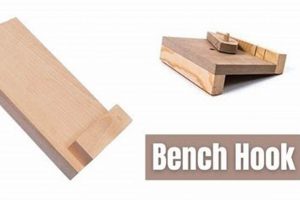
![Build A Roman Woodworking Bench [DIY Guide] | Step-by-Step Guides, Tools & Inspiration to Build Beautiful Wooden Decor on a Budget](https://woodfromhome.com/wp-content/uploads/2026/05/th-207-300x200.jpg "Build A Roman Woodworking Bench [DIY Guide] Step-by-Step Guides, Tools & Inspiration to Build Beautiful Wooden Decor on a Budget")