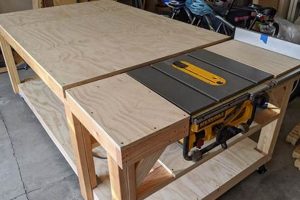
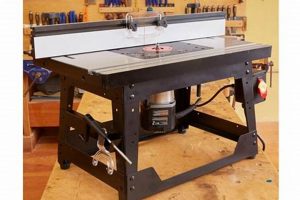
A specialized workbench designed to facilitate the precise and safe cutting of wood materials is a core component of any woodworking shop. These surfaces provide a stable and often adjustable platform for employing various cutting tools, ranging from hand saws to power saws like circular saws and jigsaws. The construction typically includes a flat, durable top made of materials such as medium-density fiberboard (MDF), plywood, or solid wood, chosen for their dimensional stability and resistance to wear. Features like integrated measuring scales, clamping systems, and dust collection ports are common enhancements.
The advantages of utilizing such a dedicated workstation are manifold. It improves accuracy by offering a level, marked surface for precise measurements and cuts, leading to fewer errors and material waste. Safety is also enhanced by providing a secure and stable platform that reduces the risk of slippage or kickback during the cutting process. Historically, woodworking involved simpler, less refined surfaces, but the evolution of woodworking practices and the increasing demand for precision have driven the development of these specialized tools. This evolution reflects a broader trend towards optimized workflows and enhanced safety in woodworking environments.
Subsequent sections will delve into different types of these dedicated workstations, exploring their specific features and applications, the materials used in their construction, and the considerations when selecting the appropriate equipment for a given woodworking project. The focus will be on providing a comprehensive understanding to guide informed decision-making in setting up an effective and efficient woodworking space.
Tips for Optimal Woodworking Cutting Table Usage
Maximizing the utility of a dedicated woodworking cutting surface requires adherence to best practices that ensure both safety and precision. The following guidelines promote efficient and accurate material processing.
Tip 1: Prioritize Surface Condition. Regularly inspect the table surface for any imperfections, such as scratches, gouges, or debris. These irregularities can interfere with accurate cutting and introduce potential hazards. Ensure the surface is clean and smooth before commencing any work.
Tip 2: Secure Material Firmly. Employ appropriate clamping mechanisms to rigidly fix the workpiece to the table. This prevents movement during cutting, leading to more accurate results and reducing the risk of kickback, particularly when using power tools. Consider using a combination of clamps and non-slip mats.
Tip 3: Utilize Measuring Aids. Many tables incorporate built-in measuring scales or T-tracks for attaching measuring tools. Leverage these features to precisely mark and align cuts. Verify the accuracy of these tools regularly, as discrepancies can accumulate over time.
Tip 4: Maintain Blade Sharpness. Dull blades require more force to cut, increasing the likelihood of errors and potential injury. Use sharp, well-maintained blades appropriate for the material being cut. Regularly inspect and replace blades as needed.
Tip 5: Implement Dust Collection. Wood dust poses both a health hazard and an impediment to accurate cutting. Connect a dust collection system to the cutting table to remove airborne particles and maintain visibility of the cut line. Ensure the dust collector has adequate suction capacity.
Tip 6: Employ Push Sticks and Push Blocks. When making narrow cuts or working with small pieces, use push sticks or push blocks to keep hands safely away from the blade. These tools provide a safe and controlled method for guiding the material through the cut.
Tip 7: Regularly Calibrate and Adjust. Ensure the cutting table is level and that any adjustable components, such as fences or miter gauges, are properly aligned. Regular calibration ensures accurate and repeatable cuts.
By consistently applying these principles, woodworkers can significantly enhance the precision, safety, and overall efficiency of their cutting processes. Adherence to these guidelines translates to improved project quality and a safer working environment.
The subsequent sections will explore specific applications and advanced techniques related to woodworking cutting table usage, building upon these foundational principles.
1. Stability

Stability constitutes a foundational requirement for any woodworking cutting table. Its presence directly influences the accuracy, safety, and overall quality of woodworking operations. A stable platform minimizes vibration and movement, ensuring consistent and predictable results during the cutting process.
- Material Composition and Construction
The selection of materials and the method of construction significantly impact the stability of the cutting table. Dense, rigid materials like MDF (Medium-Density Fiberboard) or solid hardwoods, coupled with robust joinery techniques (e.g., mortise and tenon, dovetail), contribute to a more stable structure. Lightweight or poorly constructed tables are prone to wobbling or shifting, compromising cutting precision. Examples include tables reinforced with steel frames or those utilizing thick, multi-layered tops to dampen vibration.
- Leg Design and Support System
The design and configuration of the table’s legs are crucial for maintaining stability. Legs should be adequately sized and braced to distribute weight evenly and resist lateral movement. Adjustable levelers on the feet can compensate for uneven floor surfaces, ensuring a level and stable working platform. Tables with splayed legs or those incorporating cross-bracing offer enhanced stability compared to simpler designs with straight, unsupported legs.
- Weight Distribution and Load Capacity
The ability of the cutting table to handle the weight of the workpiece and associated tools is essential for stability. Excessive weight can cause the table to flex or deform, leading to inaccurate cuts. Tables should be designed with a sufficient load capacity to accommodate typical woodworking projects. Distributing weight evenly across the table’s surface also helps to prevent localized stress points that could compromise stability.
- Surface Flatness and Rigidity
A flat and rigid surface is paramount for accurate cutting. Any warping or deformation of the table’s top can introduce errors and inconsistencies in the cut. Internal bracing and reinforcement can enhance the rigidity of the table, preventing it from flexing under load. Using a precision straightedge or level to check the flatness of the table surface is a recommended practice.
The facets discussed illustrate that stability is not a singular property but rather a composite characteristic arising from the interplay of material selection, design considerations, and construction quality. A woodworking cutting table that embodies these facets provides a reliable foundation for woodworking tasks, contributing to enhanced precision, safety, and overall project success. Consequently, stability should be prioritized when evaluating and selecting a woodworking cutting surface.
2. Precision
The relationship between a woodworking cutting table and precision is causal: the former, when properly designed and utilized, enables the latter. Precision in woodworking refers to the accuracy and repeatability of cuts, joints, and overall dimensions of a project. A dedicated cutting table directly supports this by providing a stable, flat, and often marked surface upon which to measure, align, and execute cuts. Consider, for example, the construction of a complex piece of furniture requiring numerous precisely dimensioned components. Without a cutting table, achieving consistent and accurate cuts becomes significantly more challenging, increasing the risk of errors accumulating and compromising the final product’s integrity. The presence of integrated measuring scales, T-tracks for jigs, and clamping systems on a quality cutting table directly contributes to enhanced accuracy, allowing for cuts within fractions of an inch. The absence of these features necessitates reliance on less accurate methods, such as hand measurements and improvised clamping, leading to a reduction in overall precision.
Furthermore, the material and construction of the cutting table contribute to precision. A perfectly flat and rigid surface prevents warping or flexing during cutting, which can introduce inaccuracies. For instance, attempting to cut a long, thin piece of wood on an uneven surface will invariably result in a curved or inconsistent cut. The inherent stability of the table, as determined by its legs, frame, and material density, further enhances precision by minimizing vibrations and movement during the cutting process. The integration of accessories like miter gauges and fences further refines the cutting process, providing repeatable angles and consistent cut widths. This is particularly crucial when creating multiple identical pieces for a project, such as drawer fronts or cabinet doors. The table acts as a centralized reference point for all cuts, ensuring uniformity and minimizing discrepancies between components.
In summary, a woodworking cutting table is instrumental in achieving precision in woodworking. It provides a stable, accurate, and repeatable platform for measuring, aligning, and executing cuts. The table’s design, construction, and integrated features directly influence the level of precision attainable. While skilled craftsmanship remains essential, a high-quality cutting table minimizes the potential for errors and empowers the woodworker to achieve consistently accurate results. The challenges in woodworking precision are amplified without a suitable cutting surface, underscoring its importance as a core component of any serious woodworking operation.
3. Durability

Durability is a critical attribute of any woodworking cutting table, determining its lifespan and ability to withstand the rigors of a woodworking environment. A cutting table subject to frequent use and potentially harsh conditions must possess robust construction and materials to ensure reliable performance over extended periods.
- Material Selection
The materials employed in constructing the table’s top, frame, and legs directly influence its overall durability. Hardwoods like maple or oak, known for their resistance to wear and impact, are often used for the top surface. Alternatively, high-density fiberboard (HDF) or plywood with a durable laminate coating can provide a cost-effective yet resilient surface. The frame and legs may be constructed from steel or heavy-gauge wood, designed to withstand significant weight and stress. The choice of fasteners and adhesives also plays a crucial role in maintaining structural integrity over time.
- Surface Treatment and Protection
The application of protective coatings to the table’s surface can significantly enhance its resistance to scratches, dents, and moisture damage. Durable finishes, such as polyurethane or epoxy resins, create a barrier against wear and tear. Regular maintenance, including cleaning and reapplication of protective coatings as needed, further extends the table’s lifespan. Edge banding can also be applied to protect the edges of the tabletop from chipping and impact.
- Joint Construction and Reinforcement
The method of joining the various components of the cutting table is crucial for its long-term stability and durability. Robust joinery techniques, such as mortise and tenon, dovetail, or reinforced screw joints, provide superior strength and resistance to racking or deformation. Metal brackets and corner braces can be incorporated to further reinforce the frame and legs, enhancing its ability to withstand heavy loads and repetitive use.
- Resistance to Environmental Factors
A durable cutting table should be able to withstand the environmental conditions typically found in a woodworking shop, including fluctuations in temperature and humidity. Materials prone to warping or swelling in response to moisture should be avoided or treated with appropriate sealants. A table’s resistance to chemical spills, such as solvents or adhesives, is also a factor to consider, particularly in environments where such materials are frequently used.
In conclusion, durability is not merely a desirable feature of a woodworking cutting table but a necessity for ensuring long-term functionality and value. The careful selection of materials, application of protective finishes, robust construction methods, and resistance to environmental factors all contribute to a table’s ability to withstand the demands of a woodworking environment. A durable cutting table represents a sound investment, providing a reliable and stable platform for woodworking projects for years to come.
4. Adjustability

Adjustability, in the context of a woodworking cutting table, refers to the range of customizable features designed to accommodate varying project requirements and user preferences. The inherent relationship between adjustability and the utility of the cutting table is causal: increased adjustability directly translates to greater versatility and adaptability, enhancing the table’s suitability for diverse woodworking tasks. For instance, a table with adjustable height can accommodate woodworkers of different statures, promoting ergonomic comfort and reducing strain. Similarly, an adjustable fence system allows for precise setting of cut widths, critical for repeatable and accurate cuts. The absence of adjustability limits the table’s functionality, rendering it less adaptable to specific project needs and potentially compromising the quality of the finished product.
The practical significance of adjustability extends beyond mere convenience. It directly impacts precision, efficiency, and safety. An adjustable miter gauge, for example, facilitates the creation of accurate angles, essential for constructing intricate joints and complex assemblies. Adjustable clamping systems allow for secure fixation of workpieces of varying sizes and shapes, minimizing the risk of slippage and kickback during cutting operations. Furthermore, adjustable features such as integrated dust collection ports can be positioned to maximize dust extraction, improving visibility and reducing exposure to harmful airborne particles. A lack of adjustability forces the woodworker to rely on makeshift solutions and compromises, increasing the potential for errors and accidents.
In summary, adjustability is an indispensable component of a well-designed woodworking cutting table. It enables adaptability to diverse projects, enhances precision and efficiency, and promotes a safer working environment. The degree of adjustability should be carefully considered when selecting a cutting table, taking into account the anticipated range of woodworking tasks and the individual needs of the user. While other factors such as stability and durability are also crucial, adjustability stands out as a key determinant of the table’s overall versatility and long-term value, directly influencing the success and satisfaction of woodworking endeavors.
5. Dust Control

Effective dust control is integral to the functionality and safety of a woodworking cutting table. The act of cutting wood generates particulate matter, which, if uncontrolled, poses several risks. Respiratory health is directly affected by the inhalation of wood dust, leading to potential sensitization, allergic reactions, and long-term respiratory ailments. Furthermore, accumulated dust can obscure the cut line, diminishing precision and potentially leading to errors. A well-designed cutting table incorporates features to mitigate these risks. Examples include integrated dust collection ports positioned near the cutting area, designed to connect to external dust collection systems. Baffles and enclosures may also be included to contain dust and direct airflow towards the collection point. The absence of adequate dust control transforms the cutting table from a precision tool into a source of potential health hazards and diminished accuracy.
Practical applications of effective dust control on a woodworking cutting table are diverse. For instance, consider the use of a downdraft table, where air is drawn downwards through a perforated surface, capturing dust at its source. This is particularly effective when sanding or routing operations are performed on the table. Another example is the integration of a shroud around a saw blade, connected to a vacuum system, which captures the majority of the dust generated during sawing. These systems not only improve air quality but also maintain a clear view of the workpiece, leading to more precise and efficient cutting. The effectiveness of dust control is measurable through air quality monitoring and visual inspection of the workspace. A properly functioning system should significantly reduce the visible presence of dust and maintain air quality within acceptable safety standards.
In summary, dust control is not merely an ancillary feature of a woodworking cutting table but a critical component that directly impacts health, safety, and precision. The integration of effective dust collection systems is essential for creating a safe and productive woodworking environment. Challenges remain in designing systems that are both highly effective and compatible with a wide range of tools and woodworking techniques. However, the benefits of prioritizing dust control far outweigh the costs, ensuring a healthier and more efficient woodworking experience. This understanding connects to the broader theme of responsible woodworking practices, emphasizing the importance of safety and sustainability in all aspects of the craft.
Frequently Asked Questions
This section addresses common inquiries regarding woodworking cutting tables, providing clarity and informative responses to aid in understanding their function, selection, and proper use.
Question 1: What are the primary benefits of using a dedicated woodworking cutting table versus a general workbench?
A dedicated woodworking cutting table provides a stable, flat, and often adjustable surface specifically designed for precise cutting operations. This contrasts with a general workbench, which may lack the necessary features for accurate and safe cutting, such as integrated measuring aids, clamping systems, and dust collection capabilities. The result is improved accuracy, enhanced safety, and greater efficiency.
Question 2: What materials are best suited for the surface of a woodworking cutting table, and why?
Ideal surface materials include medium-density fiberboard (MDF), plywood, or solid hardwoods like maple. MDF offers a smooth, stable, and cost-effective surface, while plywood provides good strength and resistance to warping. Solid hardwoods offer exceptional durability and can withstand heavy use. The selection depends on budget, intended use, and desired lifespan.
Question 3: How does dust collection on a woodworking cutting table contribute to safety and precision?
Effective dust collection removes airborne particles, improving visibility of the cut line and reducing the risk of respiratory health issues. By minimizing dust accumulation, the accuracy of measurements and cuts is enhanced, leading to more precise results. A clear workspace also promotes a safer working environment by reducing the risk of slips and falls.
Question 4: What are the key features to consider when selecting a woodworking cutting table for a small workshop?
In a limited space, prioritize features like portability, foldability, or compact storage options. Consider a table with integrated storage for tools and accessories to maximize space utilization. A smaller surface area may be necessary, but ensure the table is still stable and provides adequate support for common project sizes.
Question 5: How does the adjustability of a woodworking cutting table impact its versatility?
Adjustable features, such as height, fence systems, and miter gauges, allow the table to accommodate a wider range of projects and woodworking techniques. Height adjustability improves ergonomics and reduces strain, while adjustable fences and miter gauges enable precise and repeatable cuts at various angles and widths.
Question 6: What are the essential maintenance practices for ensuring the longevity and accuracy of a woodworking cutting table?
Regularly inspect the table surface for damage and clean it to remove dust and debris. Check and adjust the levelness of the table to ensure accurate cuts. Inspect and tighten any loose fasteners. Periodically apply a protective coating to the surface to prevent moisture damage and scratches. Consistent maintenance preserves its functionality and extends its lifespan.
In summary, a woodworking cutting table represents a crucial element in achieving precise and safe woodworking operations. Understanding the key features, materials, and maintenance practices associated with these tables allows for informed decision-making and optimal utilization.
The subsequent section will provide concluding remarks, summarizing the key benefits of incorporating a woodworking cutting table into any woodworking workspace.
Conclusion
This exploration has underscored the multifaceted importance of the woodworking cutting table in achieving precision, safety, and efficiency within the woodworking domain. Its stability, durability, adjustability, and dust control capabilities contribute directly to enhanced accuracy and a safer working environment. As a dedicated platform for cutting operations, it minimizes errors and maximizes the potential for consistently high-quality results. Furthermore, understanding the nuances of material selection, construction techniques, and maintenance practices ensures optimal performance and longevity.
The woodworking cutting table, therefore, stands as a critical investment for any serious woodworking endeavor. Its proper selection and conscientious utilization not only enhance the quality of individual projects but also elevate the overall standard of craftsmanship. The continued evolution of this essential tool will undoubtedly reflect the ongoing pursuit of precision and safety within the ever-evolving field of woodworking, necessitating a commitment to informed decision-making and best practices in its adoption and implementation.