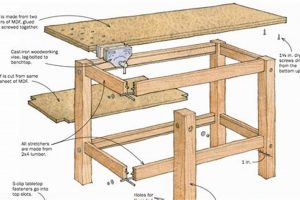
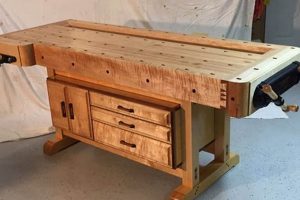
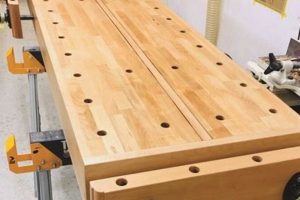
A sturdy, flat surface designed for woodworking tasks forms the cornerstone of any productive workshop. This surface provides a stable area for sawing, planing, joining, and assembling wooden components. Typically constructed from hardwoods like maple or beech, these surfaces are engineered to withstand repeated impact and the rigors of hand tool use. For example, a craftsman might use this area to precisely cut dovetail joints for a drawer or to assemble a complex cabinet carcass.
The presence of a reliable work surface offers numerous advantages. It enables accurate and efficient woodworking, improving project quality and reducing errors. The historical context shows that woodworkers have used similar surfaces for centuries, refining designs and materials to optimize performance. The robustness and durability of such a surface mean it’s a long-term investment, supporting countless projects and representing a central element in the woodworking process.
The following sections will delve into specific aspects such as the selection criteria for materials, various design considerations relating to size and features, and essential maintenance practices to ensure long-lasting performance.
Essential Guidance for Optimal Woodworking Surfaces
Achieving precision and efficiency in woodworking depends significantly on the quality and condition of the primary work surface. Careful attention to several key factors can optimize performance and extend the lifespan of this critical tool.
Tip 1: Material Selection: Opt for dense hardwoods such as maple, beech, or birch for superior durability and stability. Softwoods are susceptible to dents and wear, compromising the accuracy of your work.
Tip 2: Surface Flatness: Ensure the surface is perfectly flat to within acceptable tolerances. An uneven surface can lead to inaccurate cuts and joinery. Use a long straightedge and shims to verify and correct any deviations.
Tip 3: Secure Mounting: A stable foundation is paramount. Anchor the woodworking surface securely to the floor or a robust frame to minimize vibrations and movement during use.
Tip 4: Vise Installation: Install a high-quality vise capable of applying significant clamping pressure. A well-placed vise is essential for securely holding workpieces during sawing, planing, and carving.
Tip 5: Regular Maintenance: Routinely clean the surface to remove dust, debris, and glue residue. Apply a protective finish, such as oil or wax, to prevent moisture absorption and cracking.
Tip 6: Dog Hole Placement: Strategically position dog holes to accommodate various clamping configurations. Precisely aligned dog holes enhance versatility and ease of use.
Tip 7: Consider a Tail Vise: A tail vise allows for clamping wider boards across the surface, particularly useful when joining multiple boards or working with longer stock.
By implementing these strategies, woodworkers can create and maintain a reliable, high-performing work area. A well-maintained surface leads to improved accuracy, increased efficiency, and ultimately, higher-quality finished projects.
The concluding section will explore long-term maintenance strategies and potential upgrades to further enhance the functionality and lifespan of the surface.
1. Surface Material Selection

Surface material selection profoundly influences the performance and longevity of any woodworking surface. The chosen material dictates the work area’s resistance to wear, dimensional stability, and overall suitability for various woodworking tasks. Careful consideration of material properties is essential for creating a durable and reliable surface.
- Hardwood Density and Durability
Denser hardwoods, such as maple, beech, and birch, provide superior resistance to dents, scratches, and general wear compared to softwoods. This durability is critical for withstanding the repeated impact of tools and the pressure exerted during clamping operations. A surface constructed from a less durable material will degrade more quickly, requiring more frequent repairs or replacement.
- Dimensional Stability Under Varying Humidity
Wood’s dimensional stability, or its resistance to expansion and contraction due to changes in humidity, is crucial. Materials with lower stability are prone to warping and cracking, compromising the flatness of the surface. Kiln-dried hardwoods that have been properly acclimated to the workshop environment offer greater dimensional stability and maintain a consistent working plane.
- Impact Resistance and Shock Absorption
The ability of a surface material to absorb impact is important for protecting both the workpiece and the tools used. Certain hardwoods possess natural shock-absorbing properties that can minimize damage caused by accidental tool drops or forceful impacts during hammering or chiseling. This characteristic contributes to a safer and more efficient woodworking environment.
- Surface Texture and Workpiece Friction
The texture of the surface material affects the friction between the surface and the workpiece. A slightly textured surface can provide better grip, preventing workpieces from slipping during cutting or shaping. However, an excessively rough surface can impede the smooth movement of tools. Selecting a material with an appropriate surface texture optimizes control and precision.
The interplay of these factors underscores the significance of surface material selection in the construction of a quality woodworking work surface. By prioritizing durability, stability, impact resistance, and appropriate surface texture, woodworkers can create a robust and reliable platform for their craft, ensuring years of productive use.
2. Dimensional Stability

Dimensional stability, in the context of woodworking, refers to the ability of wood to maintain its original size and shape despite changes in environmental humidity. This property is paramount in the construction of a high-quality woodworking surface. Wood, a hygroscopic material, absorbs and releases moisture from the surrounding air. As moisture content fluctuates, wood swells and shrinks, potentially leading to warping, cracking, or joint failure. Therefore, a lack of dimensional stability in the materials used for a work surface directly compromises its flatness, structural integrity, and overall usability. For instance, a surface constructed from improperly seasoned lumber will likely develop cupping or twisting over time, rendering it unsuitable for precise woodworking tasks such as joinery or fine detail work.
The selection of wood species and appropriate drying techniques are crucial factors in achieving dimensional stability. Certain hardwoods, such as maple and beech, exhibit relatively low shrinkage rates compared to other species. Furthermore, kiln-drying lumber to a moisture content appropriate for the intended environment minimizes subsequent movement. Example: a surface built from quartersawn lumber, which is cut perpendicular to the tree’s growth rings, is significantly more stable than one built from flatsawn lumber due to the orientation of the wood grain. This reduces the likelihood of warping and ensures that the surface remains flat and true over extended periods. Understanding and mitigating the effects of moisture on wood is vital for creating a reliable and accurate woodworking platform.
In conclusion, dimensional stability is an indispensable attribute of a quality woodworking surface. The selection of stable wood species, coupled with proper drying and construction techniques, directly impacts the surface’s long-term performance and accuracy. Ignoring the principles of dimensional stability leads to a compromised work area, reducing efficiency and potentially hindering the quality of finished woodworking projects. Maintenance through humidity control is also essential to manage the dimensional stability of this surface.
3. Clamping Mechanisms

The effectiveness of a woodworking surface is inextricably linked to its incorporated clamping mechanisms. These mechanisms provide the means to securely hold workpieces, enabling precise execution of various woodworking operations. Without reliable clamping, activities such as sawing, planing, joining, and carving become significantly more difficult and prone to error. A robust clamping system transforms a simple surface into a versatile and productive tool. Consider the example of dovetail joinery; precise hand-cutting of dovetails demands that the workpiece be rigidly held in place, often utilizing a combination of vises and bench dogs. The quality and placement of these clamping elements directly influence the accuracy and efficiency of the joinery process.
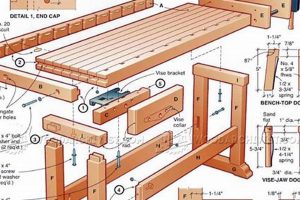
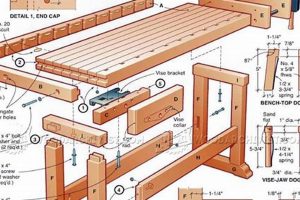
Various clamping mechanisms are commonly integrated into woodworking surfaces, each designed for specific applications. Vises, typically mounted to the front or end of the surface, offer substantial clamping force for larger workpieces. Bench dogs, small pegs that fit into pre-drilled holes, provide versatile clamping options when used in conjunction with other clamping devices. Holdfasts, driven into dog holes with a mallet, offer a quick and secure method for holding workpieces flat against the surface. The strategic placement and proper maintenance of these mechanisms are crucial. Over time, vises may require adjustment and lubrication to maintain their clamping force, while dog holes may need occasional cleaning to ensure proper peg insertion. The selection and configuration of these systems should align with the specific needs of the woodworker and the types of projects typically undertaken.
In conclusion, clamping mechanisms are not merely accessories to a woodworking surface but rather integral components that dictate its usability and effectiveness. A well-equipped surface with thoughtfully integrated clamping mechanisms provides a stable and secure platform for a wide range of woodworking tasks. Conversely, a poorly designed or inadequately maintained clamping system can significantly hinder productivity and compromise the quality of the finished product. Therefore, careful consideration of clamping mechanisms is essential when selecting or constructing a woodworking surface.
4. Surface Flatness

Surface flatness is a critical attribute of a functional woodworking surface. Deviations from a true plane, even minor ones, directly impact the accuracy of woodworking operations. An uneven surface introduces errors in measurement, cutting, and joinery. For example, attempting to plane a board on a non-planar surface results in uneven material removal, leading to a distorted final product. The degree of flatness required depends on the precision of the work undertaken; fine furniture making demands a higher degree of surface accuracy than rough carpentry. Therefore, surface flatness must be considered a foundational element of any well-designed woodworking platform.
Several factors contribute to maintaining surface flatness over time. The selection of stable and properly seasoned wood is paramount, as is the construction method used to assemble the surface. Regular maintenance, including periodic resurfacing and protection from moisture, helps to prevent warping and cupping. One practical application of this understanding involves using a long, straightedge to periodically check the surface for deviations and employing hand planes or power sanders to correct any imperfections. Furthermore, climate control within the workspace can mitigate the effects of humidity fluctuations, thus preserving surface flatness.
In summary, surface flatness is not merely a desirable feature but a fundamental requirement for a woodworking surface to perform its intended function effectively. Understanding the causes of deviations and implementing preventative and corrective measures are essential for maintaining accuracy and producing high-quality woodworking projects. Achieving and preserving this flatness presents an ongoing challenge, but the benefits in terms of improved precision and efficiency justify the effort.
5. Workbench Height

Workbench height directly influences the ergonomics and efficiency of woodworking tasks performed on a woodwork bench top. Incorrect workbench height can lead to musculoskeletal strain, reduced accuracy, and diminished overall productivity. The optimal height is determined by individual body dimensions and the type of work predominantly performed. For instance, a surface too low forces the user to stoop, causing back pain, while one too high restricts arm movement and reduces control during operations such as hand planing. Therefore, the selection of appropriate workbench height is integral to maximizing the utility and minimizing the physical stress associated with using a woodwork bench top.
The relationship between workbench height and task performance can be exemplified through specific woodworking operations. Tasks requiring downward force, such as chopping with a chisel or aggressively planing, benefit from a lower workbench height, allowing the user to leverage their body weight effectively. Conversely, tasks demanding fine motor control, such as carving or delicate assembly, are better suited to a higher surface height, providing improved visibility and reducing the need to bend over. Adjustable-height workbenches offer a versatile solution, enabling adaptation to various tasks and multiple users. Furthermore, considering shoe height and the inclusion of a floor mat or other cushioning can contribute to a refined ergonomic setup, improving comfort and mitigating fatigue during extended woodworking sessions. Proper height translates into reduced strain and, in turn, improved results.
In conclusion, workbench height is a crucial element in the design and utilization of a woodwork bench top, impacting both physical comfort and the precision of woodworking endeavors. Ignoring this element can result in discomfort and compromised work quality. By tailoring the height to the user’s anatomy and the demands of the work, productivity increases and the risk of physical strain is minimized. Recognizing this connection is essential for creating a safe and efficient woodworking environment.
Frequently Asked Questions About Woodwork Bench Tops
This section addresses common inquiries regarding the selection, use, and maintenance of woodworking surfaces. The information provided aims to offer clarity and informed guidance to woodworkers seeking to optimize their work areas.
Question 1: What is the most durable material for a woodwork bench top?
Dense hardwoods such as maple, beech, and birch provide superior durability and resistance to wear compared to softwoods. These hardwoods withstand repeated impact and heavy use, ensuring a long service life.
Question 2: How often should a woodwork bench top be resurfaced?
The frequency of resurfacing depends on the intensity of use and the material. A surface subjected to heavy use may require resurfacing every few years, while a lightly used surface may only need attention every decade. Regular inspection is advisable.
Question 3: What is the ideal height for a woodwork bench top?
The ideal height is determined by the individual’s stature and primary tasks. A general guideline is to set the surface height at the point where the knuckles touch the surface when standing upright with arms relaxed. Experimentation and adjustment are recommended.
Question 4: How should a woodwork bench top be cleaned and maintained?
Regular cleaning with a brush or vacuum removes dust and debris. A protective finish, such as oil or wax, should be applied periodically to prevent moisture absorption and cracking. Avoid harsh chemicals that could damage the wood.
Question 5: Are dog holes essential for a woodwork bench top?
Dog holes enhance versatility by providing clamping options for various workpieces. While not strictly essential, they significantly improve the ability to secure and manipulate materials during woodworking operations.
Question 6: How can warping be prevented in a woodwork bench top?
Warping can be minimized by using properly seasoned lumber, applying a protective finish to all surfaces, and controlling humidity levels in the workshop. Quarter-sawn lumber is less prone to warping than flat-sawn lumber.
The answers provided represent common knowledge and best practices in woodworking. Adhering to these guidelines contributes to the longevity and utility of woodworking surfaces.
The subsequent section explores advanced customization options and design considerations for specific woodworking applications.
Woodwork Bench Top
This exploration has underscored the critical role of the woodwork bench top in woodworking. Considerations ranging from material selection and dimensional stability to clamping mechanisms, surface flatness, and optimal height collectively define the utility and longevity of this essential tool. A properly constructed and maintained surface directly influences the accuracy, efficiency, and ultimately, the quality of woodworking endeavors.
The enduring value of the woodwork bench top lies in its capacity to serve as a stable and reliable foundation for creativity and precision. Woodworkers are encouraged to apply these principles in the construction, maintenance, and customization of their work areas, thereby ensuring continued success in their craft. The pursuit of a superior woodworking platform remains a worthwhile investment for those committed to excellence.