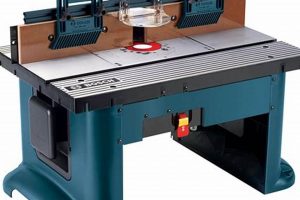
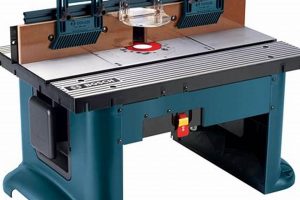
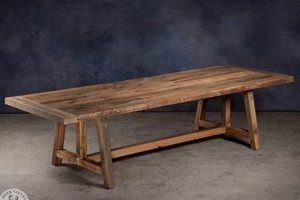
A convertible workbench designed primarily for woodworking facilitates executing multiple tasks within a confined space. This equipment typically incorporates a rotating mechanism, enabling the user to quickly switch between two distinct work surfaces. For instance, one surface might be configured for routing operations while the opposing surface is designed for sanding, thereby minimizing setup time and maximizing efficiency.
The utility of this apparatus stems from its capacity to consolidate workspace requirements. In smaller workshops or garages, the optimization of available square footage is paramount. Furthermore, the integrated design encourages workflow continuity and reduces the physical strain associated with moving between disparate workstations. Historically, similar concepts have existed in other trades, but the adaptation to woodworking reflects a growing emphasis on ergonomic design and efficient production techniques.
The following sections will delve into the diverse construction methods employed in creating such a workbench, explore various design considerations critical to its effective function, and provide guidance on selecting the appropriate hardware and materials to ensure its longevity and stability.
Essential Considerations for a Convertible Woodworking Bench
This section provides crucial guidance for maximizing the functionality and lifespan of a rotating workbench. Careful planning and execution are essential for achieving optimal performance.
Tip 1: Stability is Paramount: The base structure must provide unwavering support. Prioritize robust joinery techniques and consider adding weight to the base to mitigate any tendency for movement during operation. A steel frame incorporated within the wooden structure can significantly enhance stability.
Tip 2: Precision Alignment is Critical: When designing the rotating mechanism, ensure that both work surfaces align perfectly in their respective locked positions. Any misalignment will negatively impact the accuracy of woodworking operations. Employ precise measuring tools and jigs during assembly.
Tip 3: Locking Mechanisms Require Diligence: The locking system that secures each work surface in place demands careful consideration. The mechanism must be robust, reliable, and easily engaged/disengaged. Multiple locking points are advisable for increased safety and stability.
Tip 4: Material Selection Impacts Longevity: Opt for high-quality hardwoods or plywood with a durable surface finish. Avoid materials prone to warping or moisture damage. The rotating mechanism should ideally utilize durable metal components resistant to wear and tear.
Tip 5: Work Surface Optimization is Key: Designate specific tasks for each work surface based on frequency of use and required tools. Consider incorporating features such as integrated dust collection, clamping systems, or specialized jigs to enhance efficiency.
Tip 6: Ergonomics Influence Efficiency: The overall height of the convertible workbench should be adjusted to suit the user’s height and preferred working posture. Consider incorporating adjustable height features to accommodate different tasks and users.
Tip 7: Consider Mobility Options: While stability is crucial, the addition of heavy-duty casters can facilitate repositioning the workbench within the workspace. Ensure the casters have a reliable locking mechanism to prevent unwanted movement during use.
Implementing these guidelines will ensure the creation of a safe, efficient, and durable workstation, ultimately enhancing the woodworking experience.
The subsequent discussion will focus on potential applications and further design refinements that can tailor the convertible workbench to specific woodworking needs.
1. Space Optimization

Space optimization is a crucial consideration in woodworking, particularly for hobbyists and small-scale professional workshops where area is often limited. The concept centers around maximizing the utility of available square footage, and the woodworking flip table directly addresses this need by consolidating multiple functions into a single footprint.
- Reduced Footprint
The primary advantage of a woodworking flip table lies in its ability to perform the duties of two or more separate workstations within the space of one. This is achieved through the rotating mechanism that allows for the rapid changeover between different configurations. For instance, a flip table might house a chop saw on one side and a flat assembly surface on the other, eliminating the need for dedicated areas for both functions. In environments where every square foot counts, this consolidation is invaluable.
- Improved Workflow Efficiency
Beyond simply saving space, a woodworking flip table can contribute to a more streamlined workflow. By having multiple functions immediately accessible within a single station, the user minimizes the time and effort required to transition between tasks. This reduces the need to move materials and tools across the workshop, which can be particularly beneficial in congested environments. This increased efficiency translates to higher productivity and reduced fatigue.
- Versatile Functionality
The space-saving benefits of a woodworking flip table are further amplified by its versatility. The two work surfaces can be customized for a wide range of tasks, from sawing and routing to sanding and assembly. This adaptability makes the flip table suitable for a variety of woodworking projects, eliminating the need for multiple specialized workbenches. The ability to reconfigure the table as needed allows the user to adapt to changing project requirements and space constraints.
- Organized Storage Solutions
Many woodworking flip table designs incorporate integrated storage solutions, such as drawers, shelves, or pegboards. These features further enhance space optimization by providing convenient storage for tools, materials, and accessories. By keeping essential items within easy reach, the user can minimize clutter and maintain a more organized workspace. This, in turn, improves safety and efficiency, and contributes to a more enjoyable woodworking experience.
The facets of footprint reduction, enhanced workflow, versatile functionality, and organized storage, converge to underscore the significant contribution of the woodworking flip table to space optimization within woodworking environments. These capabilities are particularly beneficial in maximizing the efficiency of smaller workshops and allowing woodworkers to pursue their craft without being constrained by spatial limitations.
2. Dual Work Surfaces

The defining characteristic of a woodworking flip table is the presence of dual work surfaces. This feature fundamentally dictates its utility and distinguishes it from conventional workbenches. The existence of two distinct surfaces expands functionality and streamlines workflow.
- Optimized Task Specialization
Each surface can be configured for specific tasks, thereby enhancing efficiency. For example, one surface may be fitted with a miter saw for precise cuts, while the other is dedicated to assembly, featuring a flat, unobstructed area for joining components. This separation reduces setup time and minimizes the need to reconfigure a single workspace repeatedly.
- Enhanced Workflow Continuity
The presence of two surfaces enables a more fluid workflow. A project can progress from one stage to the next without interruption. Once a cutting operation is complete on one surface, the workpiece can be immediately transferred to the adjacent assembly surface. This minimizes downtime and promotes a continuous, streamlined process.
- Independent Tool Mounting
The dual surface design allows for the permanent or semi-permanent mounting of tools on each side. This eliminates the need to constantly set up and dismantle tools. A router table, drill press, or other specialized equipment can be securely attached to one surface, while the other remains available for general-purpose tasks. The tool remains readily accessible.
- Adaptable Project Handling
Certain projects may require distinct operations that are incompatible on a single surface. For example, gluing and sanding often require a clean and a dedicated space respectively. With a flip table, one surface can be kept clean for gluing, while the other can be equipped with dust collection for sanding. This adaptability is crucial for handling diverse project requirements.
The allocation of specialized tasks, workflow continuity, independent tool mounting, and project adaptability contribute to the overall effectiveness of the woodworking flip table. By providing two distinct work areas, the flip table maximizes efficiency and enhances the user experience for woodworkers of all skill levels.
3. Rotational Mechanism

The rotational mechanism is the pivotal component that defines a woodworking flip table, enabling its core functionality of transitioning between two distinct work surfaces. Its design and implementation directly influence the stability, ease of use, and overall effectiveness of the equipment.
- Bearing Systems and Load Capacity
The rotational mechanism often incorporates a bearing system, such as ball bearings or thrust bearings, to facilitate smooth rotation and distribute weight evenly. The load capacity of these bearings is a critical design factor, as it must accommodate the weight of the table surfaces, mounted tools, and workpieces without compromising stability or creating excessive friction. Selection of appropriately sized and rated bearings ensures longevity and safe operation.
- Locking Mechanisms and Positional Accuracy
A robust locking mechanism is essential for securing each work surface in its designated position. This mechanism must provide a rigid connection to prevent unintentional rotation during operation, which could lead to inaccuracies or safety hazards. Common locking mechanisms include pin detents, cam levers, or clamping systems. Positional accuracy, the ability to consistently align the work surface to a precise angle, is also paramount for repeatable results.
- Material Selection and Durability
The materials used in the construction of the rotational mechanism directly impact its durability and resistance to wear and tear. Steel is a common choice for critical components due to its strength and rigidity, while brass or bronze bushings may be used to reduce friction and prevent galling. Corrosion resistance is also an important consideration, especially in environments with high humidity or exposure to water-based finishes.
- Ergonomic Design and User Experience
The design of the rotational mechanism should prioritize ease of use and ergonomic operation. The force required to rotate the table should be minimal, and the locking mechanism should be easily engaged and disengaged. The height and placement of the mechanism should also be optimized to minimize strain on the user’s back and arms. A well-designed mechanism enhances the overall user experience and promotes efficient workflow.
The success of a woodworking flip table hinges on the effective design and implementation of its rotational mechanism. Careful consideration of bearing systems, locking mechanisms, material selection, and ergonomic design contributes to a stable, accurate, and user-friendly tool that enhances productivity in the woodworking environment.
4. Task-Specific Configurations

The adaptability inherent in a woodworking flip table is significantly enhanced by the ability to tailor each work surface to specific woodworking tasks. This capacity for task-specific configuration optimizes efficiency, promotes precision, and expands the versatility of the tool.
- Integrated Clamping Systems
The incorporation of clamping systems directly into a work surface facilitates secure workpiece retention during operations such as routing, sanding, or assembly. These systems may include T-track configurations, dog holes, or built-in vises, enabling rapid and repeatable clamping setups. The selection of appropriate clamping mechanisms is dictated by the intended tasks for the surface, optimizing stability and accuracy. For example, a dedicated surface for dovetailing might benefit from a vise tailored to securely hold the workpiece at a precise angle.
- Dedicated Tool Mounts and Storage
A woodworking flip table can accommodate dedicated tool mounts for frequently used equipment, such as routers, sanders, or drill presses. This eliminates the need for repetitive setup and teardown, streamlining workflow and reducing the risk of misalignment. Furthermore, integrated storage solutions, such as drawers or shelves, can provide convenient access to related accessories and consumables. A dedicated surface for routing operations might include a router lift, adjustable fence, and integrated dust collection, coupled with storage for router bits and templates.
- Specialized Jigs and Fixtures
The design of a flip table allows for the integration of specialized jigs and fixtures that enhance precision and repeatability for specific tasks. These may include templates for creating mortise and tenon joints, fence systems for accurate rip cuts, or custom-built supports for unusual workpiece shapes. The implementation of jigs and fixtures streamlines complex operations, minimizes errors, and promotes consistency across multiple workpieces. A surface dedicated to cutting miters, for instance, could incorporate an adjustable miter gauge and integrated stop blocks to ensure accurate and repeatable cuts.
- Surface Material and Finish Selection
The choice of surface material and finish can be tailored to the specific demands of each task. For example, a surface used for gluing operations might benefit from a non-stick coating or a replaceable wax paper overlay to prevent accidental adhesion. A surface used for sanding, on the other hand, may require a durable finish that resists abrasion and facilitates dust collection. The surface material itself can also be chosen to optimize specific tasks; for example, a soft material like MDF might be used for a surface where delicate workpieces are frequently handled.
The benefits of task-specific configurations on a woodworking flip table are multifaceted, encompassing improved efficiency, enhanced precision, and increased versatility. By carefully considering the intended tasks for each surface and implementing appropriate modifications, woodworkers can create a highly customized and effective workstation that optimizes their productivity and enhances the quality of their work. The careful integration of clamping systems, tool mounts, jigs, and appropriate surface materials directly contributes to a superior woodworking experience.
5. Enhanced Workflow

The connection between enhanced workflow and a woodworking flip table is a direct result of optimized task management and reduced setup times. The flip table inherently promotes a linear progression through project stages by providing immediate access to different work surfaces, each potentially equipped for specific operations. This eliminates the pauses and physical reconfigurations associated with using a single, general-purpose workbench. For example, a project requiring both precise cuts and subsequent sanding benefits immensely. The user can complete the cuts on one surface and then, with a simple rotation, transition to the sanding process without needing to clear the cutting tools or move the workpiece to a separate sanding station. This minimizes disruption and accelerates project completion.
The practical significance of understanding this connection lies in the ability to design and utilize the flip table for maximum efficiency. By carefully considering the sequential steps of typical woodworking projects, the user can configure each surface with the appropriate tools and accessories. This might involve dedicating one side to joinery, equipped with a vise and marking gauges, while the other side is reserved for assembly, featuring a large, flat surface and clamping systems. Furthermore, organizing tools and materials within easy reach of each surface further contributes to workflow optimization. A well-organized flip table becomes a central hub, minimizing wasted movement and maximizing productive time.
In summary, the woodworking flip tables ability to enhance workflow stems from its consolidation of workspace and streamlining of task transitions. The challenge lies in effectively planning the configuration and organization of the table to match the specific needs of the woodworker and the types of projects undertaken. A carefully considered setup, however, yields substantial improvements in efficiency and overall productivity, transforming the woodworking process from a series of disparate tasks into a cohesive, streamlined operation.
Frequently Asked Questions
The following section addresses common inquiries regarding the design, construction, and utilization of convertible woodworking workbenches.
Question 1: What are the primary advantages of incorporating a convertible mechanism into a woodworking workbench?
The key benefits center on space optimization, task diversification, and workflow improvement. By consolidating multiple workstations into a single unit, this design saves space. The conversion aspect, moreover, facilitates efficient switches among tasks and tool configurations without requiring extensive setup modifications.
Question 2: What construction materials are most suitable for a high-quality convertible woodworking workbench?
Durable hardwoods, such as maple or oak, or high-density plywood with a robust surface finish are highly recommended for structural elements and work surfaces. These materials offer stability, resistance to warping, and resilience against the wear and tear associated with woodworking activities.
Question 3: What considerations should guide the choice of a locking mechanism for a convertible workbench?
The locking system necessitates robustness, reliability, and ease of operation. It must secure the work surface firmly in position to prevent unwanted movement during operations, potentially jeopardizing accuracy and safety. Multipoint locking configurations enhance stability.
Question 4: How does one ensure optimal stability in a convertible workbench design?
Stability is achieved through robust joinery techniques, a sturdy base structure, and potentially adding weight to the base. Integrating a steel frame can also enhance rigidity and minimize any tendencies for wobble or displacement during operation.
Question 5: What is the best approach to optimizing the configuration of each work surface on a convertible workbench?
Designate specific tasks to each surface based on frequency of use and required tools. Consider incorporating features such as integrated dust collection, clamping systems, or specialized jigs to maximize efficiency and minimize setup time.
Question 6: Is it possible to add mobility to a convertible woodworking workbench without sacrificing stability?
Heavy-duty casters with reliable locking mechanisms can facilitate repositioning the workbench within the workspace. Ensure that the casters are rated to support the weight of the workbench, tools, and materials, and that the locking mechanisms are engaged during operation to prevent unintended movement.
In summary, selecting appropriate materials, ensuring a robust locking mechanism, prioritizing stability, and optimizing surface configurations are critical factors in constructing and utilizing a convertible woodworking workbench effectively.
The following section will delve into practical applications of this type of workbench and explore advanced design refinements.
Conclusion
The preceding exploration has illuminated key aspects of the woodworking flip table, including its space-saving design, dual-surface functionality, rotational mechanics, task-specific configurations, and workflow enhancement. These elements collectively contribute to its utility within a diverse range of woodworking environments. Effective implementation requires careful consideration of material selection, structural integrity, locking mechanisms, and individual user needs.
The woodworking flip table represents a significant advancement in workspace optimization and operational efficiency. Further research and development in this area may lead to more sophisticated designs and functionalities, ultimately transforming woodworking practices. Continued innovation will likely address current limitations and expand its applicability across various skill levels and project types.
![Best Woodworking Plans Drafting Table [Guide] for Table | Step-by-Step Guides, Tools & Inspiration to Build Beautiful Wooden Decor on a Budget](https://woodfromhome.com/wp-content/uploads/2026/05/th-80-300x200.jpg "Best Woodworking Plans Drafting Table [Guide] for Table Step-by-Step Guides, Tools & Inspiration to Build Beautiful Wooden Decor on a Budget")