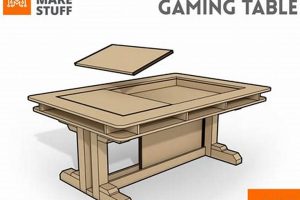
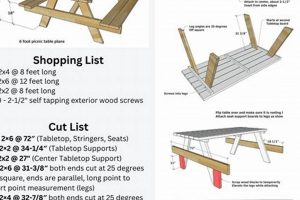
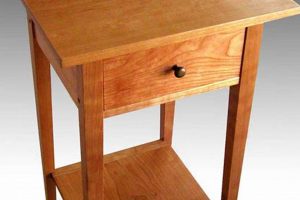
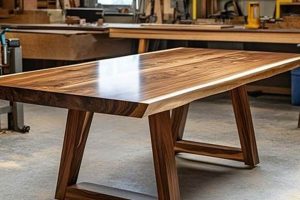
Constructions designed to provide a stable, flat surface for executing joinery, shaping, and assembly activities related to wood are essential elements within workshops. These structures, varying in size and complexity, serve as the central hub for many fabrication processes. Examples encompass basic sawhorses supporting a sheet of material, elaborate benches with integrated vises and storage, or specialized workstations tailored for specific tasks like routing or carving.
The availability of a dedicated space significantly enhances precision, safety, and efficiency during the creation of wooden articles. Proper support minimizes material movement and reduces the risk of errors. Historically, these structures have evolved from simple, temporary supports to sophisticated, multi-functional units reflecting advancements in woodworking techniques and available materials. A well-designed workspace promotes organized workflow and facilitates the production of high-quality items.
The following sections will explore fundamental design considerations, material selection criteria, and a variety of techniques used in the development of effective and practical workstations for crafting with wood. Furthermore, a survey of different styles and functionality will provide a solid foundation for constructing appropriate infrastructure to suit individual needs and workspace limitations.
Tips for Workshop Surface Development
Constructing a suitable surface for woodworking endeavors requires careful consideration of various factors to ensure optimal performance and longevity. The following tips outline essential aspects to address during the planning and execution phases.
Tip 1: Prioritize Stability: A solid, unwavering foundation is paramount. Employ robust joinery techniques, such as mortise and tenon or dovetail joints, to connect the legs and frame. Reinforce corners with gussets or metal brackets to minimize wobble and deflection.
Tip 2: Select Appropriate Material: Hardwoods like maple, beech, or oak provide excellent durability and resistance to wear. Softwoods, while less expensive, are prone to denting and scratching. Consider laminated options for superior dimensional stability and flatness.
Tip 3: Optimize Surface Flatness: A perfectly flat surface is crucial for accurate work. Employ a straight edge and levels during construction to ensure minimal deviations. Consider using a hand plane or belt sander to refine the surface after assembly.
Tip 4: Incorporate Vise Mounting: Integrate robust mounting points for one or more vises. The location and type of vise will depend on anticipated tasks. Reinforce the area around the mounting points to prevent damage from clamping pressure.
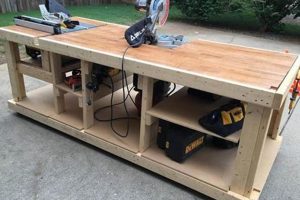
Tip 5: Add Integrated Storage: Maximize efficiency by incorporating drawers, shelves, or cabinets into the design. These storage solutions keep tools and materials organized and within easy reach, reducing clutter and improving workflow.
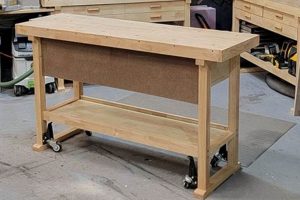
Tip 6: Consider Mobility: For smaller workshops, the integration of casters can offer valuable flexibility. Ensure that the casters are heavy-duty and lockable to prevent unwanted movement during use.
Tip 7: Apply a Protective Finish: A durable finish protects the wood from moisture, scratches, and spills. Options include oil-based finishes, polyurethane, or epoxy coatings. Apply several coats and allow ample drying time between each application.
Implementing these recommendations will result in a durable, functional, and efficient workspace that significantly enhances woodworking projects. Proper planning and execution are key to long-term satisfaction and productivity.
The subsequent sections will delve into specific examples of surface constructions, offering detailed instructions and plans for various skill levels and shop sizes.
1. Dimensional Stability

Dimensional stability, the ability of a material to maintain its size and shape under varying environmental conditions, is a paramount concern in the creation of woodworking surfaces. Fluctuations in temperature and humidity can induce expansion and contraction in wood, potentially compromising the structural integrity and flatness of the surface. Mitigating these effects is critical for achieving a functional and enduring workspace.
- Wood Species Selection
Certain wood species exhibit superior dimensional stability compared to others. Hardwoods like maple, oak, and cherry generally demonstrate less movement than softwoods like pine or fir. The inherent cellular structure and density of these hardwoods contribute to their resistance to moisture absorption and subsequent dimensional changes. Utilizing a species with a low coefficient of thermal expansion is a primary step in ensuring a stable surface.
- Kiln Drying Processes
Proper kiln drying is essential to reduce the moisture content of the wood before construction. Kiln drying minimizes the potential for future shrinkage and warping. The wood should be dried to a moisture content appropriate for the typical environment in which the workbench will be used. Failure to properly dry the wood can lead to significant dimensional instability over time.
- Joinery Techniques
The type of joinery employed significantly impacts dimensional stability. Joinery methods that accommodate wood movement, such as mortise and tenon joints with elongated mortises, are preferable. These joints allow for expansion and contraction without causing undue stress on the structure. Rigid joints, like those achieved with screws and glue alone, can restrict movement and lead to cracking or warping.
- Finishing and Sealing
Applying a sealant or finish to all surfaces of the wood helps to regulate moisture absorption and reduce dimensional changes. A penetrating oil finish, for example, saturates the wood fibers and creates a barrier against moisture. Film-forming finishes, like varnish or polyurethane, provide a more robust barrier but may require more careful application to prevent trapping moisture within the wood.
The careful selection of materials, adherence to proper drying techniques, implementation of appropriate joinery methods, and application of a protective finish collectively contribute to the dimensional stability. Addressing these factors ensures the fabrication of a surface that remains flat, stable, and functional over an extended period, providing a reliable foundation for woodworking tasks.
2. Joint Strength

The structural integrity of any woodworking surface is fundamentally contingent upon the strength of its joints. In the context of a woodworking surface, joint strength dictates its capacity to withstand applied forces, resist deformation, and maintain its overall form under the stress of tools, materials, and user interaction. Insufficient joint strength leads to instability, reduced precision, and potential structural failure, rendering the surface unsuitable for demanding tasks. A weak mortise and tenon joint, for example, would allow a table leg to wobble, compromising the stability of the entire construction.
Effective joint construction involves several critical considerations. The type of joint selected should align with the specific load-bearing requirements and the properties of the materials employed. Mortise and tenon joints, dovetail joints, and properly executed bridle joints are examples of strong, reliable connection methods appropriate for heavily loaded components. Accurate cutting and fitting are paramount; gaps or misalignments diminish surface area contact and compromise the strength of the bond. Appropriate adhesives, selected for their strength, gap-filling characteristics, and compatibility with the wood species, are also essential. Furthermore, mechanical reinforcement, such as screws or dowels, can augment the strength of certain joint types, particularly in applications subject to repetitive stress or heavy loads.
In summary, joint strength is an indispensable characteristic. Careful attention to joint design, precise execution, material selection, and adhesive application are necessary to ensure a robust and durable workspace. Neglecting these factors will inevitably lead to diminished performance and a shortened lifespan, undermining the investment in materials and labor. The understanding and proper implementation of sound joinery principles are therefore foundational to successful outcomes.
3. Surface Flatness

Surface flatness constitutes a foundational element in woodworking surface construction. Deviations from planarity introduce inaccuracies into the fabrication process, affecting the precision of cuts, joinery, and assembly. A non-flat surface will cause workpieces to rock or shift, leading to dimensional errors and compromised structural integrity. For instance, attempting to construct a perfectly square frame on an uneven plane will inevitably result in a distorted final product. The magnitude of the flatness error directly correlates to the severity of the resulting inaccuracies in the project.
Achieving optimal surface flatness necessitates meticulous attention to material preparation and construction techniques. The selection of dimensionally stable materials, such as kiln-dried hardwoods, minimizes the potential for warping or twisting. Precision milling and planing are essential to ensure that individual components are accurately sized and coplanar. During assembly, the use of clamping pressure and jigs helps to maintain flatness and prevent distortion. Furthermore, periodic maintenance, including resurfacing or planing, may be required to correct minor deviations that develop over time due to environmental factors or wear and tear.
In summary, surface flatness is not merely an aesthetic consideration but a critical performance parameter. The accuracy and quality of woodworking projects are inextricably linked to the degree of planarity exhibited by the work surface. A commitment to achieving and maintaining optimal flatness is essential for any woodworker seeking to produce high-quality results. The challenge lies in integrating best practices for material selection, construction, and maintenance to ensure a stable and accurate platform for woodworking endeavors.
4. Integrated Storage

The inclusion of integrated storage within woodworking surfaces directly influences efficiency and organization within the workspace. Dedicated drawers, shelves, and cabinets reduce clutter, streamlining workflows by ensuring that essential tools and materials are readily accessible. A well-organized surface, incorporating appropriate storage, minimizes the time spent searching for implements, thereby increasing productivity. An illustrative example involves a workbench equipped with drawers for storing hand tools, allowing a craftsman to quickly retrieve chisels, planes, or measuring devices without disrupting the workflow. Conversely, a lack of integrated storage forces workers to rely on separate toolboxes or remote storage locations, leading to delays and potential disruptions.
Beyond mere accessibility, integrated storage facilitates better inventory management and tool preservation. By assigning specific locations to each tool and material, individuals can readily assess their supplies and identify any missing items. Enclosed storage compartments protect tools from dust, moisture, and accidental damage, extending their lifespan and maintaining their performance. A cabinet with specialized dividers, designed to hold various fasteners such as screws, nails, and bolts, exemplifies this advantage. In contrast, storing these items in open bins or on exposed surfaces increases the risk of contamination, corrosion, and loss.
In conclusion, integrated storage is an indispensable element within woodworking surface projects. Its strategic implementation yields benefits beyond simple convenience, encompassing enhanced efficiency, improved organization, and prolonged tool longevity. While the specific design and configuration of the storage solutions will vary based on individual needs and workspace constraints, the underlying principle of providing dedicated, accessible, and protective compartments remains crucial for optimizing the woodworking experience. Proper integration of storage transforms a basic surface into a functional and efficient hub for crafting with wood.
5. Vibration Dampening

Vibration dampening is a critical consideration in the design and construction of woodworking surfaces, as excessive vibration negatively impacts precision, comfort, and tool longevity. Controlling transmitted oscillations enhances stability, reduces noise, and promotes a more efficient and enjoyable working environment.
- Mass and Material Selection
The mass and density of the surface significantly influence its ability to absorb vibration. Denser materials, such as hardwoods like maple or beech, are more effective at dampening vibrations than lighter softwoods. Adding mass to the surface through thicker tops or internal bracing further reduces the amplitude of transmitted oscillations. For example, a workbench constructed with a 3-inch thick maple top will exhibit significantly less vibration than one with a 1-inch thick pine top.
- Isolation Techniques
Isolating the surface from the floor or surrounding structures minimizes the transmission of external vibrations. Rubber or cork pads placed under the legs effectively decouple the surface, preventing oscillations from traveling into or out of the structure. Specialized vibration-dampening feet can further enhance isolation by incorporating damping materials and spring mechanisms. This approach is particularly beneficial in workshops with concrete floors or shared building spaces where external vibrations are prevalent.
- Joint Dampening
The design and construction of joints can play a significant role in dampening vibrations. Tight, well-fitted joints with ample surface area for glue adhesion minimize movement and energy transfer. Applying damping compounds between joint surfaces further enhances vibration reduction. For example, using a viscoelastic polymer between the tenon and mortise of a mortise-and-tenon joint can effectively dissipate vibrational energy and prevent resonance.
- Integrated Dampening Components
Incorporating specialized dampening components directly into the surface structure provides targeted vibration control. Layers of damping materials, such as constrained-layer damping (CLD) composites, can be integrated into the tabletop or frame to absorb vibrational energy. These materials typically consist of a viscoelastic core sandwiched between two rigid layers. When subjected to vibration, the viscoelastic core deforms and dissipates energy as heat, effectively reducing the amplitude of oscillations.
The integration of vibration dampening techniques into woodworking surface construction yields tangible benefits, enhancing precision, reducing fatigue, and prolonging the lifespan of tools. Implementing a combination of mass optimization, isolation, joint dampening, and integrated damping components results in a stable and quiet workspace conducive to high-quality craftsmanship. Neglecting these considerations leads to a less efficient and potentially more hazardous working environment, ultimately impacting the quality of the final product.
6. Ergonomic Height
Ergonomic height, defined as the optimal elevation of a work surface to minimize physical strain and maximize efficiency, assumes critical importance in woodworking table design. A properly configured height reduces fatigue, improves posture, and contributes to overall safety during prolonged use, directly influencing the quality and consistency of output.
- Minimizing Musculoskeletal Stress
An inappropriately low table necessitates excessive bending at the waist, leading to lower back strain and discomfort. Conversely, a table positioned too high requires elevated shoulder and arm postures, contributing to neck and upper back fatigue. By aligning the work surface with the user’s natural standing or seated height, ergonomic design minimizes these stresses, promoting long-term physical well-being. Consider a cabinet maker spending hours hand planing; a table at the correct height will allow for proper body mechanics, preventing chronic pain.
- Optimizing Force Application
Effective woodworking often involves applying significant force, whether through hand tools or powered equipment. A surface positioned at the correct height allows for optimal leverage and control, reducing the effort required to perform tasks such as sawing, chiseling, or sanding. If a table is too low, one might have to bend awkwardly to exert the necessary pressure; if too high, one might lose control due to instability. Optimal force application translates to increased precision and reduced risk of injury.
- Promoting Visual Clarity
Ergonomic height contributes to visual clarity by positioning the workpiece within the user’s optimal focal range. This reduces eye strain and allows for greater attention to detail. A surface too low can necessitate hunching over, reducing visibility and causing eye fatigue. A surface too high might force the user to view the workpiece at an awkward angle, distorting perception. Correctly positioning the work surface enhances visual acuity and contributes to higher-quality results.
- Adaptability and Adjustability
Recognizing that individuals possess varying physical characteristics, adaptability is a key element of ergonomic woodworking surface design. Incorporating adjustable-height mechanisms or offering surfaces in multiple sizes allows users to customize the setup to their specific needs. This adaptability caters to diverse body types and working preferences, ensuring that the surface remains ergonomically sound for all users, maximizing productivity and reducing the risk of injury.
In conclusion, ergonomic height is not a peripheral consideration, but a fundamental aspect of woodworking table design. The integration of ergonomic principles into these projects yields tangible benefits, encompassing improved user comfort, reduced physical strain, enhanced precision, and increased productivity. Prioritizing ergonomic considerations ensures that woodworking surfaces serve as efficient and safe platforms for creative and productive endeavors.
Frequently Asked Questions
This section addresses common inquiries and misconceptions regarding woodworking table construction, providing concise and authoritative answers to guide informed decision-making.
Question 1: What is the minimum stable dimension for a workbench surface intended for general woodworking?
A surface area of approximately 24 inches by 48 inches is generally considered the minimum for basic woodworking activities. This provides adequate space for securing workpieces and manipulating tools. However, larger surfaces offer increased versatility and accommodate larger projects. Surface area should be a key consideration in the planning phase.
Question 2: Which type of wood offers the best combination of durability and affordability for table construction?
Hard maple presents a favorable balance. While more expensive than softwoods, its hardness and resistance to wear are significantly higher. It is also more readily available than exotic hardwoods, contributing to lower overall cost. Alternative options include birch and ash, though their durability is somewhat less than maple.
Question 3: What joinery techniques are best suited for constructing a stable and long-lasting surface frame?
Mortise and tenon joints offer exceptional strength and resistance to racking forces. Dovetail joints provide excellent mechanical interlocking, particularly in drawer construction. Lap joints, reinforced with screws and adhesive, can be suitable for less demanding applications. The specific choice of joinery should reflect the anticipated loads and stresses.
Question 4: Is it necessary to incorporate a vise into a woodworking surface?
The inclusion of a vise is highly recommended, particularly for tasks involving clamping and securing workpieces. The type of vise face, leg, or end vise should align with the primary woodworking activities. A robust vise significantly enhances precision and efficiency during various processes.
Question 5: What type of finish is most appropriate for protecting a workbench surface from moisture and wear?
Oil-based finishes, such as boiled linseed oil or tung oil, penetrate the wood, providing protection from within. Polyurethane finishes offer a durable, water-resistant surface. Epoxy coatings provide maximum protection but require careful application. The choice of finish should balance aesthetic preferences with the need for durability and resistance to spills.
Question 6: How should one address surface flatness issues that arise after construction?
Minor surface imperfections can often be rectified with a hand plane or belt sander. For more significant deviations, consider employing a jointer or planer to restore planarity. Regular maintenance and the application of appropriate finishes can help prevent future flatness issues.
These answers address common questions and concerns regarding woodworking surface. Careful consideration of these points during the planning and construction will contribute to project success and utility.
The next section will detail specific surface construction plans, offering detailed instructions and designs for varying skill levels.
Conclusion
This exploration of constructions used in woodcrafting has emphasized the essential design principles, including dimensional stability, joint strength, surface flatness, integrated storage, vibration dampening, and ergonomic height. Each factor contributes significantly to the functionality, longevity, and overall effectiveness in supporting woodworking endeavors. The successful application of these concepts translates directly into enhanced precision, improved safety, and increased productivity within the woodworking environment.
The information presented provides a framework for evaluating and constructing appropriate support infrastructure. By prioritizing informed decision-making, practitioners can create optimized workspaces tailored to individual requirements and project demands. Continued focus on refining these fundamental aspects will yield lasting improvements in both the quality of craftsmanship and the overall woodworking experience.