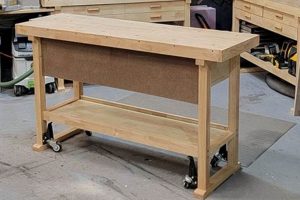
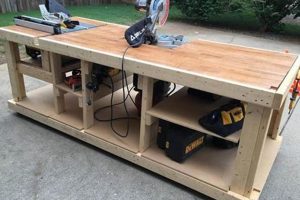
Instructions detailing the construction of collapsible tables from wood are essential resources for woodworkers. These guides provide step-by-step directions, material lists, and dimensional diagrams that enable individuals to create functional and space-saving furniture pieces. An example includes a schematic outlining the creation of a rectangular table with hinged legs, allowing for easy storage when not in use.
The significance of such resources lies in their facilitation of efficient space utilization and the promotion of woodworking skills. Historically, these guides have been instrumental in enabling the creation of adaptable furniture, particularly valuable in environments with limited square footage. The creation of such tables promotes resourceful living and allows individuals to customize furniture to meet their specific needs.
The following sections will explore the various considerations in selecting appropriate plans, the tools and materials typically required, and the common techniques employed in the construction of these versatile pieces of furniture. Emphasis will be placed on understanding design variations and ensuring structural integrity in the finished product.
Tips for Utilizing Woodworking Schematics for Collapsible Tables
Optimal results from woodworking depend upon careful planning and precise execution. The following points are intended to enhance the construction process of folding tables using woodworking instructions.
Tip 1: Select Appropriate Plans: Choose plans that match existing skill level and available tools. Review the schematic thoroughly before commencing, ensuring complete comprehension of all steps.
Tip 2: Material Selection is Crucial: Utilize hardwoods like maple or oak for enhanced durability in high-stress areas, such as hinges and leg supports. Softwoods may be suitable for less critical components.
Tip 3: Prioritize Accurate Measurements: Precise measurements are essential for proper alignment and functionality. Employ a high-quality measuring tape and double-check all dimensions before cutting.
Tip 4: Hardware Selection: Use robust hinges and locking mechanisms designed for repeated use. Consider corrosion-resistant materials for outdoor applications. Ensure fasteners are of appropriate length to prevent protrusion.
Tip 5: Joinery Techniques: Employ strong joinery methods, such as mortise-and-tenon or dovetail joints, in areas requiring high structural integrity. Biscuit joints or pocket screws may be sufficient for less critical connections.
Tip 6: Sanding and Finishing: Thoroughly sand all surfaces before applying a protective finish. This ensures a smooth, durable surface and enhances the aesthetic appeal of the finished table.
Tip 7: Test Functionality: Before final assembly, test the folding mechanism and locking system to ensure smooth operation. Make necessary adjustments to prevent binding or instability.
Adhering to these guidelines will increase the likelihood of producing a functional, aesthetically pleasing, and durable folding table. Careful planning and attention to detail are paramount to achieving professional-grade results.
The next section will discuss common troubleshooting issues encountered during the construction process and offer solutions to address them.
1. Dimension accuracy

Dimensional accuracy, a foundational element in woodworking, assumes critical importance when applied to the creation of collapsible tables. Discrepancies in measurements and cuts can compromise the table’s structural integrity, folding mechanism, and overall stability.
- Impact on Folding Mechanism
Inaccurate dimensions can hinder the seamless operation of the folding mechanism. If hinge placement or leg lengths deviate from the schematic, the table may not fold correctly, resulting in binding, uneven surfaces, or an inability to lock securely in both the open and closed positions.
- Compromised Structural Integrity
Dimensional inaccuracies can weaken joints and load-bearing components. For instance, if mortise-and-tenon joints are not precisely sized, the resulting connection may be loose and prone to failure under weight. Similar issues can arise with improperly sized aprons or leg supports.
- Aesthetic Implications
Even minor dimensional errors can be visually apparent, detracting from the finished product’s aesthetic appeal. Uneven gaps, misaligned surfaces, or non-symmetrical components diminish the overall quality and craftsmanship of the table. Attention to detail in measurements contributes to a polished and professional appearance.
- Stability and Functionality
If legs are not cut to identical lengths, the table will be unstable and wobble when deployed. Similarly, if the tabletop sections are not properly aligned, the surface may be uneven and unsuitable for its intended use. Precision in dimensions is paramount for ensuring a stable and functional table.
These considerations highlight the necessity of meticulous adherence to dimensional specifications within the schematic. Utilizing precision measuring tools, double-checking all cuts, and ensuring components are square and true are essential practices for mitigating the risks associated with dimensional inaccuracies, ultimately resulting in a durable, functional, and aesthetically pleasing collapsible table.
2. Material Selection

The selection of appropriate materials represents a critical decision point in the construction of collapsible tables. The inherent properties of different wood species directly influence the table’s durability, stability, weight, and overall aesthetic appeal. Effective material selection is therefore intrinsically linked to the specific requirements and design considerations outlined within the woodworking instructions.
- Hardwood vs. Softwood Considerations
Hardwoods, such as oak, maple, and birch, provide superior strength and resistance to wear, making them suitable for components subjected to high stress, such as the legs, frame, and hinge supports. Their density also contributes to enhanced stability and reduced flexing under load. Conversely, softwoods, such as pine or fir, are lighter and easier to work with but are more susceptible to dents, scratches, and deformation. They may be appropriate for less critical components, such as the tabletop if reinforced appropriately or if the table is not intended for heavy use.
- Moisture Content and Stability
The moisture content of lumber significantly affects its dimensional stability. Wood shrinks and expands as it gains or loses moisture, which can compromise the integrity of joints and lead to warping or cracking. It is imperative to use kiln-dried lumber with a moisture content appropriate for the intended environment to minimize these risks. Plans often specify ideal moisture content ranges to ensure long-term stability of the finished table.
- Wood Grain and Aesthetics
The grain pattern of the wood plays a crucial role in the table’s aesthetic appeal. Different wood species exhibit distinct grain patterns, ranging from the tight, uniform grain of maple to the more pronounced grain of oak. The orientation of the grain during assembly can also affect the visual impact. Woodworking plans may suggest specific grain orientations to enhance the table’s appearance or to provide additional strength in certain areas.
- Fastener Compatibility and Wood Density
The density of the chosen wood influences the selection of appropriate fasteners. Dense hardwoods require more robust screws or bolts to ensure secure connections, whereas softer woods may be prone to splitting if over-driven. Plans often recommend specific fastener types and sizes based on the wood species specified, taking into account factors such as screw thread pitch and pilot hole dimensions. Glue selection must also be considered with respect to wood porosity.
These material selection considerations are integral to the successful execution of woodworking schematics for collapsible tables. The choice of wood directly impacts the table’s longevity, functionality, and aesthetic value, highlighting the importance of aligning material selection with the design specifications and intended use of the finished product. Deviation from recommended materials can compromise the integrity of the design and ultimately reduce the lifespan of the table.
3. Hardware Suitability
Hardware suitability, in the context of folding table woodworking schematics, represents a critical determinant of the finished product’s functionality and lifespan. The appropriate selection of hinges, latches, and fasteners directly influences the table’s ability to fold and unfold smoothly, lock securely, and withstand repeated use. Plans detailing the construction of such tables must, therefore, address hardware selection with specificity and precision. For instance, a schematic specifying lightweight hinges intended for infrequent use would be inappropriate for a heavy-duty folding table designed for daily operation. The resultant premature failure of the hardware would compromise the entire structure.
Consider the selection of latches for securing the table in both its open and closed configurations. A poorly chosen latch might fail to maintain a rigid tabletop surface when deployed, rendering the table unusable for its intended purpose. Conversely, an overly complex or cumbersome latching mechanism could detract from the table’s user-friendliness. Similarly, the use of inappropriately sized or low-quality fasteners can lead to weakened joints, resulting in instability or even structural collapse under load. Woodworking schematics that neglect these considerations increase the risk of project failure and user dissatisfaction. A practical instance involves the specification of brass or stainless steel hardware for outdoor folding tables, mitigating corrosion caused by exposure to the elements.
In conclusion, hardware suitability constitutes an essential component of effective folding table woodworking schematics. The careful consideration of hinge strength, latching mechanism reliability, and fastener appropriateness directly translates to a durable, functional, and aesthetically pleasing finished product. Ignoring these details not only undermines the integrity of the design but also jeopardizes the long-term usability of the table. Recognizing this connection between appropriate hardware and successful project outcomes is paramount for both novice and experienced woodworkers.
4. Structural integrity

Structural integrity constitutes a paramount concern in the design and execution of folding table woodworking plans. It dictates the load-bearing capacity, stability, and longevity of the table, ensuring safe and reliable performance under intended use conditions. Any deficiency in structural design or execution compromises the table’s functionality and potentially poses a safety hazard.
- Joint Strength and Stability
The strength and stability of joints within a folding table framework directly impact its overall structural integrity. Meticulous planning to ensure appropriate joint selectionmortise-and-tenon, dovetail, or adequately reinforced butt jointsis crucial. The ability of these joints to withstand the stresses imparted by weight and movement during folding and unfolding is paramount. Inadequate joint construction leads to instability, racking, and eventual failure.
- Leg Support and Bracing
The design of leg supports and bracing elements is fundamental to distributing weight evenly and preventing collapse. Folding table schematics must incorporate robust leg designs with strategically placed crossbars or stretchers to enhance stability. These elements counteract lateral forces and prevent the legs from buckling under load. For instance, a simple A-frame leg design necessitates a strong hinge connection to both the tabletop and the supporting frame to ensure vertical load transfer.
- Material Selection and Load Capacity
The choice of wood species significantly affects the table’s ability to bear weight. Hardwoods such as oak or maple offer greater strength and resistance to deformation compared to softwoods. A well-executed plan specifies appropriate wood dimensions and reinforcement strategies, such as laminating or incorporating metal supports, to accommodate the anticipated load. Neglecting material properties can lead to sagging, warping, or catastrophic failure under stress.
- Hardware Integration and Durability
The integration of hardware, specifically hinges and locking mechanisms, is critical for maintaining structural integrity in a folding table. The hardware must be robust enough to withstand repeated cycles of folding and unfolding without loosening or breaking. Plans must clearly specify appropriate hardware types, sizes, and installation methods to ensure secure and reliable operation. For instance, heavy-duty hinges with adequate load ratings and properly sized fasteners are essential for preventing hinge failure and maintaining the table’s structural stability.
These considerations are intrinsically linked to the successful implementation of folding table woodworking plans. A comprehensive understanding of joint strength, leg support, material selection, and hardware integration is essential for creating a durable, functional, and safe folding table. The consequences of neglecting these aspects range from minor instability to complete structural failure, underscoring the importance of prioritizing structural integrity in the design and construction process.
5. Folding mechanism

The operational functionality of a collapsible table is inherently dependent on its folding mechanism, a critical component thoroughly addressed within woodworking schematics. A folding mechanism allows the transition between a fully deployed, stable tabletop and a compact, storable configuration. Ineffective design or flawed execution of this mechanism negates the tables primary purpose, rendering it impractical. For example, plans for a gateleg table must detail the precise hinge placement and swing arm geometry to ensure the leaves can be smoothly raised and lowered, creating a stable surface when extended. Conversely, plans for a simple folding card table necessitate a secure locking system that prevents inadvertent collapse during use.
Detailed woodworking instructions provide specific guidance on selecting appropriate hardware, such as hinges and latches, that can withstand repeated use and environmental stressors. The schematics will also delineate precise measurements and tolerances to ensure proper alignment and smooth operation of the folding mechanism. The choice of materials, the type of joinery used to connect the moving parts, and the finishing applied to reduce friction are all key elements within the design. Consider plans for a wall-mounted folding desk; these must clearly illustrate the pivot points, support arm construction, and locking hardware to allow the desk to be securely stowed and easily redeployed. The success of such a project hinges entirely on the functionality of its folding apparatus.
In conclusion, the connection between the folding mechanism and woodworking schematics is inextricable. The schematics provide the necessary roadmap for creating a functional folding table, with the folding mechanism serving as the core element determining its overall utility. Potential challenges include selecting the appropriate hardware for the intended load and frequency of use and ensuring accurate measurements during construction. The success of a folding table project hinges on the clear and accurate execution of the mechanism design as detailed in the woodworking scheme.
Frequently Asked Questions
This section addresses common inquiries regarding the utilization of woodworking instructions for the creation of folding tables, aiming to clarify potential areas of confusion and provide concise, accurate information.
Question 1: What level of woodworking skill is required to successfully execute instructions detailing collapsible table construction?
Skill requirements vary depending on the complexity of the design. Simpler tables with basic joinery can be undertaken by novice woodworkers with some experience. However, designs incorporating advanced joinery techniques or intricate folding mechanisms necessitate a higher level of expertise.
Question 2: How important is adherence to specified material dimensions within the schematic?
Adherence to dimensional specifications is crucial for the structural integrity and functionality of the folding mechanism. Deviations from specified dimensions can compromise the table’s stability, folding capability, and overall durability.
Question 3: What types of wood are most suitable for creating folding tables?
Hardwoods such as oak, maple, or birch are generally preferred due to their strength and resistance to wear. Softwoods like pine may be suitable for less critical components or designs intended for light use.
Question 4: What factors should be considered when selecting hardware, specifically hinges and latches, for folding tables?
The load-bearing capacity, durability, and corrosion resistance of hardware are critical considerations. Hinges and latches should be rated for the anticipated weight and frequency of use. Corrosion-resistant materials are recommended for tables intended for outdoor use.
Question 5: How does the choice of wood finishing affect the longevity and appearance of a folding table?
A durable finish protects the wood from moisture, scratches, and UV damage, extending the table’s lifespan. The selection of finish also influences the table’s aesthetic appearance, allowing for customization to match specific design preferences.
Question 6: What are some common troubleshooting issues encountered during the construction process and how can they be addressed?
Common issues include misaligned joints, binding folding mechanisms, and instability. Addressing these issues often requires careful adjustment of hardware, re-squaring components, or reinforcing weak joints.
In summary, successful utilization of woodworking schematics for folding tables hinges on careful planning, precise execution, and attention to detail. Understanding material properties, hardware selection, and structural considerations is essential for creating a functional and durable finished product.
The following section will present a brief conclusion summarizing the key aspects of the topic.
Conclusion
The preceding exploration of folding table woodworking plans underscores the complex interplay of design, material science, and craftsmanship required for successful execution. Accurate adherence to dimensional specifications, judicious selection of materials and hardware, and a thorough understanding of structural principles are paramount. The folding mechanism itself demands meticulous attention to detail, ensuring seamless transitions between deployed and stowed configurations. Properly implemented, these plans facilitate the creation of functional, space-saving furniture.
The enduring appeal of adaptable furniture ensures the continued relevance of these schematics. Mastery of the techniques detailed within not only empowers individuals to create bespoke pieces but also contributes to the preservation of valuable woodworking skills. Further investment in refining plan design and material selection will yield increasingly robust and aesthetically pleasing folding table solutions.