



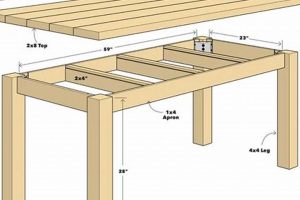
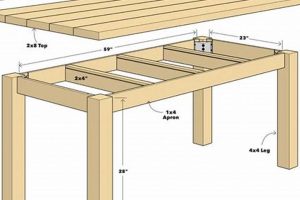
The dimensions of a workbench intended for fabrication and assembly of wooden objects are a critical consideration. These measurements, typically expressed in length, width, and height, significantly influence the usability and efficiency of the workspace. For example, a surface area of 60 inches in length and 30 inches in width, coupled with a height of 36 inches, is often considered a standard starting point for general woodworking tasks.
Optimal surface area provides adequate space for material manipulation, tool placement, and project assembly. A well-proportioned structure reduces strain on the user, contributing to improved posture and reduced fatigue during extended work sessions. Historically, the evolution of these dimensions has been driven by the increasing complexity of woodworking projects and the advancements in ergonomic design, leading to increased precision and safety.
The following discussion will delve into the factors affecting optimal dimensions, including project scale, workshop space constraints, and the specific needs of the woodworker. This analysis will encompass both fixed and adaptable designs, and present relevant considerations for selecting the structure most suited to individual requirements.
Optimizing Workbench Dimensions
Considerations for effective work surface selection are crucial for maximizing efficiency and minimizing physical strain during woodworking activities. Adherence to these guidelines will help ensure a functional and ergonomic workspace.
Tip 1: Prioritize Project Scope. Determine the typical scale of projects undertaken. Larger projects necessitate a larger surface area to accommodate material layout and assembly. Conversely, smaller projects may only require a compact structure.
Tip 2: Assess Workshop Constraints. Accurately measure the available workspace. A workbench should not impede movement or access to other tools and equipment. Account for sufficient clearance around the structure.
Tip 3: Optimize Height for Ergonomics. The height of the work surface should allow for comfortable operation without excessive bending or reaching. A general guideline is to set the height at approximately knuckle height when standing.
Tip 4: Select Appropriate Depth. Insufficient depth restricts maneuverability when working on large pieces. Excessive depth can make tools and materials difficult to reach. A depth of 24-36 inches is often optimal.
Tip 5: Factor in Material Thickness. The chosen thickness of the work surface affects overall stability and resistance to warping. Thicker materials, such as solid hardwood, provide greater rigidity.
Tip 6: Consider Add-on Features. Integration of vises, dog holes, and other work-holding devices influences the required space. Plan accordingly to accommodate these accessories without compromising the primary work area.
Tip 7: Account for Storage Needs. Integrated storage, such as drawers or shelves, can reduce clutter and improve workflow. Evaluate the storage capacity required and allocate sufficient space within the overall design.
Careful attention to the aforementioned aspects will result in a woodworking environment that increases productivity and minimizes discomfort, leading to enhanced results.
Following sections will address the types of materials for workbenches and their impact on durability and longevity.
1. Surface Area
The available surface area is a primary determinant of a woodworking structure’s utility. It directly constrains the size and complexity of projects that can be effectively undertaken, impacting efficiency and workflow.
- Material Accommodation
The magnitude of the work surface dictates the extent to which materials can be laid out, measured, and manipulated without obstruction. A larger area is required for handling sheet goods like plywood or long stock, while smaller projects, such as box construction, demand less space.
- Tool Placement and Accessibility
Adequate space must be available for the placement of essential tools and accessories. Crowding the work surface hinders accessibility and increases the risk of accidents. The surface area should allow for both active tools and tools awaiting use.
- Assembly Space
Complex assemblies often require a substantial footprint for component arrangement and joinery execution. Sufficient surface area allows for pre-assembly staging, dry fitting, and clamping operations. Limited space can force compromises in assembly methods.
- Project Footprint
The nature of the project, large projects will often require more surface areas to make sure you can complete the work correctly. For example, building a desk, entertainment center or bookshelf, will require larger surface area for more material.
In summary, surface area serves as a fundamental constraint on the nature and scale of woodworking projects. Careful consideration of surface area requirements is essential for selecting a structure that aligns with intended applications and optimizes workflow.
2. Workbench Height

Workbench height, a critical component of woodworking table dimensions, directly influences user ergonomics and operational efficiency. An inappropriately dimensioned height can induce musculoskeletal strain, hindering productivity and potentially leading to long-term health issues. The connection lies in the cause-and-effect relationship between the structure’s elevation and the user’s posture during tasks such as sawing, planing, and assembly. For instance, a height that necessitates excessive bending to perform tasks will rapidly induce lower back fatigue. Conversely, a surface too high may cause shoulder and neck strain. This makes determining the optimal workbench height integral to defining an effective woodworking table size.
The importance of this dimensional consideration is underscored by its direct impact on precision and control. When a user is forced into an unnatural posture, the stability and accuracy of their movements diminish. This can manifest in less precise cuts, misaligned joinery, and increased risk of accidents. A properly sized workbench promotes a neutral spine and allows for efficient force application, resulting in more accurate and controlled woodworking processes. For example, a woodworker planing a large surface will benefit from a height that permits them to exert downward pressure effectively without compromising their balance or posture.
In conclusion, workbench height is not merely an arbitrary dimension but a vital factor in determining the usability and ergonomic viability of a woodworking structure. Optimizing this element within the broader context of woodworking table dimensions is essential for ensuring a productive, safe, and comfortable working environment. Challenges may arise when accommodating multiple users of varying heights, necessitating adjustable height features or specialized workbenches. Regardless, a thorough understanding of the correlation between workbench height and user well-being is fundamental to effective woodworking practice.
3. Tabletop Thickness

Tabletop thickness, an integral attribute of woodworking surfaces, interacts significantly with overall dimensions to influence structural integrity and functionality. Its impact extends beyond simple support, affecting vibration dampening, work-holding capabilities, and long-term stability.
- Load-Bearing Capacity
Thickness directly determines the maximum weight a surface can sustain without deformation. Thicker tops, particularly those constructed of dense hardwoods or laminated materials, distribute loads more effectively, preventing sagging under heavy tools or workpieces. Insufficient thickness results in compromised stability and potential structural failure.
- Vibration Dampening
Workbench vibration during tasks like hammering or planing can reduce precision and cause discomfort. Increased thickness enhances a surface’s ability to absorb and dissipate these vibrations. This effect is particularly pronounced in solid wood tabletops compared to less massive alternatives.
- Work-Holding Potential
Thickness enables the effective use of work-holding devices like vises and holdfasts. A substantial tabletop allows for secure mounting of these tools and provides adequate material for them to grip without causing damage. Insufficient thickness limits the types and effectiveness of available work-holding options.
- Dimensional Stability
Wood is a hygroscopic material, meaning it expands and contracts with changes in moisture content. Greater thickness, especially when combined with appropriate joinery and finishing techniques, can enhance dimensional stability, mitigating warping, cupping, or twisting. This is critical for maintaining a flat, reliable work surface over time.
Collectively, these facets highlight the profound influence of tabletop thickness on the overall utility and longevity of a woodworking surface. The selection of an appropriate thickness should be guided by the intended applications, material properties, and anticipated load requirements to ensure optimal performance within the constraints of woodworking table size.
4. Overall Width

The overall width of a woodworking surface represents a critical dimensional parameter dictating the accessibility and functional range of the workspace. Within the context of woodworking table size, this measurement directly influences the user’s reach, the capacity for accommodating large workpieces, and the optimization of workflow.
- Reach and Accessibility
The width directly determines the ease with which a user can access tools and materials positioned at the back of the structure. Excessive width can necessitate excessive reaching, potentially leading to fatigue and reduced efficiency. For example, a surface exceeding 48 inches in width might prove challenging for a user of average stature to comfortably access the far edge.
- Workpiece Accommodation
Width dictates the maximum dimension of a workpiece that can be supported without overhang. Insufficient width restricts the capacity to handle larger projects, necessitating cumbersome repositioning or auxiliary support systems. The build of a large cabinet door would require substantial width to remain stable.
- Material Layout Efficiency
A well-proportioned width facilitates efficient material layout for cutting, shaping, and assembly. Ample width reduces the need for constant material adjustment, improving workflow and minimizing potential errors. Cutting large pieces of lumber to size becomes easier when the layout width offers ample space.
- Ergonomic Considerations
The overall width of a woodworking surface is directly related to user comfort and ergonomic efficiency. Careful consideration of width promotes better posture, minimizes strain, and enhances overall productivity. Woodworkers can easily reach for necessary equipment without bending over.
Consequently, the overall width is not merely an arbitrary dimension but a fundamental consideration influencing the functionality and usability of a woodworking table. Careful evaluation of project requirements and user ergonomics is paramount in selecting a width that optimizes workflow, minimizes strain, and enhances overall efficiency in woodworking activities.
5. Total Length

The total length, as a critical dimension within the broader scope, directly affects the capacity for material processing and project assembly. Its magnitude establishes the maximum continuous dimension a workpiece can possess without requiring additional support or manipulation. Insufficient total length may necessitate segmented fabrication or cumbersome repositioning, thereby compromising efficiency and potentially introducing inaccuracies. A lengthy tabletop, exceeding 8 feet, allows for the full-length processing of standard lumber without the need for intermediate supports.
The practical significance of total length extends beyond mere dimensional accommodation. It influences the sequence and methodology of woodworking operations. For example, when constructing a large casework piece, adequate total length permits the continuous assembly of components, reducing the reliance on separate jigs or temporary fixtures. This streamlining of the process not only saves time but also minimizes the potential for cumulative errors associated with multiple setups. Workbenches can be designed with modular extensions or drop-leafs to adapt the total length to varying project demands.
In summation, the total length is a non-negotiable parameter within the definition of woodworking surface dimensions. Its proper assessment and integration are essential for optimizing workflow, maintaining precision, and ensuring the successful completion of projects, particularly those involving substantial material dimensions. Discrepancies between the total length and project needs will predictably lead to inefficiencies and compromised results. The relationship between total length and other parameters, such as width and height, must be carefully balanced to ensure an ergonomically sound and functionally versatile woodworking workspace.
6. Leg Spacing

Leg spacing, a crucial component of woodworking surface dimensions, directly influences stability and under-table accessibility. This distance between the supporting legs determines the load distribution across the structure and affects the ease with which a user can position themselves beneath the work surface. Insufficient leg spacing compromises stability, increasing the likelihood of racking or tipping, while excessive spacing may diminish structural rigidity. For instance, a long, narrow surface with widely spaced legs might exhibit undesirable flexing under heavy loads, especially if fabricated from less dense materials. Conversely, closely spaced legs provide increased support, but may restrict legroom and storage options beneath the structure.
The practical significance of leg spacing becomes apparent when considering the integration of vises or other work-holding devices. Insufficient clearance between the legs may impede the operation of these tools, limiting their functionality. Similarly, when undertaking tasks requiring close proximity to the underside of the workpiece, adequate leg spacing allows the woodworker to comfortably position themselves for optimal visibility and access. The ideal leg spacing balances these considerations, providing a stable platform while maintaining sufficient under-table clearance for both the user and potential storage solutions. A workbench designed for carving, for example, benefits from ample leg spacing to accommodate the carver’s legs and tools, allowing them to get close to their work.
In conclusion, leg spacing represents a non-trivial aspect of woodworking surfaces. Its optimization requires a holistic assessment of structural requirements, user ergonomics, and anticipated accessory integration. Disregard for this dimensional parameter can lead to compromised stability, restricted accessibility, and ultimately, a less effective woodworking environment. The correct spacing also makes moving the workbench easier.
7. Apron Depth

Apron depth, a critical dimension within the framework of woodworking surface dimensions, significantly affects structural rigidity and the capacity to resist racking forces. The apron, the vertical component situated beneath the tabletop and connecting the legs, acts as a key element in maintaining the squareness and stability of the overall structure. Inadequate apron depth compromises the workbench’s ability to withstand lateral stresses, potentially leading to instability and diminished precision during woodworking tasks. For example, a surface with a shallow apron may exhibit excessive wobble when subjected to vigorous planing or sawing, negatively impacting the quality of the work.
The integration of apron depth within the overall woodworking surface dimensions is further underscored by its influence on joinery options. A deeper apron provides more surface area for robust joinery connections between the legs and the tabletop, such as mortise-and-tenon or dovetail joints. These stronger connections enhance the structure’s resistance to deformation and ensure long-term stability. By contrast, a shallow apron limits the potential for employing these high-strength joinery methods, often necessitating the use of weaker fasteners or less durable connections. Consider a scenario where a deep apron allows for the implementation of a robust mortise-and-tenon joint between the legs and the tabletop, resulting in a workbench that can endure years of heavy use without compromising its structural integrity.
Ultimately, apron depth is not merely an aesthetic consideration but a fundamental determinant of a woodworking structure’s performance and longevity. Its proper specification, within the broader context of woodworking table dimensions, is essential for creating a stable, reliable, and functional workspace. Failure to adequately consider apron depth can result in a workbench that is prone to instability, limits joinery options, and ultimately fails to meet the demands of rigorous woodworking activities. The effect is that the surface area is limited, and equipment is less organized.
Frequently Asked Questions
The following section addresses common inquiries regarding the selection and optimization of woodworking surface dimensions. Accurate knowledge of these parameters is crucial for establishing a functional and efficient workspace.
Question 1: What is the generally recommended surface area for a general-purpose woodworking structure?
A surface area of approximately 60 inches in length and 30 inches in width is often considered a suitable starting point for general woodworking applications. However, this figure should be adjusted based on project requirements and available space.
Question 2: How does surface height influence ergonomic considerations?
Surface height directly impacts posture and reduces strain during prolonged work sessions. A height set at approximately knuckle height when standing is often recommended to minimize bending and reaching.
Question 3: What is the effect of work surface thickness on stability?
Greater thickness generally enhances stability and load-bearing capacity. Thicker tops, particularly those constructed of dense hardwoods, distribute weight more effectively and resist warping.
Question 4: How does the overall width of the surface impact accessibility?
Excessive width can hinder accessibility to tools and materials positioned at the back of the structure. Users should be able to comfortably reach all areas of the surface without strain.
Question 5: To what extent does surface length influence project scope?
Surface length dictates the maximum continuous dimension a workpiece can possess without requiring additional support. Insufficient length may necessitate segmented fabrication or cumbersome repositioning.
Question 6: Why is leg spacing a critical factor in overall structure design?
Leg spacing influences stability and under-table accessibility. Insufficient spacing compromises stability, while excessive spacing may diminish structural rigidity and limit under-table storage options.
Careful consideration of these dimensions is essential for creating a woodworking environment that maximizes productivity and minimizes physical discomfort.
The following section will explore the selection of appropriate materials for constructing woodworking tables.
Conclusion
This exploration has established that the dimensional characteristics defining a woodworking structure are paramount to its utility and effectiveness. Surface area, height, thickness, width, length, leg spacing, and apron depth collectively dictate the scope of projects that can be undertaken, the ergonomic efficiency of the workspace, and the overall stability of the platform. Precise attention to these measurements, informed by the specific demands of the woodworking tasks at hand, is indispensable.
Therefore, the successful integration of woodworking table size into the workshop environment demands a rigorous approach to planning and execution. Careful consideration of these factors ensures a functional, safe, and ultimately productive workspace, enabling the woodworker to achieve optimal results. Further research and experimentation in this area will undoubtedly lead to continued advancements in woodworking practices and enhanced user experiences.
![Best Woodworking Plans Drafting Table [Guide] for Table | Step-by-Step Guides, Tools & Inspiration to Build Beautiful Wooden Decor on a Budget](https://woodfromhome.com/wp-content/uploads/2026/05/th-80-300x200.jpg "Best Woodworking Plans Drafting Table [Guide] for Table Step-by-Step Guides, Tools & Inspiration to Build Beautiful Wooden Decor on a Budget")