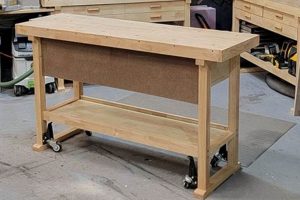
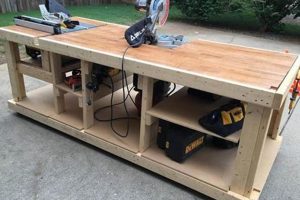
An essential addition to a stationary saw, this auxiliary surface provides support for long workpieces as they exit the blade. This support prevents material from sagging or tipping, contributing to safer operation and more accurate cuts. For instance, when ripping a large sheet of plywood, this stable plane ensures the entire length of the cut remains consistent, eliminating potential binding or kickback.
The incorporation of such a structure enhances safety, improves precision, and increases workflow efficiency within a woodworking shop. Historically, craftsmen improvised support systems, often using sawhorses or other makeshift solutions. Modern iterations offer adjustable height, integrated measuring systems, and even dust collection capabilities, reflecting advancements in both design and functionality.
The following sections will delve into the specific types available, considerations for construction versus purchase, and best practices for integrating this valuable asset into a woodworking workspace to maximize its utility and lifespan.
Enhancing Woodworking Efficiency
This section presents practical advice to optimize the use and integration of a support structure for stationary saws in a woodworking environment. Adhering to these guidelines can improve accuracy, safety, and overall workflow.
Tip 1: Material Selection. When constructing a surface, prioritize dense and stable materials such as MDF or plywood. Solid wood can be used, but it requires careful selection and construction techniques to mitigate warping and movement due to changes in humidity.
Tip 2: Height Adjustment. Ensure the support plane is precisely aligned with the saw table height. Even slight discrepancies can impact accuracy and introduce hazards. Adjustable legs or leveling feet are crucial for achieving and maintaining this alignment.
Tip 3: Surface Friction Reduction. Apply a smooth, durable coating such as melamine or a specialized low-friction finish. This reduces resistance and allows material to glide easily, minimizing strain and promoting smoother cuts.
Tip 4: Integrated Dust Collection. Consider incorporating a dust collection port or system. This minimizes airborne particles, improving visibility and creating a healthier work environment.
Tip 5: Reinforcement for Load Capacity. Properly reinforce the frame and surface to support the weight of large or heavy workpieces. Ensure the design can handle anticipated loads without deflection or instability.
Tip 6: Consider Mobility. While often stationary, adding heavy-duty casters with locking mechanisms provides flexibility for shop reconfiguration or material handling. Ensure the casters are appropriately rated for the intended load.
Tip 7: Miter Slot Compatibility. If using the auxiliary surface for miter gauge support, ensure it includes a compatible miter slot that aligns precisely with the saw’s miter slot. This enables accurate angled cuts on larger workpieces.
Implementing these strategies enhances both the functionality and safety of the support structure, leading to improved results and a more efficient woodworking process.
The subsequent sections will examine specific design considerations and explore various commercial options available to woodworkers.
1. Support

The fundamental role of a surface adjunct in woodworking centers on providing adequate support to prevent material deflection during and after cutting. Insufficient support compromises accuracy, potentially leading to material waste and unsafe operating conditions.
- Load-Bearing Capacity
The primary facet of support concerns the structure’s ability to bear the weight of the workpiece. An under-engineered surface can deflect or collapse under load, disrupting the cut and creating a potential hazard. Examples include sagging plywood or instability when processing heavy hardwoods. Proper design considerations and material selection are critical to ensure adequate load-bearing capacity.
- Planar Stability
Maintaining a consistent plane is essential for accurate cuts. Deviations from a flat surface, even slight ones, can introduce errors, particularly when working with long or thin materials. A stable framework and a rigid surface material are necessary to minimize warping, bending, or twisting. This directly impacts the precision of the final product.
- Extension Length
The length of the support extension dictates the maximum workpiece length that can be adequately supported. A short extension may be insufficient for longer boards, leading to unsupported overhang and potential sag. Determining the typical workpiece length used in a particular woodworking shop is crucial for selecting or designing an appropriate extension.
- Adjustability
Height adjustability is vital for matching the saw table height precisely. Even minor discrepancies can introduce uneven cuts and potential kickback. Fine-tuning mechanisms, such as adjustable legs or leveling feet, ensure a seamless transition between the saw table and the auxiliary surface, providing continuous and consistent support.
These facets demonstrate the interconnected nature of support and its direct impact on the functionality of a saw accessory designed for this purpose. When properly engineered and implemented, the adjunct provides consistent and reliable support, leading to safer, more accurate, and more efficient woodworking operations.
2. Accuracy

The implementation of a support adjunct directly affects the precision of cuts performed on stationary saws. Without adequate support, workpieces are prone to deflection, resulting in inaccurate dimensions and angles. This is particularly noticeable when processing extended stock, where even slight sagging can accumulate into significant errors across the length of the cut. Such inaccuracies necessitate rework, increase material waste, and compromise the overall quality of the finished product.
Consider a scenario where long shelving is being produced. Without consistent support as the material exits the saw blade, the resulting shelves will exhibit subtle, yet measurable, variations in width along their length. These variations cause fitting issues during assembly, rendering the shelves unusable or requiring time-consuming corrections. The use of a properly aligned, stable support mechanism minimizes these deviations, ensuring dimensional consistency and repeatable results. Furthermore, when cutting angles or compound miters, maintaining consistent material support is critical to ensuring accurate joint alignment and minimizing gaps.
In summary, the relationship between the cutting extension and accuracy is one of cause and effect. A well-designed and meticulously aligned surface mitigates material deflection, thereby promoting precise and repeatable cuts. Conversely, an inadequate system introduces variability, leading to inaccuracies and inefficiencies in the woodworking process. Understanding this connection is crucial for woodworkers seeking to achieve professional-grade results and minimize material waste.
3. Safety

The connection between operational safety and a support adjunct on a saw is paramount in woodworking environments. Its function extends beyond mere convenience; it directly mitigates several key hazards associated with sawing operations. The primary safety benefit stems from its ability to provide consistent support to workpieces as they exit the saw blade. Without this support, long or heavy materials are susceptible to sagging, binding against the blade, and potentially causing kickback. Kickback, a sudden and forceful ejection of the workpiece, poses a significant risk of injury to the operator.
Consider the scenario of ripping a large sheet of plywood. As the cut progresses, the unsupported section of the sheet can droop, pinching the blade and increasing the likelihood of a kickback event. A properly positioned support surface eliminates this droop, maintaining a constant plane and preventing the material from binding. Similarly, when crosscutting long boards, an extension prevents the cut-off piece from falling and potentially pulling the remaining portion into the blade, again increasing the risk of kickback or blade damage. This is also relevant when working with dense hardwoods which present a high amount of material stiffness and resistance during cutting. Moreover, a stable surface allows the operator to maintain a secure grip on the workpiece, reducing the chance of losing control and inadvertently contacting the blade.
In essence, incorporating a support adjunct as part of the saw setup proactively addresses common causes of woodworking accidents. By minimizing the risk of kickback, preventing material from binding, and promoting operator control, this simple addition significantly enhances the safety of sawing operations. This translates to a safer workspace and a reduced risk of injuries for the woodworker. This should be the top consideration when planning out a workstation.
4. Efficiency

A direct correlation exists between optimized workflow and incorporating a saw extension. This surface reduces the need for constant manual support, allowing for uninterrupted cutting and minimizing material handling time. The result is a quantifiable increase in throughput, particularly when processing repetitive cuts or large volumes of material.
Consider the fabrication of multiple identical cabinet components. Without a consistent surface for material support, the operator must frequently pause to reposition the workpiece, ensure stability, and prevent sagging. These interruptions accumulate, significantly increasing the overall production time. However, a properly installed extension, matched to the saw table height and extending sufficiently to support the full material length, eliminates these pauses, allowing for continuous cutting and a streamlined production process. Additionally, integrating features such as measuring scales or adjustable stops further enhances efficiency by facilitating accurate and repeatable cuts, reducing the likelihood of errors and rework. In environments where space is at a premium, incorporating a folding design can maintain shop efficiency without impacting workspace availability.
In essence, the relationship is one of optimized process flow. Reducing manual intervention, ensuring consistent material support, and integrating features that streamline repetitive tasks contribute to measurable gains in efficiency. These improvements translate to reduced labor costs, increased production capacity, and a more streamlined woodworking operation overall. Incorporating a functional surface designed for material stability is a very important part of this efficient process.
5. Customization

The utility of a saw support surface is significantly enhanced through customization, allowing woodworkers to adapt its functionality to specific project requirements and shop configurations. While commercially available options offer a baseline level of support, their standardized designs may not fully address the diverse needs of different woodworking applications. Customization enables woodworkers to tailor the surface dimensions, load-bearing capacity, integrated features, and overall layout to optimize workflow and improve accuracy.
One common customization involves adjusting the dimensions of the surface to accommodate the typical size of workpieces processed in a given shop. A furniture maker, for example, may require a longer and wider surface to support large panels, while a cabinetmaker may prioritize a smaller footprint to maximize space in a confined area. Furthermore, custom features such as integrated measuring scales, adjustable fences, or specialized clamping systems can streamline specific tasks and improve the precision of repetitive cuts. A woodworker constructing picture frames might integrate a miter gauge extension into the outfeed to facilitate accurate angle cuts. Another customization may address dust collection needs. Adding a custom dust collection enclosure can prevent material waste.
Ultimately, customization transforms a generic support structure into a specialized tool that seamlessly integrates into a woodworker’s workflow and enhances their ability to produce high-quality results. While requiring additional effort in design and construction, the benefits of a customized support systemincluding improved accuracy, increased efficiency, and enhanced safetyoutweigh the initial investment. Properly planned and executed customization is essential for maximizing the value and utility of a saw support structure in a demanding woodworking environment.
Frequently Asked Questions
This section addresses common inquiries regarding the implementation and function of saw adjuncts designed to support stock as it exits the blade. The following questions aim to clarify misconceptions and provide practical information for woodworkers.
Question 1: What constitutes appropriate material for constructing this surface?
Dense, stable sheet goods, such as MDF or high-quality plywood, are recommended. Solid wood may be used, but requires careful selection to minimize warping. The chosen material should resist deflection under load and maintain a consistent plane.
Question 2: How is optimal height alignment achieved?
Precise alignment with the saw table is crucial. Adjustable legs or leveling feet facilitate fine-tuning. A consistent plane between the saw table and the adjunct minimizes inaccuracies and potential hazards.
Question 3: What are the primary safety considerations?
Preventing material sag is paramount. Adequate support minimizes the risk of binding and kickback. A stable surface allows for secure material handling, reducing the likelihood of operator injury.
Question 4: Does the dimensions of the adjunct matter?
Yes, the size should be proportionate to the typical workpieces processed. Insufficient length or width compromises support and increases the risk of material deflection.
Question 5: What is the best method to reduce friction on the surface?
Applying a smooth, durable coating, such as melamine or a specialized low-friction finish, reduces resistance and facilitates smooth material movement. Waxing the surface on a regular basis is another valid option.
Question 6: Can such a structure be mobile?
Yes, heavy-duty casters with locking mechanisms allow for mobility. However, stability is paramount. Ensure the casters are rated for the intended load and that the locking mechanisms are reliable.
Key takeaways emphasize the importance of material selection, precise alignment, safety protocols, and appropriate dimensions. Prioritizing these factors ensures optimal performance and minimizes potential hazards. A well-built and properly utilized support surface enhances efficiency and improves the quality of woodworking operations.
The subsequent sections will explore the impact of the support adjunct on different types of woodworking projects and delve into advanced techniques for maximizing its effectiveness.
Conclusion
This exploration has underscored the significance of the woodworking outfeed table as a critical component in maximizing both safety and precision within a woodworking environment. The preceding sections have detailed the impact of material selection, alignment, dimensions, and customizable features on the adjunct’s overall effectiveness. A properly designed and implemented woodworking outfeed table mitigates the risks associated with material sag, binding, and kickback, while simultaneously enhancing efficiency and promoting repeatable accuracy. Its value extends beyond mere convenience, representing a fundamental investment in operator safety and the quality of finished products.
Therefore, woodworkers are encouraged to carefully consider the discussed factors when selecting, constructing, or customizing a woodworking outfeed table. Prioritizing these considerations will yield tangible improvements in workflow, minimize material waste, and foster a safer, more productive workshop. The adoption of best practices in this area is not merely a suggestion, but rather a necessary step towards achieving professional-grade results and ensuring the long-term well-being of the woodworker.