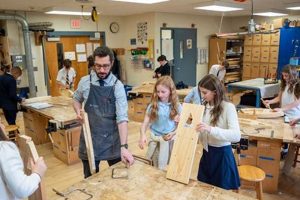
A structured learning environment focused on introducing young individuals to the fundamentals of working with wood. Such programs often incorporate age-appropriate projects, tools, and safety instruction to foster basic carpentry skills. Examples range from constructing simple birdhouses to more complex assembled toys, each designed to build confidence and proficiency.
The significance of engaging youth with woodworking extends beyond mere skill acquisition. Participation cultivates problem-solving abilities, spatial reasoning, and hand-eye coordination. Historically, woodworking has been valued as a means of developing practical skills and an appreciation for craftsmanship. The developmental benefits associated with these hands-on activities are considerable.
Subsequent sections will delve into specific project ideas, safety considerations vital in the workshop, and strategies for selecting age-appropriate tools and materials. Furthermore, insights into fostering creativity and problem-solving within the context of woodworking education will be explored.
Guidance for Youth Carpentry Programs
The following outlines best practices for conducting effective and safe programs focused on introducing young individuals to woodworking principles and techniques.
Tip 1: Curriculum Design: Structure lesson plans around age-appropriate projects. Begin with basic skills, such as measuring and sanding, before progressing to more complex joinery. Examples include building simple boxes or small wooden toys in initial sessions.
Tip 2: Safety Protocol: Implement mandatory safety briefings before each session. Emphasize the correct usage of safety equipment, including eye protection and dust masks. Demonstrate proper handling of tools and maintain a zero-tolerance policy for unsafe behavior.
Tip 3: Tool Selection: Provide tools specifically designed for smaller hands. Ensure tools are sharp and well-maintained to prevent accidents caused by excessive force. Begin with hand tools and gradually introduce power tools under strict supervision.
Tip 4: Material Choice: Select softwoods, such as pine or balsa, for initial projects. These materials are easier to work with and require less force. Avoid treated lumber due to potential health hazards associated with handling chemicals.
Tip 5: Supervised Instruction: Maintain a low student-to-instructor ratio to ensure close supervision and individualized guidance. Provide clear and concise instructions, demonstrating each step before allowing participants to proceed independently.
Tip 6: Encourage Creativity: Foster a supportive environment that encourages experimentation and problem-solving. Allow participants to personalize their projects and explore different design options within defined parameters.
Tip 7: Project Variety: Offer a range of projects that cater to different interests and skill levels. This keeps participants engaged and motivated to continue learning.
Adherence to these guidelines will contribute to a positive and enriching learning experience, fostering a lifelong appreciation for woodworking skills.
The subsequent section will discuss the long-term benefits and the future opportunities of youth carpentry programs.
1. Safety Protocols

The integration of stringent safety protocols is paramount in any youth-focused woodworking education environment. These protocols serve as the foundation for mitigating risk and fostering a secure learning atmosphere, thereby ensuring the well-being of participants and instructors alike.
- Mandatory Safety Training
Comprehensive safety training is a prerequisite for participation. This training encompasses the identification of potential hazards, proper tool handling techniques, and the correct use of personal protective equipment (PPE). For example, participants must demonstrate proficiency in using safety glasses, dust masks, and hearing protection before operating any tools. The implications of neglecting this training can range from minor injuries to more serious incidents.
- Supervised Tool Usage
Direct supervision during tool operation is critical. Instructors must closely monitor participants to ensure adherence to safety guidelines and provide immediate assistance when needed. For instance, when using saws or chisels, instructors should oversee the proper grip, stance, and cutting technique. This minimizes the likelihood of accidents caused by inexperience or improper tool handling.
- Equipment Maintenance and Inspection
Regular inspection and maintenance of tools and equipment are essential. This includes ensuring that tools are sharp, properly adjusted, and free from defects. Prior to each session, instructors must verify the functionality of safety guards, emergency shut-off switches, and other safety mechanisms. Defective equipment must be removed from service immediately to prevent potential hazards.
- Emergency Procedures
Well-defined emergency procedures must be in place and communicated to all participants. This includes protocols for handling injuries, fire hazards, and other unforeseen events. First aid kits should be readily accessible, and instructors must be trained in basic first aid and CPR. Regular drills can help familiarize participants with emergency procedures and ensure a swift and effective response in the event of an incident.
These facets of safety protocols are not merely procedural requirements but are integral to the success and sustainability of youth woodworking programs. Adherence to these standards promotes a culture of safety, encourages responsible behavior, and enables young individuals to explore the craft of woodworking with confidence and security.
2. Skill Development

Participation in woodworking programs designed for young individuals directly fosters a range of critical skill developments. The structured environment provides a platform for cultivating fine motor skills through precise manipulation of tools and materials. Activities such as sawing, hammering, and sanding necessitate the coordinated use of hand-eye coordination, enhancing dexterity and control. Cognitive abilities also benefit, as students learn to interpret plans, measure accurately, and problem-solve when faced with unexpected challenges during the construction process. For instance, the task of building a birdhouse requires an understanding of spatial relationships, measurement precision, and the application of joinery techniques, all contributing to a holistic skill development experience.
Beyond physical and cognitive skills, engagement in woodworking also promotes valuable life skills. Teamwork and collaboration are often integral components of these educational experiences, as students may work together on larger projects or assist one another with specific tasks. Furthermore, patience, perseverance, and attention to detail are cultivated as students learn to overcome obstacles and refine their techniques. The satisfaction derived from completing a tangible project instills a sense of accomplishment and pride, fostering self-confidence and a willingness to tackle future challenges. A practical example includes students learning to troubleshoot construction errors, adapting their approach and building resilience.
In conclusion, the relationship between skill development and structured woodworking activities for youth is symbiotic. These programs serve as a conduit for acquiring essential technical skills, cognitive abilities, and valuable life lessons. While challenges such as funding and accessibility may exist, the long-term benefits of investing in such educational opportunities are undeniable, contributing to the development of well-rounded individuals prepared to excel in various aspects of life. The value of woodworking as a skill-building activity extends far beyond the workshop, shaping individuals capable of critical thinking, problem-solving, and creative expression.
3. Creative Exploration

The integration of creative exploration within youth woodworking programs enhances the learning experience and broadens the educational impact. By allowing participants to deviate from prescribed project designs, they are encouraged to engage in problem-solving, critical thinking, and innovation. The opportunity to modify existing plans or develop entirely novel creations fosters a sense of ownership and investment in the learning process. For example, while constructing a basic wooden box, participants might be encouraged to experiment with different joinery techniques, decorative elements, or functional modifications, leading to the development of unique and personalized projects. This approach transforms woodworking from a purely technical exercise into a vehicle for self-expression and discovery.
Creative exploration provides a platform for developing transferable skills applicable beyond the woodworking workshop. The process of conceptualizing, planning, and executing original designs cultivates ingenuity and resourcefulness. Participants learn to adapt to unforeseen challenges, experiment with different solutions, and refine their ideas through iterative prototyping. These skills are highly valued in various academic and professional fields, where innovation and problem-solving are essential. Practical applications range from designing custom furniture pieces to developing innovative solutions for everyday problems. The emphasis on creativity in the context of woodworking fosters an entrepreneurial mindset and prepares young individuals to approach challenges with a proactive and innovative spirit.
In summary, the inclusion of creative exploration in woodworking education for youth is not merely an optional add-on but rather an essential component for maximizing learning outcomes and fostering holistic development. While maintaining safety and providing foundational technical skills are paramount, encouraging creativity unlocks the full potential of woodworking as a tool for self-expression, problem-solving, and innovation. Challenges remain in balancing structured instruction with open-ended exploration, but the benefits of fostering creativity outweigh the logistical complexities. The integration of creative exploration into these programs contributes to a well-rounded educational experience, preparing young individuals to thrive in a rapidly evolving world.
4. Tool Appropriateness

The selection of suitable tools represents a cornerstone of effective and safe instruction in youth woodworking programs. Tool appropriateness directly impacts the learner’s ability to develop skills, maintain safety awareness, and experience success in woodworking activities.
- Size and Ergonomics
Tools must be appropriately sized for smaller hands and body frames. Overly large or heavy tools can lead to strain, fatigue, and decreased control, increasing the risk of accidents. Smaller handles, lighter weights, and ergonomic designs tailored to children’s physical capabilities are essential. A hand saw with a smaller handle allows for a secure grip and controlled movement, reducing the risk of slippage and injury. Conversely, forcing a child to use a tool designed for an adult can lead to frustration and unsafe practices.
- Complexity and Functionality
Tools should be selected based on their complexity and the learner’s skill level. Introducing advanced or multi-functional tools too early can overwhelm participants and create confusion. Begin with basic hand tools, such as hammers, hand saws, and screwdrivers, before progressing to more complex tools like power drills or sanders. A gradual introduction of new tools allows learners to develop proficiency and confidence at each stage. For example, teaching basic joinery with hand tools before introducing power tools establishes a solid foundation in woodworking principles.
- Safety Features
Prioritize tools with integrated safety features. These may include blade guards, safety switches, and non-slip grips. Such features minimize the risk of accidental injuries and promote a culture of safety awareness. Power tools with automatic shut-off mechanisms can prevent injuries in the event of a mishap. Similarly, hand tools with rubberized grips offer better control and reduce the likelihood of slippage. Equipping children with tools that prioritize safety enhances their confidence and allows them to focus on learning and skill development.
- Durability and Maintenance
Tools must be durable enough to withstand frequent use and capable of being easily maintained. Low-quality tools can break easily, posing a safety hazard and disrupting the learning process. Durable tools made from robust materials ensure reliability and longevity. Regular maintenance, such as sharpening blades and lubricating moving parts, is essential for optimal performance and safety. Instructors should teach participants how to properly care for their tools, fostering a sense of responsibility and extending the lifespan of the equipment.
In summary, the careful selection of appropriate tools is integral to the success and safety of programs aimed at introducing woodworking skills to young individuals. Considerations such as size, complexity, safety features, and durability must guide tool selection to provide a positive and enriching learning experience. Tool appropriateness serves as a crucial element in fostering skill development, promoting safety, and inspiring a lifelong appreciation for woodworking.
5. Material Selection

The selection of appropriate materials is a critical determinant in the success and safety of woodworking programs designed for young individuals. Material properties directly influence the ease of manipulation, the stability of finished projects, and the overall safety of the learning environment. Prioritization of suitable materials is therefore essential.
- Wood Type and Softness
Softwoods, such as pine, balsa, and basswood, are generally preferred for introductory projects due to their lower density and ease of cutting, shaping, and fastening. Hardwoods, while offering greater durability, require more force to work and can be challenging for young, developing hands. Balsa wood, for instance, is exceptionally lightweight and can be cut with minimal effort, making it ideal for very young children. The selection of softwood minimizes the physical exertion required and reduces the likelihood of accidents caused by excessive force.
- Absence of Toxic Treatments
Lumber treated with chemical preservatives should be avoided in youth woodworking settings. Many treatments contain substances that can be harmful if ingested, inhaled, or absorbed through the skin. Untreated lumber, sourced from reputable suppliers, is a safer alternative. Ensure that any finishes, such as paints or stains, are non-toxic and specifically formulated for use by children. This minimizes the potential for adverse health effects associated with exposure to hazardous chemicals.
- Dimensional Stability and Warp Resistance
Materials should exhibit dimensional stability to prevent warping, twisting, or cracking after assembly. Kiln-dried lumber, which has been subjected to a controlled drying process, is less prone to dimensional changes than air-dried lumber. Warping can compromise the structural integrity of a project and create safety hazards. Selecting materials with minimal internal stresses ensures that finished projects remain stable and durable over time.
- Grain Structure and Splintering Potential
The grain structure of the wood should be considered to minimize the risk of splintering. Straight-grained woods are less likely to splinter than woods with irregular or knotty grain patterns. Sanding and finishing techniques can further reduce the potential for splintering. This precaution is particularly important to protect young hands from injury during the woodworking process.
The strategic selection of materials, considering factors such as wood type, treatment, stability, and grain structure, is vital for maximizing safety, enhancing the learning experience, and fostering a sense of accomplishment in youth woodworking programs. The use of appropriate materials lays the foundation for a positive and enriching educational experience.
6. Age-appropriate projects
The concept of age-appropriate projects constitutes a fundamental element in the design and execution of woodworking programs for young individuals. These projects must align with the developmental capabilities, skill levels, and attention spans of the participants, ensuring a safe, engaging, and educationally enriching experience.
- Skill Progression
Age-appropriate projects are structured to facilitate a gradual progression of skills. Initial projects should focus on basic techniques such as measuring, cutting, and fastening, using simple tools and materials. As participants gain proficiency, projects can incorporate more complex joinery methods, intricate designs, and advanced tools. A beginner project might involve constructing a simple birdhouse, while an intermediate project could entail building a small wooden toy with moving parts. This structured progression ensures that participants are challenged without being overwhelmed, fostering a sense of accomplishment and encouraging continued learning.
- Safety Considerations
The safety of participants is paramount in selecting age-appropriate projects. Projects involving sharp tools or complex machinery require careful supervision and comprehensive safety training. Projects should be designed to minimize the risk of injury, taking into account the physical capabilities and coordination skills of the participants. For younger children, projects may focus on using hand tools with rounded edges or working with soft materials that are easy to manipulate. Older children may be introduced to power tools under strict supervision, provided they have demonstrated proficiency in basic woodworking techniques. This tiered approach to tool usage ensures a safe and controlled learning environment.
- Cognitive Engagement
Age-appropriate projects should stimulate cognitive engagement and foster problem-solving skills. Projects should be designed to encourage critical thinking, spatial reasoning, and creative expression. Participants may be challenged to modify existing designs, develop innovative solutions to construction problems, or incorporate personal artistic elements into their projects. A project involving the construction of a small wooden puzzle, for instance, can promote spatial reasoning and problem-solving skills. Similarly, allowing participants to personalize their projects with paint, stain, or decorative elements can foster creativity and self-expression. This integration of cognitive challenges enhances the educational value of the woodworking experience.
- Project Duration and Scope
The duration and scope of age-appropriate projects should align with the attention spans and time constraints of the participants. Projects should be designed to be completed within a reasonable timeframe, preventing boredom or frustration. Younger children may benefit from shorter, simpler projects that can be completed in a single session, while older children may be able to tackle more complex projects that span multiple sessions. The scope of the project should also be appropriate for the skill level of the participants, ensuring that the project is challenging yet achievable. This careful consideration of project duration and scope ensures that participants remain engaged and motivated throughout the learning process.
In summation, the selection and design of age-appropriate projects are critical to the success of woodworking programs for young individuals. By considering factors such as skill progression, safety considerations, cognitive engagement, and project duration, educators can create a safe, engaging, and educationally enriching learning environment. Such an environment enables young participants to develop valuable skills, foster creativity, and build confidence in their abilities.
Frequently Asked Questions
The following section addresses common inquiries and concerns pertaining to woodworking programs designed for children and adolescents. Clarity and factual accuracy are prioritized.
Question 1: At what age is a child typically ready to participate in a structured woodworking program?
Readiness varies among individuals; however, programs generally accept participants starting around age seven. Key indicators of readiness include the ability to follow instructions, sufficient hand-eye coordination to manipulate tools safely, and an attention span adequate for completing basic tasks.
Question 2: What are the most critical safety precautions implemented in youth woodworking classes?
Mandatory safety training, supervised tool usage, personal protective equipment (PPE) such as safety glasses and dust masks, regular equipment maintenance, and clearly defined emergency procedures constitute core safety protocols.
Question 3: What types of tools are typically used in beginning-level woodworking classes for children?
Initial instruction typically focuses on hand tools, including small hammers, hand saws, screwdrivers, and measuring devices. Power tools are generally introduced only after participants demonstrate proficiency with hand tools and a thorough understanding of safety procedures.
Question 4: What are the benefits of engaging children in woodworking activities?
Participation in woodworking cultivates fine motor skills, spatial reasoning, problem-solving abilities, and hand-eye coordination. It also fosters creativity, self-confidence, and an appreciation for craftsmanship.
Question 5: How are woodworking projects adapted to suit different age groups and skill levels?
Project complexity is carefully tailored to the age and skill level of participants. Beginner projects typically involve simple designs and basic construction techniques, while more advanced projects incorporate intricate joinery and advanced tool usage.
Question 6: Are woodworking classes for children typically conducted in small groups to ensure individual attention?
A low student-to-instructor ratio is generally maintained to facilitate close supervision and personalized instruction. Small group sizes enable instructors to provide individualized guidance and address safety concerns effectively.
In summary, youth woodworking programs offer numerous developmental benefits when implemented with appropriate safety measures, skilled instruction, and age-appropriate projects.
Subsequent sections will explore potential resources and organizations that support youth woodworking education initiatives.
Kids Woodworking Class
The preceding discussion has explored the multifaceted dimensions of programs introducing woodworking to young individuals. From safety protocols and skill development to creative exploration and the careful selection of tools and materials, each aspect contributes to a holistic and enriching educational experience. The significance of age-appropriate projects, designed to foster both technical competence and cognitive growth, has been emphasized. These elements, when implemented effectively, provide a strong foundation for future skill acquisition and personal development.
Investment in programs centered on the keyword continues to be of paramount importance. By providing structured learning environments where young individuals can develop practical skills, problem-solving abilities, and a sense of accomplishment, communities contribute to the cultivation of well-rounded and capable citizens. Further support, both financial and programmatic, is essential to ensure the accessibility and sustainability of these valuable educational opportunities. Continued research into best practices and the dissemination of effective teaching methodologies will further enhance the impact of the keyword and secure a brighter future for those engaged in its pursuit.


![Learn Woodworking: Classes in Fort Collins [Skills!] | Step-by-Step Guides, Tools & Inspiration to Build Beautiful Wooden Decor on a Budget](https://woodfromhome.com/wp-content/uploads/2026/04/th-267-300x200.jpg "Learn Woodworking: Classes in Fort Collins [Skills!] Step-by-Step Guides, Tools & Inspiration to Build Beautiful Wooden Decor on a Budget")