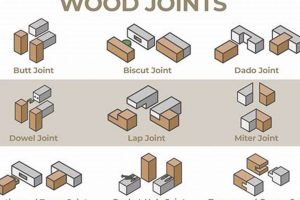
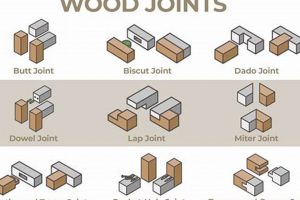
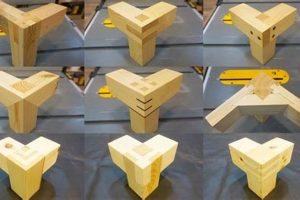
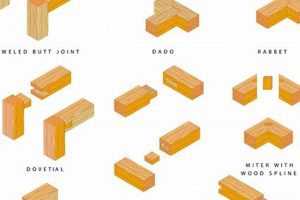
This technique utilizes small, football-shaped pieces of dried, compressed wood, typically beech, to reinforce a joint between two pieces of wood. These pieces, known as biscuits, are inserted into corresponding crescent-shaped slots cut into the edges of the wood to be joined. When a water-based glue is applied, the biscuits expand, creating a tight and strong bond. An example of its use can be seen in edge-to-edge joining for tabletops, or in creating strong corners for cabinet construction.
The employment of this method offers several advantages, including ease of alignment during assembly and increased gluing surface area, resulting in joints with enhanced strength and stability. Its relatively rapid execution makes it a popular choice in both professional woodworking shops and among hobbyists. Historically, this joining method has proven effective in minimizing racking in larger panels and aiding in the construction of durable furniture pieces.
The following sections will delve deeper into the specific tools required for this method, detail the proper techniques for creating accurate slots, discuss the selection of appropriate biscuit sizes for various applications, and provide guidance on achieving optimal glue-up procedures. This will ensure a thorough understanding of the nuances involved in creating robust and aesthetically pleasing woodworking projects using this jointing method.
Essential Considerations for Effective Implementation
This section offers crucial guidance to maximize the effectiveness and longevity of projects employing this method. Attention to detail in each phase is paramount for achieving professional-grade results.
Tip 1: Wood Selection Matters: Hardwood biscuits are generally preferred over softwood alternatives for their superior strength and resistance to compression. Consider the wood species of the biscuit in relation to the project wood to ensure compatible expansion and contraction rates.
Tip 2: Consistent Slot Depth is Critical: Ensure the biscuit joiner’s depth setting is accurate and consistent throughout the project. Variances in slot depth can compromise joint integrity and lead to misalignments during assembly.
Tip 3: Proper Glue Application is Non-Negotiable: Apply a generous and even coat of glue to both the biscuit and the inside surfaces of the slots. Insufficient glue will result in a weak bond; excessive glue can cause slippage during clamping. Use a high-quality wood glue designed for joint applications.
Tip 4: Clamping Pressure Needs Careful Calibration: Use clamps to apply even pressure across the joint during the glue-up process. Over-tightening can crush the biscuits, weakening the joint. Under-tightening can prevent proper adhesion. Distribute clamping pressure evenly to avoid warping.
Tip 5: Allow Adequate Drying Time: Adhere strictly to the glue manufacturer’s recommended drying time. Premature removal of clamps can compromise the bond’s strength and stability. Consider extending drying time in humid environments.
Tip 6: Dry Fit Before Gluing: Always perform a dry fit of the entire joint before applying glue. This allows identification of any potential alignment issues or discrepancies in slot size, enabling corrective action before permanent assembly.
Tip 7: Consider Biscuit Size for Stock Thickness: Select the appropriate biscuit size based on the thickness of the materials being joined. Using a biscuit that is too large can cause the wood to split or bulge, especially in thinner stock.
Adhering to these recommendations will significantly enhance the strength, durability, and aesthetic quality of woodworking projects employing this jointing method. Careful preparation and execution are key to realizing its full potential.
The following conclusion will summarize the key advantages and limitations of this jointing technique, providing a balanced perspective for its application in various woodworking scenarios.
1. Alignment

In biscuit joint woodworking, accurate alignment of the workpieces is paramount to achieving a structurally sound and aesthetically pleasing finished product. Misalignment can lead to weakened joints, visible seams, and overall instability of the construction.
- Biscuit Placement and Centering
The symmetrical nature of the biscuit and its slots, when accurately cut, aids in aligning the two pieces being joined. The biscuit acts as a centralizing element, pulling the pieces into a flush relationship. Precise centering of the slots on the edges or faces being joined is essential; off-center slots will result in a misaligned final assembly.
- Edge and Surface Flushness
One primary benefit of using this joining method is its inherent ability to create flush edges and surfaces. The biscuits, acting as internal clamps, help to maintain alignment during the glue-up process. This is especially critical in projects where seamless surfaces are desired, such as tabletops or cabinet doors. Proper alignment minimizes the need for extensive sanding or planing after assembly.
- Mitigating Racking and Twist
In larger panels or frames, the strategic placement of biscuits can significantly reduce the risk of racking (distortion out of square) and twist. Biscuits act as a mechanical reinforcement, resisting lateral movement and maintaining the intended geometry of the assembly. Careful planning of biscuit placement, considering the grain direction of the wood and potential stress points, is crucial for achieving optimal stability.
- Ease of Assembly and Adjustment
Compared to some other joining methods, this method offers a degree of forgiveness during assembly. The biscuits provide a temporary hold, allowing for minor adjustments before the glue sets. This is particularly beneficial in complex assemblies where multiple pieces need to be aligned simultaneously. The slight play afforded by the biscuit joint allows for fine-tuning to achieve perfect alignment before final clamping.
In summary, the successful use of biscuits as a joining method relies heavily on precise alignment. The proper placement and function of the biscuits contribute significantly to the strength, stability, and aesthetic quality of woodworking projects. Ensuring that the slots are accurately cut and that the pieces are carefully aligned during assembly is critical to maximizing the benefits of this versatile technique.
2. Glue Application

The effectiveness of a biscuit joint is inextricably linked to the proper application of adhesive. Glue serves as the primary bonding agent, transmitting stress between the wood components and the reinforcing biscuit. Incorrect application will inevitably compromise the joint’s structural integrity.
- Quantity and Coverage
An adequate quantity of glue must be applied to all mating surfaces, including the inner walls of the biscuit slots and the biscuit itself. Insufficient glue results in dry spots and a weakened bond. Conversely, excessive glue can lead to hydraulic lock, preventing the pieces from fully seating and potentially starving the joint of adhesive in critical areas. Uniform coverage is essential; avoid pooling or gaps in the glue film.
- Glue Type Selection
The choice of glue significantly impacts the performance of the joint. Polyvinyl acetate (PVA) glues, commonly known as wood glues, are generally suitable for interior applications due to their good strength and ease of use. However, for exterior projects or those exposed to moisture, water-resistant or waterproof glues, such as polyurethane or epoxy, are essential. Select a glue with an open time appropriate for the complexity of the assembly; rapid-setting glues may not allow sufficient time for alignment and clamping.
- Open Time Considerations
Open time refers to the period between glue application and when the joint is fully clamped. Exceeding the glue’s open time can result in a weakened bond, as the adhesive begins to dry and lose its ability to penetrate the wood fibers. Work quickly and efficiently after applying the glue. In hot or dry environments, the open time will be reduced; consider using a slower-setting glue or working in a cooler environment.
- Clamping Pressure and Time
Proper clamping pressure is necessary to ensure intimate contact between the glued surfaces. Insufficient pressure will result in gaps and a weak bond, while excessive pressure can squeeze out too much glue, potentially starving the joint. Distribute clamping pressure evenly across the joint to avoid distortion. Allow sufficient clamping time, as specified by the glue manufacturer, for the adhesive to fully cure and develop its maximum strength. Premature removal of clamps can compromise the bond’s integrity.
In summary, glue application is not merely a procedural step, but a critical factor determining the success or failure of biscuit joint woodworking. Careful attention to quantity, coverage, glue type, open time, and clamping parameters is essential for achieving strong, durable, and reliable joints. A well-executed glue-up ensures that the biscuit effectively reinforces the joint, maximizing its resistance to stress and extending its lifespan.
3. Biscuit Size

The dimensions of the biscuit used in joint construction directly influence the strength, stability, and aesthetic outcome of woodworking projects. Selecting the appropriate biscuit size is not arbitrary; it is a crucial decision based on the thickness of the materials being joined and the intended application of the finished piece.
- Material Thickness Compatibility
The primary determinant of biscuit size is the thickness of the wood being joined. Using an excessively large biscuit in thin stock can lead to visible bulging or even cracking of the wood, compromising the integrity of the joint. Conversely, a biscuit that is too small in thicker stock may not provide sufficient surface area for adequate glue adhesion, resulting in a weaker connection. As a general guideline, the biscuit should not exceed approximately one-third of the material’s thickness. For instance, joining two 3/4″ (19mm) boards typically necessitates a #0 or #10 biscuit, while thicker materials may accommodate a #20 biscuit.
- Joint Strength Considerations
Larger biscuits generally provide greater surface area for glue adhesion, resulting in a stronger joint. However, this increase in strength is not linear and must be balanced against the potential for material distortion. In applications where significant stress is anticipated, such as load-bearing shelves or structural frames, careful consideration should be given to the size and number of biscuits used. Reinforcing with multiple smaller biscuits strategically placed may be preferable to a single, oversized biscuit. For example, in constructing a large tabletop, multiple #10 or #20 biscuits spaced evenly along the joint will provide superior strength and resistance to warping compared to a single, larger biscuit.
- Aesthetic Impact and Concealment
Biscuit size also affects the visual appearance of the finished product. In some cases, the biscuits may be visible from the edge of the joint, particularly if the materials are not perfectly aligned or if the biscuit swells excessively during glue-up. Selecting a smaller biscuit can minimize the risk of visible imperfections. In situations where the joint will be exposed, careful consideration should be given to the aesthetic impact of the biscuit size. For example, when joining face frames to cabinet carcasses, a smaller biscuit may be chosen to ensure a clean, unobtrusive appearance.
- Joiner Cutter Size Limitations
The biscuit joiner tool is designed to accommodate specific biscuit sizes, and its cutter dictates the range of biscuit sizes that can be utilized. Attempting to force a larger biscuit into a smaller slot, or vice versa, can damage the tool and compromise the joint. Verify that the biscuit size being used is compatible with the biscuit joiner’s cutter. Some jointers offer adjustable cutters to accommodate different biscuit sizes; ensure that the cutter is properly adjusted before proceeding. In instances where a specific biscuit size is required and the current joiner cannot accommodate it, alternative joinery methods or tools may need to be considered.
The careful selection of biscuit size, based on material thickness, strength requirements, aesthetic considerations, and tool limitations, is fundamental to achieving successful and enduring results. The choice of biscuit size is not merely a matter of convenience; it is a critical decision that directly influences the structural integrity and visual appeal of woodworking projects.
4. Wood Species
The selection of wood species exerts a significant influence on the efficacy of biscuit joint woodworking. Different wood types exhibit varying densities, grain structures, and moisture absorption rates, directly impacting the strength and stability of the resulting joint. For instance, joining hardwoods like maple or oak requires careful consideration of the wood’s resistance to compression during clamping and the potential for splitting if biscuits are excessively large. Conversely, employing softwoods, such as pine or fir, necessitates accounting for their lower density, which can compromise the holding power of the biscuit, especially under stress. The expanding nature of biscuits as they absorb moisture from the glue also induces stress, with dense woods potentially inhibiting biscuit expansion and softer woods being more susceptible to deformation.
Real-world applications illuminate the importance of selecting compatible wood species. Cabinet construction utilizing a softwood frame joined with biscuit joints may exhibit weakness at the joints over time, particularly under the weight of stored items. This contrasts with a similar cabinet constructed from hardwoods, where the biscuit joints, when properly executed, provide robust and durable support. Furthermore, the choice of wood species affects the overall aesthetic. Staining and finishing characteristics differ across wood types, requiring careful consideration to ensure visual harmony across the joined pieces. A mismatch in grain patterns or coloration can detract from the finished product’s appearance.
In conclusion, a comprehensive understanding of the physical properties of different wood species is essential for successful biscuit joint woodworking. The optimal combination of wood type and biscuit size, coupled with meticulous execution, ensures a strong, durable, and visually appealing finished product. Ignoring this interplay can lead to structural weaknesses, aesthetic flaws, and ultimately, a diminished lifespan of the woodworking project.
5. Slot Accuracy

Accurate slot creation is paramount to the success of biscuit joint woodworking. The precision with which the slots are cut directly impacts the strength, alignment, and overall stability of the resulting joint. Inaccurate slots can manifest in various detrimental ways, ranging from weakened bonds due to insufficient glue surface area to misalignment issues that compromise the aesthetic appeal and structural integrity of the project. The biscuit’s function as a reinforcing element and alignment guide is contingent upon the slots being precisely dimensioned and positioned.
The creation of accurate slots necessitates utilizing a biscuit joiner that is properly calibrated and maintained. Blade sharpness is crucial; a dull blade will produce ragged edges and inaccurate slot depths, leading to poor biscuit fit. Consistent depth setting is also essential; variations in slot depth result in uneven joint surfaces and potential gaps. An example of the effect can be seen in cabinet face frame construction; inaccurately cut slots will produce frames that are not square and doors that do not fit properly. When joining panels for a tabletop, uneven slot depths will lead to a surface that is not perfectly flat, requiring excessive sanding to correct, potentially compromising the thickness of the material.
In conclusion, slot accuracy represents a critical factor in biscuit joint woodworking, directly influencing the quality and longevity of the finished product. Achieving precise slots requires careful attention to tool calibration, blade maintenance, and consistent technique. Prioritizing slot accuracy ensures that the biscuits function effectively as reinforcing elements and alignment guides, resulting in strong, stable, and visually appealing woodworking projects. Neglecting slot accuracy can lead to a cascade of problems that ultimately undermine the integrity of the joint and the overall quality of the piece.
6. Clamping Pressure

Clamping pressure in biscuit joint woodworking is a critical factor determining the joint’s ultimate strength and stability. It directly influences the glue bond’s integrity by ensuring intimate contact between the wood surfaces and the expanding biscuit. Insufficient pressure prevents adequate adhesion, leading to a weak joint vulnerable to failure under stress. Excessive pressure, conversely, can crush the biscuit or squeeze out too much glue, starving the joint of the necessary adhesive for a robust bond. For instance, consider the assembly of a cabinet carcass: if clamping pressure is inadequate, gaps may form between the frame and the sides, compromising the structural integrity of the cabinet and its ability to bear weight. Conversely, over-tightening clamps on delicate hardwood can cause indentations, marring the finished surface. Therefore, achieving the correct clamping pressure represents a critical balance.
Optimal clamping pressure is contingent upon several variables, including the wood species, biscuit size, and glue type. Softer woods require less pressure to achieve adequate contact compared to hardwoods, which may necessitate greater force. Larger biscuits may require increased clamping pressure to ensure uniform expansion within the slots, while specific glue formulations may exhibit optimal bonding characteristics at particular pressure levels. Practical application involves distributing the clamping force evenly across the joint to prevent warping or distortion. Using multiple clamps strategically placed along the joint ensures consistent pressure distribution. A real-world scenario demonstrating this is the edge-joining of wide panels for a tabletop: uneven clamping can result in a surface that is not perfectly flat, necessitating extensive sanding or planing, potentially diminishing the material’s thickness.
In summary, clamping pressure is not merely a procedural step in biscuit joint woodworking but a critical determinant of the joint’s overall quality and longevity. Understanding the interplay between clamping pressure and other factors, such as wood species and glue type, is essential for achieving successful and durable results. The ability to calibrate and apply appropriate clamping pressure, coupled with meticulous execution, distinguishes professional craftsmanship from amateur attempts, ultimately influencing the functional performance and aesthetic appeal of the finished woodworking project.
Frequently Asked Questions
This section addresses common inquiries and misconceptions regarding biscuit joint woodworking, providing concise and informative answers to enhance understanding of the technique.
Question 1: What are the primary advantages of employing this method over other joinery techniques?
The method offers rapid execution, simplified alignment during assembly, and increased gluing surface area. These features contribute to both efficiency and joint strength, making it a versatile choice for various woodworking projects.
Question 2: Is this method suitable for all wood species?
While applicable to a wide range of wood types, careful consideration must be given to the density and grain structure of the chosen species. Softer woods may require additional reinforcement, while denser hardwoods may necessitate precise slot cutting to prevent splitting.
Question 3: What factors influence the selection of an appropriate biscuit size?
Material thickness is the primary determinant. The biscuit should not exceed approximately one-third of the material’s thickness to avoid compromising the structural integrity or aesthetic appearance of the joint.
Question 4: How critical is glue selection to the success of this jointing method?
Glue selection is paramount. The adhesive must be compatible with the wood species being joined and appropriate for the intended application (interior or exterior). Water-resistant or waterproof glues are essential for projects exposed to moisture.
Question 5: What constitutes proper clamping technique during the glue-up process?
Uniform pressure distribution is crucial. The appropriate clamping pressure ensures intimate contact between the glued surfaces without crushing the biscuit or starving the joint of adhesive. Multiple clamps strategically placed along the joint are recommended.
Question 6: Can this jointing method be used for load-bearing applications?
The method can be employed in load-bearing scenarios, provided that the biscuit size and spacing are carefully calculated to accommodate the anticipated stress. Reinforcement with additional joinery techniques may be necessary for heavier loads.
In summary, successful implementation hinges on careful planning, attention to detail, and a thorough understanding of the materials and techniques involved.
The following section will delve into potential challenges and troubleshooting strategies associated with this jointing method.
Conclusion
This exploration has elucidated the multifaceted aspects of biscuit joint woodworking, emphasizing its advantages in alignment, speed, and surface area for gluing. Factors such as wood species, biscuit size, glue selection, and slot accuracy are crucial considerations for achieving strong and durable joints. The technique, when executed correctly, provides a valuable method for both amateur and professional woodworkers. Challenges such as misalignment, glue starvation, or inappropriate biscuit selection can compromise the joint’s integrity and longevity.
Mastery of biscuit joint woodworking requires not only a sound understanding of its principles but also diligent practice and attention to detail. By adhering to best practices and continually refining technique, woodworkers can unlock the full potential of this versatile method, ensuring that their projects exhibit both structural integrity and aesthetic appeal. Continued exploration and refinement are encouraged to fully leverage the benefits offered by biscuit joint woodworking.