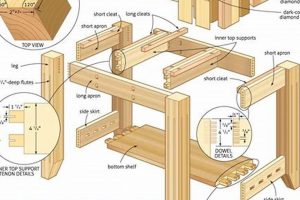
Elaborate carpentry endeavors, often characterized by intricate designs and superior craftsmanship, represent a specific segment within the broader field of woodworking. These undertakings frequently necessitate advanced skillsets and specialized tools to execute complex joinery, detailed carvings, and refined finishing techniques. Examples include crafting ornate furniture, building custom cabinetry with elaborate inlays, or constructing decorative architectural elements featuring advanced woodturning or marquetry.
Such projects hold significant value due to their aesthetic appeal, potential for heirloom status, and the tangible demonstration of artisanal skill. Historically, these elaborate creations have served as status symbols and expressions of cultural artistry. The pursuit of such complex woodworking tasks fosters creativity, problem-solving abilities, and an appreciation for the inherent beauty and versatility of wood as a medium.
The following sections will delve into the essential aspects of undertaking challenging woodworking tasks, including material selection, tool proficiency, joinery techniques, finishing processes, and project planning strategies vital for successful execution.
Essential Considerations for Elaborate Carpentry Endeavors
Successfully executing intricate woodworking tasks requires meticulous planning, precise execution, and a thorough understanding of materials and techniques. The following guidelines are intended to enhance the probability of achieving desired outcomes.
Tip 1: Material Selection is Paramount: Employing high-grade hardwoods with consistent grain patterns is essential. Variations in density or irregular grain can compromise the structural integrity and aesthetic appeal of complex designs. Kiln-dried lumber is advisable to minimize warping or cracking post-construction.
Tip 2: Invest in Precision Measuring Tools: Accuracy is non-negotiable. Digital calipers, precision squares, and high-quality measuring tapes are indispensable for ensuring accurate cuts and joinery. Deviations, even minor ones, can accumulate and lead to significant errors in the final assembly.
Tip 3: Master Advanced Joinery Techniques: Dovetail joints, mortise-and-tenon joints, and mitered corners require proficient execution. Practice these techniques on scrap material to refine skills and ensure tight, seamless connections. Consider using jigs or fixtures to maintain accuracy and consistency.
Tip 4: Prioritize Surface Preparation: Meticulous sanding is crucial for achieving a flawless finish. Progress through a series of progressively finer grits, starting with coarser grits to remove imperfections and ending with finer grits to create a smooth, even surface. Dust removal between sanding stages is essential.
Tip 5: Employ High-Quality Finishing Products: The selection of appropriate finishes is critical for protecting the wood and enhancing its natural beauty. Consider the desired sheen, durability, and resistance to moisture and UV radiation. Apply finishes in thin, even coats, allowing sufficient drying time between applications.
Tip 6: Create Detailed Shop Drawings: Comprehensive plans are not optional. Detailed drawings specifying dimensions, angles, and joinery methods are crucial for guiding the construction process and minimizing errors. These plans should include exploded views and cross-sections to illustrate complex assemblies.
Tip 7: Incorporate Mockups and Prototypes: Before committing to the final product, construct mockups or prototypes of critical components. This allows for identifying potential design flaws or construction challenges early in the process, saving time and resources.
Executing complex carpentry endeavors demands a commitment to precision, patience, and continuous learning. By adhering to these guidelines, the probability of successfully realizing intricate and aesthetically pleasing woodworking projects is significantly increased.
The subsequent sections will explore specific design considerations and innovative techniques relevant to this challenging field.
1. Intricate Joinery and Fancy Woodworking Projects
Intricate joinery forms a cornerstone of elaborate woodworking endeavors, transcending mere functionality to become an integral design element. Its mastery is often the defining characteristic that separates standard woodworking from projects considered genuinely sophisticated.
- Enhanced Structural Integrity
Beyond the aesthetic appeal, complex joinery techniques, such as dovetail joints, mortise-and-tenon variations, and intricate lap joints, significantly enhance the structural integrity of a piece. These techniques distribute stress more effectively than simpler joinery methods, resulting in furniture or structures that are more durable and resistant to deformation over time. For instance, a meticulously crafted dovetail joint in a highly stressed table leg can prevent wobble and failure far longer than a simple butt joint.
- Aesthetic Refinement
The visual complexity and precision inherent in intricate joinery elevate the aesthetic value of a project. Exposed joinery can become a decorative feature, showcasing the craftsman’s skill and attention to detail. Examples include exposed dovetail joints on drawer fronts, complex bridle joints in chair legs, or precisely mitered corners with hidden splines. These details transform functional connections into artistic statements.
- Elevated Craftsmanship Demonstration
Intricate joinery serves as a tangible demonstration of a woodworker’s skill and dedication. The execution of these techniques requires a high level of precision, patience, and understanding of wood behavior. The ability to consistently produce flawless, tight-fitting joints is a hallmark of expert craftsmanship and contributes to the overall perceived value of the finished piece.
- Functional Elegance
Beyond sheer strength, intricate joinery can contribute to the overall functional elegance of a design. For example, precisely fitted sliding dovetails can allow for controlled wood movement in tabletops, preventing cracking or warping in response to seasonal changes in humidity. Such considerations showcase a deep understanding of the material and its properties.
The incorporation of intricate joinery in elaborate woodworking tasks elevates them from mere functional objects to works of art, representing a harmonious blend of structural integrity, aesthetic refinement, and demonstrable craftsmanship. Such attention to detail transforms functional items into pieces of enduring value and beauty.
2. Exotic Hardwoods and Elaborate Woodworking

Exotic hardwoods play a crucial role in elaborate woodworking, lending unique aesthetic qualities, structural properties, and a sense of luxury to finished pieces. Their distinctive characteristics are often central to the conception and execution of sophisticated designs.
- Distinct Aesthetic Qualities
Exotic hardwoods possess visual characteristics rarely found in domestic species. Colors ranging from the deep blacks of ebony to the vibrant purples of purpleheart, coupled with unique grain patterns in woods like zebrawood, create a visual richness that elevates woodworking to an artistic level. These woods can become the focal point of a design, demanding careful consideration of their placement and use.
- Enhanced Dimensional Stability
Many exotic hardwoods exhibit superior dimensional stability compared to more common species. This resistance to warping, twisting, or shrinking in response to changes in humidity makes them ideally suited for intricate joinery and complex constructions. Using a stable wood such as African Blackwood for the fine details of a marquetry panel helps ensure its longevity and resistance to environmental stresses.
- Increased Density and Durability
The inherent density of many exotic hardwoods translates to increased durability and resistance to wear and tear. This is particularly advantageous in furniture or functional art intended for frequent use or display in high-traffic areas. A countertop crafted from Ipe, for example, offers exceptional resistance to scratching and impact, maintaining its aesthetic appeal over prolonged use.
- Elevated Perceived Value
The use of exotic hardwoods often elevates the perceived value of a finished piece, signaling a commitment to quality and craftsmanship. The rarity and cost associated with these materials contribute to a sense of luxury and exclusivity, making them particularly desirable for high-end commissions or collectible art pieces. A meticulously crafted jewelry box made of Macassar ebony, for instance, communicates both artistry and inherent value.
The strategic incorporation of exotic hardwoods represents more than a material choice; it embodies a design philosophy that prioritizes aesthetic distinction, structural integrity, and lasting value. The discerning selection and skillful application of these unique woods are defining elements in the creation of truly exceptional woodworking projects.
3. Complex Curvature

The incorporation of complex curvature into woodworking significantly elevates a project, frequently distinguishing it as an instance of refined or advanced craftsmanship. The presence of non-linear forms necessitates specialized techniques, advanced tooling, and a deep understanding of wood’s properties and behavior under stress. This often represents a considerable investment of time and skill, rendering such projects more exclusive and visually striking. For example, the sweeping lines of a sculpted rocking chair or the compound curves of a violin are immediately recognizable as challenging woodworking endeavors that transcend basic carpentry.
Achieving complex curves often involves techniques like steam bending, lamination, or the meticulous removal of material through carving and shaping. Each method presents unique challenges. Steam bending requires precise control over moisture content and temperature to avoid cracking or deformation. Lamination necessitates accurate molds and clamping pressure to ensure a uniform bond. Carving demands patience, a keen eye for form, and a mastery of hand tools. The implementation of these techniques showcases not only technical skill but also an artistic sensibility, as the woodworker must visualize and execute the intended form with precision. Consider the complex curves found in custom-designed musical instruments, like archtop guitars, where the shape directly influences the instrument’s acoustic properties, demonstrating the functional and aesthetic integration of complex curvature.
The ability to successfully incorporate complex curves into woodworking projects symbolizes a mastery of the craft, enhancing the visual appeal, functional properties, and overall value of the finished piece. This skill differentiates standard woodworking from elaborate and visually stunning projects, marking a transition from basic construction to sculptural artistry. Though challenging, the pursuit of complex curvature in woodworking ultimately allows for the creation of objects that are both functional and aesthetically compelling, standing as testament to the artisan’s dedication and expertise.
4. Refined Carving
Refined carving stands as a hallmark of elaborate woodworking, signifying a level of detail and artistry that elevates functional objects to the realm of sculpture. Its integration demands not only technical proficiency but also an artistic vision that transforms plain surfaces into visually captivating narratives. The presence of refined carving is often a defining characteristic of pieces recognized for their exceptional craftsmanship and aesthetic merit.
- Detailed Embellishment
Refined carving introduces intricate patterns, textures, and figurative representations to wooden surfaces. Examples range from delicate floral motifs adorning furniture panels to elaborate relief carvings depicting historical scenes. These embellishments serve to enhance the visual interest of the piece, drawing the viewer’s eye and inviting closer inspection. The presence of such detail distinguishes a mass-produced item from a bespoke creation, reflecting the artisan’s dedication and skill.
- Textural Contrast
Carving techniques can create a dynamic interplay of light and shadow, adding depth and dimension to otherwise flat surfaces. The contrast between smooth, polished areas and intricately textured carvings enhances the tactile and visual experience of the object. Consider the effect of deeply carved acanthus leaves on a classical chair leg, where the interplay of light and shadow accentuates the form and adds a sense of three-dimensionality.
- Artistic Expression
Refined carving offers a medium for artistic expression, allowing woodworkers to translate their creative vision into tangible form. Whether abstract geometric patterns or realistic portrayals of natural subjects, carvings can convey meaning, emotion, and cultural significance. The creation of complex and nuanced carvings reflects the artisan’s ability to not only manipulate the material but also to communicate through it, transforming functional objects into works of art.
- Historical Context and Legacy
Throughout history, refined carving has served as a means of documenting cultural narratives, commemorating significant events, and expressing social status. The styles and motifs employed in carving often reflect the prevailing aesthetic trends of a particular era, providing valuable insights into the historical context in which the object was created. Antique furniture featuring elaborate carvings serves as a tangible link to the past, preserving both the artistic skill and the cultural values of previous generations.
The integration of refined carving into elaborate woodworking projects enhances not only their visual appeal but also their historical and cultural significance. The resulting pieces serve as testaments to the enduring value of skilled craftsmanship and artistic expression, transforming functional objects into heirlooms of enduring beauty and cultural value. They bridge the gap between utility and art, enriching both the physical and aesthetic experience of the spaces they inhabit.
5. Custom Inlays
Custom inlays, characterized by the precise insertion of contrasting materials into a host surface, represent a significant technique within the realm of elaborate woodworking. Their integration often distinguishes projects as high-end, showcasing meticulous craftsmanship and artistic expression beyond basic construction.
- Material Contrast and Visual Interest
The primary role of custom inlays lies in generating visual contrast and enhancing aesthetic appeal. Contrasting materials such as mother-of-pearl, metals (brass, silver), stone, or different wood species are carefully selected and inlaid into the primary wood surface. This juxtaposition of textures, colors, and materials creates intricate patterns, detailed imagery, or personalized designs. An example would be a dark walnut table featuring a precisely inlaid maple border, accentuating the table’s shape and adding a layer of visual complexity. The selection and arrangement of these contrasting elements are crucial for achieving a balanced and harmonious composition.
- Personalization and Uniqueness
Custom inlays provide a distinct avenue for personalization, allowing woodworkers to incorporate unique motifs, monograms, or imagery that reflects the client’s tastes or the artist’s vision. This personalization significantly increases the value and emotional connection to the piece. Consider a custom-made guitar with an inlaid signature or family crest on the headstock. This level of customization elevates the instrument from a mass-produced item to a treasured heirloom.
- Demonstration of Craftsmanship
The execution of precise inlays demands a high degree of skill and precision. Achieving seamless integration of the inlaid material with the host surface requires careful planning, precise cutting, and meticulous fitting. Intricate inlays with tight tolerances serve as a tangible demonstration of the woodworker’s expertise and dedication to quality. The presence of flawless inlays often signifies a commitment to excellence and attention to detail that is highly valued in the world of fine woodworking.
- Enhancement of Design Complexity
Custom inlays contribute to the overall complexity and sophistication of woodworking projects. They can be used to enhance architectural details, add decorative elements to furniture, or create intricate patterns on smaller objects. For example, inlaid geometric patterns on a jewelry box or complex floral designs on a cabinet door significantly increase the visual interest and perceived value of the piece. The thoughtful integration of inlays can transform a simple design into a visually stunning work of art.
The incorporation of custom inlays in elaborate woodworking is not merely decorative; it is a strategic design choice that enhances visual appeal, allows for personalization, demonstrates craftsmanship, and contributes to the overall complexity of the piece. These elements combine to elevate functional objects to the level of art, highlighting the transformative power of meticulous detail in fine woodworking projects.
6. Multi-Material Integration

Multi-material integration, the strategic combination of wood with other materials, represents a significant trend in elaborate woodworking, expanding design possibilities and enhancing both aesthetic and functional characteristics. Its application often signifies a departure from traditional woodworking, pushing the boundaries of what is achievable and defining a new aesthetic for high-end projects.
- Enhanced Aesthetic Versatility
The incorporation of materials such as metal, glass, stone, or resin allows for the creation of visual contrasts and textures unattainable with wood alone. Metal accents, for instance, can provide sleek, modern lines that juxtapose the warmth and organic nature of wood. Glass inserts can create transparent elements, allowing light to pass through and adding a sense of airiness. Stone inlays can introduce natural textures and earthy tones. This broadened material palette enables designers to achieve a greater range of aesthetic effects, pushing beyond the limitations of single-material projects. A dining table featuring a live-edge wood slab supported by a steel base exemplifies this aesthetic versatility, blending rustic charm with industrial design.
- Improved Functional Performance
Multi-material integration can enhance the structural integrity and functional performance of woodworking projects. Metal components can provide superior strength and stability, particularly in load-bearing applications. Glass or resin coatings can offer enhanced resistance to moisture, scratches, or UV damage. Incorporating materials with different thermal expansion coefficients requires careful consideration, but can result in more durable and resilient pieces. For example, a wooden deck reinforced with hidden steel beams can withstand greater loads and resist warping better than a purely wooden structure.
- Technological Integration
The combination of wood with modern materials enables the integration of technology into woodworking projects. LED lighting can be embedded within wooden structures to create ambient lighting effects. Wireless charging pads can be seamlessly integrated into wooden surfaces. Electronic components can be housed within wooden enclosures, blending technology with natural materials. This integration of technology expands the functionality of woodworking projects, transforming them into smart and interactive objects. A wooden desk featuring a built-in wireless charging station and concealed LED lighting exemplifies this technological integration.
- Elevated Perceived Value
The use of high-quality non-wood materials, such as premium metals, hand-blown glass, or rare stones, often elevates the perceived value of elaborate woodworking projects. The combination of skilled woodworking with these luxurious materials signals a commitment to quality and craftsmanship, appealing to discerning clients who appreciate both artistry and exclusivity. The increased material cost and the complexity of integrating different materials contribute to a higher price point, positioning these projects as luxury items. A custom-made humidor featuring a mahogany exterior, a Spanish cedar lining, and a hygrometer with a brass bezel demonstrates this elevated perceived value, combining functionality with luxurious materials and meticulous craftsmanship.
In essence, multi-material integration serves as a catalyst for innovation in elaborate woodworking, fostering the creation of visually stunning, functionally superior, and technologically advanced pieces. By transcending the limitations of traditional woodworking techniques, this approach allows artisans to explore new creative possibilities and cater to the evolving demands of a discerning clientele.
7. Precision Finishing

The term “precision finishing” denotes a meticulous and controlled application of surface treatments to woodworking projects, achieving specific aesthetic and protective properties. Within the context of elaborate woodworking endeavors, this stage is not merely an afterthought but an integral component that directly impacts the perceived quality and longevity of the final product. The relationship is fundamentally causal: a failure to execute precision finishing techniques adequately will invariably detract from the overall impression of a complex woodworking piece, regardless of the intricacy of its design or the quality of materials employed. For instance, an ornate cabinet with meticulously carved details will appear significantly less impressive if marred by an uneven or poorly applied finish. The importance of precision finishing stems from its ability to accentuate the inherent beauty of the wood, enhance its durability, and protect it from environmental factors such as moisture and UV radiation.
Practical application of precision finishing involves a series of carefully orchestrated steps. Surface preparation, including sanding through progressively finer grits, is paramount to ensure a smooth, uniform base. The choice of finishing materialvarnish, lacquer, oil, or waxmust be aligned with the intended use and aesthetic of the project. Application techniques, such as spraying, brushing, or French polishing, demand practiced skill and attention to detail to avoid imperfections like brush marks, runs, or orange peel texture. Furthermore, each layer of finish often requires intermediate sanding or buffing to achieve optimal smoothness and clarity. The preservation of antique furniture, where original finishes are carefully restored or replicated, exemplifies the significance of understanding and applying precision finishing techniques.
In summary, precision finishing is indispensable for elaborate woodworking. Its proper execution elevates a project from a well-constructed object to a work of art. Challenges include the time investment required, the technical skill involved, and the need for specialized equipment and controlled environments. However, mastering precision finishing techniques is crucial for woodworkers seeking to produce high-quality, aesthetically pleasing, and durable pieces that stand the test of time. Its importance links directly to the broader theme of quality and craftsmanship, vital components of any successful woodworking project.
Frequently Asked Questions
The following section addresses common inquiries regarding undertaking advanced and aesthetically complex woodworking projects.
Question 1: What level of experience is required to undertake fancy woodworking projects?
Proficiency in fundamental woodworking techniques is essential. Familiarity with joinery, material selection, and finishing processes is a prerequisite. Advanced projects typically demand years of practical experience and a thorough understanding of wood behavior.
Question 2: What tools are necessary for executing elaborate woodworking tasks?
A comprehensive set of hand tools and power tools is generally required. This may include precision measuring instruments, specialized saws, carving tools, routers, planers, and sanders. The specific tools needed will vary depending on the complexity of the project.
Question 3: What are the most important considerations when selecting wood for intricate woodworking projects?
Wood species, grain pattern, moisture content, and dimensional stability are crucial factors. Hardwoods with consistent grain and minimal defects are generally preferred. Kiln-dried lumber is recommended to minimize warping or cracking.
Question 4: How can errors be minimized during the execution of complex woodworking plans?
Meticulous planning, detailed shop drawings, and the use of mockups are essential. Double-checking measurements, practicing joinery techniques on scrap material, and maintaining a clean and organized workspace can also reduce the likelihood of errors.
Question 5: What finishing techniques are best suited for high-end woodworking projects?
The choice of finish depends on the desired aesthetic and functional requirements. Traditional techniques such as French polishing, as well as modern spray finishes, are commonly employed. Multiple coats, careful sanding, and proper surface preparation are essential for achieving a flawless finish.
Question 6: How can the longevity of fancy woodworking projects be ensured?
Proper construction techniques, appropriate material selection, and protective finishes are paramount. Maintaining a stable environment with controlled temperature and humidity can also extend the lifespan of wooden objects.
In summary, successful execution of elaborate woodworking tasks necessitates a combination of skill, knowledge, and attention to detail. Adhering to best practices throughout the design, construction, and finishing phases is critical for achieving desired outcomes.
The subsequent section will explore resources and learning opportunities for aspiring artisans.
Conclusion
This exploration has detailed various facets of fancy woodworking projects, underscoring the significance of precision, material selection, intricate joinery, and refined finishing techniques. The integration of exotic hardwoods, complex curvature, custom inlays, and multi-material elements further contributes to the unique aesthetic and structural integrity of such endeavors. The pursuit of these complex projects demands expertise, dedication, and a commitment to continuous learning.
The artistry inherent in elaborate woodworking represents a confluence of technical skill and creative vision. Further exploration of design innovation and emerging techniques will undoubtedly shape the future of this craft. The commitment to excellence in design and execution remains paramount for individuals seeking to elevate woodworking to its highest potential, ensuring the creation of enduring works of art.