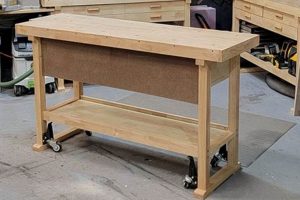
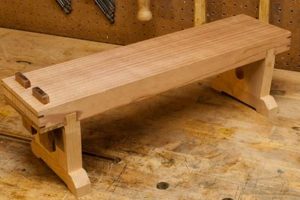
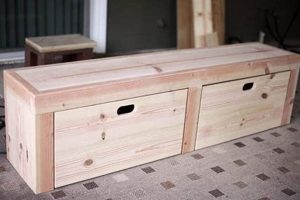
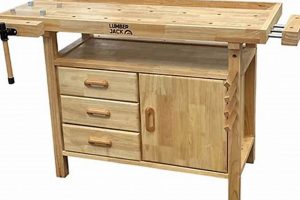
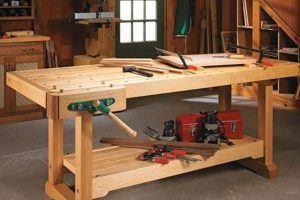
A self-constructed workbench designed specifically for woodworking activities serves as a foundational element within a workshop. These user-assembled structures provide a stable surface for performing various woodworking tasks, from sawing and planing to joinery and finishing. The designs vary considerably, reflecting individual needs, available space, and skill level.
The importance of a well-designed and sturdily built work surface cannot be overstated. Such a structure enhances efficiency, precision, and safety during woodworking projects. Historically, workbenches have been integral to woodworking trades, evolving alongside the craft itself. Constructing such a surface allows for customization based on specific project requirements and workspace limitations, often at a lower cost than purchasing a pre-made equivalent.
Subsequent sections will explore different design considerations, material selection, and construction techniques for creating an effective and personalized workspace solution. This will include analyses of various joinery methods, clamping options, and surface treatment strategies to ensure a durable and functional outcome.
Essential Considerations for Self-Constructed Woodworking Surfaces
The creation of a self-assembled woodworking surface necessitates careful planning and execution. The following considerations aim to optimize its utility and longevity within a woodworking environment.
Tip 1: Prioritize Stability. A robust undercarriage and sufficient weight are paramount. Consider incorporating mortise-and-tenon joints or bolted connections to enhance structural integrity. Employ dense hardwood for legs and stretchers to minimize movement during use.
Tip 2: Optimize Surface Flatness. A level and true surface is critical for accurate woodworking. Employ surfacing techniques such as planing or jointing to achieve a consistent plane. Regular maintenance, including re-flattening, will be required.
Tip 3: Integrate Versatile Clamping Options. Effective workholding is essential. Consider incorporating dog holes compatible with standard bench dogs and holdfasts. Face vises and tail vises provide additional clamping flexibility for a wide range of projects.
Tip 4: Account for Material Storage. Integrated storage solutions contribute to an organized workspace. Drawers, shelves, or under-bench cabinets can house tools, hardware, and works-in-progress, minimizing clutter and maximizing efficiency.
Tip 5: Select Appropriate Wood Species. The choice of lumber directly impacts the workbench’s durability and performance. Hardwoods like maple, beech, or oak offer superior resistance to wear and tear compared to softwoods. Consider cost and availability when making the selection.
Tip 6: Consider Ergonomics. The workbench height should be tailored to the user’s stature to minimize strain and fatigue. As a general guideline, the surface should be approximately at wrist height when standing.
Tip 7: Apply a Durable Finish. A protective finish safeguards the wood from moisture, stains, and scratches. Oil-based finishes or durable varnishes provide excellent protection while preserving the natural appearance of the wood.
Adherence to these principles will yield a woodworking surface that enhances project precision, minimizes physical strain, and provides years of dependable service.
Subsequent sections will elaborate on specific design options and advanced construction techniques.
1. Stability

Stability, in the context of a self-constructed woodworking platform, is paramount to its effective function. A lack of stability directly translates to reduced precision and increased risk of errors during woodworking operations. When a bench wobbles or shifts, it becomes exceedingly difficult to execute accurate cuts, joints, or assembly tasks. The absence of a firm, unyielding work surface introduces unacceptable levels of variability, undermining the entire woodworking process. For example, attempting to hand-plane a long board on an unstable surface will invariably result in an uneven, inconsistent result. The vibrations and movement transmit directly to the workpiece, making fine adjustments and consistent pressure application impossible. Similarly, attempting to chop mortises on a shaky bench can be hazardous, increasing the likelihood of misdirected blows and potential injury.
The stability of a self-constructed workbench stems directly from design and construction choices. Employing robust joinery techniques, such as mortise-and-tenon or dovetail joints, significantly enhances structural rigidity compared to weaker methods like simple butt joints. The selection of dense, heavy materials, such as hardwoods, further contributes to overall stability. Consider a scenario where two identical workbench designs are constructed one using softwood and relying solely on screws, and the other using hardwood and incorporating traditional joinery. The hardwood bench will invariably exhibit superior stability and resistance to racking or movement under load. Additional measures, such as strategically placed stretchers and a well-proportioned base, further reinforce the structure. The judicious use of weight, either through inherent material density or added ballast, helps to anchor the bench and minimize unwanted motion.
In conclusion, stability is not merely a desirable attribute of a self-assembled woodworking platform; it is a fundamental prerequisite for safe and accurate work. Neglecting this aspect can lead to compromised project quality, increased frustration, and potential safety hazards. Prioritizing robust design, appropriate material selection, and meticulous construction techniques are essential steps in creating a stable and reliable workspace for woodworking endeavors. The investment in ensuring stability translates directly to improved work quality and an enhanced woodworking experience.
2. Surface Flatness

Surface flatness, in the context of a self-constructed woodworking platform, directly influences the accuracy and quality of woodworking operations. A deviation from a true plane introduces errors that propagate through every stage of a project, impacting joinery, assembly, and finishing.
- Impact on Joinery Accuracy
A non-planar surface hinders the precise fitting of joints. Mortise and tenon, dovetail, and other joinery methods require accurately mating surfaces for optimal strength and aesthetic appeal. A warped or uneven surface will prevent these joints from seating properly, leading to weak and visually unappealing connections. Hand-cut joinery, in particular, relies on a flat reference surface for consistent chisel work and accurate layout.
- Influence on Assembly and Glue-Ups
During assembly and glue-up processes, a flat reference plane ensures even clamping pressure and proper alignment of components. An uneven bench surface can create gaps and distortions, resulting in misaligned assemblies and compromised structural integrity. Attempting to clamp multiple pieces together on an uneven plane can induce stress and warping, leading to long-term instability of the finished product.
- Effect on Planing and Surfacing Operations
Achieving a consistently flat and smooth surface on a workpiece relies heavily on a flat and stable workbench. Hand planing, in particular, demands a rigid and planar reference surface to guide the tool and prevent uneven material removal. Similarly, using power tools, such as jointers and planers, benefits from a flat workbench to support the workpiece and ensure accurate cuts. The bench serves as an extension of the tool, contributing to the overall precision of the operation.
- Calibration and Tool Setup
A reference surface for calibrating woodworking tools is provided by Surface Flatness. Tools can be calibrated accurately to a plane benchtop, guaranteeing the workpiece’s precise dimensions. In addition, it facilitates tool setup and adjustment for procedures such as planing or sawing. To achieve accurate results, a flat benchtop ensures that the tool is set at the proper angle and height.
Therefore, ensuring the surface plane of a user-built woodworking platform through careful construction and routine maintenance is crucial. Techniques such as winding sticks and precision levels are employed to assess and correct deviations. Investing in a flat surface translates to improved project outcomes, enhanced efficiency, and reduced material waste. The work area of the self-built woodworking bench is thus crucial for attaining accurate and exact woodworking results.
3. Clamping Options

The integration of effective clamping options is crucial to the functionality of a self-constructed woodworking platform. The ability to securely hold workpieces in various orientations and under varying loads directly influences the precision, safety, and efficiency of woodworking operations. This section outlines key clamping options and their relevance to a user-assembled workbench.
- Bench Dogs and Dog Holes
Bench dogs are essential for securing workpieces flat against the benchtop. These cylindrical or rectangular stops fit into strategically placed dog holes, typically arranged in a grid pattern. When used in conjunction with a vise or other clamping mechanism, bench dogs prevent movement during planing, sanding, or joinery. The material, size, and placement of dog holes on a user-built woodworking platform should align with common woodworking tasks. For example, closer spacing of dog holes near the front edge of the bench facilitates edge jointing of boards.
- Face Vise
A face vise, mounted flush with the front edge of the bench, provides a robust clamping force for a wide range of applications. It is particularly useful for holding boards on edge for operations such as dovetailing or mortising. The jaw width, opening capacity, and clamping pressure of a face vise should be carefully considered. A vise with a quick-release mechanism enhances efficiency by allowing for rapid adjustments. When integrating a face vise into a self-constructed woodworking platform, ensure that the mounting surface is adequately reinforced to withstand the applied forces.
- Tail Vise
A tail vise, also known as an end vise, is typically located at one end of the bench and is used in conjunction with bench dogs to clamp long boards along their length. The tail vise extends and retracts parallel to the benchtop, exerting pressure on the workpiece. This clamping method is particularly effective for edge-jointing or planing long boards. The design of the tail vise mechanism should allow for smooth and consistent clamping pressure across the entire length of the workpiece.
- Holdfasts
Holdfasts are traditional clamping devices that utilize friction to secure workpieces to the benchtop. These forged steel clamps are inserted into dog holes and struck with a mallet to engage the wood. Holdfasts offer a quick and versatile clamping solution for situations where conventional vises are impractical. The effectiveness of holdfasts depends on the type of wood used for the benchtop and the angle at which they are driven. Constructing a user-built woodworking surface with appropriately sized dog holes and a dense, stable benchtop maximizes the holding power of holdfasts.
These clamping options, when thoughtfully integrated into a self-constructed woodworking platform, provide the necessary versatility and holding power for a wide range of woodworking projects. The selection and placement of clamping devices should be tailored to individual needs and work styles, ensuring a functional and efficient workspace.
4. Material Storage
The integration of material storage solutions within a self-constructed woodworking platform represents a critical factor in optimizing workflow and maintaining an organized workspace. A direct correlation exists between readily accessible materials and efficient project execution. Insufficient or poorly planned storage leads to time wasted searching for tools, hardware, and lumber, thereby hindering productivity. Consider the scenario of constructing a complex joint. If essential chisels, measuring tools, and fasteners are scattered throughout the workshop, the process is inevitably slowed. Conversely, dedicated drawers or shelves within or adjacent to the workbench allow for immediate access, streamlining the operation. The absence of dedicated storage also increases the risk of damage to tools and materials. A chisel left unprotected on the benchtop is susceptible to accidental impacts, potentially damaging the blade. Similarly, lumber stored haphazardly may warp or become marred, rendering it unusable.
Several practical approaches exist for incorporating effective storage into self-built woodworking surfaces. Drawers, either integrated directly into the bench structure or housed within a separate cabinet positioned underneath, provide concealed storage for hand tools, measuring instruments, and hardware. Open shelving allows for quick retrieval of frequently used items, such as sandpaper, glue, and finishing supplies. Vertical storage solutions, such as pegboards or tool racks mounted on the side of the bench, keep tools visible and readily accessible. Lumber racks, either attached to the bench or located nearby, prevent warping and damage by storing boards vertically or horizontally in a manner that promotes air circulation. The specific storage solutions employed should align with the individual’s tool collection, project types, and available space. A woodworker specializing in small-scale projects may prioritize drawer storage for hand tools, while one focused on larger furniture pieces may require extensive lumber storage capacity.
In summary, the presence or absence of well-planned material storage within a self-constructed woodworking platform profoundly influences the efficiency, organization, and safety of the woodworking environment. Investing in dedicated storage solutions, whether through integrated drawers, shelving, or vertical storage systems, is an investment in productivity and long-term tool and material preservation. The challenge lies in tailoring storage solutions to individual needs and workspace constraints, ensuring that all essential items are readily accessible and protected from damage. Ultimately, effective material storage transforms a workbench from a mere work surface into a fully functional and organized woodworking hub.
5. Wood Species

The selection of wood species exerts a profound influence on the performance and longevity of a self-constructed woodworking platform. The inherent properties of different wood types directly impact factors such as stability, durability, workability, and cost. The mechanical characteristics, including hardness, density, and resistance to warping, dictate the workbench’s ability to withstand the stresses of woodworking activities. For instance, a workbench constructed from a softwood like pine will exhibit lower resistance to impacts and wear compared to one made from a hardwood like maple or oak. The choice of species affects the bench’s ability to maintain a flat surface over time, as hardwoods are generally less prone to deformation under load and fluctuating humidity. Workability considerations, such as ease of machining and joinery, also play a role in material selection. A species that is difficult to cut or plane may present challenges during construction, particularly for individuals with limited experience. Moreover, the cost of different wood species can vary significantly, influencing the overall budget for the project.
Practical examples underscore the importance of species selection. Consider a workbench designed primarily for hand tool woodworking. In this scenario, a dense hardwood like hard maple would be a suitable choice for the benchtop due to its resistance to wear and its ability to hold joinery well. The legs could be constructed from a less expensive but still stable hardwood like ash. Conversely, a workbench intended for light-duty tasks or for use in a dry climate may be constructed from a softwood like Douglas fir, provided that the design incorporates adequate bracing and reinforcement. The selection should align with the anticipated use of the workbench and the environmental conditions of the workshop. Building a workbench from reclaimed lumber can be a cost-effective and environmentally conscious approach, but careful inspection of the wood is essential to ensure that it is free from defects, rot, and insect infestations.
In conclusion, the appropriate selection of wood species represents a critical decision in the construction of a woodworking platform. The mechanical properties, workability, and cost of different species must be carefully weighed against the intended use and environmental conditions. Neglecting to consider these factors can lead to premature failure, reduced performance, or unnecessary expense. Thorough research and informed decision-making are essential for ensuring that the finished workbench provides years of reliable service. Understanding this ensures a durable, functional workspace tailored to your woodworking needs.
6. Ergonomics

Ergonomics, the science of fitting workplace conditions and job demands to the capabilities of the worker, holds significant implications for the construction and utilization of a self-constructed woodworking platform. The integration of ergonomic principles directly affects worker comfort, reduces the risk of musculoskeletal disorders, and enhances overall productivity within the workshop. An ill-conceived workbench design that disregards ergonomic considerations can lead to chronic pain, fatigue, and decreased efficiency. For instance, a workbench that is too low forces the woodworker to stoop, placing excessive strain on the lower back. Conversely, a workbench that is too high may cause shoulder and neck pain due to prolonged reaching and elevated arm positions. These cumulative effects can significantly impact long-term health and well-being. Therefore, careful attention to ergonomic factors during the design and construction phases of a DIY woodworking bench is crucial.
Practical applications of ergonomic principles to a DIY woodworking bench involve several key considerations. Workbench height is of paramount importance. A commonly cited guideline suggests that the ideal workbench height should be approximately at wrist level when the user is standing. However, individual variations in stature and working style necessitate adjustments to this guideline. Another aspect involves the placement and accessibility of tools and materials. Frequently used tools should be within easy reach to minimize unnecessary stretching and reaching. Integrated storage solutions, as previously discussed, contribute to ergonomic efficiency by reducing the need to bend or twist to retrieve items. Furthermore, the incorporation of features such as rounded edges and smooth surfaces minimizes contact stress and reduces the risk of skin irritation. Vibration dampening materials, strategically placed under the legs, can mitigate the impact of repetitive tasks such as hammering or chiseling.
In conclusion, the ergonomic design of a self-constructed woodworking bench transcends mere comfort; it is a critical factor in preventing injuries and maximizing work efficiency. Overlooking ergonomic principles can result in long-term health consequences and diminished productivity. By carefully considering factors such as workbench height, tool placement, and vibration dampening, woodworkers can create a workspace that promotes well-being and enhances the enjoyment of the craft. However, achieving optimal ergonomics requires ongoing assessment and adjustments based on individual needs and working styles. This proactive approach ensures that the DIY woodworking bench remains a supportive and healthy environment for years to come.
Frequently Asked Questions
The following section addresses common inquiries regarding the design, construction, and utilization of self-constructed woodworking platforms.
Question 1: What is the minimum footprint required for a functional self-constructed woodworking platform?
The minimum footprint depends on the intended use. However, a surface measuring approximately 24 inches deep and 48 inches wide is generally considered the smallest practical size for basic woodworking tasks.
Question 2: What wood species is most cost-effective for constructing a durable self-constructed woodworking platform?
Douglas fir represents a cost-effective option for the frame and legs, while a hardwood like hard maple is preferable for the work surface where resistance to wear is critical.
Question 3: Is specialized joinery knowledge required to construct a stable self-constructed woodworking platform?
While advanced joinery techniques enhance stability, bolted connections and reinforced butt joints can provide adequate structural integrity for less demanding applications. However, mortise-and-tenon joinery is highly recommended for professional use.
Question 4: How should the surface of a self-constructed woodworking platform be treated to resist moisture and wear?
Several coats of boiled linseed oil or a durable varnish provide effective protection against moisture and abrasion. Regular reapplication is necessary to maintain the finish.
Question 5: What are the essential clamping options for a versatile self-constructed woodworking platform?
A face vise, tail vise, and strategically placed dog holes are essential for securing workpieces in various orientations.
Question 6: What is the recommended workbench height for optimal ergonomics?
The ideal workbench height approximates wrist level when standing. Adjustments are necessary to accommodate individual stature and working style.
In summary, informed decisions regarding size, materials, joinery, finish, clamping options, and ergonomics are crucial for constructing a functional and durable self-constructed woodworking platform.
The following section provides guidance on maintaining a self-constructed woodworking surface.
Conclusion
This exploration of the self-constructed woodworking platform has underscored critical aspects ranging from stability and surface flatness to material storage, wood species selection, and ergonomic considerations. The success of a endeavor hinges on a comprehensive understanding of these factors and their interdependencies. Neglecting any element can compromise the platform’s functionality, durability, and the user’s safety and well-being.
The creation of a functional woodworking structure represents a significant investment of time, resources, and effort. Therefore, adherence to established best practices and a commitment to quality craftsmanship are essential. A well-executed provides a foundation for woodworking projects, fostering creativity, precision, and the satisfaction of producing tangible results. The information provided serves as a baseline for further explorations, and it’s crucial to adapt these principles based on individual needs and workspace limitations.