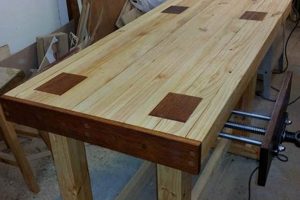
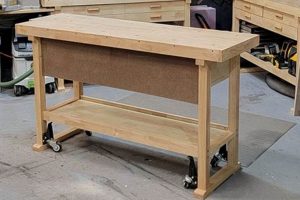
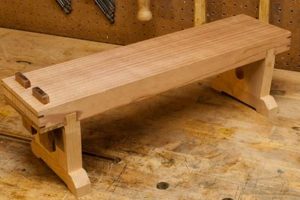
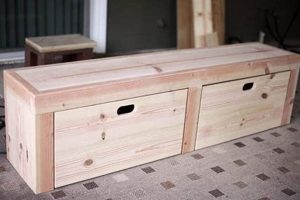
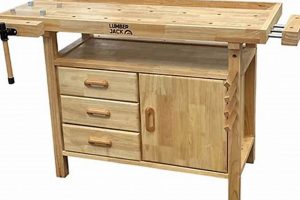
A detailed schematic for constructing a stable and functional work surface intended for woodworking tasks. These typically include dimensions, material specifications, assembly instructions, and may incorporate features such as vises, dog holes, and storage solutions. Examples range from simple, portable designs to elaborate, stationary structures.
The creation and utilization of a well-considered design are fundamental to efficient and safe woodworking practices. A robust and thoughtfully designed work platform enhances precision, reduces strain on the artisan, and contributes to the overall quality of the finished product. Historically, bespoke examples were passed down through generations, representing a tangible embodiment of accumulated skill and knowledge within a family or workshop.
Subsequent discussion will delve into the various types of work surfaces available, the key considerations in choosing the appropriate design for specific applications, and a step-by-step guide to understanding and implementing a construction blueprint.
Essential Considerations for Work Surface Blueprints
The following outlines critical guidelines for selecting and utilizing structural diagrams for woodworking projects. Adherence to these points will maximize efficiency and ensure a safe and productive working environment.
Tip 1: Material Selection is Paramount: The choice of lumber dictates the stability and longevity of the final product. Hardwoods such as maple or beech are preferred for worktops due to their density and resistance to wear. Softwoods can be utilized for legs and framing, provided adequate bracing is incorporated.
Tip 2: Prioritize Structural Integrity: Joints must be robust and precisely executed. Mortise and tenon joints, dovetails, and through bolts offer superior strength compared to simple screws or nails. Reinforce critical stress points with gussets or corner braces.
Tip 3: Accurately Interpret Dimensions: Thoroughly review the blueprint to ensure a complete understanding of all measurements. Verify that the scale is consistent and adjust accordingly. Incorrect dimensions can lead to significant errors during construction.
Tip 4: Optimize Work Surface Height: A comfortable working height reduces strain and improves ergonomics. The ideal height is typically determined by standing and measuring the distance from the floor to the palm of the hand when the arm is bent at a 90-degree angle.
Tip 5: Integrate Essential Features: Consider incorporating features such as vises, dog holes, and storage solutions to enhance functionality. The placement and type of these features should be carefully planned to accommodate specific woodworking tasks.
Tip 6: Ensure Adequate Lighting: Proper illumination is crucial for accurate work and preventing accidents. Integrate lighting fixtures into the design or ensure that the work area is well-lit by natural light sources.
Tip 7: Construct on a Level Surface: Building on an uneven surface will compromise the integrity and stability of the woodworking project. Use shims or adjustable feet to correct any irregularities in the foundation.
Careful consideration of these guidelines will result in the creation of a robust and functional work platform. These essential tips provide a foundation for transforming structural diagrams into a tangible and valuable asset for any woodworking endeavor.
The subsequent sections will explore the implementation of specific construction blueprints, providing detailed guidance on translating design into reality.
1. Dimensions

Dimensions are fundamental to the utility and functionality of a structure. They dictate the footprint within a workspace, influencing maneuverability and overall accessibility. Accurate dimensional interpretation is crucial when selecting or creating a specific type of construction schematic. For instance, a design intended for small-scale projects in a compact workshop will feature significantly different length, width, and height parameters compared to one destined for handling large timber in a spacious environment. Deviation from specified dimensions during construction can compromise structural integrity, leading to instability or rendering integrated features, such as vises, unusable. Therefore, understanding and adhering to the stated measurements represents a critical step in successful execution.
Furthermore, dimensions directly influence ergonomics. The work surface height must accommodate the user’s stature to minimize strain and maximize efficiency. A surface that is too low necessitates excessive bending, while one that is too high compromises leverage and control. Historical examples illustrate a range of heights optimized for specific tasks. The classic Roubo example often features a lower profile suitable for hand-tool work, whereas more contemporary designs might incorporate greater height to accommodate power tool operations. These varying dimensional considerations highlight the importance of tailoring the schematic to both the intended application and the individual user.
In summary, dimensions are not merely numerical specifications; they are integral to the overall success of a structure. Their accurate interpretation and execution directly impact functionality, ergonomics, and structural integrity. Failure to adequately address dimensional requirements can lead to significant challenges, ranging from workspace incompatibility to compromised structural stability. The relationship between dimensions and the broader construction context is therefore paramount.
2. Material Selection

Material selection is paramount in the construction of a woodworking support structure, directly influencing its stability, durability, and overall suitability for intended tasks. The choice of lumber significantly impacts the tool’s long-term performance and value.
- Hardwood vs. Softwood:
Hardwoods, such as maple, beech, and oak, are generally preferred for worktops due to their density and resistance to wear. These materials withstand repeated impact from tools and the compressive forces exerted during clamping operations. Softwoods, like pine or fir, can be utilized for legs and framing, offering a cost-effective alternative, but require careful design considerations to ensure adequate structural support. The combination of hardwood for the top and softwood for the base represents a common approach.
- Moisture Content and Stability:
The moisture content of the lumber is a critical factor in preventing warping and cracking. Kiln-dried lumber is essential for minimizing dimensional changes due to humidity fluctuations. Acclimation of the material to the workshop environment before construction further enhances stability. Wood movement must be accounted for in the design, particularly when joining different wood species or constructing large, solid surfaces. Ignoring these considerations can result in significant structural issues over time.
- Grain Orientation and Strength:
The grain orientation of the lumber significantly impacts its strength and resistance to splitting. Quarter-sawn lumber, with its vertical grain orientation, offers superior stability and wear resistance compared to flat-sawn lumber. Strategic placement of wood with different grain orientations can optimize the overall strength and stability of the structure. For example, using rift-sawn lumber for the legs of a structure provides increased resistance to racking forces.
- Material Cost and Availability:
Material cost and availability often influence the selection process. Exotic hardwoods offer exceptional durability and aesthetic appeal, but their high cost may be prohibitive for some. Locally sourced lumber can provide a sustainable and cost-effective alternative, provided it meets the required strength and stability specifications. The availability of specific lumber dimensions also influences design decisions, requiring careful consideration of joinery methods and overall structural design.
In summary, material selection for a woodworking support structure is a multifaceted process that requires careful consideration of factors such as wood species, moisture content, grain orientation, cost, and availability. The optimal choice balances performance, budget, and long-term durability, contributing directly to the effectiveness and longevity of the finished product.
3. Joint Strength

Joint strength is a critical determinant of a woodworking support structure’s overall stability, load-bearing capacity, and lifespan. The type and execution of joinery directly impact the structure’s ability to withstand the stresses encountered during woodworking activities.
- Mortise and Tenon Joints
Mortise and tenon joints, both traditional and modified variations, represent a robust method for connecting frame components. The tenon, projecting from one member, fits precisely into the mortise, a corresponding recess in the mating piece. This mechanical interlocking, coupled with adhesive bonding, provides significant resistance to tensile and racking forces. For a woodworking structure, this translates to enhanced stability and reduced susceptibility to wobble or collapse under load. The dimensions of the mortise and tenon must be appropriately sized to ensure optimal performance; oversized joinery weakens the surrounding material, while undersized joinery lacks sufficient strength. Examples include connecting legs to aprons, critical for stability.
- Dovetail Joints
Dovetail joints, characterized by their interlocking, fan-shaped pins and tails, offer exceptional resistance to tensile forces, particularly in applications where components are subjected to pulling or separating stresses. In a work support structure, dovetails can be employed to join the sides of drawers or to connect the top to the frame. The inherent mechanical advantage of the dovetail profile prevents the joint from pulling apart under load, making it ideal for applications where stability and durability are paramount. Variations, such as half-blind dovetails, can conceal the joint for aesthetic purposes while still providing substantial strength. Drawers holding heavy tools benefit greatly from this type of joinery.
- Lap Joints
Lap joints, formed by overlapping two members and securing them with fasteners or adhesives, provide a simple yet effective means of joining wood. While not as inherently strong as mortise and tenon or dovetail joints, lap joints offer a large surface area for bonding, distributing stress over a wider area. They are often employed in less critical structural applications, such as connecting framing members or attaching a skirt to the underside of the work surface. The strength of a lap joint depends heavily on the quality of the adhesive and the type and spacing of the fasteners. Half-lap joints, where each member is reduced in thickness by half, create a flush surface, improving aesthetics and functionality. Leg-to-frame connections can utilize reinforced lap joints.
- Fasteners and Adhesives
While not strictly a type of joint, the selection and application of fasteners and adhesives play a crucial role in joint strength. Screws, bolts, and nails provide mechanical reinforcement, while adhesives create a chemical bond between the wood fibers. The type of fastener should be carefully selected based on the application and the properties of the wood. For example, coarse-threaded screws are better suited for softwoods, while fine-threaded screws are more effective in hardwoods. Similarly, the choice of adhesive depends on the desired strength, water resistance, and working time. Epoxy resins offer superior strength and water resistance compared to polyvinyl acetate (PVA) glues, but require longer curing times and may be more difficult to work with. Properly applied fasteners and adhesives enhance the strength and durability of all types of woodworking joints. Countersinking screws and using appropriate pilot holes are essential for preventing splitting and ensuring a secure connection.
The selection and proper execution of joinery are paramount to the overall performance of the structure. By carefully considering the forces acting on each joint and choosing appropriate joinery methods, a woodworker can construct a stable, durable, and functional asset for years to come. Proper joint construction techniques are essential for optimal lifespan.
4. Vise Integration
A vice is an indispensable component of many woodworking setups. Its secure clamping action provides stability for workpieces during shaping, assembly, and finishing operations. Consequently, the manner in which a vice is integrated into a woodworking surface blueprint directly influences its overall utility and effectiveness. The location, orientation, and mounting method all contribute to the vice’s ability to accommodate various workholding requirements. For example, a face vice, typically mounted flush with the edge of a work surface, provides clamping action parallel to the surface, suitable for edge jointing or mortise and tenon work. A tail vice, integrated into the end of a construction diagram, utilizes dogs and bench stops to secure wider boards or assemblies. The presence or absence of a well-integrated vice can profoundly impact a woodworker’s ability to execute specific tasks with precision and efficiency.
The specific types of vices integrated vary depending on the woodworking focus. A patternmaker’s design might prioritize a quick-release face vice for rapid workpiece changes, while a timber framer’s might incorporate a leg vice for holding large timbers vertically. The mounting method is equally critical. A robust mounting system transfers clamping forces effectively to the structure, minimizing movement or vibration. Examples include through-bolting the vice to a reinforced section of the work surface or utilizing a dedicated mounting plate. The integration may also extend to incorporating features that complement the vice, such as dog holes aligned with the vice’s clamping axis, allowing for versatile workholding configurations.
Ultimately, proper vice integration is integral to a functional blueprint. Challenges often arise when retrofitting a vice to an existing structure lacking provisions for secure mounting or when selecting a vice incompatible with the planned work surface dimensions. A carefully considered integration enhances workflow, improves accuracy, and extends the capabilities of the entire woodworking setup. The absence of planning for vise integration can severely limit the user’s capacity.
5. Dog Hole Placement

Dog hole placement is a critical design consideration in woodworking blueprints. These precisely drilled apertures, typically arranged in a grid pattern across the work surface, serve as anchoring points for bench dogs, specialized pegs used in conjunction with vices or other clamping mechanisms to secure workpieces. The effectiveness of a plan is directly proportional to the strategic placement of these holes, influencing versatility and efficiency. Inadequate or poorly positioned holes limit the range of clamping options, hindering the execution of various woodworking tasks. Proper placement allows for secure edge-to-edge clamping, face clamping, and support for irregularly shaped objects, enhancing the user’s ability to perform precise cuts, joints, and assemblies. Historical workbenches often exhibit carefully considered arrangements, demonstrating an understanding of the importance of adapting the design to specific woodworking practices.
The distance between dog holes, their alignment relative to the vices, and their proximity to the edges of the work surface are all key factors. Closer spacing offers greater flexibility in positioning the dogs, while alignment with the vice jaws enables secure clamping of long boards or panels. Consideration must also be given to the diameter of the holes, ensuring compatibility with standard bench dog sizes. For example, a blueprint designed for hand tool work may prioritize a dense grid of dog holes closer to the work surface edge, facilitating the use of planing stops and other traditional techniques. Conversely, a design intended for power tool operations may feature a wider spacing, optimized for clamping larger workpieces and jigs. The material of the work surface also influences placement; softer materials require closer spacing to prevent tear-out around the holes.
In summary, dog hole placement is not a trivial detail but rather an integral element of a well-conceived plan. Proper implementation significantly expands workholding capabilities, allowing for greater precision and efficiency in woodworking operations. Challenges arise when retrofitting dog holes to existing surfaces lacking a pre-defined grid, highlighting the importance of incorporating these considerations into the initial design phase. Effective layout is fundamental for optimal utilization.
6. Surface Flatness

Surface flatness is a paramount characteristic of any functional woodworking support structure. Its impact reverberates throughout the woodworking process, influencing precision, accuracy, and the overall quality of finished projects. Deviation from true flatness introduces errors, complicates joinery, and compromises the stability of assembled components.
- Impact on Accuracy
An uneven surface introduces inaccuracies in measurements and layout. Marking lines, transferring dimensions, and establishing reference points become unreliable when the underlying plane is inconsistent. This directly affects the precision of cuts, the fit of joints, and the overall conformity to the intended design. For example, attempting to construct a square frame on a non-planar surface will inevitably result in skewed angles and misaligned corners. A true and level surface provides a reliable foundation for all subsequent operations.
- Facilitation of Joinery
Precise joinery relies on accurate mating surfaces. Attempting to assemble mortise and tenon joints, dovetails, or rabbets on a surface that is not flat introduces stress and misalignment. Gaps, uneven shoulders, and compromised glue lines result from forcing components together to compensate for surface irregularities. This reduces the strength of the joint and compromises its long-term integrity. Conversely, a flat surface allows for precise alignment and uniform pressure distribution during assembly, resulting in stronger and more aesthetically pleasing joints.
- Stability and Support
The stability of a woodworking structure and the support it provides for workpieces are directly related to its surface flatness. An uneven plane creates rocking, wobbling, and inconsistent contact points, making it difficult to securely clamp or support materials. This leads to increased vibration, reduced control, and a higher risk of errors or accidents. A truly flat surface provides a stable and unwavering platform, ensuring consistent contact and support for workpieces of all sizes and shapes.
- Methods of Achieving Flatness
Several techniques can be employed to achieve and maintain flatness. Initial construction should prioritize the use of stable, well-seasoned lumber and robust joinery methods. Subsequent steps involve planing, scraping, or sanding the surface to remove any irregularities. Regular maintenance, including periodic flattening and the application of protective finishes, is essential for preserving the integrity of the surface over time. Specialized tools, such as winding sticks and straightedges, are used to detect and correct deviations from true flatness.
In conclusion, surface flatness is not merely a cosmetic detail; it is a fundamental requirement for effective and precise woodworking. Its impact extends throughout the entire construction process, from initial layout to final assembly. A dedication to achieving and maintaining a truly flat surface is essential for realizing the full potential of any woodworking plan, ensuring accuracy, stability, and long-term performance. The value of the plan directly relates to surface flatness.
7. Storage Solutions

Incorporating integrated storage within a woodworking bench plan enhances functionality by providing immediate access to tools and materials. The strategic integration of storage solutions optimizes workspace efficiency and contributes to a safer working environment.
- Tool Drawer Configuration
Tool drawers, commonly incorporated beneath the work surface, offer secure and organized storage for hand tools, measuring devices, and frequently used accessories. Drawer dimensions and configurations vary depending on the types and quantities of tools to be accommodated. Shallow drawers with dividers are suitable for chisels and marking gauges, while deeper drawers can house saws and planes. The incorporation of full-extension slides provides unobstructed access to the contents of each drawer. Tool organization minimizes clutter and promotes efficient workflow.
- Open Shelving Accessibility
Open shelving provides readily accessible storage for larger tools, power tools, and project materials. Shelves positioned beneath the work surface or integrated into the structure’s legs offer convenient storage solutions without occupying valuable floor space. The shelf height and depth should be tailored to accommodate the dimensions of the stored items. Adjustable shelving allows for flexible storage configurations to adapt to changing needs. Open shelving facilitates quick retrieval of tools and materials, improving overall productivity.
- Vertical Tool Storage Systems
Vertical tool storage, such as pegboards or French cleats, maximizes space utilization by organizing tools along a vertical plane. Pegboards provide a versatile system for hanging hand tools, accessories, and frequently used items. French cleats offer a more robust and customizable solution for supporting heavier tools and equipment. Vertical tool storage minimizes clutter on the work surface and keeps tools within easy reach, promoting a safer and more efficient working environment. The specific vertical storage system should align with the users tool inventory and workspace constraints.
- Material Storage Considerations
Integrated material storage, such as lumber racks or plywood storage compartments, provides organized space for storing wood stock. Proper material storage protects wood from damage, prevents warping, and ensures easy access for project construction. Lumber racks can be integrated into the bench’s support structure or positioned adjacent to the bench. Plywood storage compartments can be incorporated beneath the work surface or as standalone units. Efficient material storage contributes to a more organized and productive woodworking environment. Proper lumber storage prevents defects.
The integration of these storage solutions within a woodworking bench plan directly impacts workflow efficiency and workspace organization. A well-designed storage system optimizes tool accessibility, minimizes clutter, and promotes a safer working environment. The specific storage configuration should be tailored to the user’s individual needs, tool inventory, and workspace constraints. These systems, when integrated properly, significantly enhance workshop function.
Frequently Asked Questions About Woodworking Bench Plans
The following addresses common inquiries regarding construction blueprints for woodworking stations. Understanding these principles is critical for success.
Question 1: What defines a suitable woodworking bench plan?
A suitable design delineates construction of a stable, functional work platform tailored to specific woodworking tasks. It includes precise dimensions, material specifications, assembly instructions, and may incorporate features such as vises and storage.
Question 2: Why is material selection a significant factor in such construction?
Material selection directly influences the durability, stability, and load-bearing capacity of the finished product. Hardwoods are generally preferred for worktops due to their resistance to wear and deformation.
Question 3: What role does joint strength play in the overall integrity of the structure?
Joint strength is crucial for resisting the forces encountered during woodworking operations. Robust joinery techniques, such as mortise and tenon or dovetail joints, are essential for ensuring structural stability and longevity.
Question 4: How does vise integration impact functionality?
Vise integration provides secure clamping of workpieces during various woodworking tasks. The type, placement, and mounting method of the vise directly influence its effectiveness and versatility.
Question 5: What is the purpose of dog holes, and how does their placement affect usability?
Dog holes serve as anchoring points for bench dogs, facilitating secure workholding in conjunction with vises or other clamping mechanisms. Strategic placement of these holes enhances the structure’s versatility and adaptability to different woodworking projects.
Question 6: Why is surface flatness essential?
Surface flatness ensures accuracy and stability during woodworking operations. A level surface provides a reliable reference plane for measurements, joinery, and assembly, contributing to the overall quality of the finished product.
Careful consideration of these factors results in the creation and effective utilization of a woodworking structure that meets the requirements of various projects.
The next section delves into considerations for adapting designs to meet individual needs and specific workspace requirements.
Woodworking Bench Plan
This exploration has underscored that a woodworking bench plan transcends a mere set of instructions; it represents a carefully considered framework for enabling precision, efficiency, and safety within the craft. The interplay between dimensions, material selection, joint strength, vise integration, dog hole placement, surface flatness, and integrated storage solutions dictates the ultimate utility and lifespan of the construction. Comprehensive understanding of these elements is paramount for successful implementation.
The selection and meticulous execution of a design represents a commitment to elevating the quality of woodworking endeavors. Its careful construction serves not only as a work surface but as an embodiment of dedication, transforming lumber into a functional tool that underpins craftsmanship and fosters precision for generations to come.