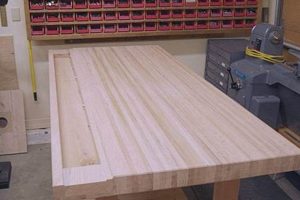
A prevalent feature on many work surfaces designed for carpentry and related crafts consists of precisely bored apertures. These openings, typically arranged in a grid-like pattern across the surface, serve as anchor points. They accommodate a range of accessories, such as bench dogs, holdfasts, and other clamping mechanisms. For instance, a woodworker might insert a bench dog into one of these to secure a workpiece against the edge of the bench during planing operations.
The incorporation of these fixtures provides significant advantages in terms of workflow efficiency and precision. They enable the user to firmly secure materials in a multitude of configurations, facilitating accurate cuts, joinery, and assembly. Historically, such features represent an evolution in workbench design, moving away from relying solely on vises and manual holding techniques to a more versatile and adaptable system. This advancement contributes to improved safety and reduces the potential for material slippage during critical phases of woodworking projects.
Subsequent sections will delve into the various types of accessories compatible with these fixtures, explore optimal placement strategies, and discuss the practical considerations for incorporating them into new or existing woodworking benches. The exploration will also cover relevant safety practices and maintenance procedures to ensure longevity and continued functionality of this important workbench component.
Practical Considerations for Aperture Integration on Carpentry Workstations
This section offers guidance on maximizing the utility of integrated apertures within woodworking bench designs. The following tips address key aspects of implementation and usage.
Tip 1: Material Selection: Prioritize the use of hardwoods, such as maple or beech, for the workbench top. These materials offer the necessary density and stability to maintain aperture integrity over prolonged use and resist deformation under clamping pressure.
Tip 2: Aperture Spacing: Implement a consistent grid pattern, typically spaced 3 to 4 inches apart. This spacing provides versatility in workpiece positioning and accommodates a wide range of clamping scenarios.
Tip 3: Aperture Diameter: Standardize the aperture diameter to a common size, such as 3/4 inch. This allows for compatibility with readily available bench dogs, holdfasts, and other clamping accessories.
Tip 4: Counterbore Incorporation: Consider including a shallow counterbore around each aperture’s opening. This detail facilitates flush seating of bench dog shoulders and prevents damage to the surrounding surface.
Tip 5: Edge Alignment: Maintain precise alignment between the aperture grid and the workbench edges. This alignment simplifies workpiece referencing and ensures consistent clamping pressure distribution.
Tip 6: Reinforcement Strategies: For thinner workbench tops, reinforce the area around the apertures with additional material or bracing. This measure prevents sagging or deformation under heavy clamping loads.
Tip 7: Periodic Maintenance: Regularly inspect the apertures for debris accumulation and remove any obstructions. Lubricate bench dogs and holdfasts to ensure smooth operation and prevent binding.
Adhering to these recommendations promotes efficient workflow, enhances precision, and prolongs the lifespan of both the workbench and its associated clamping accessories.
The subsequent section will address safety considerations and best practices related to the utilization of these features within the woodworking environment.
1. Diameter Standardization

Diameter standardization in carpentry workstations is a critical element influencing the efficacy of integrated apertures. A unified aperture diameter ensures the interchangeability of work-holding accessories, maximizing the workbench’s adaptability across a spectrum of woodworking tasks.
- Universal Accessory Compatibility
A consistent aperture diameter, typically 3/4 inch, allows the seamless integration of various bench dogs, holdfasts, and specialized clamping devices. This uniformity eliminates the need for custom-fitted accessories and streamlines workflow efficiency. For example, a woodworker can transition between using a simple bench dog for securing a board for planing and a more complex holdfast for intricate joinery without modifying the workbench itself.
- Enhanced Workflow Efficiency
Standardized aperture sizes reduce the time spent searching for compatible accessories. The woodworker can predictably reach for any appropriately sized clamp or dog and know that it will fit securely. This predictable system reduces frustration and accelerates the pace of project completion. A woodworker facing a deadline can appreciate the simplicity of using readily available accessories instead of wasting valuable time trying to customize the clamps.
- Cost-Effectiveness
Adhering to a common aperture diameter reduces the overall cost of accessory acquisition. Mass-produced, standardized accessories are generally more affordable than custom-made or proprietary options. Furthermore, the ability to use existing tools and hardware across different workbench configurations represents a significant long-term cost saving. A woodworker who upgrades or replaces their workbench will appreciate that all existing clamps will still work.
- Promotes Systematization
Standardized aperture sizes facilitate a systematic approach to workshop organization. Accessory storage and retrieval become more predictable, further enhancing workflow efficiency. A well-organized shop improves safety and allows the woodworker to quickly locate the necessary tools and hardware, promoting a cleaner and more efficient workplace.
The adoption of diameter standardization is a fundamental principle in workbench design, profoundly influencing user experience and overall operational effectiveness. These integrated apertures become a versatile and reliable component of the woodworking process, ultimately boosting efficiency and project quality.
2. Grid Pattern Consistency

The arrangement of apertures on a carpentry workstation, specifically the adherence to a consistent grid pattern, is not merely an aesthetic choice but a functional necessity. This regularity enables predictable workpiece clamping, enhancing precision and efficiency in various woodworking operations.
- Predictable Clamping Locations
A uniform grid pattern allows a woodworker to anticipate available clamping positions across the bench surface. This predictability eliminates the need for repeated measurements and adjustments when securing stock. Consider a scenario where a large panel requires edge jointing; a consistent grid ensures evenly distributed clamping pressure, minimizing warping or misalignment during the gluing process.
- Optimized Accessory Placement
Consistency in aperture spacing facilitates the optimal arrangement of bench dogs, holdfasts, and other clamping accessories. A regular grid allows for flexible positioning, accommodating diverse workpiece shapes and sizes. For example, when mortising a long stile, a user can easily position bench dogs to support the piece along its entire length, ensuring stability and preventing movement during the cutting operation.
- Enhanced Jig and Fixture Integration
A consistent grid serves as a reference system for the attachment of jigs and fixtures. The regular spacing allows for repeatable and precise alignment of auxiliary tools, streamlining complex tasks. As an illustration, a dovetail jig can be securely fastened to the bench surface using the existing aperture grid, ensuring accurate and repeatable joinery across multiple workpieces.
- Improved Workflow Efficiency
The combined effect of predictable clamping, optimized accessory placement, and enhanced jig integration contributes significantly to workflow efficiency. A consistent grid minimizes time spent on setup and adjustment, allowing the woodworker to focus on the core tasks of cutting, shaping, and assembling materials. A cabinetmaker can prepare several door frames rapidly and precisely using this system.
In essence, grid pattern consistency within the context of integrated apertures directly influences the user’s ability to secure, manipulate, and process materials with accuracy and speed. This attribute transforms the workstation into a versatile and predictable platform for a wide array of woodworking endeavors.
3. Material Compatibility

Material compatibility is a crucial consideration in the design and construction of workbenches incorporating integrated apertures. The success of this design element hinges on selecting materials for both the bench top and the accessories used within the apertures that exhibit complementary physical properties. Failure to adequately address material compatibility can lead to diminished functionality, accelerated wear, and potential structural failure. For example, using a soft wood, such as pine, for a workbench top subjected to frequent use with steel bench dogs will result in rapid deformation of the aperture edges. This compromises the dog’s holding power and necessitates premature replacement of the bench top.
The primary concerns regarding material compatibility revolve around hardness, dimensional stability, and resistance to compression. The workbench top material must be sufficiently hard to withstand the concentrated forces exerted by clamping accessories. Simultaneously, it must exhibit minimal expansion or contraction with changes in humidity or temperature to maintain aperture dimensions and prevent accessories from becoming loose or binding. Furthermore, resistance to compression is paramount, particularly in the immediate vicinity of the apertures, to prevent crushing or deformation under sustained pressure. Hardwoods like maple or beech are often preferred because they balance these competing demands. In contrast, accessories made of materials significantly harder than the bench top can cause localized wear and tear, while those prone to rust can contaminate the wood surrounding the apertures.
In summary, material compatibility is not merely a passive attribute, but an active factor influencing the longevity and effectiveness of a woodworking bench featuring integrated apertures. Careful selection of materials, informed by an understanding of their physical properties and intended usage, is essential for maximizing the bench’s performance and minimizing the risk of premature failure. Addressing this concern contributes directly to the overall utility and long-term value of the workstation.
4. Clamping Versatility
The presence of precisely placed apertures within a carpentry workstation significantly expands clamping options, thereby enhancing overall versatility. These features transition a traditional workbench from a static platform into a dynamic work-holding system, capable of accommodating diverse project requirements.
- Multi-Directional Workpiece Securing
Apertures permit securing workpieces from multiple angles and orientations. This capability is critical when tackling complex joinery or irregular shapes. For example, a craftsman can use a combination of bench dogs and holdfasts positioned within the array of apertures to stabilize a curved component during carving operations, a task that would be challenging with a traditional vise alone.
- Adaptable Jig and Fixture Integration
The consistent spacing of apertures facilitates the integration of custom-built jigs and fixtures. This adaptation enables repeatable and precise execution of specialized tasks. A mortising jig, for instance, can be securely bolted to the workbench surface utilizing the existing aperture grid, ensuring accuracy and consistency across multiple workpieces. This removes the need for ad-hoc clamping solutions.
- Variable Clamping Pressure Distribution
The strategic arrangement of clamping accessories within the aperture grid allows for controlled distribution of clamping pressure across the workpiece. This is particularly important when working with delicate materials or intricate assemblies. Consider assembling a frame; even pressure distribution is essential to avoid distortion. The apertures allow precise positioning of clamps to achieve this.
- Enhanced Workpiece Accessibility
By elevating workpieces using bench dogs inserted into the apertures, the user gains improved access to all surfaces. This is beneficial during finishing operations, such as sanding or applying coatings. The elevated workpiece allows unimpeded access to edges and corners, resulting in a more uniform and professional finish.
Clamping versatility, enabled by the strategic use of apertures, transforms the woodworking bench into a more adaptable and efficient tool. This adaptability extends beyond simple holding tasks, facilitating complex operations and contributing to overall project quality. The controlled and customizable work-holding afforded by these apertures is a cornerstone of precision woodworking.
5. Workpiece Security

The inclusion of precisely bored apertures in carpentry workstations directly addresses the critical requirement of workpiece security. These are not merely decorative features; they represent a deliberate engineering choice to enhance the stability and immobility of materials during processing. The apertures function as anchor points for a variety of clamping mechanisms, bench dogs, and holdfasts, thereby creating a system designed to counteract the forces generated by sawing, planing, chiseling, and other common woodworking operations. Absent this level of security, even minor slippage can lead to inaccuracies, material damage, or, more seriously, injury to the user. This arrangement significantly minimizes the risk of such events.
The effectiveness of this system is exemplified in numerous woodworking scenarios. During the hand-planing of a large panel, bench dogs inserted into the apertures, coupled with a tail vise, provide secure and consistent pressure, preventing the panel from shifting under the force of the plane. Similarly, when executing intricate dovetail joinery, holdfasts inserted into the apertures firmly secure the components, enabling precise cuts without fear of movement. Moreover, the consistent spacing of the apertures allows for the creation of custom jigs and fixtures that further enhance workpiece security for specialized tasks, such as routing or mortising, leading to more consistent outcomes. Work piece security when hand routing is also important.
In summary, the connection between workpiece security and the integration of apertures in woodworking benches is both direct and consequential. The consistent and reliable holding power afforded by this design element is not merely a convenience; it is a fundamental requirement for safe, accurate, and efficient woodworking. Ignoring the principles of workpiece security undermines the very purpose of a well-equipped workstation. Therefore, understanding the function and proper utilization of these features is essential for any serious woodworker.
Frequently Asked Questions About Apertures in Carpentry Workstations
This section addresses prevalent inquiries regarding the function and implementation of integrated apertures, commonly referred to as “holes in woodworking bench,” found in many carpentry workstations. These FAQs provide clarity and dispel common misconceptions.
Question 1: What is the primary function of apertures in a woodworking bench?
The primary function is to provide secure anchor points for work-holding accessories, such as bench dogs, holdfasts, and clamping mechanisms. These features enable the stable and precise manipulation of materials during various woodworking operations.
Question 2: What is the standardized diameter for these features?
The commonly accepted standardized diameter is 3/4 inch. This standardization ensures compatibility with a wide range of commercially available work-holding accessories.
Question 3: Why are these features typically arranged in a grid pattern?
A grid pattern provides consistent spacing and predictable placement options for work-holding accessories. This arrangement enhances flexibility in workpiece positioning and facilitates the creation of custom jigs and fixtures.
Question 4: What materials are best suited for a workbench top incorporating these features?
Dense hardwoods, such as maple or beech, are preferred due to their ability to withstand the compressive forces exerted by clamping mechanisms. These materials also exhibit dimensional stability, minimizing deformation over time.
Question 5: Are there any safety considerations when using workbenches with these features?
Yes. Users should ensure that all work-holding accessories are securely engaged and properly sized for the apertures. Overloading or improper use can lead to material slippage or damage to the workbench.
Question 6: Can these features be added to an existing workbench?
Yes, it is possible to retrofit an existing workbench with these features. However, careful planning and execution are essential to ensure proper alignment and structural integrity. Reinforcement may be required for thinner bench tops.
In summary, a comprehensive understanding of the function, dimensions, and materials associated with integrated apertures is essential for maximizing the utility and safety of a carpentry workstation.
The subsequent section will discuss the role of accessory selection and maintenance procedures related to these features.
Apertures in Woodworking Benches
The preceding discussion has illuminated the critical role of apertures, functionally known as “holes in woodworking bench,” within the context of carpentry workstations. These features, characterized by standardized dimensions, consistent grid patterns, and material compatibility considerations, provide a foundation for secure workpiece management and enhance the precision of woodworking operations. The versatility afforded by these anchor points is undeniable, allowing for adaptable clamping strategies and the seamless integration of auxiliary jigs and fixtures.
As such, the deliberate implementation and conscientious maintenance of “holes in woodworking bench” represent a commitment to both efficiency and safety within the craft. Woodworkers are encouraged to carefully consider these design elements when constructing or modifying their workbenches. Doing so will contribute to a more productive and secure working environment, ultimately fostering higher quality craftsmanship and reducing the potential for accidents.