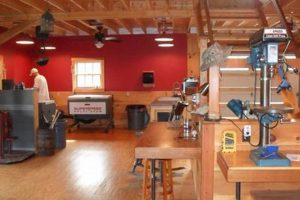
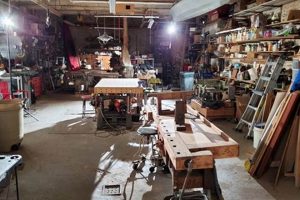
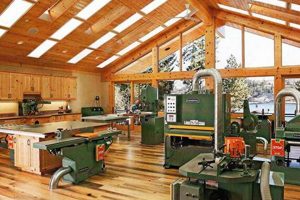
Optimal illumination in a woodworking environment refers to lighting systems that enhance visibility, reduce shadows, and accurately render colors, crucial for precision work. An example is the strategic placement of both ambient and task-specific light sources to ensure the entire workspace is adequately lit and specific areas requiring detailed attention receive focused illumination.
Adequate illumination is vital in woodworking due to its direct impact on safety, accuracy, and overall efficiency. Historically, reliance on natural light was prevalent; however, modern electric lighting provides a consistent and controllable alternative, minimizing errors and reducing eye strain. This translates to improved project quality, decreased material waste, and a safer working environment.
Therefore, detailed consideration must be given to the selection and implementation of appropriate lighting solutions, encompassing factors such as light source type, color temperature, and fixture placement. The following sections will explore these critical elements to ensure a well-lit and productive woodworking space.
Illumination Enhancement Strategies
The following guidelines address key considerations for optimizing visibility in woodworking environments, contributing to enhanced precision and safety.
Tip 1: Prioritize Ambient Luminosity: Ensure consistent overall illumination across the entire workspace. This base level of light minimizes shadows and provides a foundation for more focused task lighting.
Tip 2: Implement Task-Specific Lighting: Supplement ambient lighting with focused light sources directed at work surfaces. Articulating lamps or strip lights mounted under cabinets provide direct, adjustable illumination.
Tip 3: Select Appropriate Light Source Technology: LED lighting offers advantages in energy efficiency, lifespan, and heat output compared to traditional fluorescent or incandescent options, making it a preferred choice.
Tip 4: Consider Color Rendering Index (CRI): Opt for light sources with a high CRI (80 or above) to ensure accurate color representation of wood finishes and materials. This is crucial for staining and painting tasks.
Tip 5: Manage Glare and Reflections: Minimize glare by utilizing light diffusers or positioning light sources to avoid direct reflection off shiny surfaces. This reduces eye strain and improves visibility.
Tip 6: Employ Layered Lighting Techniques: Combine ambient, task, and accent lighting to create a balanced and versatile illumination scheme. This allows for adjustments based on specific tasks and time of day.
Tip 7: Regularly Maintain Lighting Fixtures: Clean light fixtures and replace bulbs promptly to maintain optimal light output. Dust accumulation can significantly reduce illumination levels.
By implementing these strategies, woodworkers can create a well-lit and comfortable workspace that promotes safety, accuracy, and productivity. Adequate illumination is an investment in both the quality of the work and the well-being of the craftsman.
The subsequent section will address the long-term benefits and advantages of establishing a comprehensive lighting plan.
1. Lumens and brightness

Lumens, the measure of total visible light emitted by a source, directly impact illumination quality within a woodworking shop. Insufficient lumens result in inadequate brightness, hindering visibility and increasing the risk of errors and accidents. Conversely, excessive brightness can cause glare, leading to eye strain and reduced productivity. Therefore, a calibrated approach to lumen output is essential for establishing an optimized working environment. For example, a small shop primarily engaged in fine detail work may require a higher lumen density per square foot compared to a larger shop focused on rough milling operations. Specific numerical values for acceptable ranges depend on the nature of the tasks performed and the dimensions of the workspace, but a focus on adequate lumens is a necessary foundation.
The correlation between lumens and brightness manifests in several practical woodworking scenarios. During tasks such as joinery, where precision is paramount, an ample lumen output ensures clear visibility of markings and cuts. Similarly, when applying finishes, sufficient brightness allows for accurate color matching and identification of imperfections. Poor lighting, stemming from insufficient lumens, can lead to misaligned joints, uneven finishes, and ultimately, compromised project quality. Furthermore, brightness also plays a vital role in ensuring a safe working environment. Proper illumination can help workers to see the obstacles and hazards.
In conclusion, the appropriate selection of light sources, based on their lumen output, is a critical factor in achieving optimal illumination within a woodworking shop. Brightness, as determined by lumens, directly influences both the quality of work and the safety of the workspace. A deliberate and informed approach to lumen selection, coupled with strategic fixture placement, is crucial for maximizing the benefits of effective illumination. Without adequate lumens, achieving “best lighting for woodworking shop” is impossible.
2. Color Rendering Index (CRI)

Color Rendering Index (CRI) is a critical metric in assessing illumination quality, especially when considering the attributes of optimal lighting in a woodworking environment. A light source’s CRI value, ranging from 0 to 100, quantifies its ability to accurately reproduce the colors of objects compared to natural sunlight (CRI of 100). In woodworking, where material selection, finishing, and matching are paramount, CRI plays a vital role in ensuring the fidelity of color perception.
- Accurate Material Assessment
A high CRI enables woodworkers to accurately assess the natural color and grain patterns of different wood species. Low-CRI light sources can distort colors, making it difficult to distinguish between subtle variations in wood tone. This can lead to misjudgments in material selection, potentially impacting the aesthetic outcome of a project. For example, a woodworker selecting cherry lumber under a low-CRI light might not accurately perceive its undertones, leading to a mismatched finish or an unexpected color shift after finishing.
- Precise Finish Matching
Achieving a seamless finish requires precise color matching between stains, dyes, and the wood itself. A high CRI light source ensures that the woodworker sees the true color of the finish being applied. Low CRI can mislead the eye, causing the woodworker to select an incorrect finish that does not complement the wood, resulting in an uneven or unattractive appearance. Properly discerning the color of a finish ensures accuracy and consistency.
- Identification of Defects and Imperfections
High CRI illumination enhances the visibility of defects, such as knots, blemishes, and grain irregularities. Low CRI can mask these imperfections, causing them to be overlooked during the preparation phase. This can result in structural weaknesses or aesthetic flaws in the final product. Highlighting these defects enhances safety and quality.
- Enhanced Safety Considerations
A high CRI can even contribute to safety within the shop. When working with power tools, a light source that accurately renders colors can help distinguish between different materials, such as wood and metal, reducing the risk of accidents. This enhances safety, especially when visibility is paramount.
In summary, CRI is indispensable for optimal lighting in woodworking environments. The capability to accurately perceive colors directly impacts material selection, finishing precision, defect identification, and safety. Selecting light sources with a high CRI is therefore an essential element in creating a workspace that facilitates accurate, efficient, and safe woodworking practices.
3. Fixture Placement Strategy

The strategic arrangement of lighting fixtures is integral to achieving optimal illumination within a woodworking shop. Illumination effectiveness depends not only on the type and intensity of light source, but also on its location relative to work surfaces and the user’s position. Incorrect fixture placement leads to shadows, glare, and uneven light distribution, undermining the benefits of even the highest-quality lighting technology. Proper strategy considers the specific tasks performed in different areas of the shop, the dimensions of the space, and the presence of stationary equipment. For instance, positioning lights to the side of a lathe prevents shadows from obscuring the workpiece, while angled placement over a workbench minimizes reflections that can hinder detailed tasks such as carving or joinery.
Effective fixture placement incorporates several key considerations. Firstly, assessing natural light sources and strategically supplementing them is critical. Secondly, employing a layered approach, combining ambient, task, and accent lighting, allows for flexible adaptation to different project needs. Ambient lighting provides overall illumination, task lighting focuses on specific work areas, and accent lighting highlights details or adds visual interest. Furthermore, fixture selection should consider adjustability. Articulating arms and dimmable lights allow for customized control over light direction and intensity, ensuring optimal visibility regardless of the task. Consider a scenario where a ceiling-mounted fixture casts a shadow directly where a woodworker is making a precision cut; relocating or repositioning the fixture eliminates the obstruction and improves accuracy and safety.
In summary, a deliberate and well-executed fixture placement strategy is essential for creating a functional and productive woodworking shop. It mitigates shadows and glare, promotes even light distribution, and enables adaptability to various tasks. Neglecting fixture placement negates the advantages of high-quality lighting components. When combined with appropriate light sources and thoughtful design, a strategic approach to fixture arrangement significantly contributes to safety, accuracy, and overall workflow efficiency. Properly addressing “Fixture Placement Strategy” is crucial to establishing “best lighting for woodworking shop”.
4. Ambient and Task Lighting
The synthesis of ambient and task lighting represents a foundational element in establishing optimal illumination within a woodworking shop. Ambient lighting provides a consistent, overall level of illumination, reducing contrast and minimizing harsh shadows across the entire workspace. Task lighting, conversely, delivers focused, high-intensity illumination directly onto specific work surfaces or project areas. A deficiency in either component compromises overall visibility, impacting both precision and safety. For example, relying solely on ambient lighting often results in inadequate illumination for intricate tasks such as carving or joinery, increasing the risk of errors and potential injuries. Conversely, exclusive reliance on task lighting creates stark contrasts and shadows, contributing to eye strain and limiting overall situational awareness within the shop.
The synergistic effect of ambient and task lighting is demonstrated through several practical applications. Consider a scenario involving the use of a power saw. Ambient lighting provides a general level of visibility, allowing the operator to safely navigate the shop and position the workpiece. Task lighting, strategically positioned above the saw, delivers focused illumination onto the cutting area, enabling precise alignment and minimizing the risk of kickback or other accidents. Similarly, when applying finishes, ambient lighting ensures a consistent base level of illumination, while task lighting allows for close inspection of the finish, facilitating accurate color matching and identification of imperfections. Without both components, either the overall safety or the precision of the finishing process would be compromised. For example, in a shop setup, if the ambient light is too dim, task lighting can cause greater contrast and glare. Ambient lighting helps soften task lighting and helps with smooth visual transition.
In conclusion, the effective integration of ambient and task lighting is not merely a matter of preference, but a critical determinant of the quality and safety of a woodworking environment. Ambient lighting provides the necessary foundation for overall visibility, while task lighting delivers focused illumination for specific tasks. Recognizing the complementary relationship between these two components and implementing them strategically is essential for achieving “best lighting for woodworking shop.” Addressing both aspects reduces the potential for errors, enhances worker safety, and contributes to the overall efficiency and productivity of the woodworking operation. The balancing of these elements establishes a comfortable and productive work environment.
5. Energy Efficiency
The integration of energy efficiency into illumination design is a critical component of establishing “best lighting for woodworking shop.” Energy consumption directly correlates with operational costs and environmental impact, making the selection of efficient lighting technologies and strategies a financially and ecologically prudent decision. Inefficient lighting systems generate excessive heat, increasing cooling demands, and contribute to higher electricity bills. Conversely, energy-efficient solutions, such as LED lighting, reduce energy consumption, lower operating expenses, and minimize the carbon footprint of the woodworking shop. The cause-and-effect relationship is clear: inefficient lighting leads to increased costs and environmental strain, while efficient lighting mitigates these negative consequences. The importance of energy efficiency stems from its ability to provide adequate illumination while minimizing resource consumption. For instance, replacing traditional incandescent bulbs with LEDs in a workshop can reduce energy consumption by up to 75% without compromising brightness or color rendering.
Practical applications of energy-efficient lighting extend beyond simple bulb replacement. Implementing lighting controls, such as occupancy sensors and dimmers, allows for further energy savings by automatically adjusting light levels based on occupancy and ambient light conditions. Daylight harvesting, the practice of utilizing natural light to reduce reliance on artificial lighting, can also significantly decrease energy consumption, particularly in shops with windows or skylights. Consider a woodworking shop implementing a combination of LED lighting, occupancy sensors, and daylight harvesting: the result is a substantial reduction in energy costs and a smaller environmental impact compared to a shop relying solely on traditional, inefficient lighting systems. These strategies contribute to a more sustainable and cost-effective operation.
In conclusion, energy efficiency is an indispensable consideration in the pursuit of “best lighting for woodworking shop.” The selection of energy-efficient lighting technologies, coupled with the implementation of smart lighting controls and daylight harvesting strategies, yields significant financial and environmental benefits. The challenge lies in balancing initial investment costs with long-term savings and environmental responsibility. By prioritizing energy efficiency, woodworking shops can reduce their operational expenses, minimize their environmental impact, and contribute to a more sustainable future while simultaneously enjoying the benefits of optimal illumination. Addressing this factor is critical to a shop’s operational sustainability.
Frequently Asked Questions
The following addresses common inquiries regarding the selection and implementation of suitable lighting solutions for woodworking shops, promoting safety, precision, and efficiency.
Question 1: What constitutes an adequate lumen output for general illumination in a woodworking shop?
The appropriate lumen output varies based on shop size and task complexity; however, a general guideline suggests a minimum of 500 lumens per square foot for general ambient lighting. Task-specific areas may require significantly higher levels.
Question 2: Why is Color Rendering Index (CRI) a significant factor in woodworking lighting?
CRI indicates a light source’s accuracy in revealing true colors. A high CRI (80 or above) is essential for accurate material assessment, finish matching, and defect detection, which are crucial for quality woodworking.
Question 3: How does fixture placement impact the effectiveness of shop lighting?
Strategic placement minimizes shadows and glare, ensures even light distribution, and adapts to various tasks. Fixtures should be positioned to complement natural light and provide adjustable, focused illumination where needed.
Question 4: What is the recommended balance between ambient and task lighting in a woodworking environment?
Ambient lighting should provide a consistent base level of illumination, while task lighting should focus on specific work areas. The ratio depends on individual needs, but a combination of both is critical for optimal visibility and safety.
Question 5: How can energy efficiency be incorporated into shop lighting design?
Energy-efficient solutions, such as LED lighting, reduce energy consumption and lower operating costs. Implementing lighting controls, such as occupancy sensors and dimmers, further enhances energy savings.
Question 6: What are the potential long-term benefits of investing in high-quality woodworking lighting?
Investing in quality lighting improves safety, reduces errors, enhances productivity, and lowers energy costs. It represents a long-term investment in the overall efficiency and profitability of the woodworking operation.
Proper illumination is paramount for a safe and productive woodworking environment. By addressing these considerations, woodworkers can create a workspace that facilitates precision and efficiency, reduces material waste, and minimizes the risk of accidents.
The next section will explore specific case studies illustrating the practical application of optimal lighting principles in diverse woodworking settings.
Conclusion
The preceding analysis underscores the critical role of illumination in woodworking environments. Considerations ranging from lumen output and Color Rendering Index to fixture placement, ambient/task lighting balance, and energy efficiency collectively determine the quality of the working space. Inadequate or poorly implemented lighting compromises safety, accuracy, and overall productivity. Conversely, a well-designed lighting system facilitates precision, reduces errors, and enhances the comfort and efficiency of woodworking tasks.
Therefore, prioritizing the implementation of “best lighting for woodworking shop” practices constitutes a fundamental investment in the success and sustainability of any woodworking operation. Informed decision-making regarding lighting systems promotes a safer, more productive, and ultimately, more profitable workspace. Continuous evaluation and adaptation of lighting strategies are essential to maintaining optimal conditions as needs evolve and new technologies emerge.