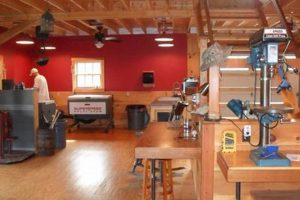
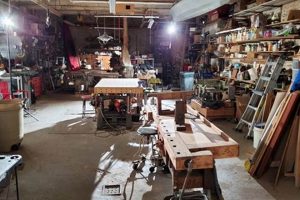
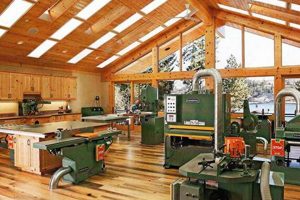
A dedicated space within a residential garage, equipped for the craft of shaping wood, allows for diverse projects ranging from furniture construction to smaller decorative items. Such an arrangement typically includes essential tools like saws, planers, and sanders, alongside workbenches and storage solutions for materials and completed items. The scale and complexity of these spaces can vary widely based on available area and the user’s specific interests. For example, an individual might utilize a compact corner of the garage for basic carving, while another could dedicate the entire space to building intricate cabinetry.
The advantages of creating this specialized workspace are numerous. It provides a designated location for potentially messy and noisy activities, separating them from the main living areas of the home. This separation helps to contain sawdust, noise pollution, and the general clutter associated with such activities. Furthermore, it allows for the uninterrupted pursuit of woodworking hobbies and professional endeavors, fostering creativity and skill development. Historically, these spaces have evolved from simple sheds to sophisticated workshops equipped with power tools and advanced dust collection systems, reflecting advancements in technology and the increasing accessibility of woodworking resources.
The subsequent sections will delve into key aspects of establishing and optimizing a personal woodworking area. Topics will include spatial planning, tool selection and maintenance, safety considerations, dust control strategies, and efficient storage solutions. The goal is to provide practical guidance for creating a functional and enjoyable environment conducive to woodworking pursuits.
Woodworking Garage Shop
Optimizing a woodworking garage shop necessitates careful planning and consistent maintenance. The following tips outline key considerations for establishing and managing a functional and safe workspace.
Tip 1: Prioritize Spatial Planning: Before acquiring equipment, thoroughly assess the available area. Develop a detailed layout that accounts for tool placement, material storage, and adequate workspace. Consider traffic flow to ensure ease of movement and minimize potential hazards.
Tip 2: Implement a Comprehensive Dust Collection System: Sawdust poses significant health risks and can compromise tool performance. Invest in a robust dust collection system, including a central collector and individual attachments for each tool. Regular cleaning of filters and hoses is crucial for maintaining efficiency.
Tip 3: Invest in Quality Lighting: Adequate illumination is essential for precision and safety. Supplement overhead lighting with task lighting directed at the workbench and individual tools. Opt for bright, energy-efficient LED fixtures to minimize shadows and enhance visibility.
Tip 4: Establish Dedicated Storage Solutions: Clutter is a major impediment to productivity and safety. Implement a well-organized storage system for lumber, tools, and hardware. Utilize shelves, drawers, and wall-mounted organizers to maximize vertical space and keep essential items readily accessible.
Tip 5: Enforce Strict Safety Protocols: Safety should be paramount in any woodworking environment. Mandate the use of appropriate personal protective equipment (PPE), including safety glasses, hearing protection, and dust masks. Regularly inspect tools for damage and ensure all safety guards are in place and functioning correctly.
Tip 6: Maintain Sharp Cutting Edges: Dull tools are not only less efficient but also more dangerous. Develop a consistent sharpening regimen for all cutting tools, including blades, chisels, and drill bits. A sharp tool requires less force and reduces the risk of kickback and other accidents.
Tip 7: Implement Effective Noise Reduction Measures: Woodworking equipment can generate significant noise levels. Consider implementing noise reduction measures, such as soundproofing materials and vibration dampeners, to minimize disturbance to neighbors and protect hearing health.
Adherence to these tips will contribute to a more efficient, safer, and more enjoyable woodworking experience within the garage environment.
The following sections will explore more advanced woodworking techniques and projects that can be undertaken within a well-equipped garage shop.
1. Spatial Organization

Spatial organization is a critical determinant of the functionality and safety within a woodworking garage shop. The arrangement of tools, equipment, and material storage directly impacts workflow efficiency, safety, and overall productivity. Inadequate spatial planning can lead to restricted movement, increased risk of accidents, and reduced usability of the workspace. The cause-and-effect relationship is evident: poor spatial organization results in diminished productivity and increased risk; conversely, well-planned spatial organization enhances efficiency and reduces hazards. For example, a poorly placed table saw obstructs movement and material handling, while a strategically positioned workbench, with adequate clearance, facilitates smooth operations.
The importance of spatial organization extends beyond mere aesthetics. Effective organization facilitates efficient material flow, minimizing unnecessary steps and reducing the likelihood of accidents. Consider a shop where lumber storage is located far from the cutting station; this requires repetitive carrying of heavy materials, increasing physical strain and the potential for injury. Conversely, locating lumber storage near the saw station streamlines the process. Another example involves tool placement. Frequently used tools should be readily accessible, while less frequently used items can be stored further away, optimizing workflow and minimizing clutter.
In summary, spatial organization within a woodworking garage shop is not simply a matter of aesthetics; it’s a core component of operational efficiency and safety. The ability to effectively plan and arrange tools, equipment, and materials has a direct and measurable impact on productivity, user well-being, and the overall success of woodworking projects. Addressing the challenges of limited space requires careful consideration of workflow, storage solutions, and ergonomic principles, ultimately contributing to a more functional and enjoyable working environment.
2. Tool Inventory

The selection and management of tools constitute a critical aspect of establishing and maintaining a productive woodworking garage shop. The tool inventory directly influences the range of projects that can be undertaken, the quality of the finished product, and the overall efficiency of the work process. A properly curated tool collection, tailored to the user’s skill level and project goals, is essential for realizing the full potential of the woodworking space.
- Essential Hand Tools
Hand tools, while often overlooked in favor of power tools, form the foundation of any competent woodworking shop. This category includes items such as saws (rip, crosscut, and dovetail), chisels (various sizes and types), planes (smoothing, block, and jack), measuring tools (rules, squares, marking gauges), and sharpening equipment. Their role is fundamental for precision work, joinery, and fine detailing, often surpassing the capabilities of power tools in certain applications. An incomplete set of essential hand tools limits the ability to execute intricate designs and achieve superior surface finishes.
- Core Power Tools
Power tools significantly enhance the speed and efficiency of many woodworking tasks. The core power tool inventory typically includes a table saw (for ripping and crosscutting large stock), a miter saw (for precise angle cuts), a jointer and planer (for preparing lumber surfaces), a router (for shaping edges and creating joinery), a drill press (for accurate drilling), and a sander (for surface preparation). Each of these tools performs a specific function that would be significantly more time-consuming and physically demanding to execute by hand. An inadequate power tool collection restricts the scale and complexity of projects that can be realistically undertaken.
- Specialized Equipment
Depending on the specific woodworking interests and project types, the tool inventory may need to be expanded with specialized equipment. This could include a bandsaw (for curved cuts and resawing), a lathe (for turning spindles and bowls), a mortiser (for creating mortise-and-tenon joints), or a CNC router (for complex and repeatable cuts). While not essential for basic woodworking tasks, these specialized tools enable the execution of more advanced techniques and designs, broadening the scope of potential projects. A lack of specialized equipment limits the creative possibilities and technical capabilities of the woodworking shop.
- Tool Maintenance and Storage
Beyond the acquisition of tools, proper maintenance and storage are essential for ensuring their longevity, performance, and safety. Regular sharpening, cleaning, and lubrication are crucial for maintaining the cutting edges and mechanical functionality of both hand and power tools. An organized storage system, including dedicated shelves, drawers, and wall-mounted racks, prevents damage, facilitates easy access, and promotes a safe working environment. Neglecting tool maintenance and storage results in reduced tool performance, increased risk of accidents, and a shorter lifespan for valuable equipment.
The tool inventory is inextricably linked to the capabilities of the woodworking garage shop. A well-considered selection of hand tools, power tools, and specialized equipment, coupled with diligent maintenance and organized storage, is paramount for achieving optimal results and maximizing the enjoyment of the woodworking craft. The investment in quality tools and their proper care represents a commitment to both the craft and the woodworking environment itself.
3. Dust Management

Woodworking activities inherently generate substantial amounts of dust, posing significant health risks and operational challenges within a woodworking garage shop. The connection between effective dust management and the overall functionality of such a workspace is direct and critical. The cause-and-effect relationship is evident: inadequate dust control leads to respiratory problems, reduced visibility, increased fire hazard, and decreased lifespan of tools and equipment. For example, prolonged exposure to fine wood dust can result in occupational asthma, chronic bronchitis, and other respiratory ailments. Furthermore, accumulated dust on machinery can impede performance, leading to overheating and premature failure. A woodworking shop lacking a comprehensive dust management system is, therefore, not only unsafe but also inefficient.
The importance of dust management extends beyond immediate health and safety concerns. A clean workspace enhances productivity and improves the quality of finished projects. Dust accumulation on surfaces can contaminate finishes, resulting in imperfections and requiring rework. Effective dust collection at the source minimizes airborne particles, improving visibility and allowing for more precise work. This is exemplified by the installation of dust extraction ports directly on power tools, such as sanders and saws, capturing dust before it becomes dispersed into the environment. The collected dust can then be routed to a central dust collector or filtered using a HEPA filter system, ensuring a cleaner and healthier work environment. Furthermore, regular cleaning of the workspace using a vacuum with a fine particle filter prevents dust buildup on floors, walls, and other surfaces, further minimizing exposure.
In summary, dust management is not merely an ancillary consideration but an integral component of a well-designed and responsibly operated woodworking garage shop. Its practical significance lies in safeguarding the health and safety of the operator, maintaining the longevity of equipment, and ensuring the quality of finished woodworking projects. Challenges in implementation, such as limited space and budget constraints, can be addressed through careful planning and the adoption of cost-effective solutions, such as shop-built dust separators and repurposed vacuum systems. Ultimately, a proactive approach to dust management is essential for creating a sustainable and productive woodworking environment.
4. Safety Protocols

The integration of stringent safety protocols is paramount within a woodworking garage shop, directly impacting the well-being of the operator and the prevention of accidents. The inherent nature of woodworking machinery, characterized by sharp cutting edges and high-speed operation, necessitates a comprehensive safety framework. The relationship between adherence to safety protocols and the reduction of workplace incidents is demonstrably causal: strict implementation leads to a decrease in injuries, while negligence increases the likelihood of accidents. For example, the failure to use appropriate eye protection while operating a lathe can result in severe eye injury from flying debris. Similarly, neglecting to properly secure workpieces on a table saw can lead to kickback, a dangerous phenomenon where the wood is ejected towards the operator at high velocity.
The importance of these protocols extends beyond mere compliance; they form the foundation of a safe and productive working environment. Establishing and consistently enforcing rules regarding the use of personal protective equipment (PPE), such as safety glasses, hearing protection, and dust masks, is crucial for mitigating potential hazards. Regular inspection and maintenance of tools and machinery are equally important, ensuring that safety guards are in place and functioning correctly. Practical application includes the implementation of a lockout/tagout procedure during maintenance or repair activities to prevent accidental activation of equipment. Furthermore, clear and conspicuous signage outlining safety procedures and potential hazards serves as a constant reminder to the operator.
In summary, safety protocols are not simply an optional addition but a fundamental component of a functional and responsible woodworking garage shop. Their practical significance lies in the prevention of injuries, the preservation of equipment, and the creation of a conducive and sustainable working environment. Addressing challenges in implementation, such as operator complacency or time constraints, requires a commitment to ongoing training, consistent enforcement, and a culture of safety consciousness. Ultimately, a proactive approach to safety protocols is essential for ensuring the long-term viability and enjoyment of the woodworking craft within the garage environment.
5. Ambient Control

Ambient control, encompassing temperature, humidity, ventilation, and lighting, plays a critical role in the functionality and safety of a woodworking garage shop. The impact of these environmental factors on woodworking processes, material behavior, and operator comfort is significant. The relationship between effective ambient control and the successful execution of woodworking projects is demonstrably causal: optimal environmental conditions promote consistent material performance, prevent warping and cracking, and enhance the precision of woodworking tasks, while uncontrolled environments lead to material instability, inaccurate measurements, and operator discomfort. For example, excessive humidity can cause wood to swell, leading to inaccurate cuts and poorly fitting joints. Similarly, inadequate lighting can impair visibility, increasing the risk of accidents and reducing the quality of finished surfaces. The absence of proper ventilation exacerbates dust and fume accumulation, further impacting operator health.
The importance of ambient control extends beyond material considerations. Operator comfort and safety are directly influenced by the environmental conditions within the workshop. Extreme temperatures can lead to fatigue and decreased concentration, increasing the likelihood of errors and accidents. Inadequate ventilation can result in the buildup of harmful fumes from finishes and adhesives, posing a threat to respiratory health. Practical application includes the installation of a climate control system to maintain consistent temperature and humidity levels, the implementation of a dedicated ventilation system to remove dust and fumes, and the installation of sufficient lighting to ensure adequate visibility throughout the workspace. Regular monitoring of temperature, humidity, and air quality is crucial for maintaining a safe and productive working environment. Furthermore, the selection of appropriate finishes and adhesives with low volatile organic compound (VOC) content minimizes the risk of exposure to harmful chemicals.
In summary, ambient control is not merely a peripheral consideration but an essential component of a well-equipped and responsibly managed woodworking garage shop. Its practical significance lies in ensuring the consistent performance of materials, promoting operator comfort and safety, and enhancing the quality of finished woodworking projects. Addressing challenges in implementation, such as budget constraints and limited space, requires careful planning and the adoption of cost-effective solutions, such as passive ventilation strategies and energy-efficient lighting systems. Ultimately, a proactive approach to ambient control is essential for creating a sustainable and enjoyable woodworking environment.
Frequently Asked Questions
The following section addresses common inquiries concerning the establishment and operation of a woodworking garage shop, offering practical guidance and clarification on essential aspects.
Question 1: What are the fundamental spatial requirements for a functional woodworking garage shop?
The minimum spatial requirement depends on the scale of projects undertaken. However, a dedicated area of at least 200 square feet is generally recommended to accommodate essential equipment, material storage, and adequate workspace. Clearances around machinery must adhere to safety guidelines.
Question 2: Which power tools are considered essential for a beginner’s woodworking garage shop?
A foundational power tool collection typically includes a table saw for ripping and crosscutting, a miter saw for angle cuts, a random orbital sander for surface preparation, and a drill press for precise drilling operations. Additional tools can be acquired as proficiency increases.
Question 3: What are the primary methods for effective dust control in a woodworking garage shop?
Effective dust control strategies involve a multi-faceted approach, including a central dust collection system connected to power tools, localized air filtration units, and the regular use of a vacuum with a HEPA filter to remove accumulated dust from surfaces.
Question 4: What personal protective equipment (PPE) is mandatory for safe operation within a woodworking garage shop?
Mandatory PPE includes safety glasses or a face shield to protect against flying debris, hearing protection to mitigate noise exposure, and a dust mask or respirator to prevent inhalation of fine wood particles. Appropriate footwear is also essential.
Question 5: How can ambient humidity levels be effectively managed in a woodworking garage shop?
Maintaining consistent humidity levels is crucial for preventing wood warping and dimensional instability. Dehumidifiers can be employed in humid climates, while humidifiers can be used in dry climates. A hygrometer is essential for monitoring humidity levels.
Question 6: What are the recommended lighting specifications for a woodworking garage shop?
Adequate lighting is essential for precision and safety. A combination of ambient and task lighting is recommended, providing a minimum of 50 foot-candles of illumination at the workbench level. LED fixtures offer energy efficiency and long lifespan.
In summary, the establishment of a functional and safe woodworking garage shop requires careful consideration of spatial requirements, tool selection, dust control, safety protocols, ambient control, and lighting specifications. Adherence to these guidelines will contribute to a productive and enjoyable woodworking experience.
The subsequent section will delve into advanced woodworking techniques and project ideas suitable for a well-equipped woodworking garage shop.
Conclusion
This exploration has highlighted the multifaceted considerations involved in establishing and operating a successful woodworking garage shop. Key aspects discussed encompassed spatial organization, tool inventory management, rigorous dust control measures, adherence to stringent safety protocols, and the critical importance of maintaining appropriate ambient conditions. Each element contributes significantly to the functionality, safety, and overall productivity of the workspace. Furthermore, addressing common inquiries through a question-and-answer format has provided practical guidance for both novice and experienced woodworkers.
The future of woodworking often begins within the confines of such spaces, fostering innovation, craftsmanship, and personal fulfillment. The responsible and informed operation of a woodworking garage shop not only facilitates the creation of tangible goods but also cultivates a valuable skill set and contributes to a rich tradition. Continued attention to safety and best practices remains paramount for ensuring the long-term viability and sustainability of this craft.