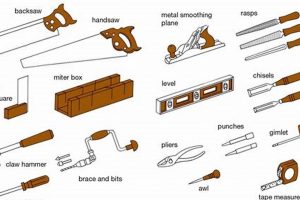
A coarse, often handheld, implement used in shaping wood, it functions through a series of individual teeth that remove material. This tool is particularly effective for aggressive stock removal and creating curved or irregular forms that might be challenging with other implements. For example, it can quickly refine the shape of a chair leg or hollow out the interior of a wooden bowl.
Its value lies in its ability to rapidly shape wood, particularly in situations where precision is less critical than speed. Historically, this tool has been vital in woodworking trades, allowing artisans to create complex shapes and forms that would be difficult or impossible to achieve with saws or chisels alone. Its design facilitates efficient material removal, reducing the effort required for certain shaping tasks.
The following sections will explore the different types of these implements, their proper use, maintenance techniques, and factors to consider when selecting the appropriate tool for a given woodworking project.
Tips for Effective Use
Employing this type of tool effectively requires understanding its characteristics and limitations. The following tips outline best practices for optimal results and tool longevity.
Tip 1: Secure the Workpiece. Proper immobilization of the wood is paramount. Utilize clamps or a vise to prevent movement during the shaping process, ensuring control and minimizing the risk of injury.
Tip 2: Apply Consistent Pressure. Maintain even pressure during each stroke. Avoid forcing the tool; let the teeth do the work. Inconsistent pressure can lead to uneven shaping and premature tool wear.
Tip 3: Use a Variety of Strokes. Employ a combination of push and pull strokes, adjusting the angle of attack to suit the desired shaping effect. Experimentation will reveal which strokes are most effective for specific contours.
Tip 4: Clean the Teeth Regularly. Wood particles accumulate within the teeth, reducing efficiency. Use a wire brush or specialized cleaning tool to remove debris frequently.
Tip 5: Consider Grain Direction. While less critical than with some cutting tools, grain direction still influences the outcome. Observe the grain and adjust the stroke direction to minimize tear-out, especially on softer woods.
Tip 6: Select the Appropriate Grade. Different grades offer varying levels of coarseness. Choose the grade best suited to the task at hand, starting with a coarser grade for initial shaping and progressing to finer grades for finishing.
Tip 7: Wear Appropriate Safety Gear. Safety glasses are essential to protect against flying debris. Depending on the scale of the work, a dust mask may also be advisable.
Adhering to these guidelines will enhance efficiency, improve the quality of the work, and prolong the lifespan of the tool.
The final section of this article will provide information on maintaining this type of tool and ensuring its continued performance.
1. Shape

The form factor of a wood shaping implement directly governs its suitability for various woodworking tasks. Different configurations are designed to address specific shaping needs, offering varying degrees of access, control, and material removal capability. The selection of an appropriate configuration is paramount for efficient and precise woodworking.
- Half-Round
The half-round configuration, characterized by one flat and one curved face, is versatile for both concave and convex surfaces. This shape facilitates efficient material removal on rounded edges, such as chair legs, and also allows for smoothing the interior of curved forms, such as bowls. The flat face can be used for flattening or shaping adjacent surfaces.
- Flat
A flat configuration is primarily employed for creating or refining flat surfaces and edges. This type is useful for leveling surfaces and removing sharp edges from wooden components. Its broad, uniform surface ensures consistent material removal and is suitable for tasks requiring a high degree of flatness.
- Round
The round configuration, often referred to as a rat-tail, excels at shaping the interior of holes and creating rounded grooves. Its tapered shape allows for gradual expansion of hole diameters and the formation of smooth, rounded recesses. This configuration is particularly valuable in instrument making and decorative woodworking.
- Oval
An oval configuration offers a compromise between the flat and round shapes, providing versatility for shaping both curved and flat surfaces. It is often used for refining complex curves and blending edges. Its elliptical cross-section allows for a varied range of shaping capabilities in a single tool.
The correlation between the shape and its intended function within woodworking cannot be overstated. Each configuration addresses specific shaping challenges, enabling woodworkers to achieve precise and aesthetically pleasing results. Consideration of the workpiece geometry and desired outcome dictates the optimal form factor for the implement.
2. Grit

The coarseness, or grit, of a wood shaping implement is a critical determinant of its performance and suitability for specific woodworking tasks. Grit refers to the density and size of the individual cutting teeth, impacting the rate of material removal, the surface finish, and the overall precision achievable. Understanding grit levels is essential for selecting the appropriate tool for a given operation.
- Coarse Grit
Coarse grit configurations feature widely spaced, large teeth designed for aggressive stock removal. These are ideal for rapidly shaping wood, removing significant amounts of material quickly. They are commonly used for initial shaping, roughing out contours, and quickly reducing the dimensions of a workpiece. However, coarse grit leaves a rough surface requiring subsequent refinement.
- Medium Grit
Medium grit tools strike a balance between material removal and surface finish. They are suitable for intermediate shaping stages, refining the contours established by coarser tools. This grit level provides a smoother surface compared to coarse, reducing the amount of subsequent sanding or finishing required. They offer versatility for general shaping tasks.
- Fine Grit
Fine grit configurations are characterized by closely spaced, small teeth optimized for achieving a smooth surface finish. They are employed for final shaping stages, removing minute amounts of material to refine contours and eliminate imperfections. Fine grit is essential for preparing surfaces for staining, painting, or other finishing processes. Material removal is slower but yields a significantly improved surface quality.
- Dead Smooth/Super Fine Grit
These are for final smoothing and burnishing the timber.
The selection of the appropriate grit level dictates the efficiency and effectiveness of the shaping process. Utilizing a coarse grit for finishing will result in an unacceptable surface, while employing a fine grit for initial shaping will prove excessively slow and inefficient. Skillful application of different grit levels throughout the shaping process is fundamental to achieving optimal results. For example, a typical project might start with a coarse implement for rapid shaping, progress to a medium grit for contour refinement, and conclude with a fine grit for surface smoothing, preparing the wood for final finishing.
3. Size
The physical dimensions of a wood shaping implement significantly influence its usability, precision, and suitability for specific woodworking applications. The overall length, width, and profile determine its maneuverability, leverage, and capacity for material removal in different contexts.
- Overall Length and Leverage
Longer tools generally provide greater leverage, allowing for more aggressive material removal with less physical effort. However, increased length can compromise control in intricate or confined spaces. Shorter implements offer enhanced dexterity and are better suited for detailed work requiring precision and responsiveness. For example, a longer tool might be preferred for rapidly shaping a large workpiece, while a shorter one would be chosen for fine-tuning a complex carving.
- Width and Surface Coverage
The width of the working surface dictates the amount of material removed per stroke. Wider surfaces are efficient for flattening large areas but can be unwieldy on curved or intricate forms. Narrower implements allow for more precise shaping of edges, corners, and tight curves. A wide shaping implement may be used on table tops while a narrow tool is typically needed for curved chair spindles.
- Profile and Accessibility
The overall profile of the implement, including its thickness and cross-sectional shape, determines its accessibility to different areas of a workpiece. Thinner profiles allow for access to confined spaces and intricate details, while thicker profiles provide greater rigidity and stability for aggressive material removal. A thin, needle shaping implement may be necessary for work on complex carvings and a thick implement can provide stability.
The interplay between these dimensional factors dictates the implement’s appropriateness for a particular task. Selecting the appropriate size involves considering the size and complexity of the workpiece, the desired level of precision, and the physical constraints of the working environment. An informed choice, based on these considerations, contributes significantly to the efficiency and quality of the woodworking process.
4. Tang
The tang is a critical, often unseen, element of a shaping tool. It functions as the connecting link between the shaped working portion of the implement and its handle. The design and quality of this component directly influence the tool’s overall strength, stability, and longevity, impacting its suitability for demanding woodworking tasks.
- Tang Geometry and Handle Fit
The shape and dimensions of the tang must precisely match the internal geometry of the handle to ensure a secure and stable connection. A properly fitted tang transmits force efficiently, minimizing stress on the handle and preventing slippage during use. Tangs that are too loose or too tight can lead to handle failure or compromised control. Variations in tang geometry may include square, rectangular, or tapered profiles, each designed for specific handle materials and construction methods. A well fitted tang prevents unwanted movement of the tool from the handle.
- Material Composition and Strength
The material used to manufacture the tang must possess sufficient strength and hardness to withstand the forces generated during shaping operations. High-carbon steel is a common choice due to its ability to be heat-treated for increased durability and resistance to bending or breakage. The tangs integrity is paramount, as failure under load can result in injury or damage to the workpiece. If the tang is weakened or breaks the tool is rendered useless.
- Tang Length and Stability
The length of the tang influences the stability of the connection between the shaping implement and the handle. Longer tangs provide a greater surface area for adhesion and mechanical interlocking with the handle material, resulting in a more secure and robust bond. Shorter tangs may be prone to loosening or detachment under heavy use. The tang allows for stability of the shaping tool.
- Tang Finish and Corrosion Resistance
The surface finish of the tang plays a role in its adhesion to the handle material. A slightly roughened or etched surface provides a better key for adhesives, enhancing the bond strength. Additionally, a protective coating, such as paint or plating, may be applied to the tang to prevent corrosion and prolong its lifespan. A rusty tang could weaken the connection and eventually break.
In summary, the tang is an essential structural component that directly affects the performance and safety of a shaping tool. Careful consideration of its geometry, material composition, length, and finish is crucial for selecting a tool that will withstand the rigors of woodworking and provide reliable service over time. A compromised tang will reduce efficiency and longevity of any shaping tool.
5. Handle

The handle is a critical interface between the woodworker and the shaping implement, directly affecting control, comfort, and the efficient transmission of force. Its design and material composition are paramount to the tool’s overall performance and usability. A poorly designed or constructed handle can lead to fatigue, reduced precision, and even injury. Consider, for example, shaping a curved chair leg: A handle that is too small or lacks sufficient grip can cause slippage, resulting in an inaccurate cut or loss of control.
Different handle materials offer varying degrees of shock absorption, grip, and durability. Hardwoods like ash or beech provide excellent strength and resistance to wear, while softer woods like pine are less durable but can be more comfortable for extended use. Synthetic materials, such as polymers, offer a balance of durability, grip, and resistance to moisture. The shape and ergonomics of the handle are also crucial. Contoured handles that fit comfortably in the hand reduce fatigue and allow for more precise control. A cylindrical handle may be cheaper to produce but provide little ergonomic benefit. The texture of the handle’s surface impacts grip. Roughened surfaces or textured coatings enhance grip, particularly in damp or sweaty conditions. A smooth, polished handle may be aesthetically pleasing but offer reduced control.
Ultimately, the optimal handle design balances comfort, control, and durability to ensure the shaping tool can be used effectively and safely for extended periods. Compromising on handle quality can negate the benefits of a high-quality shaping blade. The handle should be carefully selected based on the specific woodworking tasks for which the shaping tool will be used, considering factors such as the type of wood being worked, the amount of force required, and the duration of the shaping operation. Neglecting the handle’s importance can undermine the entire woodworking process.
6. Material

The selection of materials directly influences the performance, longevity, and suitability of wood shaping implements for diverse applications. Two key material categories exist: those used in the construction of the implement’s working portion (teeth) and those used for the handle. The properties of these materials dictate the tool’s effectiveness in shaping wood and its resistance to wear and tear. For instance, a shaping implement crafted from inferior steel may quickly dull or break, rendering it useless, while one made from high-carbon steel, properly hardened and tempered, will maintain its sharpness and structural integrity for an extended period.
Consider the specific demands of woodworking. High-carbon steel, often employed for the working portion, provides a balance of hardness, toughness, and wear resistance necessary to effectively remove wood fibers. The handle material, typically hardwood or a durable polymer, must offer a comfortable grip, absorb shock, and withstand repeated use. A poorly chosen handle material may crack, splinter, or become slippery, compromising control and potentially leading to injury. An example might be a shaping implement used to shape dense hardwoods like oak or maple, which necessitates a robust steel composition for the teeth to prevent premature dulling and a sturdy handle for efficient force transmission.
In conclusion, the careful selection of materials is paramount in the construction of wood shaping implements. The properties of the chosen steel and handle material directly determine the tool’s ability to shape wood efficiently, resist wear, and provide a safe and comfortable user experience. Understanding the relationship between material properties and performance characteristics allows woodworkers to make informed decisions when selecting or maintaining these tools, ultimately contributing to the quality and efficiency of their work.
Frequently Asked Questions About Rasp Woodworking Tools
This section addresses common inquiries regarding the selection, use, and maintenance of this type of implement, providing concise answers to assist woodworkers in maximizing their tool’s effectiveness.
Question 1: What distinguishes a rasp from a file in woodworking?
A rasp possesses individual, pointed teeth, while a file features parallel ridges or grooves. This fundamental difference results in a rasp removing material more aggressively and leaving a coarser surface finish compared to a file.
Question 2: When is a shaping implement the appropriate choice over sandpaper?
A shaping implement is preferable when significant material removal or aggressive shaping is required. Sandpaper is more suitable for refining surfaces and achieving a smooth finish after initial shaping.
Question 3: What is the optimal method for cleaning wood particles from a shaping implements teeth?
A stiff wire brush, specifically designed for cleaning shaping implements and files, is the most effective method. Regular cleaning prevents clogging and maintains optimal cutting efficiency.
Question 4: Can shaping implements be sharpened, and if so, how?
Due to their unique tooth geometry, traditional sharpening methods are not generally applicable. However, specialized shaping implement cleaning tools can help to restore some cutting efficiency by removing embedded debris and realigning teeth.
Question 5: How does the shape of a shaping implement influence its application?
The shape determines accessibility and suitability for different contours. Flat shaping implements are ideal for flat surfaces, while half-round or round shaping implements excel at shaping curved surfaces, both concave and convex.
Question 6: What safety precautions should be observed when using a shaping implement?
Wearing safety glasses is essential to protect the eyes from flying wood particles. Securely clamping the workpiece prevents movement and reduces the risk of injury.
In conclusion, understanding the nuances of this type of implement allows for informed decisions regarding its application and maintenance. Adhering to best practices ensures efficient and safe woodworking operations.
The following section will provide information on maintaining this type of tool and ensuring its continued performance.
Conclusion
The preceding exploration has delineated the multifaceted aspects of the rasp woodworking tool, encompassing its definition, diverse types, usage techniques, maintenance protocols, and critical selection criteria. An understanding of its shape, grit, size, tang, handle, and constituent materials is essential for informed application within woodworking practices. Proper utilization and care extend the tool’s lifespan and ensure optimal performance.
Mastery of the rasp woodworking tool unlocks a vital dimension of woodworking capability. Continued research, experimentation, and adherence to established best practices will further enhance skill and efficiency in its employment. Recognizing its inherent value contributes directly to the realization of superior woodworking outcomes.