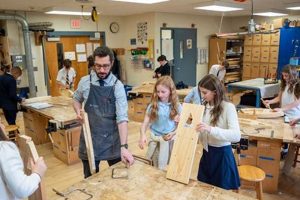
Introductory instruction in woodworking encompasses fundamental techniques and skills necessary for constructing simple projects. Participants learn about wood types, safe tool operation, joinery methods, and finishing processes. An example might include building a small box or a simple table, providing hands-on experience with essential concepts.
Acquiring foundational woodworking knowledge offers numerous advantages. It fosters problem-solving skills, enhances spatial reasoning, and cultivates creativity. Historically, woodworking has been a vital craft, contributing significantly to construction, furniture making, and artistic expression. Developing proficiency in this area can empower individuals to create custom items, repair existing structures, and pursue artistic endeavors.
The following sections will detail specific aspects of fundamental woodworking education, covering safety protocols, tool selection and maintenance, wood properties, basic joinery techniques, and finishing applications.
Essential Guidance for Novice Woodworkers
The following guidance is intended to assist individuals embarking on the journey of learning fundamental woodworking techniques. Adherence to these principles will promote safety, efficiency, and quality in project execution.
Tip 1: Prioritize Safety. Always wear appropriate personal protective equipment, including safety glasses, hearing protection, and dust masks. Ensure a clean and well-lit workspace, free from distractions.
Tip 2: Understand Wood Grain. Analyze the grain direction before cutting or joining. Working with the grain minimizes tear-out and facilitates smoother surfaces.
Tip 3: Master Basic Tool Sharpening. Sharp tools are safer and more effective. Learn to sharpen chisels and plane blades using honing guides and sharpening stones.
Tip 4: Practice Joinery Techniques. Experiment with various joinery methods, such as butt joints, rabbet joints, and mortise-and-tenon joints. Practice on scrap wood to refine accuracy and technique.
Tip 5: Use Measuring Tools Accurately. Employ precision measuring tools, such as rules, squares, and marking gauges, to ensure accurate cuts and consistent dimensions.
Tip 6: Apply Finishes Properly. Prepare the wood surface adequately before applying finishes. Sand evenly and remove dust to achieve a smooth and consistent finish. Follow the manufacturer’s instructions for the chosen finish.
Tip 7: Clamp Securely. Use clamps to hold workpieces firmly during gluing and assembly. Ensure clamps are properly aligned and apply even pressure to prevent movement or slippage.
Mastering these fundamental techniques provides a solid foundation for more advanced woodworking endeavors. Consistent practice and attention to detail will yield improved results and greater satisfaction with the craft.
The subsequent section will elaborate on specific tools and materials commonly used in fundamental woodworking practices.
1. Tool Safety Protocols

Tool safety protocols represent a core component of basic woodworking instruction. These protocols establish a framework of practices and procedures designed to mitigate the inherent risks associated with woodworking equipment and processes, ensuring a safe learning environment.
- Personal Protective Equipment (PPE)
The consistent use of PPE, including safety glasses, hearing protection, and dust masks, is mandated. Safety glasses protect against projectiles, such as wood chips and dust. Hearing protection minimizes the risk of hearing damage from loud machinery. Dust masks prevent the inhalation of fine particles, which can lead to respiratory problems. Without strict adherence to PPE guidelines, the potential for injury during introductory woodworking activities is significantly increased.
- Machine Guarding and Operation
All woodworking machinery must be equipped with functional guards to prevent accidental contact with moving parts. Before operating any machine, students receive thorough instruction on its safe operation, including proper setup, feeding techniques, and emergency shut-off procedures. Neglecting machine guarding protocols can result in severe injuries, such as lacerations, amputations, and fractures.
- Tool Handling and Maintenance
Proper tool handling techniques, including secure grip and controlled movements, are emphasized to prevent accidents. Regular tool maintenance, such as sharpening blades and inspecting power cords, ensures optimal performance and reduces the risk of malfunction. Blunt tools require more force, increasing the likelihood of slips and injuries.
- Workspace Organization and Awareness
Maintaining a clean and organized workspace minimizes trip hazards and allows for unobstructed movement. Students are trained to be aware of their surroundings and the actions of others in the shop. Crowded or cluttered workspaces contribute to accidents and impede safe operation.
The comprehensive integration of tool safety protocols within introductory woodworking education is not merely a procedural requirement but a fundamental element that instills a culture of safety and responsible practice. Adherence to these protocols empowers novice woodworkers to engage with the craft safely and confidently, forming habits that will protect them throughout their woodworking endeavors.
2. Wood Identification Basics

Wood identification basics form a cornerstone of fundamental woodworking education. Understanding the characteristics of various wood species directly impacts project planning, material selection, and execution quality. A novice woodworker’s inability to differentiate between hardwoods and softwoods, for example, can lead to inappropriate material choices for load-bearing structures, resulting in structural instability or premature failure. Conversely, accurate wood identification enables informed decisions. Recognizing the grain pattern and density of cherry wood allows a student to select it for a fine furniture piece requiring a smooth finish and dimensional stability.
The practical significance of wood identification extends beyond structural considerations. Different wood species exhibit varying degrees of workability, influencing the selection of appropriate tools and techniques. Pine, a softwood, is generally easier to cut and shape than oak, a hardwood. Misidentification can lead to tool damage or project abandonment due to unexpected resistance. Furthermore, identifying woods such as cedar, which possesses natural insect-repellent properties, informs decisions regarding outdoor projects where durability and resistance to decay are paramount. Understanding the properties of walnut, renowned for its rich color and grain, enables strategic utilization for decorative elements and high-end projects.
Accurate wood identification presents challenges, particularly for beginners. Visual inspection can be deceptive, requiring careful observation of color, grain pattern, and density. Microscopic examination and specialized testing methods offer definitive identification but fall outside the scope of introductory instruction. The integration of wood identification into the curriculum equips students with essential knowledge for making informed choices, promoting successful outcomes, and fostering a deeper appreciation for the material. Ultimately, the link between wood identification basics and introductory woodworking education is undeniable, shaping the foundation for competent and responsible woodworking practice.
3. Joinery Technique Fundamentals

Joinery technique fundamentals constitute a critical element within basic woodworking education. Mastery of these fundamentals equips individuals with the skills to create strong, durable, and aesthetically pleasing wooden structures. The application of appropriate joinery methods dictates the structural integrity and longevity of woodworking projects.
- Butt Joints
Butt joints, the simplest form of joinery, involve abutting two pieces of wood end-to-end or edge-to-edge. While easily executed, they possess minimal strength and typically require reinforcement with fasteners, such as screws or nails, or adhesive. In basic woodworking, butt joints serve as an introductory method for understanding basic assembly principles, often used in non-structural components like box construction or frame assembly where additional support is provided.
- Rabbet Joints
Rabbet joints feature a recess or channel cut along the edge or end of one board, allowing it to overlap and interlock with another. This method offers increased surface area for gluing and provides greater strength compared to butt joints. Basic woodworking classes incorporate rabbet joints in projects such as cabinet construction and drawer assembly, demonstrating a step up in joint complexity and structural reliability.
- Dado Joints
Dado joints involve cutting a groove across the grain of one board to receive the end of another. Similar to rabbet joints, dado joints offer substantial gluing surface and prevent racking or lateral movement. Instruction on dado joints within basic woodworking emphasizes precision cutting techniques using hand tools or power tools, applicable to shelf construction and cabinet dividers, showcasing the importance of accurate joinery for structural stability.
- Dovetail Joints
Dovetail joints, characterized by interlocking “tails” and “pins,” represent a highly durable and visually appealing joinery method. While complex to execute, dovetails provide exceptional strength due to their mechanical interlocking, resisting pulling forces. Though often introduced in advanced woodworking, basic classes may present simplified versions of dovetails to illustrate the principles of joinery interlocking and the value of well-fitted joints in securing drawer fronts and creating heirloom-quality projects.
The systematic instruction of these joinery techniques within basic woodworking classes provides a foundation for more advanced woodworking endeavors. Understanding the strengths and weaknesses of each joint type enables informed decision-making during project planning, directly influencing the durability, functionality, and aesthetic quality of the final product.
4. Finishing Application Methods
The application of appropriate finishes constitutes a crucial phase in woodworking, enhancing both the aesthetic appeal and protective qualities of completed projects. Within a basic woodworking class, instruction on finishing techniques provides students with the knowledge and skills necessary to produce professional-quality results.
- Surface Preparation
Prior to the application of any finish, proper surface preparation is essential. This typically involves sanding the wood to achieve a smooth, even surface, followed by the removal of dust and debris. The efficacy of the finish directly correlates with the quality of surface preparation. For instance, failure to adequately sand a surface prior to staining will result in uneven color absorption, compromising the final appearance.
- Staining Techniques
Staining serves to alter the color of the wood, enhancing its natural grain patterns or achieving a desired aesthetic. Various staining methods, including wiping, brushing, and spraying, are explored in a basic woodworking class. Each method offers distinct advantages and disadvantages in terms of application speed, consistency, and control over color intensity. An example of a staining technique that can be applied is applying a thin stain to a table.
- Sealing and Topcoating
Sealers, such as shellac or sanding sealer, create a barrier between the stain and the topcoat, preventing the stain from bleeding into subsequent layers and promoting adhesion. Topcoats, including varnishes, lacquers, and polyurethanes, provide a durable protective layer against scratches, moisture, and UV damage. In the class, students will practice topcoating and sealing on a wooden box or wooden chair.
- Application Tools and Techniques
The selection and proper use of application tools, such as brushes, rollers, and spray guns, significantly impact the quality of the finish. A basic woodworking class provides instruction on brush selection, brush loading, and brush stroke techniques to minimize brush marks and achieve a smooth, even finish. Similarly, students learn about spray gun setup, spray pattern adjustment, and proper spraying techniques to avoid runs, drips, and orange peel texture.
The integration of these finishing application methods within a basic woodworking class ensures that students develop a comprehensive understanding of the woodworking process, from material selection and joinery to surface finishing. This holistic approach empowers them to create projects that are both structurally sound and aesthetically pleasing, fostering a deeper appreciation for the craft.
5. Project Planning Execution
Project planning execution, as incorporated within a basic woodworking class, represents the practical application of learned skills and techniques to realize a tangible outcome. It is a structured process that translates theoretical knowledge into a physical object, solidifying understanding and fostering problem-solving abilities.
- Design Conceptualization
Design conceptualization involves defining the project’s parameters, including its purpose, dimensions, and aesthetic qualities. Within a basic woodworking class, this may involve selecting a pre-designed project, such as a small table or box, or creating a simple design from scratch. This stage necessitates understanding material limitations and applying basic design principles. For example, students learn to consider wood grain direction for structural integrity and visual appeal, informing their decisions regarding component layout and joinery placement.
- Material Selection and Preparation
Material selection and preparation entail choosing appropriate wood species and preparing them for construction. Students learn to identify different wood types, assessing their suitability based on factors like strength, workability, and cost. Preparation includes milling lumber to accurate dimensions, ensuring square edges and flat surfaces. This stage requires proficiency in operating woodworking machinery and understanding the impact of wood moisture content on stability. An inaccurate assessment of wood properties at this stage can result in structural weaknesses or aesthetic imperfections in the final project.
- Construction and Assembly
Construction and assembly encompass the physical process of joining the prepared materials according to the design specifications. This stage necessitates precise execution of joinery techniques, such as rabbets, dados, or butt joints, as taught in the woodworking class. Proper use of adhesives and clamping pressure is crucial for creating strong and durable bonds. Deviations from the planned dimensions or inadequate clamping can compromise the structural integrity of the project, leading to instability or premature failure.
- Finishing and Detailing
Finishing and detailing involve applying a protective and aesthetically pleasing coating to the completed project. Students learn to prepare the surface for finishing through sanding and cleaning, followed by the application of stains, sealers, and topcoats. Proper application techniques are emphasized to achieve a smooth, even finish and protect the wood from moisture and UV damage. Poorly executed finishing can detract from the overall appearance of the project and reduce its longevity.
Collectively, these facets of project planning execution within a basic woodworking class provide a holistic learning experience. Students not only acquire technical skills but also develop critical thinking, problem-solving, and project management abilities, preparing them for more advanced woodworking endeavors.
Frequently Asked Questions
The following section addresses common inquiries regarding introductory woodworking education. The information provided aims to clarify fundamental aspects of these courses and their relevance.
Question 1: What prerequisites are required to enroll?
Generally, no prior woodworking experience is necessary. These courses are designed for beginners. However, a willingness to learn and an aptitude for following instructions are beneficial.
Question 2: What tools and materials are typically provided?
Most courses provide access to essential tools and equipment within the workshop environment. Participants are often responsible for supplying consumable materials like wood and fasteners, though some courses may include a limited supply.
Question 3: What specific skills are taught?
Instruction typically covers basic tool safety, wood identification, fundamental joinery techniques, and finishing applications. The specific skills taught may vary depending on the course curriculum.
Question 4: How long does a typical class last?
Course duration varies depending on the format and curriculum. Introductory courses may range from a single-day workshop to a multi-week series of sessions.
Question 5: Is safety emphasized in the curriculum?
Safety is a paramount concern. Instruction includes comprehensive guidance on the safe operation of tools and equipment, adherence to personal protective equipment requirements, and the implementation of safe workshop practices.
Question 6: What types of projects are typically undertaken?
Projects commonly include simple items such as boxes, small tables, or cutting boards. The intent is to provide hands-on experience with fundamental woodworking techniques while creating a tangible outcome.
These frequently asked questions offer insight into the core aspects of initial woodworking courses. A comprehensive understanding of these topics empowers prospective participants to make informed decisions.
The subsequent section will elaborate on the benefits of woodworking education for personal and professional development.
Conclusion
This exploration of basic woodworking class instruction has elucidated essential aspects of the discipline. These introductory programs impart fundamental skills encompassing tool safety, material identification, joinery techniques, and finishing processes. The acquisition of these skills empowers individuals to execute basic woodworking projects and provides a foundation for further development.
The value of fundamental woodworking education extends beyond the creation of physical objects. It cultivates problem-solving abilities, enhances spatial reasoning, and fosters creative expression. Individuals are encouraged to consider enrollment in a basic woodworking class to acquire practical skills and cultivate a lifelong appreciation for the craft.

![Learn Woodworking: Classes in Fort Collins [Skills!] | Step-by-Step Guides, Tools & Inspiration to Build Beautiful Wooden Decor on a Budget](https://woodfromhome.com/wp-content/uploads/2026/04/th-267-300x200.jpg "Learn Woodworking: Classes in Fort Collins [Skills!] Step-by-Step Guides, Tools & Inspiration to Build Beautiful Wooden Decor on a Budget")