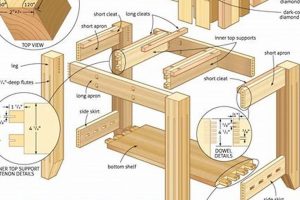
The construction of items from wood, designed and executed by young individuals, constitutes a valuable activity. These undertakings can range from simple birdhouses and toy vehicles to more complex decorative items or functional tools. Often, the projects incorporate basic carpentry techniques and involve the use of hand tools under appropriate supervision.
Engaging in such activities fosters creativity, problem-solving skills, and hand-eye coordination. Historically, woodworking has been a significant part of childhood development, imparting practical skills and an understanding of materials and construction. The successful completion of a project builds confidence and provides a tangible sense of accomplishment.
The following sections will explore safe tool usage, age-appropriate project ideas, material selection, and essential techniques for ensuring a positive and educational experience for young woodworkers. Emphasis will be placed on creating a safe and stimulating environment for exploration and skill development.
Guidance for Safe and Productive Woodworking Activities for the Young
The following guidance is designed to promote a secure and enriching woodworking experience for children, emphasizing safety, skill development, and project success.
Tip 1: Prioritize Safety Equipment: Protective eyewear is mandatory during all phases of woodworking. Furthermore, the use of dust masks is recommended to mitigate the inhalation of sawdust. Ear protection should be employed when working with power tools.
Tip 2: Supervise Diligently: Close adult supervision is essential, particularly when children are using tools. Ensure that children understand the proper techniques and potential hazards associated with each tool.
Tip 3: Start with Simple Projects: Begin with projects that require minimal steps and utilize softwoods such as pine or balsa. This approach allows children to develop basic skills and gain confidence before attempting more complex tasks.
Tip 4: Emphasize Proper Tool Handling: Demonstrate and practice the correct method for holding and using each tool. Reinforce the importance of keeping tools sharp and well-maintained for safe and efficient operation.
Tip 5: Provide a Stable Work Surface: A secure and level workbench is crucial for safety and accuracy. The workbench should be appropriately sized for the child and equipped with clamps or vises to hold workpieces in place.
Tip 6: Teach Waste Management: Instill the habit of cleaning up sawdust and scrap wood immediately after completion of a task. A tidy workspace reduces the risk of accidents and promotes a more organized approach to woodworking.
Tip 7: Plan Ahead: Prior to beginning any project, create a detailed plan outlining the steps involved, materials required, and dimensions of each component. This promotes precision and minimizes errors.
Successful engagement in woodworking fosters valuable skills and a sense of accomplishment. Adherence to these guidelines maximizes safety and promotes a positive and educational experience.
The subsequent sections will delve into the selection of age-appropriate tools and project design considerations for continued learning and enjoyment.
1. Age-Appropriate Tools

The selection of age-appropriate tools is a cornerstone of successful and safe woodworking activities for children. Utilizing tools designed for smaller hands and lower strength levels directly influences the child’s ability to control the tool effectively. Consequently, precision in cutting, shaping, and fastening is enhanced, leading to improved project outcomes and reduced risk of injury. For instance, a child using a full-sized adult hammer may struggle with the weight and balance, increasing the likelihood of missing the nail or straining their wrist, whereas a smaller, lighter hammer designed for children allows for more controlled and accurate strikes.
The impact of appropriately sized tools extends beyond immediate safety concerns. When children can manipulate tools with ease, they experience greater satisfaction and engagement with the woodworking process. This fosters a positive attitude toward learning new skills and encourages continued participation. Examples include using smaller hand saws with finer teeth for easier cutting of thin wood and employing hand drills with comfortable grips that minimize hand fatigue. The application of age-appropriate tools also facilitates the development of proper woodworking techniques from an early stage, laying a solid foundation for future skill progression.
In conclusion, the careful consideration and selection of age-appropriate tools are not merely a matter of convenience but are essential for ensuring the safety, success, and enjoyment of children engaged in woodworking. Addressing this aspect proactively allows for a more positive and enriching learning experience, encouraging children to explore their creativity and develop valuable skills. The challenge lies in providing accessible information and resources to parents and educators to guide them in making informed decisions about tool selection for young woodworkers.
2. Safety Protocol Adherence

Safety protocol adherence forms the bedrock of all woodworking activities involving children. A systematic approach to risk mitigation is crucial to prevent injuries and cultivate a safe learning environment. The absence of rigorous safety measures can lead to accidents with potentially long-lasting consequences. Therefore, a comprehensive understanding and consistent implementation of safety protocols are paramount.
- Protective Equipment Usage
The consistent use of protective eyewear, such as safety glasses or goggles, is imperative to shield children’s eyes from flying debris. Dust masks or respirators minimize the inhalation of sawdust and other airborne particles, reducing the risk of respiratory irritation. The use of appropriate gloves protects hands from splinters and abrasions. Protective equipment must fit properly and be consistently worn throughout the woodworking activity.
- Adult Supervision
Continuous adult supervision is non-negotiable. Adults must possess adequate knowledge of woodworking safety and be capable of intervening promptly in the event of a hazardous situation. Supervision extends beyond mere observation; it encompasses actively guiding children in the proper use of tools and techniques, as well as enforcing safety rules. The ratio of adults to children should be appropriate to ensure effective oversight.
- Tool Safety Training
Before engaging in any woodworking activity, children must receive thorough training on the safe and proper use of each tool. This training should include demonstrations, supervised practice, and clear explanations of potential hazards. Children should demonstrate competency in tool handling before being allowed to use them independently. Refresher training should be provided periodically to reinforce safety protocols.
- Work Area Management
Maintaining a clean and organized work area is essential for preventing accidents. Sawdust and scrap wood should be promptly removed to eliminate tripping hazards. Tools should be stored in designated locations when not in use. Adequate lighting and ventilation are necessary to ensure visibility and prevent the buildup of harmful fumes. The work area should be free from distractions that could compromise concentration and safety.
The consistent application of these facets directly correlates with a reduction in the incidence of woodworking-related injuries among children. Furthermore, adherence to safety protocols cultivates a culture of responsibility and awareness, instilling valuable safety habits that extend beyond the woodworking environment. The successful implementation of these measures relies on the commitment of educators, parents, and community organizations to prioritize safety in all woodworking endeavors.
3. Project Complexity Management

Project complexity management in the context of children’s woodwork projects dictates the level of engagement and skill acquisition achievable. Undertaking projects that exceed a childs developmental capabilities can lead to frustration, discouragement, and potentially unsafe practices. Conversely, projects lacking sufficient challenge may fail to stimulate interest or promote meaningful learning. Effective management of project complexity involves aligning the project’s demands with the child’s existing skillset and progressively introducing new techniques and concepts. For example, a beginner might start with assembling pre-cut pieces for a simple birdhouse, gradually advancing to projects requiring basic sawing and sanding skills.
The ability to manage project complexity effectively contributes directly to the safety and educational value of the activity. When a child is presented with a task within their grasp, they are more likely to follow instructions carefully and employ proper techniques. This reduces the risk of accidents and fosters a sense of accomplishment. Furthermore, successfully completing progressively more challenging projects builds confidence and motivates children to continue learning and expanding their skills. The selection of appropriate projects necessitates a careful assessment of the childs motor skills, problem-solving abilities, and attention span. It also requires adults to provide clear, concise instructions and offer support as needed, without overwhelming the child with overly complicated procedures.
In summary, managing project complexity represents a critical component of successful woodworking endeavors for children. It directly impacts safety, skill development, and overall engagement. By carefully selecting projects that align with a childs abilities and incrementally introducing new challenges, adults can foster a positive and enriching learning experience. A failure to address project complexity appropriately can result in frustration, discouragement, and potentially dangerous situations, undermining the intended benefits of woodworking activities.
4. Skill Development Focus

The deliberate integration of skill development into woodworking activities for children represents a critical component of a well-structured educational experience. The emphasis on skill acquisition transcends the mere completion of projects, shifting the focus toward the cultivation of valuable competencies applicable beyond the immediate activity.
- Fine Motor Skill Enhancement
Woodworking necessitates precise hand movements, thereby fostering the development of fine motor skills. Activities such as hammering nails, sawing along a line, and sanding surfaces refine hand-eye coordination and dexterity. The repetitive nature of these tasks reinforces neural pathways, leading to improved motor control. These skills are directly transferable to other domains, including writing, drawing, and manipulating small objects.
- Spatial Reasoning Improvement
Woodworking requires children to visualize objects in three dimensions and understand spatial relationships. Constructing a box or assembling a model requires an understanding of how different pieces fit together and how the final product will appear. This enhances spatial reasoning abilities, which are crucial for success in mathematics, engineering, and other STEM fields. Projects involving geometric shapes and precise measurements further reinforce spatial understanding.
- Problem-Solving Skill Cultivation
Woodworking inevitably presents challenges that require problem-solving skills. A piece of wood may split, a nail may bend, or a joint may not fit properly. Children must learn to identify the problem, analyze potential solutions, and implement a corrective action. This process cultivates critical thinking skills and the ability to adapt to unexpected circumstances. The iterative nature of woodworking allows for experimentation and learning from mistakes.
- Patience and Perseverance Development
Woodworking often requires patience and perseverance. Projects may take time to complete, and setbacks are common. Children must learn to remain focused and persistent in the face of challenges. This cultivates a sense of discipline and the ability to delay gratification. The satisfaction of completing a project after overcoming obstacles reinforces the value of perseverance.
These multifaceted skill development opportunities underscore the profound educational benefits of woodworking activities for children. By emphasizing skill acquisition over mere project completion, educators and parents can foster the development of valuable competencies that contribute to children’s overall cognitive and motor development. The long-term implications extend beyond the immediate woodworking experience, equipping children with skills applicable to a wide range of academic and professional pursuits.
5. Material Selection Oversight

Material selection oversight directly influences the safety, feasibility, and educational value of woodworking activities undertaken by children. The properties of the chosen wood, such as its hardness, grain, and toxicity, significantly impact the ease of manipulation and the potential for injury. For instance, hardwoods like oak or maple, while durable, present a greater challenge to young children due to their density, requiring more force to cut and shape, thereby increasing the risk of tool slippage and physical strain. Conversely, softwoods such as pine or balsa offer reduced resistance, making them easier to work with but potentially more prone to splintering if not handled correctly. The selection of treated lumber also necessitates careful consideration due to the potential presence of chemical preservatives that may pose health hazards to children through inhalation or skin contact.
Proper material selection oversight entails a thorough evaluation of each material’s suitability for the intended project and the age and skill level of the child. It involves prioritizing woods that are easy to work with, relatively free of knots and imperfections, and sourced from sustainable and non-toxic sources. This may necessitate providing pre-cut pieces or offering guidance on selecting appropriate materials from a lumberyard or craft store. Practical applications include opting for basswood for carving projects due to its fine grain and ease of shaping, or utilizing plywood with rounded edges for construction projects to minimize the risk of splinters. The implementation of comprehensive guidelines regarding material selection, coupled with adult supervision, serves to mitigate potential hazards and enhance the overall learning experience.
In conclusion, material selection oversight constitutes a critical, yet often overlooked, element of successful and safe woodworking activities for children. Careful consideration of wood properties, potential hazards, and project requirements is paramount to ensuring a positive outcome. Challenges remain in disseminating information on suitable materials and promoting responsible sourcing practices. However, by prioritizing material selection oversight, educators and parents can significantly enhance the educational value and safety of children’s woodworking projects, fostering creativity and skill development in a secure environment.
Frequently Asked Questions Regarding Children’s Woodwork Projects
The following questions address common concerns and misconceptions regarding woodworking activities undertaken by young individuals. The aim is to provide clear, concise information to ensure safe and educational experiences.
Question 1: At what age is a child ready to begin woodworking projects?
The readiness for woodworking varies. Around age six or seven, with adequate fine motor skills and the ability to follow instructions, a child may begin with simple projects under close supervision.
Question 2: What are the essential safety precautions for children’s woodworking?
Essential precautions include mandatory use of safety glasses, dust masks, and appropriate gloves. Continuous adult supervision and comprehensive tool safety training are also crucial.
Question 3: What types of wood are most suitable for children’s projects?
Softwoods such as pine or balsa are generally recommended due to their ease of manipulation. Ensure that the wood is untreated to avoid potential exposure to harmful chemicals.
Question 4: What tools are appropriate for young children to use?
Age-appropriate tools, such as smaller-sized hammers, hand saws with finer teeth, and hand drills with comfortable grips, are essential for safe and effective woodworking.
Question 5: How can project complexity be managed effectively?
Begin with simple projects that require minimal steps and basic techniques. Gradually introduce more complex tasks as the child’s skills and confidence improve.
Question 6: What are the primary benefits of engaging in woodworking activities?
Woodworking fosters creativity, problem-solving skills, hand-eye coordination, and spatial reasoning. It also builds confidence and provides a tangible sense of accomplishment.
In summary, prioritizing safety, selecting appropriate materials and tools, and managing project complexity are key factors in creating positive and educational woodworking experiences for children.
The subsequent section will provide specific project ideas suitable for different age groups and skill levels.
Conclusion
The preceding exploration of children’s woodwork projects has highlighted key aspects critical for their successful and safe implementation. From emphasizing age-appropriate tool selection and stringent safety protocol adherence to meticulously managing project complexity and prioritizing skill development, the elements discussed collectively contribute to a positive and enriching learning experience. Furthermore, the careful oversight of material selection reinforces the significance of responsible and safe practices within this domain.
The cultivation of these woodworking activities should remain focused on fostering creativity, problem-solving abilities, and a sense of accomplishment in young individuals. The continued advancement of accessible resources and comprehensive training programs is imperative to ensure that future generations can safely and effectively engage in this valuable form of hands-on learning. The long-term benefits of such endeavors extend far beyond the immediate projects, equipping children with practical skills and fostering a lifelong appreciation for craftsmanship.