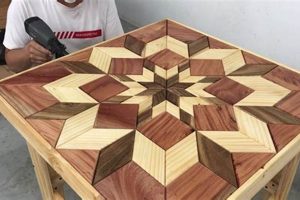
Computer Numerical Control (CNC) woodworking represents a spectrum of concepts related to the automation of wood fabrication using digitally controlled machinery. These concepts encompass a diverse array of potential projects, ranging from intricate carvings and custom furniture to mass-produced components and architectural models. For example, generating a 3D model of a chair and then using a CNC router to cut out the individual pieces from plywood exemplifies this application.
The utilization of digitally-driven wood fabrication methods offers several advantages. Increased precision and repeatability are paramount, leading to reduced material waste and enhanced product consistency. The capacity to execute complex designs previously unattainable through manual methods opens new avenues for creative expression and functional innovation. Furthermore, the reduction in manual labor can lead to increased production efficiency and cost savings. The genesis of digitally controlled woodworking can be traced back to the broader development of CNC technology in manufacturing, with advancements in computer processing power and software enabling its application to woodworking processes.
Understanding the scope of design possibilities, choosing appropriate machinery and software, and mastering the intricacies of toolpath generation are crucial elements in successfully implementing digitally controlled woodworking. Subsequent sections will delve into these aspects, providing a foundation for realizing diverse projects, optimizing workflows, and achieving desired outcomes.
Guidance for Digital Wood Fabrication
The following guidance addresses key considerations for successful implementation of digitally-driven wood fabrication. Prioritization of these factors contributes to optimized workflows and project outcomes.
Tip 1: Design Compatibility Assessment: Before commencing fabrication, ensure the chosen design is compatible with the capabilities of the CNC machine and selected tooling. Overly intricate designs may necessitate specialized tooling or machine configurations, impacting project feasibility and cost.
Tip 2: Material Selection and Calibration: The properties of the chosen material directly influence cutting parameters and final product quality. Calibration of the CNC machine to account for material thickness, density, and grain orientation is essential for precise and consistent results.
Tip 3: Toolpath Optimization: Efficient toolpaths minimize cutting time, reduce tool wear, and improve surface finish. Strategies such as climb milling versus conventional milling should be evaluated and implemented based on material properties and desired outcome.
Tip 4: Fixturing and Workholding: Secure and stable workholding is crucial for maintaining accuracy and preventing material movement during the cutting process. Appropriate fixturing methods should be employed to ensure the workpiece remains firmly in place throughout the operation.
Tip 5: Software Proficiency: Competence in CAD/CAM software is paramount for translating designs into machine-readable code. A thorough understanding of software functionalities, including toolpath generation, simulation, and error detection, is essential for efficient and accurate fabrication.
Tip 6: Machine Maintenance and Calibration: Regular maintenance and calibration of the CNC machine are critical for ensuring optimal performance and accuracy. Adherence to manufacturer-recommended maintenance schedules and periodic calibration checks are essential for long-term reliability.
These guidelines, when rigorously applied, enhance the efficiency, precision, and overall success of projects involving computer-controlled wood fabrication.
Subsequent sections will explore advanced techniques, software solutions, and practical applications, building upon the foundational principles outlined above.
1. Precision
The connection between precision and digitally-driven woodworking is intrinsic and fundamental. The inherent advantage of Computer Numerical Control (CNC) technology lies in its capacity to execute designs with a degree of accuracy and repeatability unachievable through manual woodworking methods. This precision directly impacts the dimensional accuracy of individual components and, consequently, the overall quality and structural integrity of the final product. The automated nature of CNC processes minimizes the potential for human error, leading to consistent results across multiple iterations. For example, in the production of intricate joinery for furniture, CNC machining ensures tight-fitting connections, enhancing both the aesthetic appeal and structural stability of the piece. Failure to maintain precision in digitally controlled woodworking can lead to misaligned parts, weakened joints, and ultimately, a compromised final product.
The demand for precision in digitally controlled woodworking extends beyond aesthetic considerations. In applications such as architectural modeling and prototyping, dimensional accuracy is paramount for validating design concepts and ensuring proper fit during assembly. The ability to precisely replicate complex geometries enables the creation of intricate models with a high degree of fidelity, facilitating effective communication and collaboration among designers, engineers, and clients. Furthermore, in the manufacturing of precision components for industries such as aerospace or automotive, digitally controlled woodworking serves as a viable alternative for creating tooling, molds, and fixtures. The precision achievable through CNC machining allows for the production of custom-designed components with tight tolerances, meeting the stringent requirements of these industries.
In summary, precision is not merely a desirable attribute but a core requirement for the successful application of digitally driven woodworking. It influences design feasibility, product quality, and functional performance across a diverse range of applications. While challenges remain in optimizing CNC machine calibration, tooling selection, and material properties, the pursuit of enhanced precision remains a driving force in the ongoing evolution of digitally controlled woodworking techniques.
2. Automation

The integration of automation within computer numerical control (CNC) woodworking constitutes a transformative shift from traditional manual methods. This transition directly impacts efficiency, production volume, and the complexity of achievable designs. Automation, in this context, refers to the use of computerized systems to control and execute woodworking processes, minimizing human intervention and maximizing throughput. The consequence of automating tasks such as cutting, carving, and shaping is a reduction in labor costs, decreased error rates, and the ability to produce identical components repeatedly. The importance of automation stems from its capacity to streamline workflows and enable the production of intricate designs that would be prohibitively time-consuming or impossible to execute manually. For example, the automated creation of complex furniture components with elaborate carvings demonstrates the practical significance of automation in enhancing design possibilities and reducing production time. Without automation, the potential of CNC woodworking would be significantly limited, restricting its application to simpler, less intricate projects.
Further analysis reveals that automation extends beyond the immediate machining process. It encompasses aspects such as automated material handling, tool changing, and quality control. Automated material handling systems load and unload workpieces, reducing cycle times and minimizing the risk of material damage. Automatic tool changers allow for seamless transitions between different cutting tools, enabling the execution of complex machining operations without manual intervention. Integrated quality control systems utilize sensors and software algorithms to monitor the machining process and detect deviations from specified tolerances, ensuring product consistency and minimizing waste. A practical application of this integrated automation is seen in large-scale furniture manufacturing, where entire production lines are automated from raw material input to finished product output, significantly increasing production volume and reducing lead times.
In summary, automation is a critical component of CNC woodworking, enabling enhanced precision, increased efficiency, and expanded design possibilities. While challenges remain in optimizing automation systems for diverse woodworking applications and integrating them seamlessly with existing workflows, the benefits of automation are undeniable. Understanding the interplay between CNC technology and automated processes is essential for maximizing the potential of digitally controlled woodworking and driving innovation in the woodworking industry. This understanding links directly to the broader theme of technological advancement and its impact on traditional crafts, highlighting the importance of adapting to and embracing new technologies to remain competitive in the evolving landscape of manufacturing.
3. Customization

Computer Numerical Control (CNC) woodworking significantly expands the possibilities for customization in wood fabrication. The ability to translate digital designs directly into physical objects enables the creation of bespoke pieces tailored to individual specifications. This capacity distinguishes CNC woodworking from traditional methods, where customization often involves significant manual labor and is constrained by the limitations of hand tools. The cause-and-effect relationship is clear: digital design combined with CNC precision allows for the efficient production of unique, highly personalized items. Customization is a core component because it caters to specific needs and aesthetic preferences, creating opportunities for individualized furniture, architectural elements, and artistic creations. Consider the example of a custom-designed desk fitted precisely to an unusual office space or personalized cabinetry designed to maximize storage in a uniquely shaped room. The practical significance of this capability lies in its potential to meet niche market demands, providing customers with items that are both functional and aesthetically aligned with their personal tastes.
Further analysis reveals that CNC-enabled customization extends to intricate design features that would be difficult or impossible to achieve manually. Complex curves, three-dimensional carvings, and precisely fitted joints can be executed with relative ease using CNC technology. This allows designers and woodworkers to explore more elaborate and innovative designs, moving beyond the constraints of traditional woodworking techniques. A relevant example is the creation of custom musical instruments, where precise dimensions and intricate internal structures are critical for achieving optimal sound quality. CNC machining enables the repeatable and accurate creation of these complex components, leading to improved instrument performance and greater design flexibility. Moreover, the capacity to produce customized components rapidly facilitates prototyping and iterative design processes, allowing for quicker and more efficient product development cycles.
In summary, customization is a defining characteristic of CNC woodworking, driven by the precision and flexibility of digital control. This capability unlocks opportunities for personalized designs, intricate features, and efficient prototyping, expanding the range of possibilities for wood fabrication. While challenges remain in optimizing software workflows for complex customization projects and ensuring seamless integration with client communication, the potential for individualized wood products and services is significant. The broader theme links to the evolving landscape of consumer expectations, where demand for personalized and unique products is increasing, driving the adoption of digitally-driven manufacturing processes across various industries.
4. Scalability
Scalability, in the context of computer numerical control (CNC) woodworking, refers to the ability to increase production volume without a proportional increase in cost or a reduction in product quality. It is a critical factor for businesses seeking to expand their operations and meet growing market demands. Efficient scaling requires careful consideration of equipment, software, workforce, and process optimization. The absence of scalability limits growth potential and responsiveness to fluctuating market conditions.
- Machine Capacity and Replication
Scalability often involves acquiring additional CNC machines to increase production capacity. The selection of machines with appropriate bed sizes, spindle speeds, and tool-changing capabilities is crucial. Replicating successful machine configurations allows for consistent product quality across multiple production lines. However, capital investment in new equipment must be balanced against potential gains in output and revenue. Inefficient utilization of machine capacity can negate the benefits of increased equipment acquisition. For example, a furniture manufacturer might invest in multiple CNC routers to meet increased demand for custom cabinet doors.
- Software and Workflow Optimization
Effective software solutions are essential for managing and streamlining the workflow of multiple CNC machines. Computer-Aided Design (CAD) and Computer-Aided Manufacturing (CAM) software must be capable of generating toolpaths efficiently and optimizing material usage. Implementing centralized control systems allows for remote monitoring and management of multiple machines. Automated job scheduling and nesting algorithms can maximize material yield and minimize waste. A poorly optimized software workflow can become a bottleneck, limiting the scalability of the entire production process. A woodworking company adopting CNC technology might use nesting software to efficiently cut multiple parts from a single sheet of material, reducing waste and maximizing output.
- Workforce Training and Management
Scaling up CNC woodworking operations requires a skilled workforce capable of operating, maintaining, and troubleshooting CNC machines. Investing in comprehensive training programs for operators, programmers, and maintenance technicians is essential. Effective management strategies are needed to coordinate the activities of multiple teams and ensure consistent product quality. A shortage of skilled labor can severely limit the ability to scale up production. A woodworking business expanding its CNC operations might implement a training program to equip its employees with the necessary skills to operate and maintain the new equipment.
- Material Procurement and Inventory Management
Scalability requires a reliable supply chain and efficient inventory management practices. Securing favorable contracts with material suppliers is crucial for maintaining consistent material costs. Implementing inventory management systems allows for tracking material levels, minimizing waste, and preventing stockouts. Inadequate material procurement and inventory management can lead to delays and increased costs, hindering the scaling process. A large-scale woodworking operation might utilize a just-in-time inventory system to minimize storage costs and ensure a steady supply of materials.
The discussed facets highlight the multifaceted nature of scalability in CNC woodworking. Achieving efficient and cost-effective scaling requires a holistic approach that addresses equipment, software, workforce, and material management. Businesses that prioritize these factors are better positioned to capitalize on market opportunities and achieve sustainable growth. Efficient scalability, therefore, directly translates into enhanced competitiveness and long-term success in the woodworking industry.
5. Efficiency

The intersection of efficiency and computer numerical control (CNC) woodworking represents a paradigm shift in wood fabrication processes. Efficiency, defined as maximizing output while minimizing resource consumption, is not merely a desirable attribute but an imperative for successful implementation of CNC technology in woodworking. The utilization of CNC machines directly impacts material usage, labor costs, and production time, leading to significant improvements in overall operational effectiveness. The inherent precision and automation of CNC processes reduce material waste compared to traditional methods, where manual cutting and shaping often result in higher scrap rates. Furthermore, the automated nature of CNC machining reduces the need for manual labor, lowering production costs and improving worker safety. A tangible illustration is found in the production of identical furniture components, where CNC machining ensures consistent dimensions and reduces the risk of errors, resulting in a more efficient and cost-effective manufacturing process. The practical significance of understanding this connection lies in the potential for businesses to optimize their operations, reduce costs, and enhance competitiveness in the market.
Further analysis reveals that efficiency in CNC woodworking extends beyond the immediate machining process to encompass the entire workflow. Optimization of Computer-Aided Design (CAD) and Computer-Aided Manufacturing (CAM) software is critical for generating efficient toolpaths and minimizing cutting times. Careful consideration of material selection and cutting parameters can further reduce waste and improve surface finish. Implementing automated material handling systems and tool-changing mechanisms can also contribute to increased efficiency by reducing cycle times and minimizing downtime. For example, a cabinet manufacturer might use nesting software to optimize the layout of parts on a sheet of plywood, minimizing waste and maximizing material utilization. Integrated with automated tool changing on the CNC machine itself reduces the requirement for human interaction. Furthermore, the ability to accurately estimate production times and costs allows for better planning and resource allocation. These integrated optimizations collectively enhance the overall efficiency of CNC woodworking operations, leading to increased profitability and reduced environmental impact.
In summary, efficiency is an integral component of CNC woodworking, driven by the precision, automation, and optimization capabilities of digital control. This emphasis on efficiency unlocks opportunities for reduced costs, increased output, and improved product quality, transforming traditional woodworking practices. While challenges remain in optimizing software workflows, managing machine downtime, and adapting to changing market demands, the pursuit of enhanced efficiency remains a key driver of innovation in the woodworking industry. The broader theme links to the growing focus on sustainable manufacturing practices, where resource efficiency and waste reduction are becoming increasingly important considerations for businesses and consumers alike, underscoring the need for continuous improvement in the efficiency of CNC woodworking processes.
Frequently Asked Questions
The following section addresses common inquiries regarding Computer Numerical Control (CNC) woodworking, providing concise and informative answers to clarify misconceptions and offer practical guidance.
Question 1: What level of expertise is required to operate CNC woodworking equipment?
Operating CNC woodworking equipment necessitates a foundational understanding of woodworking principles, coupled with proficiency in CAD/CAM software. Training programs and online resources can supplement existing knowledge, enabling individuals with varying skill levels to effectively utilize CNC machinery.
Question 2: What are the primary limitations of CNC woodworking?
While CNC woodworking offers numerous advantages, limitations exist. Complex manual assembly may still be required for certain projects. Initial setup costs for CNC equipment and software can be substantial. The size and complexity of projects are constrained by the machine’s work envelope.
Question 3: How does CNC woodworking compare to traditional woodworking in terms of precision?
CNC woodworking inherently surpasses traditional woodworking in terms of precision and repeatability. Digital control eliminates the inconsistencies associated with manual processes, resulting in highly accurate and consistent output.
Question 4: What types of wood are best suited for CNC machining?
A wide range of wood species can be processed using CNC machinery. Softer woods, such as pine and cedar, are generally easier to machine, while hardwoods, like oak and maple, require more robust tooling and slower feed rates. Engineered wood products, such as plywood and MDF, are also commonly used in CNC woodworking applications.
Question 5: What are the essential safety precautions to observe when operating CNC woodworking equipment?
Adherence to stringent safety protocols is paramount. Eye and ear protection are mandatory. Workpieces must be securely fastened. The machine’s safety interlocks should never be bypassed. Regular maintenance and inspection of the equipment are crucial for preventing accidents.
Question 6: What is the typical lifespan of CNC woodworking machinery?
The lifespan of CNC woodworking machinery is contingent upon factors such as machine quality, usage frequency, and maintenance practices. With proper care and maintenance, a well-built CNC machine can provide reliable service for many years.
The presented questions and answers should provide a more complete understanding of what is digitally-driven wood fabrication.
Subsequent sections will provide a conclusion on digital wood fabrication projects and ideas.
Conclusion
This exploration of concepts within Computer Numerical Control (CNC) woodworking has illuminated the transformative impact of digital fabrication on traditional woodcraft. The precision, automation, customization, scalability, and efficiency afforded by these techniques represent a significant advancement, enabling the creation of intricate designs, optimized production processes, and bespoke solutions tailored to individual needs. Effective implementation, however, necessitates a comprehensive understanding of design compatibility, material properties, toolpath optimization, and machine maintenance. Mastery of these elements is crucial for realizing the full potential of digitally-controlled woodworking.
The ongoing evolution of CNC technology promises further innovation in wood fabrication, fostering increased efficiency, reduced waste, and expanded design possibilities. Continued investment in education, research, and development will be essential for harnessing these advancements and ensuring the sustainable growth of the woodworking industry. The future of woodcraft lies in embracing these digital tools while preserving the artistry and craftsmanship that define the enduring appeal of wood as a material.