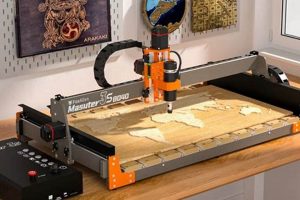
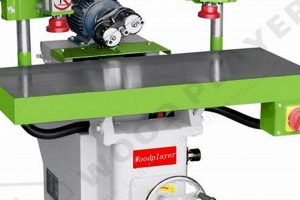
Computer Numerical Control (CNC) woodworking devices represent automated tools employed in the crafting of wooden components. These devices utilize pre-programmed computer software to dictate the movement of cutting tools, enabling the precise and repeatable creation of complex shapes and designs. For example, a CNC router can carve intricate patterns into a cabinet door, guided by a digital blueprint.
The employment of automated wood shaping equipment yields significant advantages across various industries. Increased production speed, enhanced accuracy, and reduced material waste are prominent benefits. Historically, manual woodworking processes demanded skilled labor and were prone to inconsistencies. The advent of digital control has transformed manufacturing, allowing for mass customization and the efficient production of identical components. This technological shift has facilitated innovation and growth within the furniture, construction, and custom woodworking sectors.
The subsequent sections will delve into the diverse types of automated woodworking tools available, exploring their specific applications and operational principles. Detailed discussion will also be provided concerning software considerations, material compatibility, and best practices for maintenance and optimization, ultimately providing a thorough understanding of these technologies.
Tips for Optimizing Automated Wood Shaping Equipment
The following are recommendations intended to enhance the efficiency and lifespan of computer-controlled woodworking devices. Proper implementation of these guidelines can result in improved output quality and reduced operational costs.
Tip 1: Implement a Regular Maintenance Schedule: Consistent maintenance is crucial. This includes daily cleaning of dust and debris, lubrication of moving parts, and periodic inspection of belts, bearings, and cutting tools. Neglecting maintenance can lead to equipment failure and costly repairs.
Tip 2: Utilize Appropriate Tooling for the Material: Selection of cutting tools must correspond to the wood species and desired finish. Employing incorrect tooling can result in splintering, tear-out, and premature tool wear. Consult tooling manufacturers’ recommendations for optimal performance.
Tip 3: Optimize Cutting Parameters: Feed rate and spindle speed should be carefully adjusted based on the material being processed and the tool being used. Excessive feed rates can overload the machine and compromise cut quality. Insufficient spindle speeds may lead to inefficient cutting and increased heat buildup.
Tip 4: Ensure Proper Workholding: Securely clamping the workpiece is essential for accurate and safe operation. Vibration and movement during cutting can result in dimensional inaccuracies and potential hazards. Vacuum tables, clamps, and jigs should be utilized to maintain workpiece stability.
Tip 5: Maintain a Clean and Organized Work Environment: A clean workspace minimizes the risk of contamination and damage to equipment. Regularly remove dust and debris from the machine and surrounding area. Organize tooling and supplies to prevent accidents and improve workflow.
Tip 6: Invest in Operator Training: Thorough training on machine operation, safety procedures, and software programming is paramount. A well-trained operator can maximize machine efficiency, minimize errors, and respond effectively to potential problems.
Tip 7: Implement a Dust Collection System: Effective dust collection is critical for both operator health and machine longevity. Wood dust can clog moving parts, impair visibility, and pose a respiratory hazard. Invest in a high-quality dust collection system to mitigate these risks.
Adherence to these guidelines promotes optimal performance and extends the operational life of automated wood shaping equipment, resulting in improved productivity and cost savings.
The following section will explore common troubleshooting techniques and diagnostic procedures.
1. Precision and Accuracy

Precision and accuracy are fundamentally intertwined with the capabilities of CNC woodworking machines. The programmed instructions executed by these machines dictate the cutting path, thereby determining the final dimensions and shape of the workpiece. Precision refers to the repeatability of a machine’s movements; a precise machine will consistently execute the same commands with minimal deviation. Accuracy, conversely, denotes how closely the machine’s output matches the intended design. Inaccurate machines may consistently repeat an error, even if they are precise. For instance, a CNC router tasked with cutting a mortise and tenon joint must possess both precision to consistently produce identical joints and accuracy to ensure the joint fits properly, resulting in structural integrity.
The level of precision and accuracy achievable through CNC woodworking is largely dependent on several factors, including the quality of the machine itself, the calibration procedures employed, and the skill of the programmer. High-quality machines incorporate robust components and sophisticated control systems to minimize backlash and vibration, thereby enhancing precision. Regular calibration is essential to compensate for wear and tear, ensuring the machine’s movements remain aligned with the programmed instructions. Furthermore, meticulous programming, including careful consideration of toolpath strategies and material properties, is critical for achieving accurate results. Errors in the programming phase can propagate throughout the manufacturing process, leading to deviations from the intended design.
In summary, precision and accuracy are not merely desirable attributes of CNC woodworking machines; they are essential prerequisites for producing high-quality, consistent results. The interplay between machine capabilities, calibration, and programming determines the overall effectiveness of these technologies. Ongoing efforts to improve machine design, refine calibration techniques, and enhance programming tools are crucial for expanding the applications of automated wood shaping and furthering the potential of the woodworking industry.
2. Material Compatibility

Material compatibility represents a critical consideration in the effective utilization of automated wood shaping devices. The interaction between the cutting tool, the automated device, and the selected material directly influences the quality of the finished product and the longevity of the equipment itself. The physical properties of various wood species, composite materials, and even plastics dictate the optimal cutting parameters, tooling choices, and operational strategies. For instance, machining hardwoods like maple necessitates higher spindle speeds and sharper tooling compared to softwoods like pine. Ignoring these material-specific requirements can lead to tear-out, splintering, excessive tool wear, and, in extreme cases, damage to the machine itself. Consider the manufacturing of musical instruments; the resonant qualities of specific tonewoods demand meticulous machining to preserve their acoustic properties.
The spectrum of materials processed by automated wood shaping tools extends beyond solid wood. Engineered wood products, such as medium-density fiberboard (MDF) and plywood, present unique challenges due to their layered construction and adhesive content. MDF, for example, generates significant dust during cutting, necessitating robust dust collection systems to prevent equipment malfunction and maintain a safe working environment. Plywood, with its alternating grain directions, can be prone to splintering if not properly supported and machined with appropriate tooling. Moreover, the increasing use of acrylics and other plastics in furniture and signage introduces additional complexity, requiring specialized cutting tools and cooling strategies to prevent melting or cracking. The selection of vacuum hold-down systems also depends on material porosity.
In conclusion, material compatibility is not a peripheral concern, but rather a fundamental determinant of success in automated woodworking. A comprehensive understanding of the physical properties of various materials, coupled with careful selection of tooling, cutting parameters, and support systems, is essential for achieving optimal results and maximizing the return on investment in computer-controlled woodworking equipment. The ability to adapt to the diverse material landscape is a key differentiator for woodworking professionals and a driving force behind ongoing innovation in machine design and tooling technology.
3. Software Integration

Software integration is the central nervous system of automated woodworking devices, enabling the translation of designs into actionable instructions for the machine. This integration encompasses several critical stages, starting with Computer-Aided Design (CAD) software where the initial design is created. This design data is then transferred to Computer-Aided Manufacturing (CAM) software, which generates the toolpaths and machine code necessary to control the device’s movements. Without seamless software integration, automated woodworking equipment remains inert, unable to execute even the simplest tasks. For instance, a furniture manufacturer designing a complex chair relies on CAD/CAM software to define the intricate curves and joinery, then generates the machine code to guide the cutting tool with micron-level precision. The software also simulates the cutting process, identifying potential collisions or inefficiencies before actual material is cut.
The effectiveness of software integration directly impacts production efficiency, accuracy, and design complexity. Modern CAD/CAM systems offer features such as automatic toolpath optimization, nesting algorithms to maximize material utilization, and collision detection to prevent machine damage. Furthermore, some software packages integrate directly with machine controllers, providing real-time feedback and allowing for on-the-fly adjustments. One practical application is in custom cabinet making, where software integration enables the rapid design and fabrication of bespoke components tailored to specific customer requirements. The ability to import architectural drawings, generate optimized cutting lists, and control the machine with minimal manual intervention dramatically reduces lead times and labor costs.
Challenges in software integration often arise from compatibility issues between different software versions or machine controllers. Legacy equipment may require specialized drivers or workarounds to interface with modern CAD/CAM systems. Furthermore, the learning curve associated with complex software packages can present a barrier to adoption for smaller woodworking shops. Despite these challenges, the benefits of robust software integration are undeniable. By streamlining the design-to-manufacturing process, automated woodworking devices empowered by integrated software solutions unlock new levels of productivity, precision, and creative potential. Ongoing advancements in software development promise even greater automation and optimization, further solidifying the role of software as the linchpin of modern woodworking.
4. Tooling Variety
The effectiveness of computer numerical control (CNC) woodworking machines is intrinsically linked to the variety of available tooling. These machines, capable of precise and repeatable movements, are fundamentally limited by the cutting implements they employ. The range of tasks achievable, from rough stock removal to intricate detail work, hinges on the selection of appropriate tools. A CNC router equipped solely with a straight bit, for example, would be incapable of executing complex curved profiles or intricate carvings. Consequently, tooling variety acts as a primary determinant of the machines versatility and application scope. For instance, a cabinet maker might utilize a combination of spiral upcut bits for efficient material removal, V-groove bits for decorative engraving, and compression bits for clean edge finishing on laminated materials. This selection demonstrates the essential role of diverse tooling in realizing a finished product.
The relationship between tooling and automated woodworking extends beyond mere task completion; it also impacts efficiency and material waste. Using an incorrect tool can lead to suboptimal cutting speeds, increased material tear-out, and premature tool wear. Conversely, selecting the right tool for a specific operation can minimize these issues, resulting in faster processing times, improved surface finishes, and reduced material loss. Consider the use of a nested-based manufacturing process for furniture components. Employing specialized aggregate tooling, such as angled saw blades or drilling units, allows for the creation of complex joinery directly on the CNC router, eliminating the need for secondary operations and improving overall throughput. These processes illustrate how the right tool, in conjunction with CNC automation, drastically alters the economic viability of a project.
In summary, tooling variety is not merely an accessory to computer-controlled woodworking but rather an integral component of its functionality. It dictates the range of possible operations, influences the efficiency of the cutting process, and directly impacts the quality of the finished product. Understanding the characteristics and applications of different tooling types is therefore crucial for maximizing the potential of CNC woodworking equipment. Although the initial investment in a diverse tooling inventory may appear significant, the long-term benefits in terms of versatility, efficiency, and product quality often outweigh the costs, underscoring the practical significance of this understanding.
5. Maintenance Requirements

The sustained operational efficiency and longevity of computer numerical control (CNC) woodworking machines are directly proportional to the rigor and consistency of their maintenance protocols. Neglecting maintenance leads to diminished performance, increased downtime, and premature equipment failure, ultimately impacting productivity and profitability. A comprehensive maintenance strategy addresses both preventative and corrective measures, ensuring the machines continue to operate within their design specifications.
- Lubrication of Moving Components
Moving parts within CNC woodworking machines, such as linear rails, ball screws, and bearings, require regular lubrication to minimize friction and wear. Inadequate lubrication results in increased heat generation, reduced accuracy, and accelerated component degradation. A common example is the failure of a linear bearing due to lack of lubrication, which necessitates costly replacement and machine recalibration. Manufacturers typically specify appropriate lubricants and application intervals based on machine usage and environmental conditions.
- Cleaning and Dust Removal
The woodworking environment generates significant quantities of dust and debris, which can accumulate on critical machine components, including electronic control panels, servo motors, and cutting tools. This accumulation can lead to overheating, electrical shorts, and reduced cutting performance. Regular cleaning with compressed air and specialized cleaning agents is essential to prevent these issues. For instance, a clogged ventilation system in an electronic control panel can cause components to overheat and fail, leading to machine downtime.
- Tooling Inspection and Replacement
Cutting tools are subject to wear and tear during operation, resulting in reduced sharpness and altered cutting geometry. Worn tooling can compromise the quality of the finished product and place undue stress on the machine’s spindle motor. Regular inspection of cutting edges, rake angles, and tool balance is necessary to identify tools that require sharpening or replacement. Using a dull cutting tool, for instance, will lead to increased chatter and an inaccurate final part, as well as potential damage to the CNC machine itself.
- Calibration and Alignment Verification
CNC woodworking machines are designed to operate with a high degree of precision. Over time, mechanical vibrations, temperature fluctuations, and component settling can cause deviations in alignment and calibration. Regular verification of machine accuracy using precision measuring instruments is essential to maintain dimensional consistency. Misalignment of the spindle axis relative to the machine bed, for example, will lead to inaccurate cuts and potentially scrap parts. Periodic recalibration, often performed by qualified service technicians, is required to restore machine accuracy.
These maintenance facets highlight the intricate and essential nature of proper care for computer numerical control woodworking machines. By adhering to a structured maintenance schedule, woodworking operations can optimize the performance of their CNC equipment, minimize costly downtime, and ensure the production of high-quality, precision-machined wooden components. Further, consistent attention to these maintenance details extends the lifespan of the machine, protecting the initial investment and maximizing its value over time.
6. Operational Safety

Operational safety constitutes a paramount consideration in environments utilizing computer numerical control (CNC) woodworking machines. The inherent power and automated nature of these devices present unique hazards requiring strict adherence to safety protocols. Failure to prioritize safety can result in severe injuries, equipment damage, and significant operational disruptions.
- Emergency Stop Systems
Emergency stop (E-stop) systems are critical safety features on CNC woodworking machines. These systems provide a rapid means of halting all machine operations in the event of an emergency, such as a tool breakage or operator entanglement. E-stop buttons must be readily accessible from multiple locations around the machine and clearly labeled. Regular testing of the E-stop system is essential to ensure its functionality. Consider a scenario where a workpiece becomes dislodged during machining; a functional E-stop allows the operator to immediately shut down the machine, preventing potential damage and injury.
- Safety Enclosures and Interlocks
Safety enclosures serve to physically isolate the cutting area of the CNC woodworking machine, preventing accidental contact with moving parts or flying debris. Interlock systems are incorporated into the enclosure doors or panels, preventing machine operation when the enclosure is open or improperly secured. These systems protect operators from hazards associated with high-speed cutting tools and ejected material. An example is a CNC router with an interlocked enclosure; if the enclosure door is opened during operation, the machine automatically stops, preventing potential injury.
- Personal Protective Equipment (PPE)
Personal protective equipment (PPE) is essential for mitigating risks associated with CNC woodworking operations. This includes safety glasses to protect against flying debris, hearing protection to reduce noise exposure, and dust masks or respirators to prevent inhalation of wood dust. Proper training on the selection, use, and maintenance of PPE is crucial for ensuring operator safety. In a woodworking shop utilizing CNC equipment, operators are required to wear safety glasses and hearing protection at all times to minimize the risk of eye and ear injuries.
- Lockout/Tagout Procedures
Lockout/tagout (LOTO) procedures are designed to prevent accidental machine startup during maintenance or repair operations. These procedures involve physically isolating the machine’s power source and attaching a lock and tag to indicate that the machine is undergoing maintenance and should not be operated. LOTO procedures are critical for preventing injuries caused by unexpected machine movement. If a technician is performing maintenance on a CNC woodworking machine, LOTO protocols ensure that the machine cannot be accidentally activated, safeguarding the technician from potential harm.
These safety facets demonstrate the multifaceted approach required to mitigate risks associated with computer numerical control woodworking. By implementing comprehensive safety protocols, woodworking operations can create a safer working environment, minimizing the risk of accidents and promoting the well-being of their employees. This comprehensive approach to safety not only protects individuals but also contributes to increased productivity and a reduction in operational costs associated with accidents and downtime.
7. Automation Capabilities

The integration of automation capabilities into computer numerical control (CNC) woodworking machines fundamentally alters the landscape of woodworking operations. These capabilities extend beyond simple programmed cutting paths, encompassing a range of features designed to enhance efficiency, reduce labor costs, and improve product consistency. Understanding these facets is crucial for realizing the full potential of CNC technology in woodworking.
- Automated Material Handling
Automated material handling systems reduce the need for manual loading and unloading of workpieces. These systems can range from simple conveyors to robotic arms capable of precisely positioning materials on the machine bed. In a high-volume furniture manufacturing setting, automated material handling significantly reduces cycle times and minimizes the risk of operator fatigue-related errors. The implications are a faster throughput and reduced labor cost per unit produced.
- Tool Changing Automation
Automatic tool changers (ATCs) enable CNC woodworking machines to switch between different cutting tools without manual intervention. This capability is essential for complex machining operations that require multiple tools for different tasks, such as roughing, finishing, and drilling. ATCs significantly reduce setup times and allow for continuous operation. Consider the production of intricate cabinet doors: an ATC allows the machine to seamlessly transition between a roughing bit for removing bulk material and a profile bit for creating decorative edges, all within a single program.
- Automated Nesting Software
Nesting software optimizes the placement of parts on a sheet of material to minimize waste. This software uses algorithms to efficiently arrange components, reducing the amount of scrap material generated during cutting. In applications such as cabinet making or sign manufacturing, automated nesting can significantly reduce material costs and improve resource utilization. The impact is a reduction in raw material expenses and a more sustainable manufacturing process.
- Programmable Logic Controllers (PLCs) Integration
Programmable Logic Controllers (PLCs) facilitate the integration of CNC woodworking machines with other automated systems, such as dust collection units, conveyor belts, and robotic assembly lines. PLCs enable coordinated operation and real-time feedback, ensuring smooth and efficient workflow. For instance, a PLC can control the activation of a dust collection system when the CNC machine is cutting and deactivate it when the machine is idle, optimizing energy consumption and reducing noise levels.
The convergence of these automation capabilities within CNC woodworking machines signifies a shift towards more streamlined, efficient, and precise manufacturing processes. From material handling to tool changing and software optimization, these features contribute to a higher level of automation, enabling woodworking operations to achieve greater productivity, reduce costs, and deliver consistently high-quality products. Furthermore, the integration of CNC machines with broader automated systems through PLCs represents a step towards fully automated woodworking factories, unlocking new levels of efficiency and scalability.
Frequently Asked Questions
The following section addresses common inquiries regarding the application, functionality, and operational considerations of computer numerical control (CNC) woodworking machines. The responses provided aim to offer clear and concise information relevant to both prospective users and experienced operators.
Question 1: What distinguishes CNC woodworking machines from traditional woodworking equipment?
CNC woodworking machines automate the cutting and shaping process through pre-programmed instructions, enabling greater precision, repeatability, and efficiency compared to manually operated equipment. Traditional woodworking machinery relies on operator skill and physical exertion to achieve desired results, making it less consistent and more labor-intensive.
Question 2: What range of materials are compatible with CNC woodworking machines?
CNC woodworking machines can process a wide variety of materials, including solid wood (hardwoods and softwoods), engineered wood products (plywood, MDF, particleboard), plastics, and certain non-ferrous metals. Material compatibility is dependent on machine specifications, tooling selection, and appropriate cutting parameters.
Question 3: What level of technical expertise is required to operate a CNC woodworking machine?
Operating CNC woodworking machines requires a combination of woodworking knowledge, computer literacy, and familiarity with CAD/CAM software. Formal training or certification programs are recommended to ensure safe and efficient machine operation. However, certain entry-level machines can be operated by anyone with a basic level of training.
Question 4: What are the primary maintenance requirements for CNC woodworking machines?
Maintenance requirements include regular lubrication of moving parts, cleaning of dust and debris, inspection and replacement of worn tooling, and periodic calibration to maintain accuracy. Adherence to a manufacturer-recommended maintenance schedule is essential for prolonging machine lifespan and preventing costly repairs.
Question 5: What safety precautions must be observed when operating CNC woodworking machines?
Safety precautions include the use of personal protective equipment (safety glasses, hearing protection, dust masks), adherence to lockout/tagout procedures during maintenance, and ensuring proper functioning of emergency stop systems and safety interlocks. Adequate operator training is paramount for preventing accidents.
Question 6: What is the typical cost associated with CNC woodworking machines?
The cost of CNC woodworking machines varies widely depending on machine size, capabilities, and manufacturer. Entry-level machines may cost several thousand dollars, while high-end industrial models can exceed hundreds of thousands of dollars. Additional costs include software, tooling, training, and ongoing maintenance.
These frequently asked questions provide a foundational understanding of CNC woodworking machines. The topics covered range from basic comparisons to material compatibility, maintenance, and operational considerations.
The following section will provide guidance on selecting a CNC woodworking machine.
Conclusion
This article has explored the multifaceted nature of computer numerical control woodworking machines, detailing their operational principles, maintenance needs, safety considerations, and automation capabilities. From precision and material compatibility to software integration and tooling variety, each element contributes to the machines’ overall functionality and impact on woodworking processes. By understanding these critical aspects, woodworking operations can effectively leverage automated technologies to enhance productivity, improve product quality, and reduce operational costs.
The ongoing evolution of computer numerical control woodworking technology signifies a continued shift towards greater automation and efficiency within the woodworking industry. Businesses that embrace these advancements and invest in the necessary training and infrastructure will be best positioned to thrive in an increasingly competitive market. Further research and adaptation remain essential for harnessing the full potential of computer numerical control woodworking machines, thereby shaping the future of woodworking and manufacturing practices.