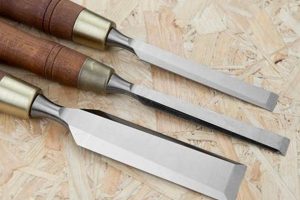
The process encompasses the design, fabrication, and assembly of implements specifically intended for shaping and manipulating wood. It ranges from crafting simple hand tools to constructing more complex machinery, depending on the level of precision and type of woodworking involved. A practical example includes forging a custom chisel from high-carbon steel, shaping its blade, and fitting it with a handle.
Proficiency in this area yields numerous advantages, including cost savings through self-sufficiency and the ability to create bespoke tools tailored to unique woodworking needs. Historically, skilled artisans often produced their own tools, granting them greater control over the quality and execution of their work. This capability fosters a deeper understanding of the tools’ functionality and promotes resourcefulness in the workshop.
The subsequent sections will explore various techniques and considerations related to tool making, covering aspects such as material selection, heat treating processes, handle construction, and sharpening methods. The aim is to provide a foundational understanding for those interested in pursuing this rewarding skill.
Essential Considerations in Tool Creation
The following guidelines represent best practices for constructing reliable and effective woodworking instruments. Adherence to these principles will improve tool performance and longevity.
Tip 1: Material Selection: Employ high-carbon steel for blades and cutting edges to ensure hardness and edge retention. For handles, consider hardwoods like maple or ash due to their durability and shock resistance.
Tip 2: Proper Heat Treatment: When working with steel, follow established heat treating procedures. This involves hardening to achieve the desired Rockwell hardness, followed by tempering to reduce brittleness.
Tip 3: Accurate Geometry: Precise angles and dimensions are critical for tool functionality. Pay close attention to the bevel angle on chisels and plane blades, and ensure accurate alignment of components.
Tip 4: Ergonomic Handle Design: Design handles that are comfortable and easy to grip for extended use. Consider the shape, size, and surface texture to minimize fatigue and maximize control.
Tip 5: Secure Fastenings: Employ robust methods for joining tool components. This may include rivets, screws, or epoxy adhesives, ensuring that connections can withstand repeated use and stress.
Tip 6: Sharpening Techniques: Master the art of sharpening. This includes using progressively finer grits of abrasive materials, such as sharpening stones or sandpaper, to achieve a keen edge.
Tip 7: Safety Precautions: Always prioritize safety when fabricating tools. Wear appropriate personal protective equipment, such as eye protection and gloves, and use machinery with caution.
Mastering these key considerations will result in woodworking instruments that are not only functional but also durable and safe to use, contributing to enhanced woodworking outcomes.
The article will now proceed to explore specific examples and detailed instructions for constructing individual woodworking tools.
1. Material Hardness

Material hardness is a critical determinant in the design and fabrication of woodworking tools. It dictates the tool’s ability to resist wear, maintain a sharp edge, and effectively cut or shape wood. The selection of materials with appropriate hardness characteristics is paramount for tool longevity and performance.
- Edge Retention
Higher material hardness directly correlates with improved edge retention. A blade crafted from hardened steel will maintain a sharper edge for a longer period, requiring less frequent sharpening. This is particularly important for tools like chisels, planes, and knives that rely on a keen edge for precise cutting.
- Wear Resistance
Hard materials exhibit superior resistance to abrasion and wear. Woodworking tools are subjected to constant friction against wood, and materials with insufficient hardness will degrade rapidly. The choice of a harder material ensures the tool maintains its shape and functionality over extended use.
- Impact Resistance vs. Brittleness
While high hardness is desirable, it is crucial to consider the trade-off with brittleness. Extremely hard materials may be prone to chipping or fracturing under impact. Therefore, a balance must be struck between hardness and toughness to ensure the tool can withstand the forces encountered during woodworking operations. Tempering processes are often employed to reduce brittleness while maintaining adequate hardness.
- Material Selection Criteria
The specific hardness requirements vary depending on the tool’s intended use. For example, a carving knife requires a very hard, yet relatively thin blade, while a mallet may be made from a softer, impact-resistant material like wood or polymer. Considerations such as the type of wood being worked, the frequency of use, and the desired level of precision all influence material selection based on hardness characteristics.
Ultimately, the careful selection and treatment of materials to achieve optimal hardness are fundamental aspects. The right material hardness ensures effective cutting, longevity, and user safety, directly influencing the overall quality of the woodworking process.
2. Handle Ergonomics

Handle ergonomics represents a crucial consideration in tool construction, significantly impacting usability, safety, and overall efficiency. The design and implementation of ergonomic principles directly influence the operator’s comfort, control, and the potential for strain or injury. A poorly designed handle can negate the benefits of a sharp blade or robust construction.
- Grip Geometry and Hand Fatigue
The shape and dimensions of the handle determine how comfortably and securely the tool can be held. Handles that are too small may cause cramping, while those that are too large can be difficult to grip firmly. Contoured handles that conform to the natural curves of the hand minimize pressure points and reduce the likelihood of fatigue during extended use. For example, a drawknife with cylindrical handles might cause wrist strain, whereas one with sculpted, palm-fitting grips would be more comfortable and controllable.
- Material Selection and Vibration Damping
The material used for the handle affects vibration transmission and overall grip. Dense hardwoods such as ash or maple offer a good balance of durability and vibration damping. Certain synthetic materials, like rubber or textured polymers, can further reduce vibration and improve grip, especially in damp or oily conditions. The selection of an appropriate handle material can significantly improve user comfort and reduce the risk of hand-arm vibration syndrome (HAVS) when using power tools or striking tools like chisels.
- Force Transmission and Leverage
Handle design influences the effective force that can be applied to the tool. A longer handle provides greater leverage, allowing for more powerful cuts or greater control. However, an excessively long handle may be unwieldy in tight spaces. The cross-sectional shape of the handle also affects force transmission; oval or elliptical shapes tend to provide a more secure and comfortable grip than circular handles. A well-designed handle optimizes force transmission, enabling the user to exert the required force with minimal effort and risk of slippage.
- Surface Texture and Grip Security
The surface texture of the handle influences grip security, especially under varied conditions. Smooth handles can become slippery when wet or oily, increasing the risk of accidents. Texturing, such as knurling, stippling, or carving, enhances grip and provides a more secure hold. The degree of texturing should be balanced against user comfort; excessively rough texturing can cause irritation during prolonged use. A carefully chosen surface texture ensures a reliable grip, improving control and safety.
The consideration of these ergonomic facets is essential when constructing woodworking tools. Optimizing handle design results in tools that are more comfortable, safer, and more efficient to use, ultimately enhancing the woodworking experience and the quality of the finished product. Prioritizing ergonomic principles during the manufacturing process ensures that the tool becomes an extension of the user’s hand, enabling precise and controlled movements.
3. Blade Geometry

Blade geometry is a foundational element in the design and production of woodworking tools. The specific angles, curves, and overall shape of a blade directly determine its cutting efficiency, the quality of the resulting surface finish, and the amount of force required for operation. A meticulous understanding of blade geometry is, therefore, indispensable for anyone engaged in tool making. For example, a chisel with an improperly ground bevel will struggle to sever wood fibers cleanly, leading to a ragged cut and increased effort on the part of the user. Conversely, a well-honed blade with the correct bevel angle will effortlessly pare away material, leaving a smooth surface.
Different woodworking tasks necessitate different blade geometries. A plane blade, designed for producing flat surfaces, requires a precise cutting edge angle and a specific relief angle to prevent the trailing edge from rubbing against the wood. A carving knife, intended for intricate detail work, demands a more acute cutting angle and a curved blade profile to allow for controlled manipulation within tight spaces. The process of achieving these geometries often involves grinding, honing, and polishing, each step requiring specialized techniques and tools. The ability to accurately shape and refine a blade’s geometry is a critical skill for any tool maker, directly impacting the functionality and usefulness of the finished product. For example, a block plane used for trimming end grain would have a different bevel angle than a smoothing plane used for refining large surfaces.
In summary, a comprehensive grasp of blade geometry is not merely an academic exercise but a practical necessity for anyone undertaking tool fabrication. Mastering the principles of blade angles, edge profiles, and surface finishes is essential for creating woodworking tools that are not only functional but also efficient and a pleasure to use. The challenges associated with achieving precise blade geometries underscore the importance of careful planning, skillful execution, and a thorough understanding of material properties. The geometry of a blade is a core component of woodworking tools functionality and therefore needs to be understood when making them.
4. Fastening Strength
Fastening strength is a critical parameter in the domain of tool construction, exerting a direct influence on the durability, reliability, and safety of implements. The connection to tool making arises from the fundamental need to securely join various components, ensuring they withstand the stresses and strains of regular use. Inadequate fastening strength can lead to premature tool failure, posing potential hazards to the user and compromising the quality of work. The selection of appropriate fastening methods and materials is, therefore, a key determinant in the longevity and performance of any woodworking tool.
The impact of fastening strength manifests in numerous ways. For example, the handle of a chisel or mallet must be securely attached to the striking surface to withstand repeated impacts. If the fastening is weak, the handle may loosen or detach, rendering the tool ineffective and potentially causing injury. Similarly, the blade of a plane or spokeshave must be firmly secured within its body to maintain proper alignment and prevent movement during use. Fastening methods can range from traditional dovetail joints and mortise-and-tenon constructions to modern adhesives and mechanical fasteners such as rivets and screws. Each approach offers different levels of strength and suitability depending on the specific application. In tool construction, the mechanical properties of the fastener must be carefully matched to the materials being joined and the anticipated stresses to which the tool will be subjected.
In summary, fastening strength is not simply a desirable attribute but a necessary condition for robust and reliable woodworking tools. Understanding the principles of fastening, selecting appropriate techniques and materials, and implementing quality control measures during tool fabrication are all essential steps. Ignoring these considerations can result in tools that are prone to failure, unsafe to use, and ultimately, a poor investment. Proper construction ensures that the tool will withstand the rigors of use and provide years of service, thus ensuring safety for the worker.
5. Sharpening Precision

Sharpening precision constitutes an indispensable element within the broader skill set of tool creation. The ability to create and maintain keen cutting edges directly influences the performance and effectiveness of woodworking implements. A tool meticulously crafted but inadequately sharpened will prove significantly less useful than one sharpened with a high degree of accuracy. The connection arises from the inherent need for sharp edges to efficiently sever wood fibers, enabling clean cuts and smooth surface finishes. Examples include the construction of a plane blade: even if the blade is perfectly dimensioned and aligned, a dull or poorly sharpened edge will result in tear-out and uneven planing. Therefore, mastering the techniques of sharpening precision is a critical step in completing the process of tool making.
Achieving sharpening precision involves a comprehensive understanding of abrasive materials, sharpening angles, and honing techniques. This includes the selection of appropriate sharpening stones, the consistent maintenance of the correct bevel angle, and the elimination of any burr or wire edge. The practical application extends to various tool types: a carving chisel demands a different sharpening approach than a marking knife, and each tool requires a specific edge profile for optimal performance. Furthermore, the ability to diagnose edge imperfections and correct them efficiently is essential for maintaining peak performance over time. A practical example includes observing the reflection of light on the edge of a blade to detect any rounding or dull spots, and then using appropriate sharpening methods to restore a sharp, well-defined cutting edge.
In summary, sharpening precision is not merely an ancillary skill but an integral component of successful tool production. The time and effort invested in honing and maintaining sharp edges directly translate into enhanced tool performance, improved woodworking results, and increased user satisfaction. While the challenges of achieving consistent sharpness can be significant, the benefits of mastering this skill are undeniable. By integrating sharpening precision into the tool-making process, craftspeople ensure that their creations are not only well-designed and constructed but also capable of performing their intended functions to the highest standard.
Frequently Asked Questions
The following section addresses common inquiries regarding tool fabrication, offering insights into best practices and key considerations.
Question 1: What are the primary benefits of crafting one’s own woodworking tools?
Creating tools allows for customization to specific needs, potential cost savings compared to purchasing commercially available options, and a deeper understanding of tool functionality and maintenance.
Question 2: Which materials are most suitable for constructing tool blades and handles?
High-carbon steel is preferred for blades due to its hardness and edge retention. Hardwoods such as maple, ash, or hickory are recommended for handles due to their durability and shock resistance.
Question 3: What is the importance of heat treating steel during tool making?
Heat treatment, specifically hardening and tempering, is crucial for achieving the desired balance of hardness and toughness in steel blades. Hardening increases wear resistance, while tempering reduces brittleness.
Question 4: How does blade geometry affect tool performance?
Blade geometry, including the cutting edge angle and relief angle, directly influences cutting efficiency, surface finish quality, and the amount of force required for operation. Different geometries are suited to different tasks.
Question 5: What safety precautions should be observed when crafting tools?
Appropriate personal protective equipment, such as eye protection and gloves, is essential. Machinery should be used with caution, and established safety protocols must be followed to minimize the risk of injury.
Question 6: How can optimal sharpness be maintained on woodworking tools?
Regular sharpening using progressively finer grits of abrasive materials is necessary. Consistent maintenance of the correct bevel angle and the elimination of burrs contribute to sustained edge sharpness.
This FAQ section provided an overview of essential considerations when crafting woodworking tools. These tools require careful planning, a methodical approach, and adherence to safety guidelines.
The subsequent section will explore specific tool construction projects in detail.
Conclusion
The preceding discussion has detailed the multifaceted process of how to make woodworking tools. Material selection, heat treatment, handle ergonomics, blade geometry, fastening strength, and sharpening precision have been established as critical factors influencing the quality, durability, and effectiveness of self-made implements. A comprehensive understanding of these elements is necessary for achieving optimal results.
The information presented is intended to serve as a foundational resource for individuals seeking to construct their own tools. Continued study, practice, and adherence to safety protocols are essential for success. The ability to produce reliable, high-performing tools represents a significant asset for any serious woodworker and therefore requires a diligent approach.
![Buy Woodworking Tools Sales Online - [Your Brand] | Step-by-Step Guides, Tools & Inspiration to Build Beautiful Wooden Decor on a Budget](https://woodfromhome.com/wp-content/uploads/2026/05/th-213-300x200.jpg "Buy Woodworking Tools Sales Online - [Your Brand] Step-by-Step Guides, Tools & Inspiration to Build Beautiful Wooden Decor on a Budget")