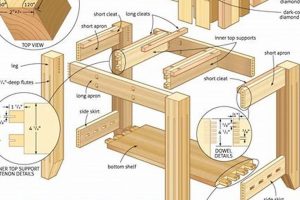
The term identifies constructive activities involving young children using wood and basic tools. These endeavors typically involve soft woods, pre-cut shapes, and child-safe implements like small hammers, glue, and sandpaper. A basic birdhouse construction, for instance, exemplifies such an activity.
Introducing young learners to these activities offers several developmental advantages. Fine motor skill refinement, spatial reasoning enhancement, and problem-solving abilities are all cultivated. Historically, engagement with tangible materials has been recognized as vital in early childhood education, fostering creativity and self-confidence.
The subsequent discussion will explore suitable wood types, tool selection guidelines, project ideas appropriate for this age group, and safety protocols critical for ensuring a positive and educational experience. These elements form the cornerstone of successful and enriching interactions with woodworking within the early childhood curriculum.
Essential Guidance for Early Childhood Woodcrafting
The following recommendations are designed to facilitate safe and effective implementation of wood-based activities with young children, ensuring an enriching and developmentally appropriate experience.
Tip 1: Material Selection: Opt for softwood varieties such as pine or balsa. These woods are easier for small hands to manipulate and require less force to shape, minimizing the risk of injury.
Tip 2: Tool Adaptation: Employ child-sized tools specifically designed for small hands. Ensure tools are well-maintained and sharp enough to function effectively with minimal pressure, preventing frustration and accidents.
Tip 3: Project Simplicity: Begin with basic projects involving minimal steps and readily achievable outcomes. Simple geometric shapes or pre-cut kits offer a successful initial engagement, fostering confidence.
Tip 4: Comprehensive Supervision: Maintain close and constant supervision during all activities. Provide clear and concise instructions, demonstrating each step and offering assistance as needed.
Tip 5: Prioritize Safety: Implement stringent safety protocols, including mandatory safety goggles to protect eyes from sawdust and potential splinters. Emphasize the importance of responsible tool handling.
Tip 6: Workspace Preparation: Designate a dedicated workspace free from clutter and distractions. Ensure adequate lighting and ventilation to promote visibility and air quality.
Tip 7: Instruction and Demonstration: Prior to commencing any task, carefully demonstrate the process step-by-step. Encourage queries and furnish guidance as needed.
Adherence to these guidelines will contribute to a secure and rewarding environment, promoting skill development and fostering a positive association with constructive activities.
The subsequent sections will provide detailed project examples and address potential challenges encountered during these activities, offering practical solutions for a comprehensive approach.
1. Tool Safety

Tool safety is paramount in the context of woodworking endeavors undertaken by young children. Given their limited motor skills and understanding of potential hazards, a stringent focus on safety protocols is non-negotiable.
- Appropriate Tool Selection
The selection of tools specifically designed for young children is crucial. This includes smaller, lightweight hammers, hand saws with safety guards, and clamps that are easy to manipulate. Tools should be in good working order, with sharp edges (where applicable) properly maintained by adults to ensure efficient operation and minimize the risk of slippage or accidental injury.
- Supervision Ratio
An adequate adult-to-child supervision ratio is essential. A higher ratio allows for closer monitoring, immediate intervention in unsafe situations, and individualized instruction on proper tool usage. This proactive approach is more effective than reactive measures taken after an incident.
- Work Environment Setup
The physical environment must be meticulously prepared to minimize risks. This includes ensuring adequate lighting, a stable work surface, and clear pathways to prevent tripping hazards. The work area should be free of distractions and extraneous materials that could interfere with the activity.
- Safety Education and Demonstration
Prior to engaging in any woodworking activity, children must receive clear and concise instruction on tool handling and safety procedures. Demonstrations should be slow and deliberate, emphasizing proper grip, posture, and cutting or hammering techniques. Reinforcement of safety rules should be ongoing throughout the activity.
These facets of tool safety are inextricably linked within the framework of woodworking projects involving young learners. Neglecting any one aspect can compromise the safety of the children and negate the developmental benefits of the activity. Ongoing evaluation and adaptation of safety protocols are essential to maintain a secure and enriching learning environment. For example, consistent checks of tools for wear and tear and regular discussions about safety rules can enhance the overall safety culture.
2. Softwood Selection

The selection of appropriate wood materials is a critical determinant in the success and safety of wood-based activities for young children. Softwoods, such as pine, balsa, and basswood, are preferentially indicated for use in woodworking projects. The inherent properties of these materials directly mitigate risks associated with strength exertion and tool control. For instance, the reduced density of pine compared to hardwoods like oak necessitates less force to cut, sand, or hammer, thereby minimizing the likelihood of injury or fatigue among young participants. This choice is, therefore, not merely a matter of convenience but a fundamental consideration in pedagogical design, aligning the demands of the activity with the physical capabilities of the children involved. An example of this impact can be seen in a project involving the construction of a simple birdhouse; using pine allows children to independently drive nails without requiring excessive force, fostering a sense of accomplishment and reducing the reliance on adult assistance.
The benefits of employing softwoods extend beyond safety considerations to encompass broader educational objectives. The ease with which these woods can be manipulated facilitates greater creative expression and exploration. Children are able to shape, carve, and decorate softwoods with relative ease, fostering a sense of ownership and engagement. The smooth grain and uniform texture of these materials also provide an ideal surface for painting, staining, or embellishing, allowing for personalized customization. A practical application of this understanding is observed in projects involving the creation of decorative wooden ornaments; the children are enabled to shape and adorn these ornaments according to their individual aesthetic preferences, thereby promoting artistic development and individual expression.
In conclusion, the deliberate selection of softwoods as the primary material constitutes a cornerstone of responsible and effective woodworking instruction for young children. This choice directly addresses concerns related to safety, facilitates skill development, and promotes creative expression. Challenges may arise in sourcing high-quality, sustainably harvested softwoods, but these are outweighed by the inherent advantages. This understanding highlights the practical significance of material choice in shaping the overall quality and impact of constructive activities.
3. Project Simplicity
Project simplicity is a critical determinant of success in woodworking endeavors for young children. Complexity can induce frustration, diminish engagement, and compromise safety. Straightforward designs with limited steps facilitate understanding and skill acquisition. The cognitive load is reduced, allowing greater focus on fundamental techniques such as hammering or sanding. For example, constructing a pre-cut birdhouse from a kit with minimal assembly steps presents a higher probability of successful completion and reinforces positive associations with constructive activities. The link to fundamental techniques cannot be overemphasized. A primary benefit of simple projects is its contribution to fine motor skill development. Complex projects increase the risk of the development of bad habits because kids will be doing anything to get it finished.
The effects of project simplicity extend beyond immediate task completion. Successfully navigating a straightforward project fosters confidence and self-efficacy. This sense of accomplishment serves as a powerful motivator for future engagement. Simple projects also require fewer specialized tools or techniques, reducing the need for intensive adult supervision and allowing children to exercise greater autonomy within a controlled environment. This fosters independence and problem-solving skills. For instance, building a basic wooden frame requires only cutting, and basic assembly; the child can learn basic math skills through these activities as well.
In summary, project simplicity is not merely a matter of convenience; it is a fundamental element of effective woodworking instruction for young children. It enhances safety, promotes skill development, fosters confidence, and allows for greater autonomy. While challenges may arise in balancing simplicity with educational value, the strategic design of age-appropriate, straightforward projects remains paramount for ensuring a positive and enriching experience. The understanding of project simplicity is the first step towards introducing woodworking to kids.
4. Adult Supervision

The presence and engagement of adults constitute a critical component in the safe and effective execution of woodworking projects involving kindergarten-aged children. The age group’s developmental stage necessitates a heightened level of oversight to mitigate potential hazards and maximize learning opportunities. Adult involvement transcends mere observation; it requires active participation, instruction, and proactive intervention.
- Hazard Identification and Mitigation
Adults are responsible for identifying potential hazards within the woodworking environment and implementing measures to minimize risks. This includes ensuring appropriate tool selection, maintaining a safe workspace, and providing clear instructions on tool usage. For example, an adult should inspect tools for sharpness and proper functioning before each use, and ensure that children wear safety goggles to protect their eyes from flying debris. The implications of failing to identify and mitigate hazards can range from minor injuries to more serious accidents.
- Skill Instruction and Technique Guidance
Effective woodworking requires the acquisition of specific skills and techniques. Adults provide direct instruction and guidance on proper tool handling, cutting methods, and assembly procedures. Demonstrating correct techniques and offering constructive feedback are essential components of skill development. An example of this is demonstrating the correct grip and sawing motion before allowing a child to use a hand saw. This proactive instruction can prevent the development of bad habits and ensures safe tool usage. Safety and technique must be taught hand-in-hand. A failure in this area directly impacts learning and safety.
- Emotional Support and Encouragement
Woodworking can be challenging for young children, and adults play a crucial role in providing emotional support and encouragement. Positive reinforcement and constructive feedback can boost confidence and motivation. Adults can also help children overcome frustration and persist through difficult tasks. An example of this is providing praise for a child who successfully hammers a nail straight, even if it takes several attempts. The presence of a supportive adult can significantly impact a child’s overall experience and foster a positive association with woodworking.
- Enforcement of Safety Protocols
Adults are responsible for enforcing safety protocols and ensuring that children adhere to established guidelines. This includes monitoring tool usage, ensuring proper protective equipment is worn, and intervening when unsafe practices are observed. An example is immediately correcting a child who is not wearing safety goggles while sanding. Consistent enforcement of safety protocols is essential for creating a safe and predictable learning environment.
The facets of adult supervision collectively contribute to a safe, enriching, and educational experience for young children engaging in woodworking projects. Without adequate adult involvement, the inherent risks associated with tool usage and material handling can significantly outweigh the potential benefits. Strategic implementation of these supervisory components maximizes learning outcomes and fosters a positive relationship with constructive activities.
5. Skill Development

The integration of woodworking activities into the kindergarten curriculum provides a tangible platform for the cultivation of essential developmental skills. These structured experiences foster cognitive, physical, and social-emotional growth through engagement with tools, materials, and constructive processes.
- Fine Motor Skill Refinement
Woodworking necessitates the precise manipulation of tools and materials, contributing directly to the development of fine motor skills. Activities such as hammering nails, sanding surfaces, and applying glue require controlled hand and finger movements. These actions strengthen hand-eye coordination and dexterity, skills that are transferable to other academic and life-related tasks, such as writing and self-care. For example, a child learning to hammer a nail into a piece of wood improves their ability to control the force and direction of their movements, enhancing overall motor control. A common issue is the child using their other hand as a fulcrum which is why monitoring is a must.
- Spatial Reasoning Enhancement
Woodworking projects often involve understanding spatial relationships and geometric concepts. Children must visualize how different components fit together to create a finished product. This process fosters spatial reasoning abilities, which are critical for understanding concepts in mathematics and engineering. For example, constructing a birdhouse requires understanding how different shapes interlock to form a three-dimensional structure, reinforcing spatial awareness. Pre-cut birdhouses are a great way to start this activity because they have the shapes for the kids already present and the spatial awareness comes with how the pieces come together.
- Problem-Solving Abilities
Woodworking inherently presents challenges that require problem-solving skills. Children must learn to troubleshoot issues, adapt to unexpected outcomes, and devise creative solutions to overcome obstacles. This process cultivates critical thinking and analytical reasoning skills. For instance, if a piece of wood splits while hammering, a child must develop a strategy to rectify the situation, such as using glue or selecting a different nail. It is also worth investigating what caused the split to happen in the first place so they don’t happen again. Safety first of course.
- Social-Emotional Growth
Collaborative woodworking projects offer opportunities for social interaction and emotional development. Children learn to share tools, communicate effectively, and cooperate towards a common goal. This fosters teamwork, empathy, and conflict resolution skills. Working together to build a large wooden structure, for example, requires children to negotiate roles, share ideas, and resolve disagreements constructively, promoting social-emotional learning and collaboration.
These interconnected facets highlight the significance of incorporating woodworking projects into the early childhood curriculum. The constructive manipulation of materials not only imparts practical skills but also fosters holistic development across cognitive, physical, and social-emotional domains. The carefully considered integration of these projects can therefore contribute significantly to a child’s overall readiness for future academic and life challenges.
Frequently Asked Questions
The following questions and answers address common concerns and misconceptions surrounding the implementation of constructive activities involving wood for children aged five to six.
Question 1: Is woodworking safe for kindergarten children?
When implemented with appropriate safety measures, including close supervision, child-sized tools, and softwoods, woodworking can be a safe and beneficial activity. Comprehensive safety protocols are essential for mitigating potential risks.
Question 2: What types of wood are most suitable for these projects?
Softwoods such as pine, balsa, and basswood are recommended. These materials are easier for young children to manipulate and pose a lower risk of injury due to their reduced density.
Question 3: What tools are appropriate for kindergarten woodworking?
Child-sized hammers, hand saws with safety guards, and clamps designed for small hands are appropriate choices. All tools must be well-maintained and in good working order.
Question 4: How much supervision is required?
Close and constant adult supervision is paramount. A high adult-to-child ratio ensures that each child receives adequate attention and guidance during the activity.
Question 5: What are the developmental benefits of woodworking for young children?
Woodworking fosters fine motor skill development, spatial reasoning, problem-solving abilities, and social-emotional growth. It provides a tangible platform for learning and creativity.
Question 6: How can projects be designed to be age-appropriate?
Projects should be simple and straightforward, with minimal steps and readily achievable outcomes. Pre-cut kits and basic geometric shapes can be used to ensure success and build confidence.
In conclusion, careful planning, adherence to safety protocols, and the selection of appropriate materials and tools are essential for ensuring a positive and enriching experience for children engaging in woodworking. The benefits far outweigh the risks when these factors are thoughtfully considered.
The subsequent section will address potential challenges encountered during these projects and offer practical solutions for overcoming them.
kindergarten woodworking projects
This exploration has underscored the critical elements for successful implementation. Safety protocols, appropriate material selection, simplified project designs, and attentive adult supervision are not merely suggested practices; they are fundamental preconditions. The developmental benefits, spanning fine motor skills, spatial reasoning, problem-solving, and social-emotional growth, are contingent upon these foundational principles. A lapse in any of these areas compromises the entire endeavor.
The future of early childhood education should recognize the value of hands-on learning. By prioritizing safety and carefully structuring activities, educators can unlock the potential of constructive projects to shape well-rounded individuals. The emphasis is now on educators and caregivers to adopt these projects, fostering a secure environment to enrich development through such a fundamental form of hands-on work.