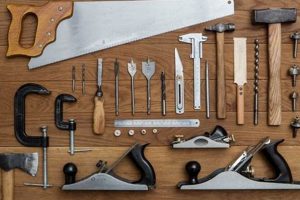
Essential implements for shaping wood, pared down to the absolute core requirements, define a specific approach to the craft. This involves a focused selection of hand tools, prioritizing versatility and effectiveness, thereby enabling a wide range of woodworking projects with a significantly reduced inventory. For example, a saw, a chisel, a hand plane, and measuring/marking tools could form the basis of a set designed for furniture making or smaller crafts.
Adopting this limited toolkit offers several advantages. It reduces financial investment, simplifies workspace management, and encourages a deeper understanding of each tool’s capabilities. Historically, many skilled artisans relied on a smaller collection of implements, mastering their use through experience and necessity, resulting in finely crafted pieces. This philosophy fosters resourcefulness and problem-solving skills within the woodworking practice.
The subsequent discussion will delve into the specific selection criteria for building such a set, explore crucial maintenance techniques for longevity, and highlight project types particularly well-suited to this focused approach. Detailed consideration will be given to optimizing work practices with a reduced number of implements.
Essential Guidance for a Streamlined Woodworking Approach
The following are suggestions for those seeking to minimize their tool investment without compromising the ability to produce quality woodwork.
Tip 1: Prioritize Quality Over Quantity: Investing in higher-quality hand tools results in increased durability, improved performance, and greater long-term cost-effectiveness. Avoid purchasing large sets of inexpensive tools; instead, focus on acquiring individual implements from reputable manufacturers.
Tip 2: Begin with Core Functionality: A hand saw, a sharp chisel, a smoothing plane, and accurate measuring tools form the basis of a functional set. Add specialized tools only as specific project requirements demand them.
Tip 3: Sharpening is Paramount: Maintaining sharp edges on cutting tools is crucial for efficiency and safety. Invest in a reliable sharpening system and develop consistent honing practices. A dull tool requires more force, leading to fatigue and potential errors.
Tip 4: Consider Multi-Purpose Tools: Explore tools designed for multiple functions. Combination squares, for instance, can serve as a square, miter, depth gauge, and level, reducing the need for multiple specialized instruments.
Tip 5: Optimize Workspace Organization: A well-organized workspace maximizes efficiency, even with a limited set of tools. Implement a system for storing and accessing tools that minimizes clutter and wasted time.
Tip 6: Embrace Hand Tool Techniques: Develop proficiency in hand tool techniques to maximize their capabilities. Practice accurate sawing, precise chiseling, and controlled planing to achieve professional results.
Tip 7: Research Before Purchasing: Before acquiring any tool, research its features, reviews, and intended applications. Online forums, woodworking books, and experienced woodworkers can provide valuable insights.
By focusing on essential high-quality implements, maintaining their sharpness, and developing efficient work practices, one can achieve significant woodworking results without an extensive collection of tools.
The subsequent section will address specific tool selection guidelines and demonstrate how to adapt project designs to suit a reduced tool inventory.
1. Versatility

The concept of versatility occupies a central position within a streamlined woodworking approach. The capacity of a single implement to perform multiple functions is paramount when striving for efficiency with a reduced tool inventory. Maximizing the utility of each tool lowers overall investment, minimizes workspace requirements, and encourages a deeper understanding of its capabilities.
- Multi-Functional Design
Certain tools are inherently designed for a range of tasks. For instance, a combination square serves as both a square and a measuring device, while a block plane can be used for smoothing end grain, chamfering edges, and light shaping. Employing such multi-functional tools allows the woodworker to avoid acquiring specialized instruments for each individual operation. This approach is especially advantageous in limited workspace environments.
- Adaptability Through Technique
Proficiency in technique can expand the functional range of implements. A skilled artisan can adapt a single chisel for tasks ranging from fine paring to chopping mortises. Mastery of sharpening techniques further contributes to tool adaptability, enabling precise control over cutting edges. This emphasis on technique requires dedicated practice and an intimate understanding of wood behavior.
- Material Compatibility
A versatile tool should ideally be compatible with a range of wood types. A well-tuned hand plane, for example, should be capable of efficiently working both hardwoods and softwoods. Tools that require extensive modification or are only suitable for specific wood densities diminish the overall efficiency of a streamlined kit. Material selection can be impacted by the type of tool used.
- Space Efficiency
Workspaces are often limited and valuable. Versatile tools consolidate function and reduce physical clutter, improving workspace ergonomics and productivity. A smaller collection of implements facilitates easier organization and quicker access, minimizing time spent searching for the right tool.
Ultimately, the relationship between implement versatility and minimalist woodworking practices reflects a focus on resourcefulness and efficient application of skills. Rather than relying on an extensive array of specialized tools, the woodworker seeks to maximize the potential of a smaller, carefully selected collection, adapting techniques and materials to suit the available implements. This philosophy promotes a deeper appreciation for the craft and encourages innovative problem-solving.
2. Sharpness

Within the context of a reduced tool inventory, sharpness assumes heightened importance. Inefficient cutting edges diminish the capabilities of each tool, demanding increased physical exertion and compromising precision. A dull chisel requires more force, potentially leading to uncontrolled movements and inaccurate results. A dull saw creates rougher cuts, necessitating additional refinement. Therefore, maintaining optimal sharpness is not merely a matter of convenience, but a foundational element for achieving quality outcomes with fewer implements.
Sharpness directly impacts the versatility of a minimalist tool collection. A razor-edged plane, for instance, can effectively smooth both hardwoods and softwoods, negating the need for multiple planes with varying blade angles. A keen chisel can execute fine paring cuts as well as chop mortises, maximizing its functional range. Conversely, a dull tool limits the materials it can effectively process and restricts the types of cuts it can perform, thus undermining the efficiency gains associated with a minimal toolset. Consider a single, high-quality Japanese pull saw; its finely sharpened teeth allow for precise cuts across various wood grains, whereas a dull saw would struggle, potentially requiring additional tools to compensate.
In conclusion, the relationship between sharpness and a minimalist toolkit is symbiotic. Enhanced sharpness amplifies the effectiveness and versatility of each tool, mitigating the limitations inherent in a reduced inventory. The investment in quality sharpening equipment and the development of consistent sharpening practices are thus essential components of achieving professional results within this woodworking philosophy. A focus on sharpness ensures that the few tools selected perform at their peak potential, transforming limited resources into high-quality craftsmanship.
3. Durability

Durability is a cornerstone of a streamlined woodworking approach. The practice of employing a limited set of implements places a premium on the longevity and resilience of each item. When resources are constrained, the failure of a single tool can significantly impede progress, necessitating costly repairs or replacements. Therefore, the selection of robust, well-constructed tools becomes a critical factor in ensuring the consistent and reliable execution of woodworking tasks. Consider, for instance, a hand plane. If the plane’s body is constructed from inferior materials, it may warp or crack under stress, rendering it useless for achieving flat, consistent surfaces. This highlights the critical importance of selecting durable tools to avoid unexpected interruptions and maintain workflow efficiency.
The selection of durable tools extends beyond the initial purchase price. While less expensive options may be tempting, their reduced lifespan and potential for premature failure can result in higher long-term costs. Investing in tools crafted from high-quality materials, such as hardened steel for cutting edges and dense hardwoods for handles, ensures years of dependable service. Furthermore, proper maintenance practices, including regular cleaning, lubrication, and sharpening, contribute significantly to the lifespan of tools. A well-maintained tool, even one subjected to heavy use, can retain its functionality and precision for extended periods. As an example, a high-quality chisel, properly cared for, can last for generations, serving as a reliable instrument for a wide range of tasks.
In summary, durability directly impacts the viability of a minimal woodworking setup. By prioritizing robust construction, employing diligent maintenance practices, and recognizing the long-term cost-effectiveness of high-quality implements, woodworkers can ensure that their limited toolkit remains a reliable and effective resource. This focus on durability translates into reduced downtime, lower replacement costs, and the sustained ability to produce high-quality woodworking projects, ultimately maximizing the value and efficiency of a streamlined approach.
4. Portability

Reduced tool volume directly corresponds to enhanced mobility, a crucial attribute within the minimalist woodworking philosophy. A smaller collection facilitates easier transportation and storage, enabling woodworking projects to be undertaken in diverse locations with limited space. The ability to relocate a complete working setup efficiently expands project opportunities and accommodates various lifestyle constraints. This is a particular consideration for hobbyists, apartment dwellers, or individuals engaging in on-site repair work.
The practical significance of portability extends beyond mere convenience. Consider a craftsman working in temporary or shared workshop spaces. A reduced, easily transportable set of essential implements allows for quick setup and teardown, minimizing disruption to the workspace and maximizing productive time. Similarly, for individuals involved in restoration projects at remote locations, the ability to transport a comprehensive, yet compact, set of woodworking tools is indispensable. The selection of lightweight, durable materials for both the tools themselves and their storage containers further enhances portability. For example, a canvas tool roll or a compact toolbox can efficiently organize and protect essential implements while minimizing weight and bulk.
In conclusion, portability is not merely a desirable feature but a fundamental element of the minimalist approach to woodworking. It expands the potential for woodworking projects to be undertaken in diverse environments, enhances efficiency in shared or temporary workspaces, and contributes to a more flexible and adaptable approach to the craft. By carefully considering the weight, size, and storage requirements of each tool, woodworkers can create a highly portable kit that aligns with the principles of minimalist woodworking.
5. Precision

In the realm of woodworking, accuracy is paramount, and its importance is amplified when working with a streamlined set of tools. Each cut, joint, and measurement must be executed with meticulous care, as there are fewer opportunities to compensate for errors or make adjustments. Precision, therefore, becomes an indispensable attribute within a minimalist woodworking practice.
- Accurate Measurement and Marking
Precise measurement and marking form the foundation of accurate woodworking. With limited tooling, the need for precise transfer of dimensions and angles becomes critical. Examples include using a precise measuring square or marking gauge to ensure consistent dimensions across multiple workpieces, reducing cumulative errors. Without such accuracy, joinery will suffer, and the final project may deviate from the intended design. This is more crucial when the tool selection available cannot easily correct errors.
- Sharp and Well-Maintained Tools
The sharpness of cutting tools directly affects the accuracy of the work. Dull tools require more force, leading to inaccuracies and potential tear-out. Sharp chisels and planes allow for controlled and precise removal of material, crucial when a minimal toolset necessitates adaptability and multi-use functionality. Consistent honing and sharpening are therefore essential for achieving accuracy with a limited tool selection.
- Controlled Cutting Techniques
Mastery of hand-tool cutting techniques enables consistent and accurate cuts. Precision sawing, for example, requires focus and skill to maintain a straight line and consistent depth. Similarly, controlled chiseling techniques allow for precise shaping of joints and other details. These skills become particularly important when the tool inventory lacks specialized equipment for specific tasks, relying instead on the woodworker’s ability to adapt techniques.
- Careful Joinery Execution
Accurate joinery is paramount when constructing sturdy and aesthetically pleasing woodworking projects. Precise cutting of tenons, mortises, and other joinery elements ensures tight-fitting, strong connections. When using a smaller number of tools, each step in the joinery process requires meticulous attention to detail, as there are fewer opportunities for corrections. For instance, a precisely cut dovetail joint demonstrates both skill and adherence to accurate measurement.
In summary, the reliance on accurate measurement, tool maintenance, skilled techniques, and careful joinery highlights the symbiotic relationship between precision and minimalist woodworking. By prioritizing these elements, woodworkers can overcome the limitations of a reduced tool inventory and achieve exceptional results through skillful execution and meticulous attention to detail.
6. Affordability
Cost considerations represent a primary impetus for adopting a focused approach to woodworking. A reduced inventory minimizes initial expenditure, mitigating the financial barrier to entry for aspiring woodworkers and providing a cost-effective alternative for experienced craftspeople.
- Reduced Initial Investment
Acquiring a comprehensive set of power tools and specialized hand tools can require a substantial financial outlay. Focusing on core implements, such as a quality saw, chisel, and plane, significantly lowers initial costs. For instance, a beginner might acquire a functional set of essential hand tools for a fraction of the cost associated with a comparable power tool collection. This allows individuals with limited budgets to engage in the craft without incurring significant debt.
- Lower Maintenance Expenses
Fewer tools translate to reduced maintenance requirements. Power tools often necessitate periodic servicing, replacement parts, and specialized cleaning supplies. Hand tools, by contrast, typically require only sharpening and occasional lubrication. The cost of maintaining a minimal set of hand tools is significantly lower compared to the upkeep of a larger, more complex tool collection. This contributes to long-term cost savings and simplifies tool management.
- Decreased Storage Requirements
A smaller collection of implements requires less storage space, reducing the need for extensive workshop facilities. This is particularly relevant for individuals working in apartments, small homes, or shared workspaces where square footage is at a premium. The cost of renting or maintaining a dedicated workshop space can be substantial. A minimalist approach allows woodworkers to operate in smaller, more affordable environments.
- Increased Tool Lifespan
Investing in high-quality versions of essential tools, rather than purchasing a large quantity of inexpensive alternatives, often results in increased longevity. Durable implements constructed from robust materials are less prone to breakage and require less frequent replacement. This reduces long-term costs and provides a more sustainable approach to woodworking. Focusing on quality over quantity ensures that each tool performs reliably for an extended period.
The financial benefits extend beyond mere savings; they foster resourcefulness and encourage a deeper understanding of each tool’s capabilities. Woodworkers utilizing a limited set often develop innovative techniques to overcome challenges, maximizing the utility of their resources and cultivating a more profound connection with the craft. The emphasis on affordability thus promotes both financial prudence and creative problem-solving within the woodworking practice.
Frequently Asked Questions
The subsequent section addresses common inquiries regarding the practical application and underlying philosophy of a pared-down approach to woodworking tools. The goal is to clarify potential misconceptions and provide informative guidance based on experience and best practices.
Question 1: Is it possible to construct complex furniture pieces using a reduced tool collection?
Achieving intricate designs with a minimalist set necessitates careful planning and adapted techniques. Joinery methods might require simplification, and reliance on hand tools becomes paramount. Projects may demand more time and patience, but the creation of complex pieces remains achievable with skill and dedication.
Question 2: How does the absence of power tools impact efficiency in a minimalist woodworking environment?
The absence of powered instruments typically increases the time required for certain operations, such as dimensioning lumber and cutting large joints. However, hand tools offer greater control and precision, potentially reducing errors and rework. Efficiency is achieved through skillful application of hand tool techniques and optimized workflow.
Question 3: What constitutes a “core” set of implements for an individual starting with a refined toolset?
A fundamental assortment generally includes a high-quality hand saw, a sharp chisel set, a smoothing plane, measuring and marking tools (square, marking gauge), and sharpening equipment. These tools enable a wide range of woodworking tasks, providing a solid foundation for future expansion based on specific project needs.
Question 4: How does this relate to specific types of wood?
Material selection should align with the capabilities of the available implements. Softer woods are often easier to work with hand tools, requiring less force and reducing the risk of tool wear. Harder woods demand sharper tools and refined techniques. The specific wood type influences tool performance and the required level of skill.
Question 5: How frequently should edges be sharpened for optimal performance?
Sharpening frequency depends on tool usage and wood type. Regular honing is crucial to maintain a keen edge. As a general guideline, tools should be sharpened whenever cutting becomes difficult or the edge appears dull. Consistent maintenance ensures optimal performance and prolongs tool lifespan.
Question 6: Is this is a suitable path for individuals new to woodworking?
This serves as an advantageous starting point for beginners. It encourages a deeper understanding of tool functionality and fosters essential woodworking skills. The reduced initial investment also minimizes financial risk, making it an accessible entry point into the craft.
In summary, the essence of a pared-down approach lies in maximizing the potential of a few, carefully selected items. Skill development and resourcefulness are paramount to achieving quality outcomes.
The next section will address strategies for adapting project plans to accommodate a reduced inventory.
Conclusion
The preceding exploration has underscored the multifaceted nature of minimalist woodworking tools. It has examined the selection criteria, maintenance requirements, and practical applications associated with this focused approach. Central to its effectiveness is the emphasis on quality, sharpness, durability, and adaptability, which, when combined, facilitate a surprising range of woodworking tasks.
The significance of this method lies in its potential to democratize the craft, encouraging resourcefulness and fostering a deeper connection between woodworker and material. A commitment to mastering essential implements, coupled with mindful project design, can unlock considerable creative potential. Further investigation into advanced joinery techniques and adaptable project plans will continue to expand the possibilities within this framework.