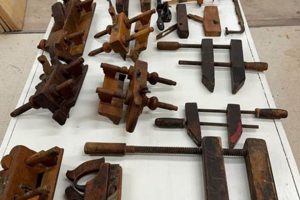
Precision in woodworking begins with accurate marking and measurement. Instruments employed for this purpose guide the cutting, shaping, and joining of wood components. Examples include squares for ensuring right angles, rulers and measuring tapes for length determination, marking gauges for parallel lines, and compasses for creating arcs and circles.
Employing these instruments correctly is fundamental to achieving desired dimensions and alignment. Accurate dimensioning prevents errors that can accumulate throughout a project, leading to structural weakness or aesthetic flaws. Historically, craftspeople relied on simple, hand-made versions of these tools. Modern manufacturing has introduced greater precision and features, enhancing efficiency and accuracy in the woodworking process.
The following sections will delve into specific types of these instruments, outlining their uses, benefits, and proper application for various woodworking tasks. Understanding and mastering the use of these instruments is essential for both novice and experienced woodworkers seeking to produce high-quality work.
Optimizing Woodworking Precision
Effective utilization of instruments designed for dimensioning and marking is crucial for achieving superior woodworking results. The following tips offer guidance on maximizing their potential.
Tip 1: Square Calibration: Regularly verify the accuracy of squares against a known right angle. Deviations, however small, can compound over the course of a project.
Tip 2: Measuring Tape Tension: Maintain consistent tension when using a measuring tape. Varying tension introduces inaccuracies, particularly over longer distances.
Tip 3: Marking Gauge Application: Ensure the fence of a marking gauge remains firmly against the workpiece edge throughout the marking process. Slippage results in inconsistent line placement.
Tip 4: Compass Stability: When scribing circles or arcs, secure the compass pivot point firmly. A shifting pivot leads to distorted shapes.
Tip 5: Lighting Considerations: Adequate lighting is essential for precise mark visibility. Shadows and poor illumination obscure fine lines, increasing the risk of error.
Tip 6: Pencil Sharpness: Maintain a sharp pencil point for fine, accurate markings. Dull pencils produce wider, less precise lines.
Tip 7: Material Selection: Choose instruments suited to the specific woodworking task and material. Delicate instruments may be unsuitable for rough or abrasive materials.
Employing these strategies enhances accuracy, minimizes errors, and ultimately contributes to the creation of higher-quality woodworking projects.
The subsequent section will explore the selection of appropriate instruments based on specific project requirements and budget considerations.
1. Precision Measurement

The relationship between dimensional accuracy and woodworking outcome hinges on the application of precision measurement. Effective dimensioning requires utilizing instruments capable of providing accurate readings, thereby minimizing errors in the construction process.
- Instrument Calibration and Validation
The inherent accuracy of a layout instrument is contingent upon proper calibration. Validation protocols, such as comparing a square against a known reference angle or verifying a measuring tape against a standard, ensure the instrument functions within acceptable tolerance ranges. Failure to validate and regularly calibrate impacts the reliability of all subsequent measurements.
- Resolution and Scale Divisions
The resolution of a measurement tool dictates the smallest increment that can be accurately discerned. A measuring tape with clear, finely divided markings allows for measurements to the nearest fraction of an inch or millimeter. Inadequate resolution limits the ability to achieve precise dimensions, particularly in projects demanding tight tolerances.
- Parallax Error Mitigation
Parallax error arises from viewing a measurement scale at an angle, leading to inaccurate readings. Proper technique involves aligning the eye directly perpendicular to the scale marking and the point being measured. This alignment minimizes the apparent shift in position, ensuring a more accurate measurement.
- Environmental Factors and Material Stability
Temperature and humidity fluctuations can affect both the measurement tool and the workpiece. Metal measuring tapes expand and contract with temperature changes, introducing potential errors. Wood undergoes dimensional changes with variations in moisture content, potentially compromising the accuracy of layout markings made on unstabilized stock.
These facets of precision measurement collectively influence the accuracy of woodworking projects. By acknowledging and addressing potential sources of error, woodworkers can achieve more predictable and consistent results. The selection of suitable layout tools and the consistent application of sound measurement techniques are critical for project success.
2. Angle Verification

Angle verification within woodworking is the process of confirming that angles, most commonly 90 degrees, are accurately represented in a workpiece. The absence of accurate angle verification during the dimensioning and assembly stages directly impacts the structural integrity, aesthetic appeal, and overall functionality of a project. Squares, protractors, and bevel gauges are instruments used in angle verification; any deviation from the intended angle can propagate errors through subsequent steps. For instance, an inaccurate 90-degree cut on a cabinet frame compromises the alignment of doors and drawers, leading to operational difficulties and an unprofessional appearance.
Practical application of angle verification extends to ensuring that mitered corners meet precisely, that tenons are correctly oriented within mortises, and that structural elements such as frame assemblies are true. Construction of a rectangular picture frame serves as a clear example: If the corners are not precisely 90 degrees, the frame will be rhomboidal rather than rectangular, resulting in misaligned artwork and visual disharmony. Furthermore, the use of digital angle finders and laser levels can facilitate more precise angle verification, especially in complex projects where traditional tools may prove inadequate. Proper angle verification also requires considering material properties, as wood can warp or twist over time, necessitating corrective adjustments.
In summary, angle verification represents a critical facet of woodworking precision. Failure to adequately verify angles throughout the layout and construction process directly leads to compromised project outcomes. The proper selection and utilization of suitable instruments for angle verification, coupled with awareness of potential material-related challenges, are essential skills for woodworking. Mastery of these techniques yields stable and aesthetically pleasing results in a variety of woodworking applications.
3. Parallel Marking

Parallel marking, a critical component of woodworking layout, dictates the accuracy of joinery, material removal, and decorative elements. Instruments such as marking gauges and panel gauges facilitate the creation of lines consistently equidistant from a reference edge. The correlation between these instruments and the precision of the resulting marks is direct: inaccurate or improperly used tools compromise the uniformity of the marks, cascading into dimensional errors in the finished product. A marking gauge, for instance, ensures a precisely sized tenon cheek, vital for a snug mortise-and-tenon joint. Deviation from parallel in this context leads to a weak or misaligned joint.
Beyond joinery, parallel marking informs the removal of material. When creating a rabbet or dado, a marking gauge establishes the depth and width of the cut. Similarly, inlay work relies on the precisely parallel outlines created by marking tools to ensure a flush and aesthetically pleasing result. The process ensures that elements fit correctly without gaps or protrusions. In furniture making, consistent parallel lines are essential for decorative features such as stringing or banding. Inconsistent lines distract from the overall appearance and reduce the perceived quality of the piece. In cabinetry, properly marked and cut parallel lines are required for shelving support systems and ensure level surfaces.
Ultimately, the effectiveness of parallel marking is a function of tool quality, user skill, and attentiveness to detail. Selection of appropriate layout instruments, careful calibration, and consistent application are essential for achieving accurate and repeatable results. Proper understanding of the impact of parallel marking minimizes errors, enhances the visual appeal of woodworking projects, and contributes to the structural soundness of the final product.
4. Curve Generation

Curve generation within woodworking fundamentally relies on specific tools to transfer a designed arc, circle, or complex curve onto the workpiece. This process diverges from straight-line layout, demanding instruments and techniques adapted to create flowing, non-linear forms. Instruments such as compasses, trammel points, flexible curves, and French curves serve to define and replicate curved profiles. The precision with which these profiles are transferred directly impacts the visual harmony and functional integrity of the resulting object. Erroneous curve generation inevitably introduces visual discordance or compromises the structural properties of curved components, such as bent laminations or arched supports. For instance, a poorly drawn curve on a cabriole leg disrupts its aesthetic flow, diminishing the overall elegance of the furniture piece. The accurate transfer of a template derived from ship design to create the curved hull of a model boat showcases the significant connection between accurately generated curves and the final product.
The application of curve generation extends across diverse woodworking disciplines, influencing both design and structural integrity. Furniture making utilizes curves for chair backs, table aprons, and decorative moldings. Instrument builders rely on accurate curves for soundboards and resonators. Boat builders require precision in the curves of hulls and decks to ensure hydrodynamic efficiency and seaworthiness. Template creation is an inherent part of curve generation. Tools and methods are employed to produce accurate templates, often from materials like MDF or acrylic, used as guides for shaping multiple identical components. This process ensures uniformity and consistency in production. The utilization of CAD/CAM technology for curve generation also allows for complex, mathematically defined curves to be transferred to CNC machines, producing highly accurate and repeatable curved parts. This process creates complex or compound curves such as those found in musical instruments.
In summary, curve generation is an indispensable component of woodworking, extending beyond mere aesthetics to influence structural behavior and design intent. Understanding the characteristics and limitations of available instruments, coupled with a rigorous approach to layout, dictates the success of projects involving curves. The ability to generate and accurately transfer curved profiles represents a core skill for woodworking.
5. Material Compatibility
The effectiveness and longevity of instruments employed for dimensioning and marking are directly correlated to material compatibility. The inherent properties of both the layout tool and the workpiece dictate the potential for damage, wear, and inaccurate results. A tool constructed from a material significantly softer than the workpiece is prone to accelerated wear, rendering it less precise over time. Conversely, an overly rigid tool may mar or damage delicate materials. For instance, a steel marking knife used on softwood is appropriate, while the same knife applied to thin veneer risks splitting or crushing the wood fibers. Careful selection based on material properties minimizes potential negative interactions and ensures accurate transfer of layout markings.
Considerations extend beyond simple hardness comparisons. Abrasive materials, such as certain hardwoods or engineered composites, necessitate the use of tools with hardened tips or edges to resist rapid blunting. Water-based marking mediums are suitable for unfinished wood surfaces, while oil-based mediums are preferable for coated materials to prevent bleeding or absorption. The chemical reactivity between the layout tool and the workpiece also warrants attention. Certain metals can react with tannins present in wood, leading to discoloration or corrosion. Selection of tools constructed from non-reactive materials mitigates these risks. Furthermore, the scale and precision required for a given task influence tool choice. A fine-point pencil is adequate for general layout, while a specialized scribing tool is essential for precision joinery on dense hardwoods.
The concept of material compatibility represents a core component of responsible woodworking practice. Neglecting this principle results in premature tool failure, compromised workpiece integrity, and diminished accuracy. Selecting appropriate instruments for the specific material properties encountered ensures both efficient workflow and high-quality results. By considering material characteristics and selecting compatible layout instruments, woodworkers can enhance precision, minimize waste, and ensure the longevity of their tools.
6. Tool Maintenance

The precision of layout tools is contingent upon consistent and appropriate maintenance practices. A direct causal relationship exists between the condition of layout instruments and the accuracy of woodworking projects. Neglecting instrument maintenance invariably leads to diminished performance, resulting in dimensional inaccuracies, flawed joinery, and compromised structural integrity. The sharpness of a marking knife, the flatness of a square, and the legibility of a measuring tape are directly influenced by regular care. Tool maintenance, therefore, is not an ancillary consideration, but an integral component of accurate dimensioning and marking in woodworking.
Practical examples illustrate this connection. A rusted marking gauge, for instance, fails to glide smoothly along the workpiece, resulting in uneven or wandering lines. This error directly impacts the fit of joints or the consistency of decorative elements. Similarly, a square with a damaged or bent blade cannot reliably establish right angles, leading to misalignment in frame construction or compromised structural support. Routine maintenance, including cleaning, lubrication, sharpening, and calibration, preserves the inherent accuracy of these instruments. Furthermore, proper storage, such as hanging squares to prevent blade warping or encasing delicate instruments in protective cases, minimizes damage from environmental factors and physical impacts.
In summary, tool maintenance represents a critical investment in woodworking precision. The practical significance of this understanding lies in the prevention of errors that can accumulate throughout a project, ultimately leading to substandard results. Adherence to regular maintenance protocols safeguards the accuracy and extends the lifespan of layout instruments, enabling woodworkers to achieve consistent and high-quality outcomes. Maintaining the tools protects the investment as well as protects the quality of future projects.
Frequently Asked Questions
This section addresses common inquiries regarding layout tools for woodworking, offering clarification and guidance on their selection, usage, and maintenance.
Question 1: What constitutes an essential set of layout tools for a beginner woodworker?
A foundational set should include a combination square, a measuring tape, a marking gauge, a sharp pencil, and a bevel gauge. These instruments facilitate accurate measurement, angle establishment, parallel line marking, and angle transfer, forming the basis for most woodworking operations.
Question 2: How frequently should layout tools be calibrated?
Calibration frequency depends on tool usage and environmental factors. Tools subjected to heavy use or exposed to temperature and humidity fluctuations require more frequent calibration, ideally before each project. Less frequently used tools should be checked at least quarterly.
Question 3: What is the difference between a marking knife and a marking gauge?
A marking knife is used to create a fine, shallow incision along a line, typically for precise joinery work. A marking gauge establishes a line parallel to an edge, utilizing a fence that rides along the workpiece to maintain consistent distance. The knife excels at detail work, while the gauge is suited for broader parallel lines.
Question 4: What factors should be considered when selecting a square?
Key considerations include blade thickness, blade flatness, and handle construction. A thicker blade resists bending, while a perfectly flat blade ensures accurate right angles. Handle attachment should be robust and perpendicular to the blade. Materials should also be considered, with hardened steel offering improved durability.
Question 5: How can parallax error be minimized when using a measuring tape?
Parallax error is minimized by ensuring the line of sight is perpendicular to the tape measure at the point of reading. Viewing the measurement from an angle introduces distortion. Proper lighting is also critical to accurately see the measurement gradations.
Question 6: What are some common mistakes to avoid when using layout tools?
Common errors include using dull pencils, applying excessive pressure to marking gauges, failing to calibrate tools, ignoring wood movement, and neglecting proper lighting. These mistakes introduce inaccuracies and compromise the final product.
Accurate layout represents the bedrock of quality woodworking. Proper tool selection, diligent maintenance, and mindful application are paramount.
The subsequent section will provide guidance on selecting layout tools suited to specific woodworking projects.
Layout Tools for Woodworking
This exploration has underscored the critical role of precision instruments in woodworking. From accurate dimensioning to precise angle verification, effective parallel marking, and the generation of harmonious curves, the discussed instruments form the foundation for quality craftsmanship. The principles of material compatibility and diligent maintenance further contribute to reliable and consistent outcomes.
The pursuit of excellence in woodworking demands a commitment to accuracy in initial layout. Mastery of these tools and techniques empowers woodworkers to translate designs into tangible reality with confidence, precision, and enduring quality. Continued refinement of layout skills remains paramount for achieving lasting success in this craft.