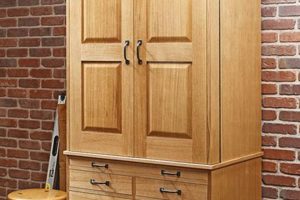
Miniature constructions created from wood offer a diverse range of applications, from decorative items and scale models to functional objects for dollhouses or small spaces. These endeavors typically involve a high degree of precision and attention to detail, often requiring specialized tools and techniques. Examples include crafting miniature furniture, small wooden toys, or delicate decorative boxes.
The appeal of such crafting lies in several factors. It presents an opportunity to develop fine motor skills and patience. The limited material requirements make it an accessible and economical hobby. Historically, creating scaled-down replicas of objects has been a practice employed in apprenticeships and architectural planning, as well as for recreational purposes. The results often have significant aesthetic or sentimental value.
The following discussion will delve into the selection of appropriate wood types, the essential tools required, and various techniques employed in achieving precision and detail. Furthermore, the text will explore considerations for finishing and protecting these delicate creations, and will offer resources for discovering inspiration and project ideas.
Essential Tips for Miniature Woodcraft
This section provides critical guidance for successfully executing miniature woodcraft, emphasizing precision, material selection, and technique.
Tip 1: Select Appropriate Wood Species. The choice of wood significantly impacts the ease of carving and the final aesthetic. Basswood and balsa wood are recommended for their softness and fine grain, facilitating intricate cuts and detailed shaping. Harder woods like maple or cherry can be used for durability in functional miniatures, but require sharper tools and more careful handling.
Tip 2: Employ Precision Measuring Instruments. Accuracy is paramount. Digital calipers, precision rulers, and magnifying glasses are essential for ensuring accurate dimensions and clean cuts. Verify measurements repeatedly throughout the project to minimize errors.
Tip 3: Utilize Sharp, Specialized Tools. A dull blade tears the wood fibers, resulting in a ragged edge. Invest in a set of miniature carving tools, hobby knives with replaceable blades, and a high-quality fret saw for detailed work. Sharpen tools regularly to maintain optimal cutting performance.
Tip 4: Practice Safe Cutting Techniques. Securely clamp the workpiece to prevent slippage. Use a cutting mat to protect the work surface. Always cut away from the body and wear appropriate safety glasses to shield the eyes from debris.
Tip 5: Master the Art of Wood Finishing. Proper finishing enhances the wood’s natural beauty and protects it from damage. Apply thin coats of finish, allowing each coat to dry completely before applying the next. Use fine-grit sandpaper between coats to achieve a smooth, professional finish.
Tip 6: Consider Joinery Techniques Carefully. Miniature joinery requires careful consideration of scale. Micro-dowels, tiny screws, or specialized adhesives are preferable to traditional joinery methods like mortise and tenon. Ensure a strong and stable bond, keeping the miniature size in mind.
Tip 7: Plan the Project Meticulously. Before commencing, create a detailed plan or blueprint of the miniature project. This blueprint should include precise measurements, material lists, and step-by-step instructions. This minimizes waste and reduces the likelihood of errors.
Adhering to these guidelines can significantly improve the outcome of woodworking at reduced scales. A commitment to precision, quality materials, and safe practices are key determinants of project success.
The subsequent sections will offer insights into selecting specific projects and resources for continued learning.
1. Wood Selection

Wood selection is a pivotal factor in the successful execution of miniature woodworking endeavors. The choice of wood species directly impacts the ease of manipulation, the resulting structural integrity, and the aesthetic qualities of the finished piece. For instance, dense hardwoods like maple, while durable, present challenges when carving intricate details at a small scale due to their resistance to cutting tools. Conversely, softwoods like balsa offer ease of shaping but may lack the necessary strength for functional components. The practical significance of understanding these properties lies in optimizing both the construction process and the longevity of the miniature item.
Consider, for example, the creation of a miniature chair. Using basswood, a softwood with a fine, even grain, allows for the carving of delicate details in the chair back and legs. However, the seat, which experiences more stress, may benefit from a hardwood insert, such as birch, to prevent cracking or deformation over time. Alternatively, a small wooden toy intended for handling will necessitate the use of a durable and splinter-resistant wood like cherry or walnut to withstand wear and tear. The appropriate wood selection minimizes the risk of project failure due to material limitations.
In conclusion, proper material selection in miniature woodworking is not merely a matter of aesthetic preference but a critical element that directly influences workability, durability, and the overall quality of the finished product. A thorough understanding of wood properties allows the craftsman to make informed decisions, optimizing both the construction process and the longevity of the completed work. Improper wood selection introduces challenges and risks impacting the project’s structural integrity and aesthetic appeal.
2. Tool Precision

In the realm of diminutive woodcraft, the concept of tool precision is not merely a desirable attribute; it is an indispensable precondition for successful project execution. The inherent scale of these projects demands an accuracy far exceeding that required in larger woodworking endeavors. A slight deviation from a prescribed measurement, undetectable to the naked eye in standard construction, can render miniature components unusable, leading to structural instability or aesthetic disharmony. The relationship between tool precision and successful miniature woodworking is therefore one of direct causality: a reduction in tool precision inevitably precipitates a decline in project quality and feasibility. Consider the creation of miniature dovetail joints; any imprecision in the saw or chisel will result in gaps and misalignments, compromising the joint’s structural integrity and aesthetic appearance.
One practical example highlighting the importance of tool precision is the construction of miniature furniture for dollhouses. Creating hinges requires accurate drilling for pins and precise cuts to allow for smooth operation. Incorrect positioning can result in a door or drawer that binds or fails to close properly. A high-quality digital caliper becomes essential for verifying dimensions to within a hundredth of an inch. Similarly, achieving a flawless finish necessitates precise sanding tools and techniques. The use of miniature sanding blocks with varying grits and a steady hand ensures a smooth surface, free from imperfections, which is critical for the final aesthetic appeal. This emphasis on precise sanding underscores its practical importance in producing high-quality miniature woodworking.
In summary, tool precision is a non-negotiable requirement for miniature woodworking projects. The inherent constraints of working at a reduced scale amplify the impact of even minor errors, necessitating the utilization of high-quality tools and meticulous techniques. The challenges presented by miniature woodworking underscore the need for skilled craftsmanship and a commitment to precision at every stage of the process. A firm understanding of this relationship is vital for anyone venturing into the world of scaled-down wooden constructions.
3. Joint Strength

Within miniature woodworking, the significance of joint strength is amplified due to the diminished scale of the components. A joint that would provide adequate stability in a larger construction may fail catastrophically in a miniature context, rendering the entire project structurally unsound. Therefore, careful consideration of joint design and execution is paramount. The selection of appropriate joinery techniques, such as miniature dovetails, mortise and tenon, or the strategic use of adhesives, directly impacts the long-term integrity of any miniature wooden article. The causes of joint failure in small-scale work often stem from insufficient surface area for bonding, inadequate material strength relative to applied stress, or inaccuracies in joint fabrication that compromise fit and load distribution. The selection of materials and joint design directly influence joint strength, a critical component of successfully miniature woodworking.
A practical example illustrating this principle is the construction of a miniature table. If the legs are attached to the tabletop solely with butt joints and insufficient adhesive, the table will likely collapse under minimal weight. Employing a miniature mortise and tenon joint, or even a meticulously crafted lap joint reinforced with appropriate adhesive, significantly increases the table’s load-bearing capacity and overall durability. Similarly, creating miniature drawers that slide smoothly and maintain their structural integrity requires precise joinery at the drawer’s corners. Utilizing miniature dovetail joints, though challenging to execute at a small scale, provides superior strength and resistance to racking forces compared to simpler butt joints or mitered corners. The ability to calculate or at least estimate the stresses a joint will endure and select a method accordingly is vital.
In summary, joint strength represents a critical constraint in miniature woodworking. The success of any project hinges on the careful selection and execution of joinery techniques that can withstand the anticipated stresses. While the challenges of working at a reduced scale are considerable, a thorough understanding of joint mechanics and material properties allows for the creation of durable and aesthetically pleasing miniature wooden objects. The implications of inadequate joint strength extend beyond mere structural failure, potentially compromising the visual appeal and overall value of the finished piece. A commitment to robust joinery practices is therefore essential for achieving high-quality results in miniature woodworking.
4. Scale Accuracy

Scale accuracy is not merely a desirable attribute; it represents a foundational prerequisite for successful miniature woodworking projects. Discrepancies in scale, even minor ones, can disproportionately impact the aesthetic coherence and functional integrity of a diminutive piece. The direct consequence of inaccurate scaling manifests as components that appear disjointed, creating a visually jarring effect that undermines the overall quality of the finished product. Consider, for instance, a miniature chair where the legs are slightly too long or the seat is marginally too wide. These seemingly insignificant deviations can render the chair unusable in its intended setting (e.g., a dollhouse) and aesthetically unappealing. The importance of precise scaling stems from its role in maintaining proportional harmony and conveying a sense of realism, essential characteristics of high-quality miniature craftsmanship. Precision in adherence to the chosen scale facilitates harmonious proportions and visual realism, qualities of top-tier miniature woodworking.
Practical examples further underscore the critical role of scale accuracy. In replicating a historical piece of furniture in miniature, any deviation from the original proportions would compromise its authenticity and historical accuracy. Miniature architectural models, often used for design visualization or historical preservation, rely heavily on accurate scaling to represent the original structure faithfully. Furthermore, the interchangeability of components within a larger miniature construction, such as a dollhouse, depends entirely on maintaining consistent scaling across all individual elements. The absence of accurate scaling creates discrepancies, making furniture and accessories appear ill-fitting, thereby degrading the overall aesthetic. Thus, in practical terms, scale accuracy serves as the unifying principle that ensures cohesiveness and functionality within a miniature environment.
In summary, scale accuracy is an indispensable element in miniature woodworking projects. Its influence extends beyond mere dimensional precision, impacting the aesthetic appeal, functional utility, and overall value of the finished piece. The challenges associated with maintaining scale accuracy highlight the need for meticulous measurement, careful planning, and a deep understanding of proportional relationships. Ultimately, the commitment to precise scaling is what elevates a simple miniature project to the level of refined craftsmanship, linking directly to the broader goal of creating realistic and aesthetically pleasing miniature objects.
5. Finish Quality

The finish quality of miniature woodworking projects exerts a disproportionate influence on the overall perception of the finished piece. Due to the reduced scale, any imperfections in the surface treatment become magnified, detracting significantly from the aesthetic appeal and perceived craftsmanship. The connection between finish quality and the successful execution of tiny woodworking projects is causal: inadequate finishing techniques invariably result in a lower-quality final product, regardless of the precision achieved in the initial construction stages. For example, sanding marks, uneven stain application, or a poorly applied topcoat will be far more noticeable on a miniature item than on a full-sized piece of furniture. Thus, a commitment to high-quality finishing techniques is paramount for achieving professional results in miniature woodworking. The application of appropriate coatings serves to protect the wood, highlight grain patterns, and contribute greatly to the item’s aesthetics.
Practical applications of understanding finish quality extend beyond mere aesthetics. The correct choice of finish can provide critical protection against moisture, UV radiation, and physical abrasion, thereby extending the lifespan of the miniature object. For instance, a miniature wooden toy coated with a durable, non-toxic finish will withstand more handling than one with a simple varnish. Likewise, a miniature exterior architectural model benefits from a UV-resistant sealant to prevent fading and degradation over time. The selection of appropriate finishing materials stains, sealers, and topcoats must consider both the desired aesthetic and the environmental conditions to which the miniature will be exposed. Improperly selected finishes can lead to issues such as cracking, peeling, or discoloration, negating the effort invested in the initial construction. It enhances durability and aesthetics.
In summary, finish quality represents a critical element in the miniature woodworking process. The unique challenges associated with working at a reduced scale necessitate a heightened focus on achieving a flawless and durable finish. The choice of appropriate materials, combined with meticulous application techniques, directly influences the longevity, aesthetic appeal, and overall value of the finished product. The integration of protective elements is also important. The challenges of achieving a perfect finish should be anticipated and addressed through careful planning and diligent execution, directly impacting the quality of the miniature pieces.
6. Design Complexity
Design complexity, in the context of miniature woodworking, directly influences both the execution time and the skill level required for a given project. A design incorporating intricate carvings, complex joinery, or multiple, precisely fitted components necessitates a significantly greater investment of time and expertise compared to a simpler design involving basic shapes and straightforward assembly. The practical effect of escalating design complexity is an increased likelihood of errors, demanding greater precision in measurement, cutting, and assembly. The challenges intrinsic to the design thus directly affect the feasibility and success of small-scale woodcraft. Projects exhibiting heightened detail and intricacy test the woodworker’s technical abilities and aesthetic sensibility.
Consider, for example, a miniature Chippendale chair versus a simple Shaker stool. The Chippendale chair, with its cabriole legs, pierced splat back, and meticulously carved details, represents a high degree of design complexity. Creating this miniature requires advanced carving skills, precise joinery techniques, and a deep understanding of furniture construction. Conversely, the Shaker stool, characterized by its clean lines, simple mortise-and-tenon joints, and lack of ornamentation, embodies a far lower level of design complexity, making it accessible to novice woodworkers. Similarly, a complex miniature clock with functioning gears and intricate ornamentation contrasts sharply with a simple wooden box. Design dictates the techniques, and consequently, the required experience.
In summary, the level of design complexity represents a critical determinant in the miniature woodworking arena, influencing project feasibility, skill requirements, and overall execution time. A clear understanding of the design’s intricacies allows the woodworker to realistically assess their abilities, plan the project accordingly, and mitigate potential challenges. Selecting projects appropriate to skill level and available resources is paramount for achieving satisfying results and avoiding the frustration associated with overly ambitious endeavors. The choice of an appropriate design complexity will increase the woodworker’s abilities while minimizing risks.
Frequently Asked Questions About Tiny Woodworking Projects
The following questions address common inquiries and potential misconceptions surrounding the pursuit of woodworking on a diminutive scale. The answers provided aim to offer practical guidance and clarify key considerations.
Question 1: What is the smallest practical scale for woodworking projects?
The smallest practical scale depends heavily on the complexity of the design and the woodworker’s skill level. While projects approaching 1:48 scale (quarter scale) are achievable, maintaining structural integrity and detail becomes increasingly challenging at smaller sizes. A scale of 1:24 (half scale) or 1:12 (dollhouse scale) is generally recommended for beginners.
Question 2: What specific safety precautions are necessary when working with miniature tools?
Due to their small size, miniature tools can be difficult to control, increasing the risk of injury. Securely clamping workpieces is essential. Eye protection is crucial to shield against flying debris. The use of appropriate dust masks or respirators is recommended, especially when sanding or working with finishes.
Question 3: Are specialized adhesives required for miniature woodworking?
While conventional wood glues can be used, specialized adhesives formulated for small joints and delicate materials are often preferable. Cyanoacrylate (CA) glue, also known as super glue, provides a rapid and strong bond. Epoxy resins offer excellent gap-filling properties and water resistance. Careful consideration of the adhesive’s properties is essential to avoid unsightly glue lines or structural weaknesses.
Question 4: How can warping or distortion be prevented in miniature woodworking?
Wood is susceptible to changes in humidity, which can cause warping or distortion, particularly in thin sections. Selecting well-seasoned wood and storing projects in stable environmental conditions can minimize these effects. Applying a consistent finish to all surfaces of the wood can also help to seal it against moisture absorption.
Question 5: What are the key considerations for selecting wood species for tiny projects?
Wood selection directly impacts workability and final project durability. Softer woods like basswood are ideal for intricate carving, while hardwoods such as maple offer greater strength and resistance to wear. The grain pattern of the wood is also a crucial factor in determining the visual appeal of the completed piece.
Question 6: What are some reliable resources for finding miniature woodworking plans and tutorials?
Several resources provide valuable guidance for miniature woodworking projects. Online forums and communities dedicated to miniatures offer project plans, tutorials, and expert advice. Books and magazines specializing in dollhouse construction and model building often feature detailed instructions and scaling techniques.
Careful attention to safety, material selection, and technique remain essential. A solid understanding of the challenges and considerations associated with miniature woodworking enables the creation of detailed small-scale wooden objects.
The subsequent section will explore advanced woodworking techniques and provide insights into designing original miniature pieces.
Conclusion
This examination of tiny woodworking projects has underscored the demanding precision, careful material selection, and specialized techniques inherent in this craft. Success requires a thorough understanding of wood properties, tool mastery, and meticulous planning. The inherent challenges amplify the need for careful attention at every stage, from design conception to final finishing.
Mastery of this delicate art form demonstrates a commitment to detail and an appreciation for the enduring beauty of handcrafted objects. Further exploration of advanced techniques and innovative designs will undoubtedly expand the boundaries of what is achievable in the realm of woodworking at a reduced scale. Continued dedication promises both personal enrichment and a contribution to the legacy of fine craftsmanship.