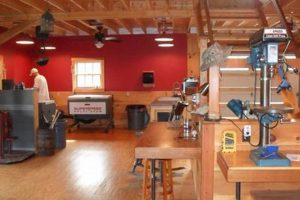
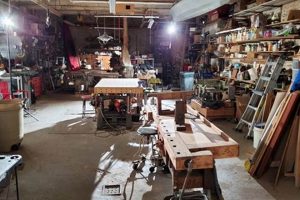
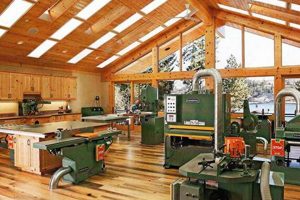
A workshop dedicated to the craft of woodworking, equipped with tools and machinery primarily from past eras, is the focus of this discussion. These spaces often feature items manufactured before the widespread adoption of modern, computer-controlled equipment. For example, a facility might contain a 1940s Delta Unisaw, a pre-1960s drill press, and various hand tools from the early 20th century.
The appeal of such spaces lies in several factors. They frequently offer a connection to historical methods of production and craftsmanship, providing insights into techniques that predate contemporary approaches. Moreover, the equipment, often built with robust materials and simpler designs, can prove exceptionally durable and reliable when properly maintained. This equipment’s lifespan can extend far beyond that of more modern, mass-produced alternatives. The output from such a workshop often carries a distinct aesthetic, reflecting the character of the tools and techniques used.
The following sections will delve into specific aspects of this environment, including the procurement and restoration of antique tools, the unique considerations for workspace design and safety, and the techniques and skills essential for effectively utilizing equipment from bygone eras.
Tips for the Vintage Woodworking Shop
Effective operation of a workspace dedicated to older woodworking equipment necessitates careful planning and execution. The following guidelines address key aspects of establishing and maintaining such a facility.
Tip 1: Assess Tool Condition Thoroughly: Before acquiring any equipment, a comprehensive inspection is paramount. Evaluate the functionality of moving parts, check for structural damage like cracks or excessive rust, and determine the availability of replacement parts. Understanding the extent of required restoration informs purchasing decisions and budget allocation.
Tip 2: Prioritize Safety Mechanisms: Many older machines lack modern safety features. Upgrading or adding appropriate guards, emergency shut-off switches, and dust collection systems is crucial to mitigate potential hazards. Thoroughly research and implement best practices for safeguarding each machine.
Tip 3: Master Traditional Techniques: Operating older equipment often requires different approaches compared to contemporary methods. Seek out resources, such as vintage manuals or experienced craftsmen, to learn the correct operating procedures and maintenance routines specific to each machine. This minimizes the risk of damage and ensures optimal performance.
Tip 4: Establish a Comprehensive Maintenance Schedule: Regular maintenance is essential for the longevity of vintage tools. Develop a schedule for cleaning, lubrication, and adjustment of each machine. Keep detailed records of performed maintenance, including dates and specific actions taken. Proactive maintenance prevents breakdowns and extends the equipment’s lifespan.
Tip 5: Ensure Adequate Power Supply: Older machinery may require specific voltage and amperage configurations. Verify the electrical system’s compatibility with each piece of equipment. If necessary, install appropriate wiring, circuits, and transformers to prevent electrical issues and ensure safe operation.
Tip 6: Optimize Workspace Layout: Arrange equipment strategically to maximize workflow efficiency and minimize potential hazards. Consider the sequence of operations, material flow, and accessibility for maintenance. Adequate space around each machine is vital for safe and comfortable operation.
Tip 7: Preserve Original Documentation: Acquire and preserve original manuals, diagrams, and parts lists for each piece of equipment. These documents provide invaluable information for maintenance, repair, and troubleshooting. Digitizing these resources ensures their long-term accessibility.
Implementing these guidelines contributes to the safe, efficient, and rewarding operation of a woodworking environment focused on older equipment, preserving craftsmanship skills for future generations.
The subsequent sections of this article will explore specific tools and techniques commonly found and used in this kind of shops.
1. Tool Restoration

The practice of tool restoration is intrinsically linked to the viability of a woodworking shop centered on vintage equipment. Without diligent restoration efforts, the core functionality of these facilities would be compromised, rendering them impractical for serious woodworking endeavors. The cause-and-effect relationship is direct: neglected tools degrade in performance, leading to inaccurate cuts, inefficient material removal, and increased risk of injury. Conversely, careful restoration returns tools to a usable, and sometimes superior, state. For instance, a rusted and seized hand plane, when cleaned, sharpened, and properly adjusted, becomes a precision instrument capable of producing exceptionally smooth surfaces. This restoration process is not merely cosmetic; it addresses the underlying mechanical integrity of the tool.
Tool restoration within this context encompasses a range of activities, from simple cleaning and lubrication to complex disassembly, part replacement, and recalibration. A common example involves the refurbishment of a vintage drill press. This might entail replacing worn belts, rebuilding the motor, and aligning the spindle to ensure accurate drilling. Similarly, cast iron machinery often requires the removal of rust through electrolysis or abrasive methods, followed by the application of protective coatings. The importance of restoration extends beyond functionality; it also preserves the historical value and craftsmanship inherent in these older tools. When executed properly, tool restoration ensures the continued availability of robust and reliable equipment, bypassing the need for reliance solely on modern, often less durable, alternatives.
In conclusion, tool restoration is not merely a supplementary task within a shop utilizing vintage woodworking tools; it is a foundational requirement for its operational success. The challenges include sourcing replacement parts, acquiring the necessary skills for specialized repairs, and managing the time commitment involved. However, the rewards are significant: the preservation of historical tools, the continued practice of traditional woodworking techniques, and the creation of high-quality woodworking projects using equipment built to last. The success of a shop using antique equipment is directly correlated to the dedication and skill applied to tool restoration.
2. Safety Upgrades

Operating a woodworking facility equipped with vintage machinery necessitates a rigorous focus on safety upgrades. The inherent design of older equipment often lacks the safety features prevalent in contemporary models, posing increased risks to operators. Integrating modern safety measures is therefore crucial for mitigating potential hazards and ensuring a safe working environment.
- Emergency Stop Systems
Many vintage machines lack readily accessible emergency stop mechanisms. Installing prominent and easily activated shut-off switches is essential. These systems should be strategically located to allow immediate cessation of machine operation in the event of an accident. Integrating these systems may require retrofitting existing electrical circuits or mechanical linkages.
- Blade and Cutter Guards
Exposed blades and cutters are a significant hazard on older woodworking machines. Fabricating or acquiring appropriate guards for saws, jointers, and planers is paramount. Guards should be designed to allow for unobstructed operation while minimizing the risk of contact with moving parts. Proper adjustment and maintenance of guards are crucial for their effectiveness.
- Dust Collection
Older machines often lack integrated dust collection systems, leading to increased exposure to wood dust, a known respiratory irritant and potential carcinogen. Retrofitting dust collection ports and connecting them to a centralized dust collection system is vital for maintaining air quality. Implementing appropriate filters and ensuring adequate airflow are also essential components of effective dust control.
- Power Cord and Wiring Updates
Original wiring and power cords on vintage machinery may be degraded or lack proper grounding. Replacing these components with modern equivalents ensures electrical safety and reduces the risk of shock or fire. Inspecting and upgrading electrical systems should be performed by a qualified electrician to comply with relevant safety codes.
The incorporation of these safety upgrades is not merely a matter of compliance but a fundamental aspect of responsible operation within a woodworking facility using vintage equipment. Diligence in implementing and maintaining these measures directly correlates to a reduction in accidents and injuries, safeguarding the well-being of the operators and preserving the longevity of the workshop.
3. Technique Mastery

The successful operation of a woodworking shop centered around vintage equipment hinges significantly on the mastery of traditional woodworking techniques. Modern, computer-controlled machinery often compensates for a lack of operator skill, whereas vintage tools demand a high level of proficiency. The connection between technique mastery and this environment is therefore causal: inadequate skill leads to inefficient material use, lower-quality output, and increased risk of damage to both equipment and operator. A properly sharpened hand plane, for example, yields a surface finish unattainable with a dull blade, regardless of the tool’s age. This illustrates the critical role of manual skill in achieving desired results.
Technique mastery encompasses a wide range of skills, from understanding wood properties and grain direction to mastering hand tool sharpening and machine setup. The use of a mortise and tenon joint, a staple in traditional woodworking, demonstrates this point further. Precisely cutting a mortise and tenon with hand tools, ensuring a tight and strong fit, requires considerable skill and practice. The tolerances are far less forgiving than when using a modern mortising machine. Another example lies in the adjustment and calibration of vintage machinery. Older machines often lack the precise adjustment mechanisms found on modern equipment, demanding that the operator develop a feel for the machine and the ability to diagnose and correct problems through careful observation and adjustment.
In summary, technique mastery is not merely desirable but essential for the viability of a woodworking shop focused on older tools. The challenges involved in mastering these techniques include the time and dedication required for practice, the scarcity of experienced mentors, and the need to acquire specialized knowledge. However, the rewards are substantial: the production of high-quality work, the preservation of valuable skills, and the ability to fully exploit the capabilities of vintage woodworking equipment. The value of the woodworking from old shops is heavily dependent to the level of the operator’s mastery of traditional techniques.
4. Maintenance Schedules

The functionality and longevity of a woodworking facility centered on vintage equipment are inextricably linked to the implementation and adherence to rigorous maintenance schedules. The causal relationship is direct: neglected maintenance leads to accelerated wear, reduced performance, and eventual equipment failure. These consequences are amplified in older machinery, where original parts may be difficult or impossible to replace, potentially rendering entire machines unusable. The establishment of a well-defined maintenance schedule is, therefore, not merely a best practice but a fundamental requirement for the sustained operation of such a space. For example, failing to regularly lubricate the bearings on a vintage bandsaw can result in overheating, bearing seizure, and potential motor damage, requiring costly repairs or even replacement of the entire machine.
Effective maintenance schedules encompass a range of activities, including regular cleaning, lubrication, inspection, and adjustment. The frequency and scope of these activities should be tailored to the specific needs of each piece of equipment, taking into account its age, usage intensity, and operating environment. Consider the example of a pre-1950s jointer. Its knives require frequent sharpening and alignment to maintain precise cutting performance. A maintenance schedule should incorporate knife sharpening at defined intervals, as well as regular checks for proper fence alignment and table flatness. Furthermore, specialized maintenance procedures, such as belt tension adjustments and spindle lubrication, should be performed according to the manufacturer’s recommendations (if available) or based on established best practices for similar machinery.
In summary, the absence of comprehensive maintenance schedules jeopardizes the viability of a woodworking environment centered on older equipment. The challenges include the time commitment required, the need for specialized knowledge and skills, and the potential difficulty in sourcing appropriate lubricants and replacement parts. However, the benefits far outweigh these challenges. Consistent maintenance ensures optimal performance, extends equipment lifespan, reduces the risk of breakdowns, and preserves the historical value of the tools. The long-term success of a vintage woodworking space is directly proportional to the diligence and thoroughness of its maintenance schedules.
5. Power Compatibility

The operation of a woodworking environment featuring vintage equipment necessitates a thorough understanding and management of electrical power compatibility. These machines, often manufactured decades ago, may have power requirements that differ significantly from modern standards. Ensuring proper power compatibility is not merely a matter of plugging in a machine; it involves careful assessment, modification, and adherence to safety protocols.
- Voltage Requirements
Vintage machinery may operate on different voltage levels than those commonly available in modern workshops. Many older machines, particularly those from the early to mid-20th century, were designed for 220V or even 440V, while contemporary North American circuits typically provide 120V or 240V. Operating a machine at an incorrect voltage can result in damage to the motor, inefficient performance, or even fire hazards. Step-up or step-down transformers are often required to adapt the available voltage to the specific needs of the vintage equipment. Accurate voltage assessment and appropriate transformer selection are paramount for safe and reliable operation.
- Phase Configuration
Some vintage woodworking machines, especially larger industrial models, require three-phase power, a configuration less common in residential or small commercial settings. Three-phase power provides a more consistent and efficient power supply for heavy-duty motors. Operating a three-phase machine on single-phase power can lead to motor damage or failure. Phase converters, either rotary or static, are necessary to convert single-phase power to three-phase power. The selection of an appropriate phase converter depends on the horsepower requirements of the machine and the load characteristics of the electrical system.
- Amperage Capacity
Vintage equipment may draw significant amperage, potentially exceeding the capacity of existing circuits. Overloading a circuit can result in tripped breakers, damaged wiring, and fire hazards. Evaluating the amperage requirements of each machine and ensuring that the corresponding circuit breaker and wiring are appropriately sized is crucial. Upgrading electrical panels and wiring may be necessary to accommodate the power demands of multiple vintage machines operating simultaneously. Consultation with a qualified electrician is advisable to ensure compliance with local electrical codes and safety standards.
- Wiring and Grounding
Older machinery may have outdated wiring and grounding systems that do not meet modern safety standards. Replacing frayed or damaged wiring with appropriate gauge wire and ensuring proper grounding is essential for preventing electrical shocks and minimizing the risk of fire. Grounding provides a path for fault current to flow, tripping the circuit breaker and disconnecting the power supply in the event of an electrical fault. Implementing a robust grounding system that complies with current electrical codes is a critical safety measure in a vintage woodworking shop.
The successful integration of vintage woodworking equipment hinges on careful attention to these facets of power compatibility. Ignoring voltage requirements, phase configurations, amperage capacity, and wiring/grounding issues can result in equipment damage, safety hazards, and operational inefficiencies. By thoroughly assessing the electrical needs of each machine and implementing appropriate modifications and safety measures, the viability and safety of the vintage woodworking shop can be ensured.
6. Workspace Layout

The arrangement of equipment and work areas significantly impacts the efficiency and safety of a woodworking facility featuring vintage machinery. Inefficient layout can impede workflow, increase the risk of accidents, and limit the full potential of the equipment. Conversely, a well-planned layout enhances productivity, reduces hazards, and promotes a more organized and comfortable working environment. For example, a shop with poor spatial planning may necessitate moving materials through circuitous routes, increasing the likelihood of collisions and slowing down the overall production process. This demonstrates a direct cause-and-effect relationship between spatial arrangement and operational effectiveness. Consider a hypothetical scenario where a bandsaw and a jointer are positioned too closely together: this configuration could hinder the safe and efficient processing of long stock, increasing the risk of kickback or accidental contact with moving parts.
Effective workspace layout considers several factors, including the sequence of operations, the size and weight of materials, and the accessibility of each machine for maintenance and repair. The positioning of machines should reflect the typical workflow within the shop, minimizing unnecessary movement and reducing the distance materials need to be transported. Machines used in conjunction with one another should be located nearby. For instance, placing a planer adjacent to a jointer streamlines the process of surfacing lumber. Adequate space must be provided around each machine to allow for safe and comfortable operation, including sufficient clearance for feeding and removing materials. Storage areas should be organized and easily accessible, preventing clutter and minimizing the risk of tripping hazards. Furthermore, the lighting should be adequate and evenly distributed throughout the workspace, reducing eye strain and improving visibility.
In summary, workspace layout is not a trivial aspect of a woodworking shop featuring older equipment but a fundamental component that directly affects its productivity, safety, and overall effectiveness. The challenges of optimizing workspace layout include the constraints of limited space, the varying sizes and configurations of vintage machinery, and the need to accommodate multiple operators. However, the benefits of a well-designed workspace far outweigh these challenges. A thoughtfully planned layout promotes a safer, more efficient, and more enjoyable working environment, allowing woodworkers to fully realize the potential of their vintage tools. The functionality of the whole woodworking operations depend on a carefully designed workspace layout.
7. Documentation Preservation

The long-term operational viability of a woodworking shop focused on vintage equipment is intrinsically linked to the meticulous preservation of relevant documentation. These resources provide critical information unavailable elsewhere, serving as a cornerstone for maintenance, repair, and the perpetuation of traditional techniques.
- Original Manuals and Schematics
Original owner’s manuals, parts lists, and assembly schematics are indispensable resources for understanding the construction, operation, and maintenance requirements of vintage machinery. These documents often contain detailed diagrams, troubleshooting procedures, and specifications not found in contemporary resources. For example, a manual for a 1940s Delta bandsaw may provide specific instructions for adjusting blade tension or replacing drive belts, information essential for maintaining optimal performance.
- Repair Logs and Maintenance Records
Comprehensive repair logs and maintenance records provide a historical account of the equipment’s upkeep, documenting past repairs, replacement parts, and recurring issues. This information can be invaluable for diagnosing problems, identifying patterns of wear, and anticipating future maintenance needs. For instance, a record indicating frequent bearing replacements on a specific machine may suggest an underlying alignment issue requiring attention.
- Technical Drawings and Modifications
Technical drawings, including blueprints and engineering specifications, offer detailed insights into the design and construction of vintage machinery. These documents can be particularly useful for fabricating replacement parts or modifying equipment to improve functionality or safety. Additionally, records of any modifications or alterations made to the machinery over time should be meticulously documented, providing a valuable history of the equipment’s evolution.
- Historical Catalogs and Advertisements
Historical catalogs and advertisements provide context regarding the original intent and capabilities of vintage woodworking equipment. These documents can offer valuable information about the intended applications of specific machines, the available accessories and attachments, and the prevailing woodworking techniques of the era. Studying these resources can enhance the understanding of the historical significance of the equipment and inspire the application of traditional woodworking methods.
The diligent preservation of this documentation ensures the continued operability and historical integrity of the woodworking environment. The accessibility of original manuals, repair logs, technical drawings, and historical catalogs empowers woodworkers to maintain their vintage equipment effectively, perpetuate traditional techniques, and appreciate the historical significance of their craft. The long term survival and success of any vintage woodworking shop lies in the documentation preservation.
Frequently Asked Questions
The following addresses common inquiries and misconceptions concerning the establishment, operation, and maintenance of woodworking facilities that utilize tools and machinery from past eras.
Question 1: What distinguishes a “vintage woodworking shop” from a standard woodworking shop?
A primary distinction resides in the age and origin of the equipment. A facility utilizing vintage woodworking tools relies predominantly on machines and hand tools manufactured prior to the widespread adoption of modern, computer-controlled technologies. A standard woodworking shop may incorporate a blend of older and newer equipment, with a greater emphasis on contemporary tools.
Question 2: Is operating a “vintage woodworking shop” inherently more dangerous than using modern equipment?
The potential for increased risk exists due to the absence of contemporary safety features on many vintage machines. However, with proper safety upgrades, adherence to safe operating procedures, and a comprehensive understanding of the equipment’s limitations, the risk can be effectively mitigated.
Question 3: Where does one source equipment for a “vintage woodworking shop”?
Potential sources include estate sales, auctions, antique tool dealers, online marketplaces, and private collectors. Thorough inspection of equipment prior to purchase is essential to assess its condition and functionality.
Question 4: Are replacement parts readily available for vintage woodworking machinery?
The availability of replacement parts varies significantly depending on the make and model of the machine. Some parts may be readily available from specialized suppliers, while others may require fabrication or scavenging from other machines.
Question 5: Does operating a “vintage woodworking shop” require specialized skills or knowledge?
Operating vintage equipment often demands a greater understanding of traditional woodworking techniques, machine maintenance, and troubleshooting procedures. Familiarity with hand tool sharpening, machine calibration, and older electrical systems is advantageous.
Question 6: What are the primary benefits of operating a “vintage woodworking shop”?
Potential benefits include a connection to historical craftsmanship, the potential for producing unique and high-quality work, the satisfaction of preserving and restoring antique machinery, and the potential cost savings associated with acquiring used equipment.
In summary, the operation of a woodworking facility utilizing vintage equipment presents both challenges and opportunities. With careful planning, diligent maintenance, and a commitment to safety, it is possible to create a productive and rewarding workspace.
The following section will consider the legal and regulatory aspects of setting up such a shop.
Conclusion
This exploration of the vintage woodworking shop environment has illuminated key aspects of its establishment and maintenance. From the acquisition and restoration of antique tools to the implementation of stringent safety protocols and the mastery of traditional techniques, a commitment to preserving the past is essential. Considerations regarding power compatibility, workspace optimization, and meticulous documentation further underscore the complexities inherent in operating such a facility.
The decision to establish a woodworking space focused on older equipment represents a significant investment in both time and resources. However, the potential rewardsthe preservation of historical skills, the creation of unique and high-quality craftsmanship, and a deeper connection to woodworking historyare considerable. Individuals and organizations contemplating such an endeavor must carefully weigh these factors and proceed with informed diligence to ensure both operational success and the continued appreciation of woodworking’s rich heritage.