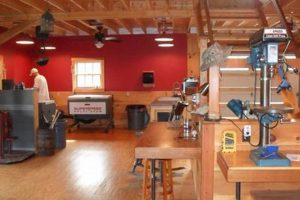
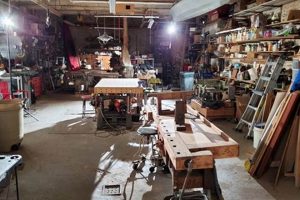
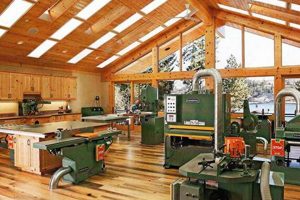
The selection of an appropriate vacuum system is a critical element in maintaining a safe and efficient woodworking environment. This tool is specifically designed to remove dust and debris generated during processes such as sawing, sanding, and routing. A well-suited unit effectively captures particulate matter at the source, contributing to improved air quality and a cleaner workspace. For example, a model featuring a HEPA filter is often preferred for its ability to capture very fine dust particles, promoting healthier working conditions.
Employing a dedicated vacuum system for woodworking yields several significant advantages. It minimizes the risk of respiratory problems associated with dust inhalation, enhances the precision of cuts by clearing the workpiece, and reduces the time spent on post-project cleanup. Historically, manual sweeping was the primary method of dust removal, a labor-intensive and often ineffective solution compared to modern vacuum systems. The evolution of these systems has dramatically improved woodworking practices.
Subsequent discussion will delve into the factors that contribute to optimal vacuum performance in woodworking applications. These include airflow capacity, filtration capabilities, hose diameter and length, and the availability of accessories tailored to specific tools and tasks. An examination of various models available on the market will provide insight into the features and benefits offered by each.
Selection Strategies for Woodworking Dust Extraction
The following guidelines assist in identifying suitable vacuum equipment for woodworking applications. Consideration of these points will facilitate the selection of a unit that effectively manages dust and debris.
Tip 1: Assess Airflow Requirements: Airflow, measured in cubic feet per minute (CFM), is crucial for efficient dust collection. Tools producing significant amounts of dust, such as planers and jointers, necessitate higher CFM ratings. Verify the manufacturer’s recommendations for each power tool to determine the appropriate airflow capacity.
Tip 2: Evaluate Filtration Efficiency: A HEPA (High-Efficiency Particulate Air) filter is highly recommended. These filters capture at least 99.97% of particles at 0.3 microns, significantly reducing the risk of respiratory irritation. Standard filters may not effectively capture fine dust.
Tip 3: Consider Hose Diameter and Length: Wider diameter hoses generally provide better airflow and reduce the risk of clogging. Minimize hose length to maintain optimal suction. Excessive hose length reduces airflow and performance.
Tip 4: Examine Canister Capacity: The canister size dictates the frequency of emptying. For frequent use or larger projects, a larger canister is preferable. Models with automated filter cleaning systems can extend the intervals between emptying.
Tip 5: Evaluate Portability and Maneuverability: Consider the unit’s weight and the presence of wheels or casters. A portable system enhances flexibility within the workshop. Assess the ease of movement around equipment and obstacles.
Tip 6: Investigate Noise Levels: Some models are significantly quieter than others. Consider the noise level, measured in decibels (dB), particularly if working in a shared or residential environment. Noise reduction features can improve user comfort.
Tip 7: Prioritize Compatibility with Power Tools: Ensure compatibility with the power tools in use. Adapters may be required for direct connection. Universal adapters provide flexibility with various tool port sizes.
Effective implementation of these selection strategies ensures the acquisition of a dust extraction system that promotes a cleaner, safer, and more efficient woodworking environment. These factors contribute to improved respiratory health and enhanced project quality.
The subsequent sections will provide a comparative analysis of specific models and brands, offering further insights into the features and benefits of each system.
1. Airflow (CFM)

Airflow, measured in cubic feet per minute (CFM), constitutes a fundamental performance parameter for any vacuum system employed in woodworking. In the context of selecting suitable vacuum equipment, the CFM rating directly impacts the system’s ability to capture dust and debris effectively at the source. Insufficient airflow results in particulate matter escaping the vacuum’s intake, leading to air quality degradation and potential health risks. Conversely, an appropriate CFM rating ensures that dust generated by power tools such as saws, sanders, and routers is immediately drawn into the vacuum system, mitigating environmental contamination.
The relationship between CFM and the effectiveness of dust collection is demonstrably causal. For instance, a high-speed router generating substantial quantities of fine dust requires a system with a correspondingly high CFM to maintain a clean and safe working environment. Similarly, wide belt sanders often necessitate specialized dust collection systems with very high CFM ratings due to the large surface area being sanded and the significant volume of dust produced. Choosing a vacuum without adequate CFM will result in visible dust accumulation on surfaces and in the air, regardless of other features such as filtration.
Therefore, the assessment of airflow requirements is a primary step in determining the optimal vacuum system for woodworking. Identifying the CFM requirements of the power tools in use and selecting a vacuum that meets or exceeds those specifications is crucial. While other features, such as filtration and portability, are important considerations, they cannot compensate for inadequate airflow. A vacuum system’s CFM rating directly dictates its ability to remove dust, making it a critical factor in evaluating vacuum options for woodworking applications. Neglecting this aspect undermines the purpose of dust collection, leading to compromised air quality and increased health risks.
2. Filtration efficiency
Filtration efficiency is a critical determinant in the selection of an effective vacuum system for woodworking. The ability of a vacuum to capture and retain fine particulate matter directly influences the air quality within the workshop environment. Inadequate filtration allows hazardous dust particles to recirculate, posing respiratory health risks to the operator. Therefore, a vacuum’s filtration capability is not merely a secondary feature, but a primary consideration in defining the suitability of the tool for woodworking applications. High filtration efficiency is thus inextricably linked to the concept of optimal dust control.
A vacuum featuring HEPA (High-Efficiency Particulate Air) filtration exemplifies the practical significance of high filtration efficiency. HEPA filters are engineered to capture a minimum of 99.97% of particles 0.3 microns in diameter. Wood dust, often composed of particles within this size range, can penetrate deep into the lungs, leading to chronic respiratory conditions. A vacuum lacking HEPA filtration, or utilizing a lower-grade filter, will permit these particles to escape, rendering the system significantly less effective in safeguarding air quality. For example, vacuums using standard paper filters offer minimal protection against the smallest, most hazardous particles, necessitating careful evaluation of filtration capabilities when selecting woodworking equipment. The selection of a suitable filter is based on the kind of materials that is being worked on in the shop.
In summary, filtration efficiency is a fundamental attribute of a vacuum intended for woodworking applications. The choice of filtration technology directly impacts the system’s ability to protect the operator from the harmful effects of dust inhalation. Systems lacking high-efficiency filtration, such as HEPA filters, compromise air quality and undermine the purpose of dust collection. Consequently, filtration efficiency represents a core criterion in determining the appropriate and safe vacuum system for woodworking, directly affecting worker health and the overall quality of the work environment.
3. Hose Diameter
Hose diameter constitutes a critical variable in the performance of any vacuum system intended for woodworking. The diameter of the hose directly influences the volume and velocity of airflow, impacting the system’s ability to effectively capture dust and debris at the source. A hose with an insufficient diameter restricts airflow, reducing suction power and diminishing the vacuum’s effectiveness, irrespective of the motor’s capabilities. Conversely, an appropriately sized hose ensures optimal airflow, maximizing the vacuum’s ability to remove particulate matter from the work area. The selection of an appropriate hose diameter is thus integral to defining an effective dust collection solution.
The practical significance of hose diameter is readily apparent in various woodworking scenarios. For instance, connecting a small-diameter hose to a dust port on a planer will result in significantly reduced dust collection efficiency. The restricted airflow impedes the vacuum’s ability to draw away shavings and dust, leading to accumulation on the workpiece and in the surrounding environment. Conversely, utilizing a larger-diameter hose on the same planer facilitates efficient removal of waste material. The relationship between hose diameter and airflow adheres to fundamental fluid dynamics principles; wider pathways offer less resistance to airflow, resulting in increased suction power. Different woodworking tools have different size requirements.
In summary, hose diameter is not a trivial consideration but rather a fundamental parameter governing the performance of woodworking vacuum systems. The selection of an appropriate hose diameter is critical to maximizing airflow, enhancing dust collection efficiency, and maintaining a clean and safe workshop environment. While motor power and filtration capabilities are also important, inadequate hose diameter will inherently limit the system’s overall effectiveness. Therefore, a careful assessment of hose diameter requirements, relative to the tools and tasks being performed, is essential in determining the suitability of any vacuum system for woodworking applications. Correct hose sizing allows to reduce static electricity.
4. Canister Capacity

Canister capacity, referring to the volume of the collection container within a vacuum system, represents a crucial factor influencing the practical utility of the system in woodworking applications. The capacity directly dictates the frequency with which the canister must be emptied. A smaller capacity necessitates more frequent interruptions for emptying, reducing workflow efficiency, particularly during extended projects. Conversely, a larger capacity minimizes downtime, allowing for continuous operation and enhanced productivity. The selection of an appropriately sized canister is thus integral to optimizing workflow within a woodworking environment. The kind of materials also affects the canister choice.
The influence of canister capacity is readily observable in different woodworking scenarios. For instance, a vacuum system with a small canister may be unsuitable for use with a thickness planer, which generates a substantial volume of shavings. The canister would quickly fill, requiring frequent emptying and interrupting the planing process. In contrast, a system with a larger canister could accommodate a greater volume of shavings, allowing for extended periods of uninterrupted operation. Similarly, the scale of woodworking operations and shop size also affect the canister decision. This example illustrates the direct correlation between canister capacity, operational efficiency, and the suitability of a vacuum system for specific woodworking tasks.
In summary, canister capacity is a substantive consideration in evaluating vacuum systems for woodworking. The volume of the collection container directly impacts workflow efficiency and the frequency of maintenance. Selecting a system with an adequate canister capacity, proportionate to the scale and nature of woodworking activities, is essential for optimizing productivity and minimizing downtime. While factors such as airflow and filtration are also important, an insufficient canister capacity can negate the benefits of these other features, thereby emphasizing the significance of this parameter in selecting a suitable vacuum system.
5. Portability

The portability of a vacuum system exerts a significant influence on its overall utility within a woodworking environment. Portability, in this context, refers to the ease with which the unit can be moved and positioned relative to various tools and work areas. A highly portable system enhances operational flexibility, allowing for on-demand dust collection at multiple locations within the shop. Conversely, a less portable unit restricts its use to a fixed location, potentially requiring the user to move tools or workpieces to the vacuum, rather than vice versa. Thus, portability is an essential attribute of an effective woodworking vacuum system.
The impact of portability manifests in several practical scenarios. A small woodworking shop, for example, might benefit significantly from a vacuum with casters, enabling it to be easily moved between a miter saw station, a workbench, and a sanding area. This eliminates the need for multiple vacuum systems or for extended hoses that can impede movement and reduce suction. Conversely, a large, stationary vacuum might be more suitable for connection to a dedicated dust collection system with fixed ductwork, sacrificing portability for increased suction power and collection capacity. A light-weight model makes portability even easier.
Ultimately, the degree of portability required in a woodworking vacuum system is contingent upon the size of the workshop, the diversity of tools in use, and the specific woodworking practices employed. While not necessarily indicative of overall performance, portability contributes significantly to the system’s usability and adaptability. Selecting a vacuum that balances portability with other crucial factors, such as airflow and filtration, is essential to optimizing dust collection and maintaining a safe and efficient woodworking environment. It’s important to balance performance with user needs.
Frequently Asked Questions Regarding Woodworking Vacuum Systems
The following questions address common inquiries concerning the selection and utilization of vacuum systems in woodworking environments, aiming to clarify best practices and address potential misconceptions.
Question 1: What airflow (CFM) is generally recommended for woodworking dust collection?
Airflow requirements vary depending on the tool. Small power tools, such as sanders, require a minimum of 70 CFM. Larger tools, such as planers and jointers, necessitate 300-400 CFM or higher for effective dust extraction.
Question 2: Is a HEPA filter essential for a woodworking vacuum?
While not legally mandated in all contexts, a HEPA filter is highly recommended. HEPA filters capture a high percentage of fine dust particles, mitigating respiratory health risks associated with wood dust inhalation.
Question 3: Does hose diameter significantly impact vacuum performance?
Yes, hose diameter directly influences airflow. Smaller diameter hoses restrict airflow, reducing suction power. Wider diameter hoses generally optimize dust collection efficiency. Selecting the correct diameter is crucial.
Question 4: How frequently should the canister of a woodworking vacuum be emptied?
Emptying frequency depends on canister capacity and the volume of dust generated. Continuous monitoring of the canister level is advised. Regular emptying prevents overloading and maintains suction performance. A clogged bag also reduces overall vacuum performance.
Question 5: What factors determine the portability of a woodworking vacuum?
Portability is influenced by weight, the presence of wheels or casters, and hose length. Lighter units with casters offer greater maneuverability. Consider the size and layout of the workspace when evaluating portability.
Question 6: Can a standard household vacuum be used for woodworking dust collection?
Standard household vacuums are generally not recommended. They typically lack the airflow, filtration, and durability required for effective woodworking dust collection. Furthermore, they are prone to damage from fine dust and debris.
Effective dust collection is a crucial component of safe and efficient woodworking practices. Careful consideration of these questions aids in the selection and utilization of appropriate vacuum equipment.
The next section will address specific product recommendations and provide a comparative analysis of available models.
Conclusion
Determining the optimal shop vacuum for woodworking necessitates a thorough evaluation of several key performance indicators. Airflow, filtration efficiency, hose diameter, canister capacity, and portability each contribute significantly to the overall effectiveness of a dust collection system. A suitable unit effectively captures particulate matter at the source, promoting improved air quality and a cleaner workspace.
Selecting the appropriate vacuum system enhances productivity and minimizes health risks associated with dust inhalation. Continuous vigilance in maintaining and upgrading dust collection systems remains a cornerstone of responsible woodworking practice. The pursuit of a cleaner and safer workspace should be a continual goal.