



The array of motorized implements designed to shape, cut, and join wood represents a significant category within woodworking. These devices provide increased efficiency and precision compared to traditional hand tools. A common example includes a circular saw utilized for making straight cuts in lumber.
Their adoption has revolutionized woodworking, enabling faster project completion and the ability to work with larger and more complex designs. The historical context reveals a shift from laborious manual techniques to a more mechanized approach, expanding the possibilities for both hobbyists and professionals.
Understanding the various types available, their specific applications, and safety considerations is essential for anyone involved in woodworking. This exploration will delve into specific tool categories, providing a framework for informed selection and effective utilization.
Essential Guidance on Motorized Woodworking Implements
This section provides crucial advice regarding the selection and application of motorized woodworking devices, intended to enhance project outcomes and ensure operational safety.
Tip 1: Prioritize Safety Equipment: Consistent use of safety glasses, hearing protection, and dust masks is non-negotiable. Adequate protection mitigates the inherent risks associated with high-speed machinery and airborne particulates.
Tip 2: Select the Appropriate Tool for the Task: Employing a router for jointing or a jigsaw for ripping lumber compromises accuracy and efficiency. Match the tool’s capabilities to the project requirements.
Tip 3: Maintain Sharp Cutting Edges: Dull blades and bits demand excessive force, increasing the likelihood of kickback and inaccurate cuts. Regular sharpening or replacement is essential for optimal performance.
Tip 4: Understand Material Properties: Hardwoods require slower feed rates and sharper blades compared to softwoods. Adjusting technique based on wood density minimizes tear-out and ensures clean cuts.
Tip 5: Practice Proper Work Holding: Securely clamp workpieces to prevent movement during operation. Instability leads to inaccurate cuts and potential injury. Utilizing vises, clamps, and bench dogs is crucial.
Tip 6: Ensure Adequate Dust Collection: Controlling dust accumulation improves visibility, reduces health risks, and minimizes cleanup. Invest in a dust collection system or utilize portable dust extractors.
Tip 7: Conduct Regular Maintenance: Lubricate moving parts, inspect cords for damage, and clean dust buildup from motors. Preventative maintenance extends tool lifespan and ensures consistent performance.
These strategies, when implemented diligently, contribute to improved woodworking outcomes, increased safety, and extended tool longevity.
The subsequent sections will explore specific tool categories in greater detail.
1. Cutting
Cutting represents a fundamental operation in woodworking, necessitating specific motorized implements for efficient and accurate material removal. The selection of the appropriate cutting tool directly impacts project quality and completion time.
- Circular Saws
Circular saws offer versatility in ripping and crosscutting lumber. Models range from handheld portable saws to stationary table saws, each suited for different scales of operation and precision requirements. The blade type significantly affects the cut quality, with specialized blades available for various materials and applications.
- Band Saws
Band saws excel in cutting curves and irregular shapes. Their narrow blade allows for intricate cuts and the ability to resaw thicker stock into thinner pieces. The depth of the throat dictates the maximum width of the workpiece that can be accommodated.
- Miter Saws
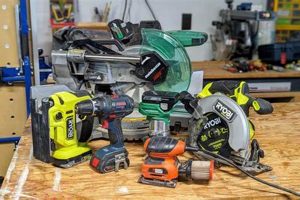
Miter saws are specifically designed for making precise angled cuts. Compound miter saws combine miter and bevel cuts, facilitating the creation of complex joinery. Digital miter saws offer enhanced accuracy and repeatability for production environments.
- Jigsaws
Jigsaws provide maneuverability for cutting intricate designs and curves in various materials. The blade selection is critical for optimizing performance and cut quality based on the type and thickness of the material being cut.
The diverse range of cutting tools allows woodworkers to address a wide spectrum of tasks, from rough stock preparation to intricate detailing. Careful consideration of the project requirements and material properties is essential for selecting the optimal cutting tool and achieving desired results.
2. Shaping
Shaping in woodworking encompasses the modification of a workpiece’s form beyond simple cutting. It involves refining contours, creating decorative profiles, and achieving specific aesthetic qualities. The proper selection of motorized implements is paramount for efficient and precise shaping operations.
- Routers
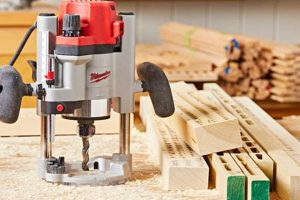
Routers represent a versatile tool for shaping edges, creating grooves, and hollowing out areas in wood. The interchangeable bits allow for a wide array of profiles and patterns. Routers are indispensable for creating decorative moldings, joinery details, and custom edge treatments.
- Spindle Sanders
Spindle sanders are utilized for smoothing curved edges and contours. The oscillating spindle action ensures even material removal and prevents burning. They are particularly useful for refining shapes created with band saws or other rough-shaping methods. Drum sanders function similarly for larger curves or flat surfaces.
- Planers
While primarily used for thicknessing lumber, planers also contribute to shaping by creating flat, parallel surfaces. They can remove excess material to achieve a desired dimension or refine the overall form of a workpiece. Handheld power planers offer more localized shaping capabilities.
- Belt Sanders
Belt sanders are aggressive material removal tools suitable for shaping contours and smoothing large surfaces. Their linear sanding action makes them effective for leveling uneven areas and blending different shapes. Care must be taken to avoid over-sanding or creating unwanted flat spots.
The selection of shaping implements directly impacts the final appearance and functionality of woodworking projects. An understanding of each tool’s capabilities and limitations enables woodworkers to achieve desired forms and enhance the overall quality of their creations. Effective shaping integrates seamlessly with other woodworking processes, such as cutting, joining, and finishing, to create cohesive and aesthetically pleasing designs.
3. Drilling

Drilling, as a fundamental process within woodworking, relies heavily on specific motorized implements to create precisely dimensioned holes. The efficacy of hole creation significantly impacts the integrity of joinery, the installation of hardware, and the overall structural stability of wooden constructions. Therefore, the selection of appropriate drilling devices constitutes a critical component of overall woodworking power tool considerations.
The selection of a power drill for woodworking is determined by multiple factors, including the required hole diameter, material density, and desired precision. For instance, drilling pilot holes for screws necessitates a smaller diameter drill bit and a controlled drilling speed to prevent wood splitting. Conversely, creating larger diameter holes for mortise and tenon joinery requires specialized drill bits, such as Forstner bits or auger bits, coupled with a high-torque drilling apparatus. The use of a drill press, a stationary drilling machine, provides increased accuracy and control, particularly beneficial when drilling perpendicular holes or repetitive hole patterns.
Comprehending the nuances of drilling techniques and matching these with the appropriate power tools are essential for successful woodworking outcomes. Inadequate equipment or improper execution during drilling can lead to inaccurate hole placement, material damage, and compromised joint strength. A thorough understanding of drilling as a subset of “what power tools for woodworking” enhances the overall efficiency and craftsmanship of woodworking endeavors, contributing to the creation of durable and aesthetically pleasing wooden structures.
4. Sanding

Sanding, as an integral step in woodworking, necessitates specific motorized implements for efficient surface preparation. The relationship between sanding and available motorized equipment is direct; power sanders automate and accelerate the process of smoothing and refining wood surfaces, significantly impacting project timelines and achievable finish quality. Inadequate sanding compromises subsequent finishing stages, leading to uneven stain absorption and diminished aesthetic appeal. An example is the use of an orbital sander to prepare a tabletop for staining; without proper sanding, the stain may highlight imperfections and create a blotchy appearance. The implementation of proper motorized sanding tools ensures a consistent and professional finish.
Different motorized sanding tools cater to specific woodworking needs. Random orbital sanders excel at producing swirl-free finishes on flat surfaces, while belt sanders offer aggressive material removal for shaping or leveling. Detail sanders, equipped with pointed or triangular pads, access tight corners and intricate profiles. The choice of sandpaper grit, used in conjunction with these sanders, further refines the sanding process, progressing from coarse grits for initial stock removal to fine grits for final polishing. Understanding the characteristics of each sander type and grit range enables precise control over the final surface quality. Consider the task of refinishing an antique chair; careful selection of sanding tools and gradual grit progression can restore the original beauty while preserving the piece’s character.
In summation, motorized sanding implements constitute a crucial element within the broader context of woodworking. Effective use of power sanders and understanding of appropriate grit progressions are critical for achieving professional-grade finishes and maximizing the aesthetic potential of woodworking projects. While motorized sanders streamline the sanding process, challenges such as dust control and the potential for over-sanding require careful attention and appropriate mitigation strategies. Sanding plays a key role in overall project completion with other power tools for woodworking to be more attractive and quality.
5. Joining

Joining, in the context of woodworking, signifies the process of uniting individual wood components to form a cohesive structure. This phase relies heavily on specialized motorized implements to ensure structural integrity, dimensional accuracy, and aesthetic quality. The selection and application of appropriate power tools are paramount to achieving durable and visually appealing joints.
- Biscuit Jointers
Biscuit jointers utilize pre-shaped wooden biscuits and corresponding slots to align and reinforce joints. These tools excel in creating strong, visually unobtrusive joints for edge-to-edge panel connections, frame construction, and furniture assembly. The consistent depth and alignment afforded by biscuit jointers significantly reduce errors and improve joint strength compared to traditional methods. An example is joining panels for a tabletop where biscuit joints provide alignment and added strength, reducing the likelihood of warping or separation.
- Pocket Hole Jigs
Pocket hole jigs facilitate the creation of angled screw holes, allowing for concealed fastening. This technique is commonly employed in face frame construction, cabinet making, and furniture assembly where aesthetics dictate the avoidance of visible fasteners. The angled screw provides both clamping force and mechanical retention. For instance, in assembling a cabinet face frame, pocket hole screws create a strong, clean joint while concealing the fasteners on the interior of the cabinet.
- Mortise and Tenon Machines
Mortise and tenon joints, characterized by a projecting tenon inserted into a corresponding mortise, offer exceptional strength and durability. Motorized mortise and tenon machines, including hollow chisel mortisers and oscillating mortisers, automate the creation of these intricate joints, ensuring precision and repeatability. These machines are crucial for constructing robust furniture frames, timber frame structures, and other applications requiring superior joint strength. An example is the construction of a dining table frame where mortise and tenon joints provide the necessary structural integrity to withstand daily use.
- Dowel Jigs
Dowel jigs provide accurate alignment for drilling holes used in dowel joinery. Dowels, cylindrical wooden pins, are inserted into corresponding holes to reinforce joints and provide alignment. Dowel joints are commonly used in edge-to-edge joinery, frame construction, and attaching cabinet faces. These jigs allow for consistent spacing and depth, improving joint accuracy. Dowel joints provide strength for connecting shelves to the sides of bookcase by properly use of dowel jigs.
The effectiveness of joining techniques directly correlates with the correct choice and skillful application of motorized implements. From biscuit jointers facilitating seamless panel connections to mortise and tenon machines enabling robust structural frameworks, the integration of power tools enhances the efficiency, precision, and durability of woodworking joints. The evolution of “what power tools for woodworking” has significantly transformed joining methods, allowing for more complex and robust constructions with improved aesthetic outcomes.
6. Routing
Routing, as a core function within woodworking, involves the shaping or hollowing of wood using a rotary cutter. This operation relies on specialized motorized implements known as routers, underscoring the integral connection between routing and power tool selection in woodworking.
- Edge Profiling
Edge profiling, a common routing application, shapes the edges of wooden workpieces to create decorative or functional profiles. Routers equipped with various edge-forming bits enable the creation of roundovers, chamfers, ogees, and other intricate designs. The consistent depth and smooth finish achievable with routers make them indispensable for crafting furniture edges, cabinet doors, and decorative moldings. For instance, creating a decorative edge on a tabletop using a router enhances its aesthetic appeal and adds a professional touch. Without a router, achieving such intricate and consistent edge profiles would be significantly more challenging and time-consuming.
- Groove and Dado Cutting
Routers facilitate the creation of grooves and dados, essential for joinery and structural applications. Grooves, narrow channels cut into the wood’s surface, serve as guides for sliding panels or decorative inlays. Dados, wider grooves that accommodate the edge of another board, create strong, interlocking joints. Routers, when used with appropriate jigs or guides, ensure precise and consistent groove and dado dimensions. These are crucial in cabinet construction, where accurately cut dados allow for precise shelf placement and structural integrity. Without suitable routing, achieving precise and consistent grooves and dados would necessitate laborious hand-tool methods, resulting in increased production time and potential inaccuracies.
- Inlay and Pattern Routing
Routers enable the creation of intricate inlays and patterns on wooden surfaces. Using templates and guide bushings, routers can accurately remove material to accommodate decorative inlays or replicate complex patterns. This technique is commonly employed in creating decorative panels, custom signage, and personalized woodworking projects. For instance, using a router to create a contrasting wood inlay on a box lid adds a unique and aesthetically pleasing element. The precision and control offered by routers are essential for achieving clean lines and tight fits in inlay work, making it a versatile tool for adding intricate details to woodworking projects.
- Mortise Creation
While dedicated mortising machines offer specialized mortise creation, routers can also be employed for this purpose. Using a plunge router and a mortising jig, woodworkers can create accurate and consistent mortises for mortise and tenon joinery. This technique is particularly useful for creating smaller mortises or when a dedicated mortising machine is unavailable. An example would be creating mortises in chair legs to accept the tenons of the seat rails. Routers provide a viable alternative for mortise creation, enhancing the versatility of a woodworking shop and expanding the range of achievable joinery techniques.
The versatility of routing, as evidenced by its application in edge profiling, groove cutting, inlay work, and mortise creation, underscores its significance in woodworking. The correct selection and skillful application of routers are essential for achieving desired outcomes, whether creating decorative elements or structural joinery. Consequently, routers constitute a crucial component within “what power tools for woodworking,” profoundly influencing the efficiency, precision, and creative possibilities of woodworking endeavors.
7. Fastening
Fastening, in the context of woodworking, represents the mechanical joining of wood components through the use of discrete hardware elements. This critical process relies on specialized implements, both manual and motorized, to ensure secure and durable connections. The efficacy of the fastening process directly influences the structural integrity, longevity, and aesthetic quality of the finished product. The selection of appropriate fastening tools and techniques is therefore essential for achieving desired woodworking outcomes. The improper use of these tools can cause the joints to become weak.
Motorized fastening tools significantly enhance efficiency and precision compared to traditional hand tools. Nail guns, for example, rapidly drive nails into wood, streamlining construction and assembly processes. Screw guns, equipped with adjustable clutches, consistently drive screws to the correct depth without stripping the screw head or damaging the surrounding wood. Power drills, when paired with appropriate drill bits, create pilot holes for screws, preventing wood splitting and ensuring secure connections. Air impact wrenches are also used when it’s important to fasten with high level torque. Using the right torque to fasten components are very important in woodworking. Each type of these tools contribute for efficient and robust constructions.
In conclusion, motorized fastening implements represent an integral component of modern woodworking practices. Their proper selection and application are crucial for achieving strong, durable, and aesthetically pleasing joints. A comprehensive understanding of the connection between fastening and power tools enables woodworkers to optimize their workflows, enhance the quality of their projects, and ensure the longevity of their creations. These tools have allowed workers and hobbyist to build more complex and artistic projects.
Frequently Asked Questions
The subsequent section addresses common inquiries regarding the application and selection of motorized implements within the woodworking domain. These answers aim to provide clarity and promote informed decision-making.
Question 1: What constitutes the essential motorized implements for a beginner woodworker?
A circular saw, drill/driver, and random orbital sander represent a foundational set. These enable basic cutting, fastening, and surface preparation tasks, providing a versatile starting point for project execution. Additional tools can be acquired as project complexity increases.
Question 2: What safety precautions are paramount when operating motorized woodworking implements?
Consistent use of approved eye protection, hearing protection, and respiratory protection is non-negotiable. Furthermore, adherence to manufacturer safety guidelines, proper work holding techniques, and awareness of potential hazards are essential for minimizing risk.
Question 3: How does one determine the optimal saw blade for a specific woodworking task?
Factors such as material type, cut direction (rip vs. crosscut), and desired finish quality dictate the appropriate blade selection. Blades with fewer teeth are generally suitable for ripping, while blades with more teeth are preferred for crosscutting and achieving smoother cuts.
Question 4: How does one ensure accurate and repeatable cuts when using a miter saw?
Precise calibration of the saw’s miter and bevel angles is crucial. Additionally, secure work holding and a consistent cutting motion contribute to accuracy. Utilizing stop blocks or jigs can enhance repeatability for multiple cuts of the same dimension.
Question 5: What are the advantages of a variable-speed router compared to a fixed-speed router?
Variable-speed routers offer greater control over the cutting process, allowing adaptation to different material densities and bit sizes. Slower speeds are generally preferred for larger diameter bits and harder materials to prevent burning and maintain control. This versatility enhances the router’s applicability across a wider range of tasks.
Question 6: How frequently should motorized woodworking implements undergo maintenance?
Regular cleaning, lubrication, and inspection are essential for maintaining optimal performance and extending tool lifespan. Specific maintenance intervals depend on usage frequency and operating conditions, but a proactive approach is recommended to prevent malfunctions and ensure safety.
In essence, informed selection and diligent maintenance are key to maximizing the benefits and minimizing the risks associated with motorized woodworking implements.
The concluding section will provide a summary and final considerations.
Conclusion
This discourse has illuminated the diverse array of motorized woodworking implements and their significance in shaping, cutting, joining, and finishing wood. From fundamental cutting tools to specialized shaping and fastening devices, the effective selection and utilization of these implements are essential for achieving desired project outcomes. Safety protocols and regular maintenance practices are non-negotiable aspects of responsible tool operation.
The continued evolution of woodworking technology promises further advancements in tool design and functionality. A comprehensive understanding of these implements empowers woodworkers to pursue complex projects with greater efficiency and precision, fostering innovation and elevating the craft. Continued education and adherence to best practices are crucial for maximizing the potential of motorized implements and contributing to the enduring legacy of woodworking.
![Buy Woodworking Tools Sales Online - [Your Brand] | Step-by-Step Guides, Tools & Inspiration to Build Beautiful Wooden Decor on a Budget](https://woodfromhome.com/wp-content/uploads/2026/05/th-213-300x200.jpg "Buy Woodworking Tools Sales Online - [Your Brand] Step-by-Step Guides, Tools & Inspiration to Build Beautiful Wooden Decor on a Budget")