![Essential: What Tools Do I Need to Start Woodworking? [Guide]](data:image/svg+xml;base64,PHN2ZyB4bWxucz0iaHR0cDovL3d3dy53My5vcmcvMjAwMC9zdmciIHdpZHRoPSI0NzQiIGhlaWdodD0iNjUiIHZpZXdCb3g9IjAgMCA0NzQgNjUiPjxyZWN0IHdpZHRoPSIxMDAlIiBoZWlnaHQ9IjEwMCUiIHN0eWxlPSJmaWxsOiNjZmQ0ZGI7ZmlsbC1vcGFjaXR5OiAwLjE7Ii8+PC9zdmc+ "Essential: What Tools Do I Need to Start Woodworking? [Guide] Step-by-Step Guides, Tools & Inspiration to Build Beautiful Wooden Decor on a Budget")
The fundamental implements required for initiating projects involving the manipulation of wood are crucial to successful execution. These implements encompass a range of devices designed for cutting, shaping, joining, and finishing wood. For example, a hand saw is essential for making precise cuts, while a chisel is necessary for shaping wood and creating joinery. Measurement tools such as a tape measure and square ensure accuracy in dimensions and angles, crucial for project stability and aesthetics.
Possessing the right set of instruments at the outset offers several advantages, including enhanced precision, increased efficiency, and improved safety. The historical evolution of woodworking tools demonstrates a continuous pursuit of better functionality and precision, significantly impacting the quality and complexity of woodworking projects. Investment in quality implements initially reduces the potential for errors, minimizes material waste, and fosters a safer working environment.
The following sections will detail specific implements, categorized by their primary function, that are essential for a beginning woodworker. This detailed examination will provide a solid foundation for selecting appropriate implements and understanding their application within various woodworking processes.
Essential Considerations for Equipping a Woodworking Shop
The acquisition of woodworking implements should proceed strategically, prioritizing versatility and durability. Consider these factors to ensure a productive and cost-effective start.
Tip 1: Prioritize Safety Equipment: Safety glasses, hearing protection, and a dust mask are non-negotiable starting points. These protect against splinters, noise pollution, and harmful dust inhalation, respectively. Neglecting these can lead to irreversible health issues.
Tip 2: Start with Hand Tools: Before investing heavily in power tools, focus on acquiring essential hand tools like a hand saw, chisels, a marking gauge, and a block plane. Proficiency with these tools builds fundamental woodworking skills and enhances understanding of wood behavior.
Tip 3: Invest in Quality Measuring Tools: A reliable tape measure, a combination square, and a set of rulers are critical for accurate layouts and cuts. Inaccurate measurements compromise the entire project, leading to wasted material and time.
Tip 4: Gradually Expand Power Tool Inventory: As skills develop, introduce power tools such as a circular saw, a drill press, and a sander. Choose models known for reliability and precision over budget-friendly options with compromised performance.
Tip 5: Select Versatile Clamps: Clamps are essential for holding workpieces together during glue-ups and assembly. Acquire a variety of clamp types (e.g., bar clamps, pipe clamps, spring clamps) in different sizes to accommodate various project needs.
Tip 6: Develop Sharpening Skills: Sharp tools are safer and more efficient. Learn to sharpen chisels, planes, and saws regularly using sharpening stones or a honing system. A dull tool requires more force and is more likely to slip, causing injury.
Tip 7: Research Tool Reviews and Ratings: Before purchasing any tool, research its performance and durability. Consult online reviews, woodworking forums, and reputable tool review websites to make informed decisions.
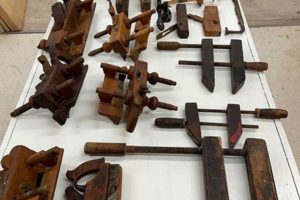
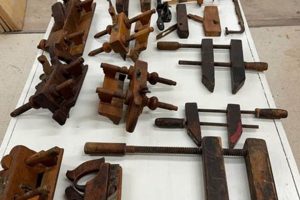
Tip 8: Consider Used Tools: High-quality used tools can often be found at a fraction of the cost of new tools. Attend estate sales, auctions, and online marketplaces to find well-maintained vintage tools. However, thoroughly inspect used tools for damage or wear before purchasing.
By carefully considering these factors, one can establish a well-equipped woodworking shop that supports both current and future projects. This phased approach minimizes initial expenses and ensures that each acquired tool contributes meaningfully to the woodworker’s skill set.
The subsequent sections will address the practical application of these implements in specific woodworking techniques and projects, further solidifying the foundational knowledge necessary for successful woodworking endeavors.
1. Measuring and Marking

Dimensional accuracy is paramount in woodworking; thus, the selection of appropriate measuring and marking implements is a foundational element in the determination of necessary tools for initiating woodworking projects. These tools ensure precise cuts, joinery, and overall project dimensions, contributing directly to the structural integrity and aesthetic appeal of finished pieces.
- Tape Measure and Rules
Tape measures and rigid rules are essential for obtaining accurate linear measurements. A tape measure typically provides longer-distance measurements, while rules offer greater precision for smaller dimensions. Inaccurate measurements at this stage propagate errors throughout the entire project, potentially leading to misaligned joints or structurally unsound assemblies. A 16-foot tape measure with clear markings and a locking mechanism is a standard requirement, as is a 6-inch steel rule for detail work.
- Squares
Squares, including combination squares and speed squares, facilitate the creation of accurate right angles and the marking of perpendicular lines. Ensuring squareness is critical for joinery and the overall stability of the woodworking project. A combination square, adjustable for depth and angle, serves multiple purposes, including marking mortise and tenon joints, while a speed square quickly establishes 90-degree and 45-degree angles for crosscuts.
- Marking Gauges
Marking gauges are used to scribe parallel lines at a consistent distance from an edge, essential for accurately marking mortises, rabbets, and other joinery details. The consistent line produced by a marking gauge ensures uniform depth and alignment in joinery, leading to stronger and more aesthetically pleasing connections. A wheel marking gauge or a mortise gauge are preferable due to their ease of use and precision.
- Protractor and Bevel Gauge
Protractors and bevel gauges enable the measurement and transfer of angles, crucial for projects involving non-right angles. The ability to accurately replicate angles is essential for crafting complex shapes and ensuring that components fit together seamlessly. An adjustable bevel gauge allows for the transfer of an existing angle to a workpiece, while a protractor facilitates the measurement and marking of specific angles.
The integration of these measuring and marking tools into the woodworking process provides a framework for precision and accuracy. Each tool serves a specific function in establishing correct dimensions and lines, and their collective use minimizes errors, resulting in a higher quality finished product. Therefore, proficiency in their use is fundamental for anyone seeking to engage in woodworking, affirming their essential role in determining “what tools do I need to start woodworking”.
2. Cutting Implements
The inventory of cutting implements constitutes a core element of “what tools do I need to start woodworking.” These tools enable the division and shaping of wood, forming the basis for all subsequent construction and refinement processes. Inadequate cutting implements, whether due to poor quality or inappropriate selection, can lead to inaccurate dimensions, splintering, and material waste, directly impacting project success. For example, attempting to cut a precise dovetail joint with a dull or inappropriate saw will invariably result in a poorly fitted joint and compromised structural integrity. Consequently, the selection of suitable cutting implements is not merely a matter of convenience but a prerequisite for achieving professional results and efficient workflow.
A fundamental division exists between hand saws and power saws, each offering distinct advantages and disadvantages. Hand saws, such as dovetail saws and crosscut saws, provide greater control and precision, particularly in intricate cuts and delicate joinery. Power saws, including circular saws and jigsaws, offer increased speed and efficiency for larger cuts and rough shaping. The specific needs of a project and the desired level of precision dictate the appropriate choice. For instance, a hand saw would be ideal for cutting intricate curves on a cabriole leg, whereas a circular saw would be more efficient for cutting plywood panels for a cabinet carcass.
Ultimately, the determination of “what tools do I need to start woodworking” necessitates a careful evaluation of cutting needs. A balanced selection of both hand saws and power saws, coupled with proper maintenance and sharpening, provides the versatility and precision required for a wide range of woodworking tasks. While power saws offer speed and efficiency, the understanding and application of hand saws build essential skills and enable fine-tuned control. A beginning woodworker may face challenges in mastering both types of cutting implements; however, this mastery is essential for a comprehensive and proficient woodworking practice.
3. Shaping Tools
Shaping tools constitute a critical category in the assessment of implements necessary to begin woodworking. These tools serve to refine the form of wood, creating contours, profiles, and joinery elements beyond the capabilities of basic cutting tools. The inclusion of appropriate shaping tools directly influences the aesthetic and functional quality of the finished piece.
- Planes
Planes, encompassing block planes, smoothing planes, and jack planes, remove thin layers of wood to create smooth, flat surfaces or to refine curves. A block plane, for example, is invaluable for chamfering edges and trimming end grain, while a smoothing plane is employed to eliminate imperfections and prepare a surface for finishing. The selection of planes directly influences the quality of the wood surface; a properly tuned plane leaves a glass-smooth surface that minimizes the need for sanding.
- Chisels
Chisels are employed for detailed shaping, joinery creation, and the removal of small amounts of material. Beveled edge chisels, specifically, are suitable for creating clean corners and intricate joinery. A common application involves paring the sides of a mortise to achieve a precise fit with a tenon. The sharpness and quality of a chisel directly correlate with the precision and cleanliness of the resulting cut; a dull chisel can crush wood fibers and lead to inaccurate joinery.
- Spokeshaves
Spokeshaves are designed for shaping curved surfaces, such as chair spindles and table legs. These tools allow for controlled removal of material along a curve, enabling the creation of smooth and flowing forms. A spokeshave’s blade is adjustable, allowing for varying depths of cut depending on the desired profile and the hardness of the wood. Mastery of a spokeshave allows for the creation of complex curved elements that would be difficult to achieve with other shaping tools.
- Rasps and Files
Rasps and files are used for shaping wood and removing material in a controlled manner. Rasps are typically coarser than files and are used for rough shaping, while files are used for finer refinement. These tools are particularly useful for shaping irregular surfaces and for removing tool marks left by other shaping tools. A cabinet rasp, for example, can be used to refine the shape of a curved table apron, while a file can smooth the edges of a hand-cut dovetail.
The appropriate selection and skillful application of shaping tools directly influence the final form and finish of woodworking projects. These tools enable the creation of intricate details, smooth surfaces, and precise joinery, elevating the quality and craftsmanship of the finished piece. Therefore, a thorough understanding of shaping tools and their appropriate applications is essential when determining “what tools do I need to start woodworking,” ultimately dictating the potential scope and quality of woodworking endeavors.
4. Fastening Devices

The efficacy of woodworking projects often relies not only on the precision of cuts and the accuracy of shaping but also on the integrity of the bonds created through fastening devices. These components, frequently underestimated, play a pivotal role in ensuring structural stability, aesthetic cohesion, and long-term durability. Therefore, the proper selection and application of these devices constitute a significant aspect of determining the tools needed to commence woodworking endeavors.
- Screws
Screws provide a mechanical means of joining wood components, offering significantly improved holding power compared to nails. The selection of appropriate screw type and size is critical, considering factors such as wood density, joint stress, and aesthetic requirements. For example, constructing a cabinet carcass demands screws with sufficient length and thread engagement to withstand the weight of the contents and the stresses of regular use. Furthermore, countersinking screws and concealing them with wood plugs contributes to a refined aesthetic, especially in visible areas of the finished piece.
- Nails
Nails represent a traditional method of fastening wood, offering simplicity and speed of application. While nails generally provide less holding power than screws, they remain suitable for applications where shear strength is not a primary concern. Different types of nails, such as finishing nails and common nails, serve distinct purposes. Finishing nails, with their small heads, are often employed for trim work where concealment is paramount. Conversely, common nails, with larger heads, provide increased holding power in structural applications. The correct selection of nail type and size contributes to the overall integrity and aesthetic of the woodworking project.
- Adhesives
Adhesives, commonly referred to as wood glue, facilitate the creation of strong and permanent bonds between wood surfaces. Different types of wood glue, such as polyvinyl acetate (PVA) glue and polyurethane glue, offer varying properties in terms of strength, water resistance, and open time. PVA glue is suitable for general-purpose woodworking applications, while polyurethane glue offers superior water resistance, making it ideal for outdoor projects. The proper application of adhesive, including surface preparation, glue distribution, and clamping pressure, directly influences the strength and longevity of the bond. Failures in adhesive bonding can compromise the structural integrity and aesthetic appearance of the woodworking project.
- Clamps
While not technically fasteners themselves, clamps are indispensable tools for applying pressure to joints during glue-up, ensuring proper adhesion and alignment. Bar clamps, pipe clamps, and spring clamps each serve different purposes, offering varying degrees of clamping force and reach. Bar clamps are suitable for large-scale assemblies, while pipe clamps offer versatility in length adjustment. Spring clamps provide quick and easy clamping for smaller components. The effective use of clamps during glue-up is essential for achieving strong and durable joints, preventing gaps and misalignments that could compromise the structural integrity and aesthetic appearance of the finished piece.
The integration of appropriate fastening devices and related tools into the woodworking process directly influences the structural integrity, aesthetic appeal, and overall longevity of finished projects. From selecting the correct type of screw for a load-bearing joint to employing clamps during glue-up, these considerations are crucial for translating design intentions into tangible, durable, and visually pleasing woodworking creations. Therefore, understanding the nuances of fastening devices is fundamental when determining the essential tools needed for a successful woodworking practice.
5. Safety Equipment

The consideration of “what tools do I need to start woodworking” invariably encompasses safety equipment, a category whose absence directly correlates with increased risk of injury. The operation of woodworking implements, both hand-powered and motorized, inherently presents potential hazards, including lacerations, projectile debris, and respiratory irritation. The causal relationship is direct: inadequate safety measures lead to preventable accidents. For example, the use of a power saw without eye protection can result in wood particles or splintered blade fragments causing severe ocular damage. Therefore, safety equipment is not merely an ancillary consideration, but a fundamental component of the tool set required to engage in woodworking safely and responsibly. Its importance cannot be overstated; neglecting safety equipment equates to knowingly increasing the probability of physical harm.
Practical application of this understanding dictates a proactive approach to safety. This approach includes, but is not limited to, the consistent use of safety glasses or a face shield to protect the eyes, hearing protection to mitigate noise-induced hearing loss, and a respirator or dust mask to prevent the inhalation of fine particulate matter. Furthermore, appropriate footwear and clothing are necessary to protect against foot injuries and entanglement with machinery. Workspaces should be well-ventilated to minimize the accumulation of airborne dust and fumes. The selection of safety equipment should align with the specific tasks being performed and the potential hazards involved; for instance, using a full-face respirator when applying finishes with volatile organic compounds. Regular inspection and maintenance of safety equipment ensures its continued effectiveness, as degraded or damaged equipment offers diminished protection.
In summary, the integration of safety equipment into the woodworking process is not optional but essential. This equipment represents a proactive defense against the inherent risks associated with woodworking, mitigating the potential for injury and promoting a safer working environment. While woodworking can be a rewarding and productive pursuit, it necessitates a commitment to safety, beginning with a comprehensive assessment of potential hazards and the consistent use of appropriate protective measures. Failure to recognize and address these safety considerations renders the entire endeavor fundamentally flawed, jeopardizing both the individual’s well-being and the quality of the final product.
Frequently Asked Questions Regarding Essential Woodworking Tools
This section addresses commonly encountered inquiries concerning the selection and application of necessary implements for initiating woodworking projects. The responses provided are intended to offer clarity and guidance based on established woodworking practices.
Question 1: Is it necessary to acquire all recommended tools before commencing woodworking projects?
A complete tool inventory is not mandatory for initiating woodworking projects. A phased approach is recommended, focusing on essential tools that align with the scope of initial projects. As experience and project complexity increase, additional tools can be acquired to meet evolving needs. This approach minimizes initial financial investment and allows for a more informed selection of tools based on practical experience.
Question 2: What is the minimum level of investment required to assemble a basic woodworking toolkit?
The minimum investment required depends heavily on the quality and brand of tools selected. A basic set of hand tools, including a saw, chisel, measuring implements, and safety equipment, can be assembled for a moderate investment. However, prioritizing quality over affordability is recommended, as higher-quality tools typically offer greater durability and precision, ultimately resulting in improved project outcomes and reduced long-term costs.
Question 3: How frequently should woodworking tools be sharpened?
The frequency of sharpening depends on the type of tool, the hardness of the wood being worked, and the intensity of use. Chisels and planes should be sharpened regularly, ideally before each use or when a noticeable decline in cutting performance is observed. Saws should be sharpened less frequently, typically when they begin to bind or require excessive force to operate. Consistent sharpening practices are essential for maintaining tool performance, safety, and longevity.
Question 4: Is it advisable to purchase used woodworking tools?
Acquiring used woodworking tools can be a cost-effective approach, provided that the tools are in good working condition and meet the required standards of quality. Thorough inspection is essential to identify any damage, wear, or misalignment. Used tools may require restoration or sharpening to achieve optimal performance. Purchasing used tools from reputable sources or knowledgeable individuals is recommended to minimize the risk of acquiring substandard or unreliable implements.
Question 5: Which is more important: Hand tools or power tools?
Neither is inherently more important; rather, each fulfills different needs within woodworking. Hand tools foster greater control and precision, particularly for intricate joinery and detail work. Power tools enhance efficiency and speed for tasks such as rough shaping and dimensioning lumber. A balanced skillset encompassing both hand tool and power tool proficiency provides the greatest versatility and adaptability in woodworking projects.
Question 6: Is specialized training required before using woodworking tools?
While formal training is not always mandatory, it is highly recommended, especially for novice woodworkers. Training courses or workshops can provide essential instruction on tool safety, proper usage techniques, and fundamental woodworking principles. Even experienced woodworkers can benefit from specialized training to enhance their skills and knowledge. Resources such as online tutorials, books, and mentorship from experienced woodworkers can also supplement formal training.
The answers provided represent general guidance and should be supplemented by additional research and practical experience. Woodworking projects are inherently variable, and specific tool requirements may differ depending on the project scope and design.
The next section will provide a project overview, integrating the tools detailed above in a practical woodworking scenario.
Conclusion
This exploration has underscored the critical implements necessary to initiate woodworking projects. From the precision afforded by measuring instruments to the shaping capabilities of planes and chisels, the selection of appropriate tools dictates the potential for success. The integration of safety equipment, often overlooked, forms an inseparable element of responsible woodworking practice. Furthermore, the intelligent application of fasteners and adhesives determines the structural integrity and longevity of finished projects.
Therefore, a thorough understanding of the diverse tool landscape is paramount. The deliberate acquisition and proficient use of these implements facilitate not only the realization of woodworking aspirations but also the cultivation of craftsmanship. The ongoing pursuit of knowledge regarding tools and techniques will serve as a cornerstone for continued growth and achievement within this discipline.