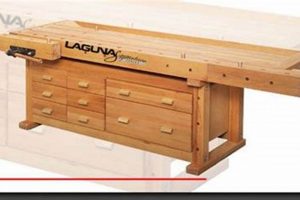
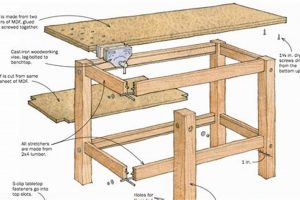
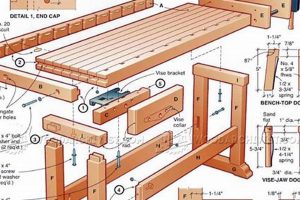
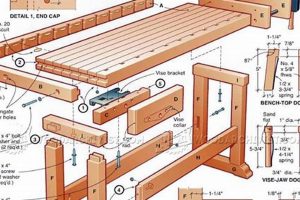
A fundamental tool in woodworking, this apparatus firmly secures materials during cutting, shaping, and assembly processes. It typically features two jaws, one fixed and one adjustable, that clamp onto the workpiece. For instance, a craftsman might employ this device to hold a piece of lumber while chiseling a mortise or planing a surface.
Its implementation is crucial for precision and safety, enabling controlled manipulation of wood. Historically, these tools have evolved from simple screw-based mechanisms to more sophisticated designs incorporating quick-release levers and specialized jaw configurations. The resulting secure hold enables efficient work and mitigates the risk of material slippage, improving the overall quality of finished pieces.
Further discussion will delve into specific types, mounting techniques, maintenance procedures, and selection criteria relevant to choosing an appropriate model for various woodworking applications. This includes evaluating jaw width, clamping force, and material construction to suit individual project requirements.
Essential Usage Tips
Optimal utilization of this tool enhances woodworking precision and project outcomes. These guidelines promote efficient operation and prolonged equipment lifespan.
Tip 1: Ensure Proper Mounting. The device must be securely affixed to the workbench. Insufficient fastening leads to instability and compromised work accuracy. Utilize robust bolts and backing plates for reliable attachment.
Tip 2: Utilize Jaw Liners. Employ wooden or cork liners to protect delicate workpieces from marring. These liners distribute clamping pressure evenly and prevent indentation of soft materials.
Tip 3: Avoid Over-Tightening. Excessive force can damage both the device and the material being held. Apply only the necessary pressure to maintain a secure grip, avoiding distortion or compression of the workpiece.
Tip 4: Regularly Lubricate the Screw Mechanism. Periodic lubrication ensures smooth operation and prevents binding. Use a high-quality machine oil or dry lubricant specifically designed for threaded components.
Tip 5: Clean Jaws Frequently. Remove debris, glue, and sawdust from the jaws after each use. Accumulated residue compromises grip and can transfer unwanted markings onto future projects.
Tip 6: Align the Jaws. Periodically check that the jaws are aligned properly. Misalignment will result in uneven clamping pressure and inaccurate work.
Tip 7: Consider Jaw Extensions. For larger or oddly shaped objects, jaw extensions can provide extra support and stability. These extensions can be easily fabricated from hardwood.
Adhering to these principles ensures consistent and reliable performance. The result is enhanced control, accuracy, and preservation of both the tool and the materials being worked.
The following sections will explore various types and specific applications in greater detail. Understanding these nuances further optimizes woodworking processes.
1. Secure Clamping

Secure clamping constitutes a fundamental prerequisite for effective woodworking, intrinsically linked to the functionality of the central apparatus. It is the principle action enabling controlled material manipulation, converting the tool into more than a mere fixture. A robust grip minimizes workpiece movement during cutting, shaping, and joining operations, directly influencing precision and safety. For example, attempting to hand-cut dovetails on a board that shifts under pressure compromises joint integrity and presents a risk of injury. The device, therefore, serves as the primary means of achieving this secure hold.
The absence of secure clamping necessitates increased manual force to stabilize the workpiece, leading to fatigue and potential errors. Conversely, a properly secured component allows the woodworker to apply focused, controlled pressure, resulting in cleaner cuts and more accurate assemblies. Mortise and tenon joinery, intricate carvings, and even simple sanding processes benefit significantly from the stability provided by a well-maintained and correctly utilized clamping system. The design and construction of the tool, including jaw material, screw mechanism, and overall robustness, directly impact its clamping effectiveness.
In conclusion, secure clamping is not merely a feature of the tool; it is its core purpose. Understanding the mechanics of secure clamping and its effect on woodworking operations is crucial for achieving high-quality results. Challenges, such as material selection and proper maintenance, are addressed through careful consideration of the device’s design and its integration into overall workshop practices. The efficiency and safety of woodworking are contingent upon this fundamental principle.
2. Material preservation

Material preservation, in the context of woodworking, refers to the prevention of damage or alteration to wood during fabrication processes. The implementation of a woodworker’s bench apparatus plays a pivotal role in this aspect, influencing the final quality and longevity of wooden products. Its design and proper use directly affect the structural integrity and aesthetic condition of the materials being worked.
- Jaw Liners and Protective Inserts
The selection and utilization of appropriate jaw liners, often constructed from wood, cork, or leather, serve as a primary defense against indentation or marring of the workpiece. These inserts distribute clamping force evenly, minimizing stress concentration that can lead to surface damage. A hard steel jaw directly contacting a soft wood species, for instance, will almost certainly leave an impression. Therefore, suitable liners are imperative when handling delicate or valuable materials.
- Controlled Clamping Pressure
The ability to regulate the clamping pressure exerted by the apparatus is critical. Excessive force can crush wood fibers, leading to permanent deformation or even cracking, particularly when working with brittle or thin stock. Woodworkers must exercise caution and develop a feel for the appropriate level of pressure required to secure the workpiece without causing damage. Variable-pressure mechanisms on higher-quality tools facilitate precise control.
- Alignment and Surface Contact
Proper alignment of the jaws ensures consistent and even surface contact with the workpiece. Misalignment results in uneven pressure distribution, concentrating force on specific areas and increasing the risk of damage. Regular inspection and maintenance of the tool’s alignment are essential for preventing such occurrences. This includes verifying that the jaws are parallel and free from obstructions that could compromise full surface contact.
- Material Compatibility
The material composition of the apparatus’s jaws can impact wood preservation. Jaws made from softer metals or incorporating non-abrasive coatings are less likely to cause surface scratches or blemishes than those constructed from hardened steel. Furthermore, consideration of the workpiece’s moisture content is essential. Clamping excessively dry wood can lead to splitting, while working with wet wood can result in warping upon drying. Understanding these material interactions is crucial for optimal preservation.
Collectively, these facets highlight the significance of the woodworker’s apparatus in safeguarding material integrity during woodworking processes. The judicious selection, maintenance, and operation of this tool are vital for preserving the aesthetic and structural characteristics of wood, ensuring the creation of high-quality and durable finished products. The integration of protective measures, such as appropriate jaw liners and controlled clamping force, enhances the tool’s capacity to facilitate precise work while minimizing the risk of damage to valuable woodworking materials.
3. Workpiece Stabilization
Workpiece stabilization constitutes a primary function of a woodworkers bench apparatus. The tool directly facilitates secure positioning of materials during various woodworking operations. Without adequate stabilization, precision cuts, controlled shaping, and accurate joinery become significantly more difficult and potentially hazardous. The apparatus, therefore, serves as a crucial element in maintaining consistent and safe working conditions. For example, attempting to route the edge of a board without securing it in a apparatus could lead to uncontrolled movement, resulting in inaccurate cuts and a heightened risk of injury. In essence, the apparatus transforms from a mere accessory into a fundamental requirement for effective woodworking.
The apparatus achieves stabilization through a combination of mechanical clamping force and strategically designed contact surfaces. The jaws of the apparatus, often augmented with wooden liners or other protective materials, provide a broad, secure grip on the workpiece. The screw mechanism, a core component of most designs, allows for controlled application of pressure, ensuring the material remains firmly in place. The effectiveness of stabilization is also dependent on the apparatus’s mounting. A loose or poorly mounted apparatus will compromise the stability of the workpiece, regardless of the clamping force applied. Consider the process of hand-planing a large panel; if the apparatus is not securely attached to the bench, the force exerted during planing will cause both the apparatus and the panel to shift, rendering the operation ineffective.
In summary, workpiece stabilization is inextricably linked to the utility and efficacy of a woodworkers bench apparatus. The ability to securely hold materials is paramount for achieving accurate and safe woodworking outcomes. Factors such as clamping force, jaw design, mounting integrity, and material compatibility all contribute to the overall effectiveness of stabilization. Proper attention to these details not only enhances the quality of the finished product but also reduces the risk of accidents and improves the efficiency of the woodworking process. Therefore, understanding and prioritizing workpiece stabilization is essential for any woodworker seeking to achieve professional results.
4. Precise Positioning
Precise positioning, in the context of woodworking, denotes the accurate placement and secure fixture of a workpiece to facilitate specific operations. The woodworkers bench apparatus serves as a critical tool in achieving this level of precision, enabling the craftsman to execute intricate tasks with minimal deviation.
- Controlled Clamping
The apparatus allows for controlled application of clamping force, ensuring the workpiece remains stationary during operations such as sawing, routing, and chiseling. This stability minimizes the risk of slippage, which can lead to inaccurate cuts or damage to the material. For example, when cutting dovetails, the precise positioning afforded by the apparatus enables the woodworker to create tight-fitting joints with minimal gaps or imperfections.
- Adjustable Orientation
The design of most bench apparatus permits adjustable orientation of the workpiece, allowing the woodworker to position the material at specific angles for specialized tasks. This is particularly useful in operations such as carving or shaping curved components, where maintaining a consistent angle of attack is crucial for achieving the desired outcome. The ability to rotate and secure the workpiece enhances the craftsman’s control over the shaping process.
- Consistent Reference Points
The apparatus establishes consistent reference points, enabling repeatable and accurate positioning of the workpiece for multiple operations. This is especially important in batch production or when creating components that must conform to precise dimensions. For instance, when creating multiple identical mortises, the apparatus ensures each mortise is located in the same position on each workpiece, facilitating consistent assembly.
- Enhanced Safety
Precise positioning, facilitated by the apparatus, contributes significantly to safety in woodworking operations. By securely holding the workpiece, the apparatus reduces the risk of sudden movements or kickbacks, minimizing the potential for accidents or injuries. The ability to work with both hands on the tool, rather than using one hand to stabilize the material, enhances control and reduces fatigue.
The interplay between precise positioning and the woodworkers bench apparatus is central to the execution of high-quality woodworking. By providing a stable and adjustable platform for the workpiece, the apparatus empowers the craftsman to achieve greater accuracy, consistency, and safety in their work. The effectiveness of the apparatus, therefore, directly correlates with the precision and quality of the final product.
5. Mechanical Advantage
Mechanical advantage, a fundamental principle of physics, directly influences the functionality and efficiency of a woodworker’s bench apparatus. This principle allows for the amplification of force, enabling the user to exert significant clamping pressure with relatively minimal effort. The design and implementation of this concept within the tool are critical determinants of its overall performance.
- Screw Thread Pitch and Clamping Force
The screw thread pitch is a primary factor in determining mechanical advantage. A finer pitch (more threads per unit length) increases the mechanical advantage, requiring less force to rotate the screw but resulting in slower jaw movement. Conversely, a coarser pitch allows for faster jaw movement but requires greater force. The selection of an appropriate pitch represents a design compromise to balance clamping power and operational speed within the woodworking apparatus.
- Leverage and Handle Length
The length of the handle or lever used to tighten the screw directly affects the mechanical advantage. A longer handle provides greater leverage, enabling the user to apply more torque with the same amount of force. This extended lever arm effectively multiplies the applied force, contributing to a more robust clamping action. Handle design, including material and ergonomics, further influences the user’s ability to maximize the available mechanical advantage.
- Jaw Design and Force Distribution
While not directly related to the screw mechanism, the design of the jaws influences the effective application of mechanical advantage. Jaws that provide a broad, flat surface for contact with the workpiece distribute the clamping force more evenly, preventing localized stress concentrations. Conversely, poorly designed or worn jaws can reduce the effective clamping force and compromise the stability of the workpiece, negating some of the mechanical advantage gained through the screw and lever system.
- Friction and Efficiency
Friction within the screw mechanism reduces the overall efficiency of the mechanical advantage. Friction between the threads and the screw body dissipates some of the applied force, resulting in a lower clamping force than theoretically predicted. Lubrication and material selection play a role in minimizing friction and maximizing the transfer of force from the user to the workpiece. Regular maintenance and proper lubrication are essential for preserving the mechanical efficiency of the woodworking apparatus.
In conclusion, the mechanical advantage inherent in a woodworker’s bench apparatus is a product of multiple interacting design elements. The screw thread pitch, handle length, jaw design, and friction all contribute to the tool’s ability to amplify force and securely clamp workpieces. A comprehensive understanding of these principles is essential for selecting, maintaining, and effectively utilizing woodworking apparatus to achieve optimal results.
6. Ergonomic access
Ergonomic access, when considered in relation to a woodworker’s bench apparatus, directly impacts user efficiency, reduces strain, and promotes safety. The positioning and usability of the apparatus components significantly influence the user’s posture, reach, and overall comfort during prolonged woodworking tasks. Suboptimal apparatus design and placement can lead to awkward body positions, repetitive strain injuries, and decreased productivity. For example, an apparatus positioned too far from the user requires excessive reaching, increasing the risk of shoulder and back strain. Conversely, an apparatus positioned too low necessitates constant bending, leading to similar ergonomic issues.
The height of the bench relative to the user is a primary consideration in achieving ergonomic access. The apparatus should ideally be mounted at a height that allows the user to maintain a neutral wrist position and a comfortable arm angle while working. Furthermore, the design of the apparatus itself should facilitate easy operation of the clamping mechanism. Handles should be easily grasped and turned without requiring excessive force or awkward movements. A quick-release mechanism that allows for rapid adjustment of the jaws can also significantly improve ergonomic access, reducing the time and effort required to secure and release workpieces. An example could be a cabinet maker, who spends several hours a day working with their bench apparatus. A poorly designed apparatus will have a massive impact on their production rate as well as health.
In summary, ergonomic access is an essential component of the woodworker’s bench apparatus system, influencing both user well-being and work efficiency. Proper bench height, strategic apparatus placement, and thoughtful design of the apparatus mechanism are critical factors in achieving optimal ergonomic access. Addressing these ergonomic considerations minimizes the risk of musculoskeletal disorders and fosters a more productive and comfortable woodworking environment. The implementation of ergonomic practices in apparatus design and usage represents a practical investment in the long-term health and productivity of the woodworker.
7. Durability assessment
Durability assessment, when applied to woodworking apparatus, directly relates to the lifespan, reliability, and long-term value of the tool. The ability of the apparatus to withstand repeated use, varying clamping forces, and exposure to workshop conditions determines its utility and overall cost-effectiveness. Premature failure of a bench apparatus disrupts workflow, necessitates costly repairs or replacements, and potentially compromises the quality of woodworking projects. Therefore, evaluating the durability of a woodworking apparatus is a critical step in the selection and maintenance process. Consider a professional furniture maker who relies daily on their bench apparatus; a failure of the apparatus during a critical stage of production can result in project delays, material waste, and potential loss of income.
Several factors contribute to the durability of a woodworking apparatus. The materials used in construction, particularly the jaw material, screw mechanism, and frame, directly impact its resistance to wear, deformation, and corrosion. Cast iron, for example, offers high compressive strength and vibration dampening but is susceptible to rust. Steel provides greater tensile strength and corrosion resistance but may be more prone to vibration. The design of the apparatus, including the size and shape of the jaws, the thread pitch of the screw, and the overall structural integrity, also influences its ability to withstand stress and maintain alignment over time. For instance, an apparatus with poorly aligned jaws or a loose screw mechanism will experience increased wear and tear, leading to premature failure. Regular maintenance, including lubrication of moving parts and protection from moisture, is essential for preserving the durability of a woodworking apparatus. A neglected apparatus is more likely to corrode, bind, or develop excessive play, reducing its clamping force and increasing the risk of breakage.
In summary, durability assessment is an indispensable aspect of evaluating woodworking apparatus. It informs purchasing decisions, guides maintenance practices, and ultimately determines the long-term value and reliability of the tool. Factors such as material selection, design integrity, and maintenance procedures all contribute to the durability of a woodworking apparatus. A comprehensive understanding of these factors enables woodworkers to select and maintain apparatus that will provide years of reliable service, contributing to both the quality and efficiency of their work. Ignoring durability assessment will lead to poor apparatus selections, higher costs, and increased project times.
Frequently Asked Questions about Woodworkers Bench Vice
This section addresses common inquiries regarding the application, maintenance, and selection of woodworkers bench apparatus. The information presented aims to clarify prevalent misunderstandings and provide actionable guidance.
Question 1: What constitutes the optimal mounting height for a woodworkers bench vice?
The apex should be situated such that, when planing a workpiece, the elbow is bent at approximately ninety degrees. This positioning minimizes strain and maximizes planing efficiency.
Question 2: How frequently should a woodworkers bench vice be lubricated?
Lubrication should occur at least every six months, or more frequently if the action becomes stiff or binding. A high-quality machine oil or dry lubricant formulated for threaded mechanisms is recommended.
Question 3: What jaw width is appropriate for general woodworking applications?
A jaw width of six to nine inches is generally suitable for a broad spectrum of woodworking tasks. Larger jaw widths may be required for specific applications involving larger or irregularly shaped workpieces.
Question 4: Can a woodworkers bench vice be used to clamp metal workpieces?
While adaptable, usage with metal workpieces is not recommended without protective jaw liners. Direct contact can damage the hardened steel jaws and transfer residue to future woodworking projects. Special considerations should be taken when using steel.
Question 5: What is the recommended method for removing rust from a woodworkers bench vice?
Rust removal is achieved through mechanical means, such as a wire brush or abrasive pad, followed by application of a rust inhibitor. Disassembly of the apparatus may be necessary for thorough cleaning.
Question 6: How does the screw pitch affect the clamping force of a woodworkers bench vice?
A finer screw pitch provides greater mechanical advantage, resulting in increased clamping force for a given input torque. However, finer pitches typically require more rotations to achieve full clamping. The design must be strong enough, because a strong screw pitch can also cause it to break.
Effective application of these principles promotes optimal performance and extends the lifespan of woodworking apparatus.
The following section explores advanced techniques and specialized applications of these apparatus.
In Conclusion
The preceding discourse has meticulously examined the woodworkers bench apparatus, elucidating its critical role in woodworking. From secure clamping and material preservation to workpiece stabilization, precise positioning, mechanical advantage, ergonomic access, and durability assessment, the multifaceted nature of this tool has been thoroughly explored. The analyses highlighted that its effective utilization is contingent upon a comprehensive understanding of its design, mechanics, and proper maintenance protocols.
The continued advancement and refinement of the woodworkers bench apparatus remain pivotal for enhancing precision, safety, and efficiency in woodworking practices. Further research and development efforts should focus on optimizing ergonomic designs, incorporating innovative materials, and improving clamping mechanisms. The adoption of best practices, grounded in sound engineering principles, is essential for maximizing the utility and longevity of this indispensable woodworking tool. These parameters set the course for future studies on this crucial tool.