



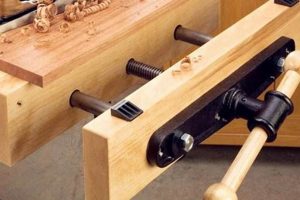
These devices are work-holding accessories used in woodworking. They typically consist of a metal or composite component that fits into a corresponding hole, usually round or rectangular, on a workbench. The primary function is to secure a workpiece to the benchtop, providing stability during operations such as sawing, planing, and routing. One common example is a cylindrical metal peg inserted into a bench hole, used in conjunction with a vise or other similar device to clamp lumber.
The utility of these tools lies in their ability to create a reliable and consistent clamping surface. This promotes accuracy and safety when working with wood. Their widespread adoption stems from their ease of use, adaptability to different workpiece sizes and shapes, and the efficiency they bring to a woodworking workflow. The historical use of similar bench accessories extends back centuries, reflecting a long-standing need for effective work-holding solutions in the craft.
The following sections will delve deeper into the various types of these woodworking accessories, examining their specific features, applications, and considerations for selecting the appropriate tools for diverse woodworking projects.
Optimizing Woodworking with Bench Dog Clamps
Effective utilization of these accessories significantly enhances precision and efficiency in woodworking tasks. The following tips outline best practices for their selection and application.
Tip 1: Material Compatibility: Consider the material of these accessories relative to the workpiece. Avoid using metal accessories on delicate hardwoods without protective measures, as they can cause indentation. Opt for nylon or rubber-coated versions in such cases.
Tip 2: Bench Hole Consistency: Ensure consistent diameter and spacing of bench holes to guarantee secure and predictable accessory placement. Irregular holes compromise clamping force and accuracy. Implement a standardized drilling template.
Tip 3: Clamping Pressure Regulation: Exercise caution when applying pressure using these accessories in conjunction with vises or other clamping mechanisms. Over-tightening can damage the workpiece. Gradual tightening and even pressure distribution are recommended.
Tip 4: Accessory Variety: Maintain a diverse selection of accessory types, including those with variable heights, angles, and clamping faces. This allows for adaptation to a wide range of workpiece geometries and clamping requirements.
Tip 5: Maintenance and Storage: Regularly inspect these accessories for wear, damage, and debris. Clean and lubricate metal components to prevent corrosion. Store in an organized manner to prevent damage and ensure accessibility.
Tip 6: Proper Alignment: Prior to clamping, ensure the workpiece is accurately aligned with the desired position. Misalignment can result in inaccurate cuts or joinery. Utilize auxiliary measuring tools to verify accuracy.
Tip 7: Sequential Clamping: When securing large or complex workpieces, employ a sequential clamping approach. This involves gradually tightening multiple accessories in a strategic order to distribute pressure evenly and prevent warping.
Adherence to these guidelines fosters a more efficient and accurate woodworking process, minimizing errors and maximizing the quality of the finished product.
The subsequent sections will address specific applications of these accessories in common woodworking projects, providing further insights into their practical utilization.
1. Material Composition

The material composition of these work-holding accessories directly influences their performance and suitability for various woodworking tasks. The choice of material affects several critical factors, including clamping force, durability, and potential for workpiece damage. Steel, for instance, offers high clamping force and robustness, making it appropriate for securing dense hardwoods. However, direct contact with softer woods can lead to indentation or marring. Conversely, accessories made of nylon, rubber, or composite materials provide a gentler clamping surface, minimizing the risk of damage to delicate workpieces. The decision to use steel vs. nylon will directly affect clamping force, potentially leading to workpiece movement if a lower clamping force is selected. A common example illustrating this concept is the use of steel accessories when routing a dado in oak; the clamping force ensures the workpiece remains stationary, maintaining consistent dimensions. However, the same accessory used on a piece of pine could leave visible impressions.
Further, the coefficient of friction between the accessory’s surface and the workpiece material contributes to clamping effectiveness. A higher coefficient of friction reduces the likelihood of slippage under load. Surface treatments, such as knurling or coating, can be employed to enhance grip. The material’s resistance to deformation under pressure also determines its longevity and ability to maintain a consistent clamping force over time. Polymer accessories, while less prone to causing damage, may deform more readily under sustained pressure compared to steel, affecting long-term performance. For example, a knurled steel accessory provides increased friction, further minimizing the risk of slippage.
In summary, understanding the impact of material composition on clamping force, durability, and workpiece protection is crucial for selecting the appropriate woodworking bench accessory. Careful consideration of the wood species, clamping requirements, and accessory material enables woodworkers to achieve secure and accurate work-holding, thereby improving overall project quality. Choosing the wrong material can have cascading effects on the safety and accuracy of woodworking tasks, and therefore should be an important consideration for selecting which accessory to utilize.
2. Clamping Force

Clamping force is a critical parameter in woodworking, directly impacting the stability and security of a workpiece held by these bench accessories. It refers to the amount of pressure exerted by the accessory on the wood, ensuring it remains stationary during operations like sawing, planing, or routing. Insufficient clamping force results in workpiece movement, leading to inaccuracies and potential safety hazards. Excessive clamping force, conversely, can damage the wood, especially softer species. Thus, understanding and controlling clamping force is paramount for precision woodworking.
- Accessory Design and Material
The design and material composition directly influence the achievable clamping force. Steel accessories typically offer a higher potential clamping force compared to polymer or wooden alternatives. The shape and surface texture of the accessory also contribute; for example, a knurled surface increases friction and enhances grip, allowing for greater clamping force without slippage. The mechanical properties of the material, such as tensile strength and elasticity, determine the accessory’s ability to withstand prolonged use under high clamping forces. A steel accessory will typically provide higher clamping force than a nylon or composite accessory.
- Mechanical Advantage and Leverage
Many of these accessories are used in conjunction with vises or other clamping mechanisms. The mechanical advantage provided by these devices amplifies the force applied by the user, resulting in increased clamping force on the workpiece. The placement of the accessory relative to the vise jaws and the workpiece influences the distribution of clamping force and the overall stability of the setup. Incorrect placement can result in uneven pressure, leading to workpiece deformation or slippage. The closer the accessory is to the vise, the higher the force. For example, a cam-action accessory provides a quick and substantial force when used in conjunction with a vise or hand tightened.
- Workpiece Material Properties
The material properties of the workpiece dictate the required clamping force. Softer woods, such as pine or cedar, require lower clamping forces to prevent indentation or crushing. Hardwoods, like oak or maple, can withstand higher clamping forces. The moisture content of the wood also affects its compressibility and the required clamping force. Wood with higher moisture content is more susceptible to deformation under pressure. Clamping force should therefore be adjusted based on the type of wood. Pine will require much less clamping force than maple. In most cases this can be determined through experimentation.
- Clamping Accessory Type and Configuration
The type of accessory and its configuration on the bench significantly influence the distribution and effectiveness of clamping force. Accessories with larger contact surfaces distribute the force over a wider area, reducing the risk of localized damage. The number and placement of accessories determine the overall stability of the workpiece. Using multiple accessories strategically positioned around the workpiece provides a more even distribution of clamping force and prevents movement during machining operations. The distribution and quantity of these accessories should be planned out before engaging in any cutting of the material.
In conclusion, the interplay between accessory design, material properties, mechanical advantage, and workpiece characteristics determines the optimal clamping force in woodworking. Selecting the appropriate accessories and configuring them correctly ensures secure and accurate work-holding, contributing to high-quality woodworking projects. Overestimating or underestimating this force can lead to project failure, wasted material, and potential injuries. Careful calibration of clamping force is a hallmark of skilled woodworking.
3. Bench Hole Compatibility
Bench hole compatibility is a fundamental aspect of effective work-holding in woodworking, directly impacting the usability and performance of accessories designed for this purpose. Mismatched dimensions between the accessory and the bench hole compromise clamping force and stability, potentially leading to inaccurate cuts or workpiece slippage.
- Diameter Standardization
Consistent bench hole diameters are crucial for ensuring a secure fit. The industry standard for bench hole diameter is typically 3/4 inch or 20mm, but variations exist. Using accessories with incompatible diameters results in either a loose fit, reducing clamping effectiveness, or an inability to insert the accessory at all. For example, attempting to use a 3/4-inch accessory in a 1-inch hole renders the accessory ineffective. Similarly, forcing an oversized accessory into an undersized hole can damage either the accessory or the workbench.
- Hole Spacing and Grid Systems
The spacing between bench holes, organized into a grid system, dictates the versatility of work-holding configurations. Regular, consistent spacing allows for flexible accessory placement to accommodate various workpiece sizes and shapes. Irregular spacing limits the options for accessory positioning and may require custom adaptations. A common example is the use of a 4-inch on-center grid, which enables predictable and repeatable clamping setups. Variations in grid spacing necessitate the use of custom-made accessories or modifications to existing ones.
- Hole Depth and Blind Holes
The depth of bench holes influences the stability of accessories, especially those with extended shafts. Insufficient hole depth can cause accessories to wobble or tilt under load, compromising clamping accuracy. Blind holes, which do not penetrate the entire thickness of the benchtop, prevent the use of accessories with through-tenons or extended clamping mechanisms. Hole depth must align with the accessories being used on it. This also prevents damage from inadvertently boring through the bench.
- Hole Shape and Geometry
While round bench holes are most common, other shapes exist, including square and rectangular holes. The shape of the hole dictates the type of accessories that can be used. Square or rectangular holes may be designed for specific accessories with corresponding shapes, offering enhanced resistance to rotation under load. Adapting accessories designed for round holes to fit non-round holes typically requires modifications or the use of specialized adapters, potentially compromising clamping strength. For example, square holes are frequently used in conjunction with metal work to provide consistent square corners, minimizing work piece rotation.
The facets of bench hole compatibility underscore the need for careful consideration during workbench construction or modification. Adhering to standardized dimensions and establishing a consistent grid system ensures maximum flexibility and effectiveness in utilizing accessories for work-holding. Deviations from these standards can significantly limit the usability of the workbench and hinder the accuracy of woodworking operations.
4. Workpiece Stability
Workpiece stability is paramount in woodworking, directly affecting the accuracy and safety of various operations. These work-holding accessories are instrumental in achieving the necessary stability, preventing movement during cutting, shaping, and assembly tasks. Inadequate stability leads to inaccuracies, material waste, and increased risk of injury.
- Clamping Pressure Distribution
These accessories facilitate controlled distribution of clamping pressure across the workpiece. Strategic placement of these accessories minimizes the risk of warping or distortion caused by uneven pressure. Consistent pressure ensures the workpiece remains firmly anchored to the bench surface, preventing slippage during machining operations. An example is the use of multiple accessories when routing a long board; evenly spaced accessories distribute pressure, preventing bowing or vibration.
- Horizontal and Vertical Restraint
These accessories provide both horizontal and vertical restraint, preventing movement along multiple axes. Horizontal restraint prevents the workpiece from sliding or shifting during lateral forces, such as sawing or planing. Vertical restraint prevents lifting or rocking, ensuring consistent contact between the workpiece and the bench surface. The integration of a face vise and a bench accessory allows for both horizontal and vertical restraint, enabling precise edge jointing of lumber.
- Vibration Dampening
Proper use of these accessories contributes to vibration dampening, reducing resonance and minimizing the effects of machine-induced vibrations. By securely clamping the workpiece to the bench, these accessories dampen vibrations that can compromise cut quality and precision. For example, when using a router, securing the workpiece reduces vibration, resulting in cleaner edges and smoother surfaces.
- Integration with Auxiliary Systems
These accessories integrate seamlessly with auxiliary work-holding systems, such as vises, jigs, and fixtures, to provide comprehensive workpiece stabilization. The combined use of these elements expands the versatility of the workbench and enables complex work-holding configurations. Combining a miter saw with these accessories on the sides enable the cutting of long stock without losing stability.
The interplay between clamping pressure distribution, horizontal and vertical restraint, vibration dampening, and integration with auxiliary systems underscores the critical role of these accessories in achieving optimal workpiece stability. Proper selection and placement of these accessories ensure secure and accurate work-holding, contributing to safer and more efficient woodworking practices.
5. Versatility
The connection between versatility and work-holding accessories manifests through the adaptable nature of these tools across a spectrum of woodworking tasks. The capacity to accommodate diverse workpiece sizes, shapes, and orientations defines their practical significance. This attribute stems from variations in accessory design, allowing for secure clamping of irregularly shaped objects, thin materials, or pieces requiring specific orientations for machining. Their versatility ensures efficient work-holding without necessitating specialized jigs or fixtures for every project, thereby increasing productivity.
Real-world applications exemplify this versatility. For instance, a standard cylindrical accessory can secure a square board for edge jointing. When paired with a low-profile clamping accessory, it can support thin plywood during sanding operations. Furthermore, accessories with adjustable heights facilitate the creation of angled clamping surfaces, enabling the construction of complex joinery. The capacity to integrate with other work-holding devices, such as vises and fences, amplifies their versatility, allowing woodworkers to create customized clamping solutions for specific tasks.
In essence, versatility is an intrinsic property of these woodworking accessories, dictated by their design, compatibility, and adaptability to different woodworking scenarios. The ability to address diverse clamping needs with a relatively small set of tools underscores their value in any woodworking shop. Understanding this aspect enhances the efficiency and effectiveness of woodworking processes, enabling the creation of high-quality projects with minimal tooling complexity.
6. Ergonomics

The ergonomic considerations surrounding these accessories center on minimizing physical strain and maximizing efficiency during woodworking tasks. Improper utilization can lead to repetitive stress injuries, back pain, and reduced productivity. The height and placement of the workbench, in conjunction with the positioning of these accessories, directly impact posture and reach. Bending or reaching excessively to secure a workpiece with these devices can strain the lower back and shoulders. Optimized placement and easily accessible storage of these accessories reduce unnecessary movements, contributing to a more comfortable and productive work environment. For instance, if the accessory is too low, one would need to bend down to properly utilize it, which over time would result in back issues.
The design of the accessories themselves also contributes to ergonomic outcomes. Accessories with easy-to-grip handles or levers require less force to operate, minimizing strain on the hands and wrists. Quick-release mechanisms allow for rapid adjustment and repositioning, reducing the time spent manipulating the work-holding setup. Materials with a comfortable texture and weight can improve grip and reduce fatigue. The physical dimensions of these accessories also play a role; overly large or cumbersome accessories can be difficult to handle, particularly for users with smaller hands. A real life example is when you compare a small accessory vs. a large accessory on a piece of ply wood. A smaller accessory would allow for ease of use, without having the need to over-extend to reach the accessory.
Ultimately, integrating ergonomic principles into the selection and utilization of these woodworking accessories is crucial for promoting long-term well-being and maximizing efficiency. A thoughtful approach to workbench design, accessory placement, and accessory selection can minimize physical strain, reduce the risk of injury, and enhance the overall woodworking experience. Neglecting these ergonomic factors can lead to discomfort, decreased productivity, and potential health problems. It is also important to note that even the best accessory used incorrectly would result in injury over time.
Frequently Asked Questions
The following addresses common inquiries regarding the selection, application, and maintenance of these woodworking accessories.
Question 1: What factors determine the appropriate diameter for bench holes intended to accommodate these accessories?
The selection of bench hole diameter hinges on standardization. The 3/4 inch and 20mm diameters are prevalent, ensuring compatibility with a wide range of commercially available accessories. Deviations from these standards necessitate custom-made accessories or modifications, potentially compromising work-holding effectiveness.
Question 2: How does material composition impact the choice of accessory for different wood species?
Material hardness and surface properties dictate compatibility. Steel accessories, while robust, can mar softer woods. Accessories made of nylon or rubber offer a gentler clamping surface, mitigating the risk of damage to delicate workpieces. The choice should correlate with the wood’s susceptibility to indentation.
Question 3: What is the significance of clamping force, and how is it regulated?
Clamping force ensures workpiece stability during machining operations. Excessive force can damage the wood, while insufficient force allows movement. Regulation is achieved through a combination of accessory design, mechanical advantage (e.g., vises), and user judgment, balancing security and material integrity.
Question 4: How does the spacing of bench holes affect work-holding versatility?
Consistent spacing allows for flexible positioning of accessories, accommodating diverse workpiece sizes and shapes. A regular grid system, typically 4 inches on center, provides predictable and repeatable clamping setups. Irregular spacing limits positioning options and may require creative adaptations.
Question 5: What maintenance procedures are recommended to prolong the lifespan of these accessories?
Regular inspection for wear and damage is essential. Metal accessories should be cleaned and lubricated to prevent corrosion. Proper storage in an organized manner prevents damage and ensures accessibility. Neglecting maintenance can compromise performance and reduce longevity.
Question 6: In what ways can accessories be integrated with other work-holding systems to enhance stability?
These accessories often function in conjunction with vises, jigs, and fixtures. Integrating these components creates comprehensive work-holding solutions, expanding the capabilities of the workbench and enabling complex clamping configurations. This approach maximizes stability and precision.
In summary, judicious selection, proper application, and consistent maintenance are key to maximizing the utility and lifespan of these woodworking accessories. Understanding their properties and integrating them effectively into work-holding systems contributes to superior woodworking outcomes.
The following sections provide information on accessory selection criteria and optimal usage techniques.
Conclusion
This exploration has elucidated the significance of woodworking bench dog clamps as essential components in achieving stable and precise work-holding. Key points have included the importance of material compatibility, clamping force regulation, bench hole consistency, and accessory versatility. The ergonomic considerations associated with their use have also been underscored, highlighting the need for mindful integration into woodworking workflows.
The effective application of woodworking bench dog clamps contributes directly to the quality and safety of woodworking projects. Continued adherence to best practices in selection, application, and maintenance will ensure these devices remain valuable assets in the pursuit of woodworking excellence. Further research into innovative designs and materials promises to enhance their capabilities and expand their role in future woodworking endeavors.
![Top-Rated: Best Quick Clamps for Woodworking Projects [2024] | Step-by-Step Guides, Tools & Inspiration to Build Beautiful Wooden Decor on a Budget](https://woodfromhome.com/wp-content/uploads/2026/04/th-264-300x200.jpg "Top-Rated: Best Quick Clamps for Woodworking Projects [2024] Step-by-Step Guides, Tools & Inspiration to Build Beautiful Wooden Decor on a Budget")