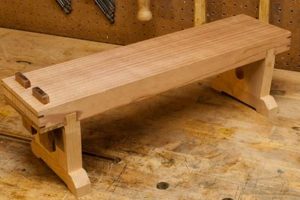
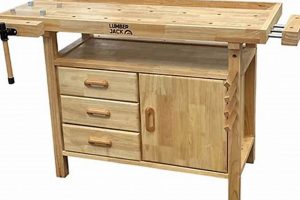
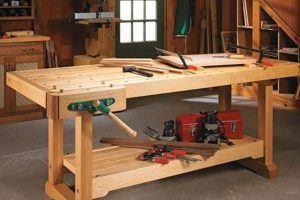
The vertical distance from the floor to the work surface of a carpentry table is a critical dimension influencing the user’s posture and efficiency. This measurement determines how comfortably and effectively a woodworker can perform tasks such as sawing, chiseling, and assembly. An example would be a workbench with a surface 36 inches above the floor, designed for an individual of average height.
Proper table elevation minimizes strain, enhances control, and improves overall precision during woodworking activities. Historically, this dimension was often determined by the individual craftsman, tailored to their body and working style. This customization reduced fatigue, promoted better ergonomics, and ultimately contributed to higher quality craftsmanship. Ignoring correct dimension can lead to back pain, shoulder discomfort, and reduced accuracy in woodworking tasks.
Understanding the factors that influence the ideal dimension for a carpentry table, including individual anthropometrics and task requirements, is crucial for designing or selecting a suitable workstation. Subsequent sections will delve into specific considerations for determining optimal surface elevation, exploring methods for adjustment, and examining the implications of different heights on various woodworking operations.
Optimizing Carpentry Table Elevation
The following recommendations provide guidance on achieving an appropriate carpentry table elevation for enhanced ergonomics and improved woodworking outcomes.
Tip 1: Determine Primary Task. The optimal dimension varies depending on the predominant woodworking activities. For detailed work requiring close visual inspection, a slightly higher surface may be beneficial. Conversely, for tasks involving forceful downward pressure, a lower surface might be preferable.
Tip 2: Consider Individual Anthropometrics. User’s height is a primary determinant. A common guideline suggests that the surface should be at wrist height when standing straight with arms relaxed. However, this is a starting point; adjustments may be necessary based on individual body proportions and preferences.
Tip 3: Employ Adjustable Solutions. Workbenches with adjustable legs or risers offer flexibility to fine-tune the surface to the ideal dimension. This is particularly advantageous in shared workspaces or when undertaking diverse woodworking projects.
Tip 4: Mimic Traditional Techniques. Traditional woodworking practices often involved lower work surfaces for enhanced stability and control, especially during hand-tool operations. Experimentation with lower dimensions can reveal potential benefits for specific techniques.
Tip 5: Assess Posture and Comfort. Regularly evaluate posture and comfort during woodworking sessions. If discomfort arises in the back, shoulders, or wrists, adjustment of the table elevation is warranted. Minor adjustments can often yield significant improvements.
Tip 6: Prioritize Stability. Regardless of the chosen dimension, ensuring the table remains stable is paramount. Instability can compromise safety and accuracy. Reinforce the table’s structure if necessary, especially when employing an elevated dimension.
Tip 7: Evaluate Tool Accessibility. Consider the placement of tools and materials in relation to the work surface. Optimal organization enhances workflow and reduces the need for excessive reaching or bending, further minimizing strain.
Achieving the correct carpentry table elevation leads to improved comfort, reduced fatigue, and enhanced precision. These incremental improvements contribute to a more enjoyable and productive woodworking experience.
The next section will explore the practical application of these guidelines in specific woodworking scenarios, providing concrete examples and troubleshooting advice.
1. Individual's height

The correlation between an individual’s physical stature and the elevation of a woodworking surface is fundamental to ergonomic woodworking practices. Stature directly influences the optimal vertical distance between the floor and the work surface, affecting posture, reach, and overall comfort. For instance, a taller individual working at a bench designed for someone of shorter stature will likely experience stooping, leading to back strain and reduced efficiency. Conversely, a shorter individual utilizing a bench designed for a taller person may encounter difficulty reaching and applying adequate force, also diminishing both productivity and safety. Therefore, individual’s height is a critical determinant in establishing an ergonomically sound carpentry workspace.
The effect of incorrect bench dimension extends beyond mere discomfort; sustained improper posture can result in chronic musculoskeletal issues. A workbench too low necessitates excessive bending at the waist, increasing the risk of lower back pain and fatigue. A bench too high may cause elevated shoulders and strained neck muscles. By contrast, a surface correctly proportioned to individual height promotes a neutral posture, distributing weight evenly and reducing strain on joints and muscles. A practical approach involves adjusting the bench dimension until the user can stand comfortably with their shoulders relaxed and elbows bent at approximately 90 degrees while performing common woodworking tasks.
In summary, the dimension of a carpentry table should be viewed as a function of the user’s height, rather than a fixed parameter. Failure to account for this variable can have significant implications for user comfort, efficiency, and long-term physical well-being. Adjusting or custom-building workbenches to suit individual dimensions is therefore a worthwhile investment in ergonomic woodworking practice. The consideration of stature represents the crucial starting point in tailoring a workspace to individual needs, mitigating potential health risks, and maximizing productivity.
2. Task specificity

The elevation of a carpentry table is not solely determined by user’s height but also is intricately linked to the specific woodworking tasks being performed. Task specificity necessitates a nuanced understanding of how different operations influence the optimal vertical plane for the work surface.
- Detailed Carving and Engraving
These activities demand close visual inspection and fine motor control. A higher surface elevation may be advantageous, bringing the workpiece closer to eye level and reducing strain on the neck and back. For example, a woodcarver working on intricate details may prefer a surface that allows them to maintain an upright posture without hunching over.
- Heavy Sawing and Planing
These operations often require significant downward force and leverage. A lower surface elevation provides greater stability and allows the user to exert more power efficiently. A carpenter sawing large boards might find a lower bench more suitable for maintaining control and applying the necessary pressure.
- Assembly and Joinery
Assembly frequently involves manipulating larger components and ensuring precise alignment. A mid-range surface elevation that allows for comfortable reach and manipulation of parts is typically optimal. A cabinetmaker assembling a frame might choose a dimension that allows them to comfortably reach all parts while maintaining visual alignment.
- Mortising and Chiseling
These activities demand a balance of control and force, often requiring the user to lean into the work. An intermediate surface elevation, providing both stability and access, is typically recommended. A woodworker chiseling a mortise might require a surface that allows them to apply force efficiently without compromising control.
In conclusion, task specificity dictates that the dimension of a carpentry table should be adaptable to the demands of different woodworking operations. While user’s height provides a baseline, the specific tasks being undertaken refine the ideal surface dimension. Failure to account for task specificity can lead to decreased efficiency, increased strain, and potentially compromised quality of work. Adjustable workbenches or multiple specialized tables are therefore valuable assets in a versatile woodworking shop, allowing for optimization of the work surface for each specific activity.
3. Ergonomic factors

The relationship between ergonomic factors and carpentry table elevation is intrinsic, impacting user comfort, efficiency, and long-term physical health. Ergonomic considerations, such as posture, reach, and repetitive motions, directly influence the optimal dimension of the work surface. An improperly dimensioned surface compels the user to adopt awkward postures, leading to muscle strain, fatigue, and potentially chronic musculoskeletal disorders. Conversely, a surface optimized for ergonomic factors promotes a neutral posture, minimizing stress on joints and muscles, and enhancing overall well-being. The primary goal is to create a work environment that minimizes physical stress and maximizes productivity, which is achieved through careful attention to dimensions and work processes.
Proper surface elevation based on ergonomic analysis not only enhances comfort but also improves the quality of work. For example, a surface that is too low forces the user to hunch over, impairing visibility and reducing precision. A surface that is too high may cause the user to elevate the shoulders, leading to neck and shoulder pain. Real-world examples include custom-built workbenches designed with adjustable height mechanisms, allowing users to fine-tune the surface to their individual dimensions and specific tasks. These adjustable benches are often found in professional woodworking shops where ergonomic considerations are prioritized to maintain employee health and productivity. Similarly, the strategic placement of tools and materials, another ergonomic factor, minimizes unnecessary reaching and bending, further reducing physical strain. Designing a layout that keeps essential tools within easy reach promotes efficiency and mitigates the risk of injury.
In summary, ergonomic factors are integral to determining the optimal carpentry table dimension. By carefully considering posture, reach, and other ergonomic principles, a work environment can be created that promotes comfort, efficiency, and long-term physical health. Ignoring these factors can lead to a range of musculoskeletal issues and decreased productivity. The challenge lies in balancing individual preferences, task requirements, and available space to create a truly ergonomic workspace. A comprehensive understanding of these principles is essential for both amateur and professional woodworkers seeking to optimize their work environment and protect their physical well-being.
4. Material thickness

The dimension of the material being worked on a carpentry table is a primary factor influencing the optimal table elevation. Material dimension dictates the vertical space occupied during various woodworking operations, impacting the user’s posture, reach, and overall comfort. Neglecting to account for material dimension can lead to awkward body positions, reduced efficiency, and potential safety hazards.
- Workpiece Stability
The dimension of the stock impacts how stable the workpiece is on the surface. Thicker materials may require a lower surface, allowing the user to apply downward force more efficiently and maintain control. For example, when planing a thick timber, a lower dimension permits the user to leverage body weight for increased pressure. Conversely, thinner materials may benefit from a slightly higher surface, bringing the work closer to eye level for detail work.
- Hand Tool Clearance
The space required for hand tools, relative to the workpiece and the surface, is directly affected by material dimension. Thicker materials necessitate more vertical clearance for tools such as chisels, planes, and saws. An adequate surface height ensures that these tools can be used effectively without the handle impacting the table. For instance, when mortising a thick leg, ample clearance above the work surface is essential for proper chisel technique.
- Machine Operation Space
When using power tools on the work surface, such as routers or sanders, the dimension of the material affects the available space for maneuvering the tool safely and accurately. Thicker materials elevate the workpiece, potentially reducing the clearance between the tool and the user’s hands. Consideration must be given to maintaining sufficient space for control and preventing accidental contact with the cutting surface. When routing a thick tabletop, ensuring ample clearance is crucial for safe operation.
In conclusion, material dimension is an unavoidable consideration when determining an optimal carpentry table elevation. A workbench designed without accounting for the range of material dimensions to be worked on will inevitably lead to compromises in posture, efficiency, and safety. Adapting the surface, either through adjustable height mechanisms or the use of auxiliary supports, is essential for accommodating the variable requirements imposed by different material dimensions.
5. Tool clearance

Tool clearance, the unobstructed space required for the full range of motion and operation of woodworking tools above the work surface, directly influences the necessary dimension of a carpentry table. Inadequate clearance impairs tool functionality, compromises safety, and forces the operator into awkward postures, thereby directly impacting the efficacy of woodworking processes. The height of the surface must accommodate the vertical space demanded by various tools, from hand planes to routers, to ensure seamless operation without obstruction. For example, the effective use of a hand plane necessitates sufficient vertical space to allow for a complete stroke without the handle colliding with the table.
Insufficient tool clearance often results in diminished control, which can lead to inaccurate cuts and potential injury. Consider the use of a dovetail saw; proper manipulation requires both vertical and horizontal space. An elevated work surface might provide the needed vertical clearance, but could simultaneously compromise the user’s ability to apply downward pressure effectively, leading to imprecise cuts. Conversely, a surface that is too low might restrict the saw’s movement, forcing the user to contort their body and risk losing control. Real-world workshops adapt to this by incorporating adjustable-height benches or utilizing specialized jigs and fixtures to elevate the workpiece and increase effective tool clearance. Similarly, when using power tools such as routers or spindle sanders, the dimension must account for the tool’s base and any auxiliary attachments, such as fences or guides.
In summary, achieving adequate tool clearance is not merely a matter of convenience; it is a critical element in ensuring safe, efficient, and accurate woodworking practices. Surface dimension must be carefully considered in relation to the tools employed, the nature of the task, and the physical dimensions of the operator. The absence of sufficient clearance impedes functionality, elevates risk, and compromises the overall quality of the woodworking process. This intersection of tool clearance and surface is central to an effective and ergonomic woodworking environment.
6. Workbench style

The design and structural characteristics, termed “workbench style,” exert a demonstrable influence on the determination of appropriate carpentry table elevation. Different styles, catering to specific woodworking techniques and material handling requirements, necessitate adjustments to surface, impacting the ergonomic efficiency and overall utility of the bench. For instance, a traditional Roubo workbench, characterized by its substantial mass and low stance, often suits hand tool operations, with a surface optimized for forceful downward pressure and stability. Conversely, a Nicholson-style bench, typically lighter and featuring a higher surface, may be preferable for tasks demanding detailed visual inspection and fine motor control. Therefore, the correlation between workbench style and table dimension is not merely aesthetic; it is a functional determinant shaped by the intended applications of the bench.
Consider the practical implications of workbench style on specialized woodworking activities. A cabinetmaker’s bench, equipped with integrated storage, vises, and a relatively clean surface, benefits from a higher plane, facilitating access to stored tools and accommodating the manipulation of larger components during assembly. Conversely, a timber framing bench, designed to support heavy timbers and withstand significant impact forces, necessitates a lower surface to enhance stability and leverage during operations such as mortising and tenoning. These examples illustrate how the physical attributes and inherent functionality of different workbench styles directly affect the preferred surface, influencing posture, reach, and the application of force during woodworking processes. Ignoring this interdependency can lead to compromised ergonomics, reduced efficiency, and potential safety hazards.
In conclusion, workbench style represents a critical factor in determining carpentry table elevation. The choice of workbench style must be informed by the specific woodworking activities to be undertaken, the materials to be processed, and the ergonomic needs of the user. While individual preferences and physical characteristics play a role, the inherent design and intended functionality of different styles fundamentally shape the optimal surface dimension, impacting overall performance and user satisfaction. Recognizing and accommodating the nuanced relationship between workbench style and surface is essential for creating a functional and ergonomically sound woodworking environment.
7. Adjustability
The capacity to modify the vertical dimension of a carpentry table, termed “adjustability,” is a significant feature influencing the ergonomic adaptability and functional versatility of woodworking workstations. Adjustability enables the customization of surface to accommodate varying user anthropometrics, diverse task requirements, and evolving project needs.
- Accommodation of User Variance
Adjustable surfaces facilitate tailoring the table to the individual dimensions of different users within a shared workspace. For instance, a woodworking classroom or community workshop can accommodate individuals of varying height by providing benches with adjustable legs, ensuring that each user can attain a comfortable and ergonomically sound working posture. Without adjustability, compromises must be made, potentially leading to discomfort or strain for some users.
- Adaptation to Task Demands
Different woodworking tasks necessitate different surface elevations. Fine detail work, such as carving or inlay, often benefits from a higher surface, bringing the workpiece closer to eye level and reducing strain on the neck and back. Conversely, heavy operations, such as planing or sawing, often require a lower surface to enhance stability and leverage. Adjustable benches enable the optimization of the surface for each specific task, promoting efficiency and reducing fatigue.
- Response to Evolving Project Needs
Woodworking projects frequently involve multiple phases, each with its own dimensional requirements. An adjustable surface allows the user to modify the bench height as the project progresses, optimizing the workspace for each stage. For example, a furniture building project might involve initial dimensioning of rough lumber on a lower surface, followed by detailed joinery and finishing on a higher surface. Adjustability eliminates the need for multiple specialized benches, streamlining the workflow and conserving space.
- Mitigation of Physical Strain
Prolonged woodworking sessions can lead to physical strain and fatigue. Adjustable benches allow the user to periodically alter the surface, shifting their posture and alleviating pressure points. By promoting dynamic movement and varying postures, adjustability can reduce the risk of repetitive strain injuries and improve overall well-being. Furthermore, it allows for minor adjustments based on the user’s immediate comfort levels throughout the work day.
In conclusion, adjustability represents a valuable feature in carpentry tables, enhancing their adaptability and promoting ergonomic well-being. The capacity to modify the dimension in response to user variance, task demands, and evolving project needs allows for a more customized and efficient woodworking experience. Prioritizing adjustability in bench selection or design is an investment in user comfort, productivity, and long-term physical health.
Frequently Asked Questions About Woodworking Bench Elevation
The following addresses common inquiries regarding the establishment of proper carpentry table elevation for optimal woodworking practices.
Question 1: What constitutes the primary determinant of appropriate carpentry table dimension?
The individual’s height is the initial factor in determining suitable surface. A general guideline suggests aligning the surface with the user’s wrist when standing erect with arms relaxed. Subsequent adjustments should be made based on specific tasks and ergonomic considerations.
Question 2: How does the nature of woodworking tasks influence surface selection?
The type of work being performed dictates fine adjustments to surface. Detailed carving benefits from a higher surface, bringing the workpiece closer to eye level. Conversely, heavy sawing and planing may require a lower surface for increased leverage and stability.
Question 3: What are the potential consequences of an incorrectly dimensioned table?
An inadequately dimensioned table can lead to musculoskeletal strain, fatigue, and reduced precision. A surface that is too low induces stooping, while a surface that is too high causes elevated shoulders. Both scenarios contribute to discomfort and potentially chronic health issues.
Question 4: Should material thickness factor into the determination of surface dimension?
Yes, the thickness of the material being worked significantly affects the required surface. Thicker materials necessitate greater vertical clearance for hand tools and machine operations, influencing the optimal surface dimension.
Question 5: Is adjustability a desirable feature in a carpentry table?
Adjustability represents a valuable asset, allowing the user to fine-tune the surface to accommodate diverse tasks, varying material thicknesses, and individual preferences. Adjustable benches enhance ergonomic adaptability and promote long-term physical well-being.
Question 6: How does workbench style impact surface selection?
Different workbench styles, such as Roubo or Nicholson, are designed for specific woodworking techniques and material handling requirements. The inherent characteristics of each style necessitate adjustments to surface to optimize functionality and ergonomic efficiency.
Accurate determination of carpentry table dimension is paramount for a comfortable and productive woodworking experience. Consideration of individual height, task requirements, material thickness, and workbench style is essential for achieving an optimal working environment.
The next section will explore the selection of materials for woodworking benches, considering factors such as durability, stability, and cost-effectiveness.
Woodworking Bench Height
This exploration has emphasized that the dimension from floor to work surface is not a trivial detail, but rather a fundamental element affecting posture, efficiency, and long-term physical well-being. Considerations of individual anthropometrics, task-specific requirements, material dimensions, and workbench style all contribute to the determination of an appropriate carpentry table dimension. Achieving an optimal dimension mitigates strain, enhances control, and promotes superior craftsmanship.
The informed selection and adjustment of dimension represents a commitment to both the craft and the craftsman. As woodworking practices evolve, a thorough understanding of the principles governing dimension will remain essential for creating functional and ergonomically sound workspaces. Woodworkers are encouraged to prioritize these considerations to ensure a future of sustained productivity and minimized physical strain.