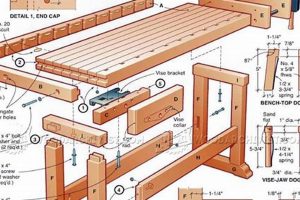
A device employed on a workbench to secure workpieces during various woodworking operations. Typically constructed from metal, wood, or composite materials, it provides a fixed point against which material can be held, preventing movement while sawing, planing, or routing. An example is a retractable metal peg that fits into a dog hole on the workbench surface, offering a stable abutment for the wood being worked.
This component is essential for efficient and accurate woodworking. By preventing slippage and unwanted motion, it enhances safety, allowing the user to focus on the task at hand. Furthermore, it contributes to improved precision in cuts and shaping, leading to higher quality finished projects. Historically, similar devices have been integral to woodworking practices, evolving from simple wooden pegs to more sophisticated, adjustable mechanisms.
Understanding the different types, materials, and applications of these fixtures is paramount for any woodworker seeking to optimize their workflow. The selection of an appropriate model depends on the nature of the projects undertaken, the type of bench used, and the desired level of adjustability and holding power. Subsequent sections will delve into these aspects, providing a detailed overview of the options available.
Essential Usage Guidance
The effective application of work-holding mechanisms is crucial for precision and safety in woodworking. The following guidelines offer best practices for maximizing the utility of these components.
Tip 1: Material Selection: Consider the material of the chosen device relative to the workpiece. Hardened steel variants are suitable for dense hardwoods, while softer materials like wood or plastic may be preferable for delicate surfaces to prevent marring.
Tip 2: Hole Alignment: Ensure precise alignment between the device and the corresponding holes in the workbench. Misalignment can compromise holding power and potentially damage both the workpiece and the bench.
Tip 3: Adjustable Height Considerations: For workpieces of varying thicknesses, employ adjustable height models. This allows for consistent pressure and secure holding, regardless of the material’s dimensions.
Tip 4: Leverage Principles: When using a single component, understand leverage principles. Positioning the device closer to the point of force application minimizes movement and maximizes stability.
Tip 5: Combination with Other Holding Methods: Integrate the device with other work-holding techniques, such as vises or clamps, for complex or unusually shaped workpieces. This ensures comprehensive stability during demanding operations.
Tip 6: Regular Maintenance: Routinely inspect components for wear or damage. Replace worn or damaged parts promptly to maintain optimal performance and prevent potential hazards.
These recommendations emphasize the importance of selecting the appropriate type, ensuring proper installation, and employing effective techniques to optimize stability and precision. Adhering to these principles will enhance both the quality and safety of woodworking projects.
The next section will summarize key considerations for selecting the most appropriate tool for various applications.
1. Material
The selection of appropriate material for a work-holding component is not arbitrary; it dictates the tool’s performance, durability, and suitability for specific woodworking tasks. Material choice profoundly impacts the component’s ability to withstand force, resist wear, and avoid damaging the workpiece.
- Steel Composition and Hardness
Steel, often hardened for increased durability, is a prevalent material. The specific alloy and hardening process dictate its resistance to deformation under load. For instance, high-carbon steel offers superior hardness, making it suitable for securing dense hardwoods during aggressive planing. However, its potential for marring softer woods necessitates careful consideration.
- Wood Species and Grain Orientation
Hardwoods like maple or beech are commonly employed for creating wooden versions. Grain orientation is critical; end grain provides superior resistance to compression compared to long grain. The natural properties of wood offer a balance of strength and gentleness, making it suitable for delicate work or situations where minimal marking is desired.
- Polymer Properties and Chemical Resistance
Polymers, such as polyurethane or nylon, offer a combination of resilience and non-marring characteristics. These materials are often chosen for adjustable models or components intended to contact finished surfaces. Their resistance to solvents and finishes is also a significant advantage in certain woodworking environments.
- Composite Material Integration
Composites, blending materials like wood and resin, can be engineered to provide specific properties. For example, a composite might offer the compressive strength of hardwood with the dimensional stability of a polymer. This allows for the creation of specialized components tailored to demanding applications.
The interplay between these material properties and the demands of the woodworking task is central to component selection. An informed choice ensures optimal performance, longevity, and protection of the workpiece, ultimately contributing to the quality and efficiency of the woodworking process.
2. Shape
The geometry of a woodworking bench stop significantly influences its functionality and effectiveness in securing workpieces. Its form dictates the contact area, the direction of force application, and the overall stability of the held material. Variations in shape are driven by specific woodworking tasks and the properties of the materials being worked.
- Peg Shape and Holding Power
Cylindrical or slightly tapered pegs are a common form. The diameter and length of the peg, along with the precision of its fit within the bench dog hole, directly impact its ability to resist lateral forces. A poorly fitted peg allows movement, compromising accuracy. Conversely, a peg with an overly tight fit risks damaging the workbench or the workpiece.
- Wedge-Shaped Stops and Tapered Workpieces
Wedge-shaped stops are frequently employed for securing tapered components or when working with non-parallel edges. The angled face of the wedge allows for variable pressure to be applied, conforming to the workpiece’s geometry and distributing force evenly. This shape is particularly useful when shaping complex curves or tapers using hand tools.
- Low-Profile Designs and Planing Operations
Low-profile designs, such as thin metal plates or recessed fittings, are employed when minimal obstruction is desired, often during planing operations. These shapes allow the plane to glide smoothly over the workpiece without interference from the stop. Their reduced height minimizes the risk of the plane catching on the stop, preventing gouges or uneven surfaces.
- Pivoting Stops and Variable Angles
Pivoting stops offer adjustability in angle, allowing for securing workpieces at various orientations relative to the workbench surface. The pivot point enables the user to fine-tune the holding position, accommodating angled cuts or shaping operations. The locking mechanism on pivoting stops ensures stability at the desired angle, preventing unwanted movement during work.
The correlation between the shape of the work-holding device and the specific woodworking operation dictates the success of the task. Understanding the principles of geometry and force application allows for the selection of the most suitable form for a given project, enhancing both precision and safety.
3. Placement

The strategic positioning of a work-holding component, such as a bench stop, directly affects its capacity to secure a workpiece effectively. Improper placement can lead to instability, inaccurate cuts, and potential hazards. The location is not arbitrary; it is a determinant of the force vector’s direction relative to the tool’s point of contact with the material. For example, a stop positioned too far from the area where a chisel is impacting the wood offers minimal resistance, potentially leading to the workpiece shifting and compromising the cut’s precision. Conversely, a stop placed too close to the working area may obstruct the tool’s movement and impede the operation. The placement, therefore, must optimize resistance to movement while allowing for unobstructed tool access.
The interaction between placement and workpiece geometry is also crucial. When securing a long board for edge planing, multiple stops may be required to prevent bowing or flexing under the force of the plane. These stops should be spaced strategically along the board’s length, providing consistent support and maintaining a flat surface. Similarly, when creating a mortise and tenon joint, the placement of stops must account for the orientation of the workpiece and the direction of the chisel’s force, ensuring that the wood remains stable throughout the cutting process. Consideration must also be given to the type of bench stop employed. A pop-up dog will be limited by the fixed locations of the dog holes on a bench, while a clamping bench stop may allow for greater flexibility in positioning.
In summary, strategic location is a vital determinant of a work-holding component’s efficacy. An understanding of the principles of force vectors, workpiece geometry, and the constraints of available work-holding options is essential for achieving secure and accurate woodworking. Challenges arise when working with irregularly shaped objects, requiring the user to adapt placement strategies to maximize stability. Effective deployment complements the other elements of bench stop utilization, contributing to a safe and efficient woodworking environment.
4. Adjustability
The capacity for modification in a work-holding device is a critical factor influencing its versatility and effectiveness in woodworking. Adjustability directly affects the range of workpiece sizes and shapes that can be securely held, as well as the precision with which operations can be performed. Lack of adjustability limits a work-holding device to a narrow set of applications, potentially requiring multiple specialized tools.
- Height Adjustment and Workpiece Thickness
The capacity to alter the vertical position of a bench stop is essential for accommodating workpieces of varying thicknesses. Mechanisms employing threaded rods or ratcheting systems enable precise height adjustments, ensuring consistent pressure against the material regardless of its dimensions. This is particularly crucial when planing thin stock, where excessive pressure can cause bowing or flexing, or when working with thick components, where insufficient height would render the stop ineffective.
- Lateral Adjustment and Workpiece Width
Lateral adjustability, the ability to reposition the stop horizontally along the workbench, expands its capacity to secure workpieces of varying widths. Sliding mechanisms or adjustable clamping systems facilitate this adjustment, allowing the stop to be positioned closer to the point of force application. This is especially important when working on wide panels or boards, where a single, fixed stop would be insufficient to prevent movement during operations such as routing or sanding.
- Angularity Adjustment and Beveled Edges
The capacity to modify the angle of a bench stop allows for securing workpieces with beveled edges or non-parallel sides. Pivoting mechanisms or adjustable wedges provide this functionality, enabling the stop to conform to the geometry of the material. This is particularly relevant when constructing angled joinery or shaping complex curves, where a fixed, perpendicular stop would be unsuitable. Securing workpieces at appropriate angles is vital for accuracy.
- Combination Adjustments and Complex Geometries
Some advanced work-holding systems integrate multiple axes of adjustability, enabling the user to modify height, lateral position, and angle simultaneously. These systems are designed for securing workpieces with complex geometries or performing intricate operations requiring precise control. The combination of adjustments offers enhanced versatility and adaptability, catering to a broader range of woodworking challenges.
Consideration of adjustability, therefore, must be at the forefront of equipment selection and usage. It defines the scope and function of the stop in relation to a range of projects, providing options and efficiencies and promoting precision when working with various shapes and sizes.
5. Force

The function of a woodworking bench stop is inextricably linked to the concept of force. The stop’s primary purpose is to resist the forces applied to a workpiece during woodworking operations. These forces can originate from a variety of sources, including sawing, planing, chiseling, routing, and sanding. The magnitude and direction of these forces dictate the demands placed on the stop and, consequently, its design and placement.
For instance, when planing a board, the force exerted by the plane is directed along the length of the board. A properly positioned bench stop resists this force, preventing the board from sliding across the bench. The effectiveness of the stop depends on its ability to withstand the applied force without deforming or shifting. Similarly, when chiseling, the impact force is concentrated on a small area, requiring the stop to provide localized support and prevent the wood from splitting or moving. Failure to adequately resist these forces results in inaccurate cuts, damaged workpieces, and potential safety hazards. Therefore, appropriate force management is vital for safe and efficient woodworking.
Ultimately, the understanding of force dynamics is essential for selecting and utilizing bench stops effectively. Consideration must be given to the types of forces likely to be encountered, the magnitude of these forces, and the optimal placement and design of the stop to resist them. This knowledge translates into improved precision, enhanced safety, and the production of high-quality woodworking projects. Challenges in the application of stops arises when the force is coming from an angle, often requiring additional stops. Such conditions require careful consideration, highlighting the necessity of understanding the properties of force in woodworking.
6. Durability
The longevity and reliability of a woodworking bench stop are paramount for sustained performance and safety. A robust component minimizes the need for frequent replacement, reduces downtime, and ensures consistent functionality over extended use. The construction and materials directly influence its resistance to wear, impact, and environmental factors.
- Material Composition and Resistance to Wear
The constituent materials determine a bench stop’s ability to withstand abrasion, friction, and repeated stress. For example, hardened steel alloys exhibit superior resistance to deformation and wear compared to softer metals or polymers, making them suitable for heavy-duty applications involving hardwoods. Conversely, wooden components may exhibit greater susceptibility to wear and tear, especially with exposure to moisture or solvents. The selected material must align with the intended frequency and intensity of use.
- Structural Integrity and Load-Bearing Capacity
The physical design and construction methods influence the capacity to withstand applied forces without failure. A robustly designed bench stop with reinforced joints and secure fastenings can withstand significantly greater loads than a poorly constructed counterpart. The structural integrity dictates the stop’s ability to resist bending, breaking, or loosening under sustained pressure, ensuring consistent performance and preventing potential hazards.
- Corrosion Resistance and Environmental Factors
Exposure to moisture, solvents, and other environmental factors can degrade certain materials, compromising the overall lifespan of the component. Stainless steel or polymer coatings provide enhanced resistance to corrosion, extending the service life of the bench stop in demanding environments. Protecting the device from harsh conditions prevents premature deterioration and maintains its functional integrity.
- Maintenance and Component Longevity
Regular inspection, cleaning, and lubrication contribute significantly to preserving the functional lifespan of a bench stop. Prompt replacement of worn or damaged parts prevents further deterioration and ensures consistent performance. Proactive maintenance minimizes the risk of sudden failure and maximizes the return on investment in the work-holding equipment. Simple practices significantly extend the tool’s useable life, promoting safety.
The consideration of durability is inseparable from the selection and utilization of woodworking bench stops. Material choice, structural design, environmental factors, and maintenance practices collectively determine the component’s longevity and reliability, ultimately influencing the safety and efficiency of woodworking operations. A durable stop provides reliable support and resistance, enabling precision and promoting a stable woodworking experience.
7. Compatibility
The operational efficacy of a woodworking bench stop hinges significantly on its congruity with the broader workbench system and the tools employed in conjunction. Compatibility, in this context, transcends mere physical fit, encompassing functional and ergonomic alignment to ensure seamless integration and optimal performance.
- Dog Hole Dimensions and Stop Diameter
Standardized dog hole dimensions are a prerequisite for interoperability. Deviation from established norms necessitates custom modifications or compromises holding power. A stop with an undersized diameter results in instability and reduced resistance to lateral forces. Conversely, an oversized diameter may prevent insertion or damage the workbench surface. Conformance to industry standards is thus paramount.
- Bench Thickness and Clamping Range
For clamping-style bench stops, the thickness of the workbench top dictates the required clamping range. An insufficient range precludes secure attachment, rendering the stop ineffective. Conversely, an excessive range introduces unnecessary complexity and potential interference with other tools or workpieces. Matching the clamping range to the bench thickness ensures stable and secure operation.
- Workpiece Material and Stop Surface
The surface material of the bench stop must be compatible with the workpiece material to prevent damage or slippage. Abrasive or overly rigid surfaces can mar delicate woods, while slick or non-compliant surfaces fail to provide adequate grip. Consideration of material properties is essential for preserving the integrity of the workpiece and achieving precise results.
- Vise Integration and Work-Holding Strategy
A cohesive work-holding strategy integrates bench stops and vises synergistically. Stops can supplement vise action by preventing workpiece rotation or providing additional support points. Stops work together with a vise to provide a robust and well-rounded system to accommodate various woodworking operations.
The multifaceted nature of compatibility underscores its importance in optimizing the utility of a woodworking bench stop. Attentive consideration of dimensions, clamping range, material properties, and integrated work-holding strategies is crucial for achieving seamless integration, enhanced performance, and sustained reliability. These components work together to allow woodworkers to enjoy a more secure woodworking experience.
Frequently Asked Questions About Woodworking Bench Stops
The following section addresses common inquiries regarding the function, selection, and application of woodworking bench stops, providing clear and concise answers to promote a comprehensive understanding of these essential tools.
Question 1: What is the primary function of a woodworking bench stop?
The primary function is to provide a secure and stable point of resistance against a workpiece, preventing movement during woodworking operations such as planing, sawing, chiseling, and routing.
Question 2: What materials are commonly used in the construction of woodworking bench stops, and what are their respective advantages?
Common materials include steel, wood, and polymers. Steel offers superior strength and durability, wood provides a balance of strength and non-marring properties, and polymers offer non-marring characteristics and resistance to certain chemicals.
Question 3: How does the shape of a woodworking bench stop influence its functionality?
The shape affects the contact area, direction of force application, and overall stability. Cylindrical pegs offer simple resistance, wedge shapes accommodate tapered workpieces, and low-profile designs minimize obstruction during planing.
Question 4: What factors should be considered when determining the optimal placement of a woodworking bench stop?
Factors include the direction and magnitude of forces being applied to the workpiece, the geometry of the workpiece, and the location of other work-holding devices, such as vises.
Question 5: Is adjustability a crucial feature in a woodworking bench stop, and if so, why?
Yes, adjustability is essential for accommodating workpieces of varying thicknesses and shapes. Height, lateral position, and angularity adjustments enhance versatility and precision.
Question 6: How can the lifespan and performance of a woodworking bench stop be maximized?
Regular inspection, cleaning, and lubrication, as well as prompt replacement of worn or damaged parts, contribute significantly to preserving the functionality and longevity of the tool.
In summary, a careful understanding of these questions and their answers will empower woodworkers to select, deploy, and maintain bench stops effectively, contributing to safer, more precise, and more efficient woodworking practices.
The subsequent section provides a conclusive overview of the key considerations discussed, offering guidance for selecting the most appropriate woodworking bench stop for individual needs and applications.
Conclusion
The foregoing exploration has illuminated the multifaceted nature of the woodworking bench stop. Its significance extends beyond a mere accessory; it is a foundational element for secure, precise, and safe woodworking practices. Critical attributes such as material composition, geometric design, placement strategy, adjustability, force resistance, durability, and system compatibility have been meticulously examined. An understanding of these elements is paramount for informed selection and effective utilization.
The application of this knowledge translates into a more controlled and predictable woodworking experience. As woodworking techniques evolve and material options expand, the principles governing the function and selection of this tool will continue to be relevant. Therefore, continued diligence in understanding and applying these principles remains essential for all serious practitioners of the craft.