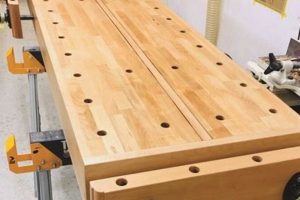
The vertical distance from the floor to the work surface of a woodworking station is a critical dimension affecting posture, ergonomics, and efficiency. An example of this measurement would be 36 inches, a common dimension used for individuals of average stature.
Appropriate sizing of the work surface elevation minimizes strain, enhances control over tools and materials, and reduces the risk of long-term musculoskeletal issues. Historically, this measurement was often determined by personal preference or limited by available materials; however, modern woodworking increasingly emphasizes data-driven approaches to optimize the work environment.
Consideration of these principles facilitates improvements to overall productivity and safety within a woodworking environment, leading to quality craftsmanship.
Optimizing Woodworking Ergonomics
Selecting the proper work surface elevation is paramount for promoting comfort, preventing injuries, and increasing efficiency in the workshop. The following guidelines provide actionable insights for establishing the optimal woodworking environment.
Tip 1: Determine User Stature. Accurate measurement of the user’s height is the initial step. Obtain a precise measurement of the individual’s height, as this forms the basis for subsequent calculations.
Tip 2: Employ Elbow Height as a Baseline. A commonly used starting point is elbow height. The work surface should approximate the user’s elbow height when standing relaxed. This serves as a general guideline; adjustments may be necessary based on specific tasks.
Tip 3: Adjust for Specific Tasks. Different woodworking tasks necessitate varying surface elevations. For detail work, such as carving or intricate joinery, a higher surfaceslightly above elbow heightallows for closer visual inspection and finer motor control. For heavier tasks like planing or sawing, a lower surface provides increased leverage and stability.
Tip 4: Utilize Adjustable Height Mechanisms. Consider incorporating adjustable mechanisms, such as threaded inserts and adjustable legs, into the bench design. This allows for fine-tuning the work surface elevation to accommodate multiple users or a range of tasks. Adjustable solutions offer flexibility and adaptability.
Tip 5: Prioritize Proper Posture. Maintaining an upright posture is crucial, regardless of the surface elevation. Avoid hunching or excessive reaching. Adjust the surface elevation, or use a footrest, to ensure a comfortable and ergonomic working position.
Tip 6: Incorporate Task-Specific Jigs and Fixtures. The integration of jigs and fixtures can significantly alter the effective surface elevation for certain tasks. Ensure that these accessories are accounted for when determining the appropriate work surface dimension.
Tip 7: Regular Adjustment. Periodically reassess the surface elevation as woodworking skills and task requirements evolve. A surface dimension that was optimal initially may require modification over time to maintain ergonomic benefits and performance.
Implementing these strategies ensures a workspace optimized for both comfort and efficiency, significantly contributing to the quality and longevity of woodworking endeavors.
Adhering to these principles minimizes physical strain, promoting a more productive and sustainable woodworking practice.
1. Elbow height correlation

Elbow height serves as a foundational metric in determining optimal woodworking station dimensions. The correlation stems from the principle of minimizing physical strain and maximizing control during manual operations. Specifically, when the work surface approximates the user’s elbow height while standing, the shoulders remain relaxed, and the forearms align in a neutral posture. This alignment reduces the likelihood of developing musculoskeletal disorders associated with repetitive motions and prolonged static positions. An illustrative example involves a woodworker performing hand planing. If the station is too high, the individual must elevate their shoulders, inducing fatigue. Conversely, a station that is too low requires excessive bending, stressing the lower back. Therefore, elbow height provides a critical benchmark for initiating the process of customization.
The practical significance of understanding the elbow height correlation extends beyond mere comfort. It directly influences the precision and quality of the finished product. A stable, ergonomic posture enables the woodworker to exert consistent force and maintain accuracy during tasks such as joinery or carving. In professional woodworking environments, where productivity and quality are paramount, adherence to this ergonomic principle translates into increased efficiency and reduced error rates. Furthermore, its importance scales with the duration of work, as postural stressors exacerbate over time.
In summation, the correlation between elbow height and work station dimensions is instrumental for achieving an optimal working environment. While individual task requirements may necessitate slight modifications, elbow height offers a reliable starting point for fostering a productive and sustainable woodworking practice. The challenge lies in recognizing that this is not a fixed value but rather a flexible guideline that should be continuously assessed and adjusted based on specific needs and user feedback, acknowledging that ergonomic considerations are inherently dynamic.
2. Task-specific adjustments

The elevation of the work surface during woodworking operations must adapt to the specific task undertaken, representing a critical refinement to baseline ergonomic principles. Variations in required precision, force application, and material manipulation necessitate alterations to the vertical distance between the floor and the workpiece. For example, detailed carving or intricate joinery often benefit from a higher surface elevation, permitting closer visual inspection and enhanced fine motor control. Conversely, planing or heavy sawing demands a lower surface, facilitating greater leverage and stability.
Failure to incorporate task-specific adjustments can result in reduced efficiency, increased physical strain, and compromised quality. A surface dimension optimized for one activity may prove detrimental for another. A high woodworking bench height, suitable for delicate work, would hinder the application of necessary force during planing, potentially leading to back strain and imprecise results. Similarly, a low surface, ideal for forceful operations, would force excessive bending during detail work, diminishing visibility and control. An example of task-specific adjustment would be a bench that allows height adjustment for different kind of woodworking tasks such as carving or cutting.
The integration of adjustable height mechanisms or the use of supplementary work surfaces designed for specific purposes mitigates these challenges. Modular systems, incorporating risers or lower platforms, offer versatility in adapting the work environment to the demands of diverse tasks. Recognizing and accommodating these task-specific requirements is paramount to achieving optimal ergonomic conditions and maximizing productivity within the woodworking environment. The capability to fine-tune the work surface elevation based on the activity at hand directly influences the comfort, efficiency, and ultimately, the quality of the woodworking outcomes.
3. Material thickness impact

The vertical dimension of the material undergoing processing directly affects the perceived and actual effective woodworking bench height. Failure to account for this variable can compromise posture, reduce control, and diminish overall efficiency.
- Workpiece Elevation
The addition of material thickness elevates the working surface relative to the floor. This elevation change must be factored into the user’s posture. Ignoring this increase causes hunched posture if not considered.
- Tool Clearance
Material thickness dictates the necessary clearance for tools. Insufficient vertical space due to excessive material thickness requires awkward maneuvering and reduces precision. For example, using a hand plane on a thick board on a bench set too high might cause the plane to strike the bench before achieving a full stroke.
- Jig and Fixture Integration
Jigs and fixtures, designed to secure or guide workpieces, add to the overall height. Accurate accounting for the combined height of material and fixtures is essential to maintaining ergonomic working conditions.
- Visual Angle
Material thickness impacts the optimal visual angle. Working on thin stock may require a lower surface to bring the workpiece into optimal view. Conversely, thicker materials might necessitate a higher elevation to prevent excessive bending. Therefore, adjusting the height is imperative.
These considerations underscore the necessity of either adjustable-height work surfaces or task-specific benches to accommodate the varying dimensions of project materials. Efficient woodworking practice mandates proactive adaptation to the height introduced by the stock being worked, ensuring ergonomic and productive workflow.
4. Adjustability mechanisms

The ability to alter the vertical dimension of a woodworking station, provided by various adjustability mechanisms, directly influences the realized woodwork bench height. This adjustability addresses the inherent variability in user stature, task requirements, and material thicknesses. A fixed-height bench, while simpler in construction, inherently restricts the user to a single ergonomic profile, potentially inducing strain or hindering performance across a range of activities. An adjustability mechanism, conversely, provides the means to customize the work surface to suit specific needs.
Adjustability mechanisms manifest in diverse forms, ranging from simple threaded inserts in the legs that permit incremental height adjustments to sophisticated hydraulic or pneumatic systems enabling rapid and precise positioning. Consider a woodworker transitioning from hand planing a thick board to carving intricate details on a smaller workpiece. The adjustability mechanism allows for raising or lowering the bench to maintain optimal posture and visual access, tasks that would be severely compromised on a static platform. The presence of such mechanisms transforms the bench from a static fixture into a dynamic tool, enhancing adaptability and mitigating the risks associated with prolonged work in non-ergonomic postures.
The incorporation of adjustability mechanisms into woodworking station design is thus a critical element for promoting user well-being and maximizing productivity. While adding complexity and potentially cost, the benefits in terms of reduced strain, enhanced control, and increased versatility justify the investment. Furthermore, the ability to fine-tune the woodwork bench height ensures that the station can accommodate a variety of users within a shared workspace, fostering inclusivity and preventing the need for multiple, task-specific benches. Prioritizing adjustability is therefore a key principle in contemporary woodworking practice.
5. Stance and reach

Stance and reach, integral components of ergonomic work practices, directly correlate with the appropriate vertical dimension. Stance refers to the positioning of the feet and lower body relative to the work surface, while reach describes the extent of arm extension required to access materials and tools. Inappropriately configured woodwork bench height can force compromised stances, such as excessive bending or leaning, and necessitate extended or constrained reach. This misalignment induces muscular strain, reduces precision, and increases the risk of repetitive stress injuries. A bench too low, for instance, forces a forward-leaning posture, straining the lower back. Conversely, a bench too high results in elevated shoulders and restricted reach, limiting control during detailed tasks. For example, if a woodworker must continually extend their reach to access tools positioned further back on an elevated bench, their shoulder muscles fatigue rapidly, impacting accuracy during intricate joinery.
Proper stance and reach are contingent upon aligning the work surface with the user’s anthropometric measurements and the demands of the task. The establishment of a stable, balanced stance is prioritized. Feet should be positioned shoulder-width apart, with weight distributed evenly. Reach should remain within a comfortable zone, minimizing the need for excessive extension or contortion. The dimension should facilitate a neutral wrist position, avoiding extreme flexion or extension. Furthermore, incorporating features such as cutouts or tool wells within the bench design allows for closer proximity to materials, reducing reach requirements. Workpieces need not be out of reach and in an uncomfortable setting.
In summary, the interdependence of stance, reach, and vertical dimensions of a woodworking station underpins ergonomic efficiency and safety. Addressing postural considerations during bench design and setup is crucial for mitigating physical strain and enhancing the quality of woodworking outcomes. Challenges in optimizing stance and reach often stem from neglecting individual anthropometric variations and failing to adapt the work surface to the specific requirements of diverse tasks. Integrating adjustability and prioritizing user feedback are essential steps in addressing these challenges and fostering a sustainable woodworking practice.
6. Posture maintenance
Maintaining proper posture is paramount during woodworking activities and is directly influenced by the vertical distance from the floor to the work surface. The elevation of the woodworking station dictates the degree to which a user can maintain a neutral spinal alignment and avoid undue strain. This relationship necessitates careful consideration during station setup and workflow design.
- Spinal Alignment
The primary objective of posture maintenance is preserving the natural curvature of the spine. An inappropriate vertical dimension, relative to user height and task demands, forces deviations from this alignment, leading to muscular imbalances and discomfort. For example, a station positioned too low necessitates excessive forward bending, placing undue stress on the lumbar region. Conversely, an excessively high surface promotes shoulder elevation and neck strain.
- Shoulder and Arm Positioning
The position of the shoulders and arms is inextricably linked to spinal alignment. A properly dimensioned station allows for relaxed shoulder positioning and unrestricted arm movement. The workpiece must be accessible without requiring excessive reaching or hunching. For instance, tasks involving fine detail work necessitate a higher station elevation to facilitate closer visual inspection without compromising shoulder posture.
- Core Engagement
Effective posture maintenance relies on engagement of the core musculature. A stable and supportive core prevents excessive spinal movement and distributes forces evenly throughout the body. An inappropriately sized woodworking station can undermine core engagement, leading to reliance on peripheral muscles and increased risk of injury. A level surface, aligned with the appropriate body metrics helps the distribution.
- Muscular Fatigue and Endurance
The ability to sustain proper posture throughout extended woodworking sessions directly impacts muscular fatigue and endurance. A poorly dimensioned station accelerates fatigue, reducing work capacity and increasing the likelihood of errors. Continuous strain of muscles while using a product leads to a diminished level of work output.
These considerations highlight the critical role of appropriate work surface elevation in supporting posture maintenance. The selection of a vertical dimension should prioritize the preservation of natural spinal alignment, facilitate relaxed shoulder and arm positioning, promote core engagement, and minimize muscular fatigue. By addressing these factors, woodworkers can optimize their work environment, reduce the risk of musculoskeletal disorders, and enhance productivity and quality of work. The ability to adjust the station height or utilize auxiliary supports to fine-tune the working plane is essential for accommodating a variety of tasks and individual anthropometric variations.
Frequently Asked Questions
The following questions address common concerns regarding the optimal vertical dimension for woodworking stations, focusing on ergonomic principles and practical applications.
Question 1: Why is woodworking bench height important?
Proper work surface elevation directly impacts posture, reduces strain, and enhances control, contributing to improved efficiency and decreased risk of musculoskeletal disorders. The incorrect dimension will negatively impact posture.
Question 2: How does the ideal dimension relate to an individual’s height?
Elbow height serves as a primary guideline. The work surface should approximate the user’s elbow height when standing, providing a neutral starting point for adjustments based on specific tasks and preferences. Measure your elbow to the ground to determine.
Question 3: Should bench height be adjusted for different tasks?
Yes. Detail work benefits from a slightly higher surface, while planing and heavier tasks require a lower surface to facilitate leverage. The best practice is adjusting to the most suitable work surface.
Question 4: What role do adjustable height mechanisms play?
Adjustable legs or integrated systems enable fine-tuning of the work surface, accommodating multiple users and diverse task requirements. This is useful for diverse workplaces.
Question 5: How does material thickness affect the effective height?
The addition of material to the work surface alters the perceived elevation. This factor must be considered to maintain proper posture and prevent strain. Add more if the surface is thick.
Question 6: What constitutes proper stance and reach relative to the work surface?
A stable, balanced stance with comfortable reach is essential. Excessive bending or reaching should be avoided, as these compromise posture and increase the risk of injury. Stand straight, no curves.
Understanding and implementing these principles optimizes the woodworking environment for enhanced comfort, productivity, and long-term well-being.
The subsequent section explores specific techniques for fine-tuning the woodworking environment based on individual needs and project requirements.
Woodwork Bench Height
This exploration has underscored the multifaceted importance of establishing an optimal woodwork bench height. Considerations extend beyond simple measurement, encompassing ergonomic principles, task-specific adaptations, material influence, and user-centered adjustability. Failure to address these elements comprehensively compromises working posture, diminishes efficiency, and elevates the risk of musculoskeletal disorders. A properly configured workstation is not merely a matter of convenience but a fundamental requirement for sustainable woodworking practice.
Implementing the presented guidelines represents a crucial step toward fostering a safer and more productive woodworking environment. Continued research and refinement of these principles will undoubtedly yield further advancements in ergonomic station design, ultimately benefiting both professional and hobbyist woodworkers. The pursuit of optimal woodwork bench height remains an ongoing endeavor, demanding diligent attention to detail and a commitment to user well-being.