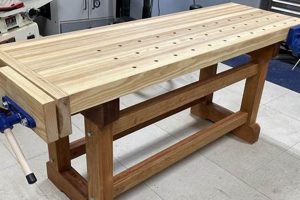
The surface upon which woodworking projects are executed is a crucial element of any workshop. This working area must be durable, stable, and suited to withstand the rigors of various woodworking tasks, including sawing, planing, and assembly. A common example is a solid slab of hardwood carefully selected and prepared for longevity and performance.
The selection of the appropriate composition for this surface directly impacts the efficiency and quality of work performed. A robust and flat surface provides a stable platform, minimizing movement and vibration, which translates into more precise cuts and joinery. Historically, woods like maple and beech have been favored for their density and resistance to wear, contributing to both productivity and the overall lifespan of the workbench itself.
Subsequent sections will delve into the specific characteristics of different compositions available, examining factors such as cost, durability, maintenance requirements, and suitability for various woodworking applications. Considerations will include solid wood options, engineered wood products, and alternative surfacing solutions.
Considerations for Optimizing Your Woodworking Bench Surface
Selecting and maintaining the appropriate working surface is paramount for efficient and accurate woodworking. The following points provide essential guidance for ensuring optimal performance and longevity.
Tip 1: Prioritize Density and Hardness: Opt for options with high density and hardness ratings, like hard maple or European beech, to resist dents and scratches. These choices provide a stable foundation for detailed work and prevent the surface from degrading rapidly under heavy use.
Tip 2: Ensure Flatness and Stability: A perfectly flat surface is essential for accurate joinery and assembly. Correct any warps or twists before use and periodically check for changes due to humidity. Consider using a reliable straightedge and shims to level the bench top as needed.
Tip 3: Apply a Durable Finish: A suitable finish protects the surface from moisture, glue spills, and other contaminants. Consider using a penetrating oil finish, such as boiled linseed oil or tung oil, for easy repair and maintenance. Alternatively, a durable varnish or polyurethane coating can provide greater protection.
Tip 4: Incorporate a Vise System: Integrate a robust vise system to securely hold workpieces during sawing, planing, and joinery operations. Consider different vise styles, such as face vises, tail vises, or leg vises, based on specific woodworking needs.
Tip 5: Regularly Maintain the Surface: Remove debris, glue, and other materials promptly to prevent buildup and damage. Periodically flatten and re-finish the surface as needed to maintain its integrity and flatness. A well-maintained surface translates to greater accuracy and efficiency.
Tip 6: Consider Edge Banding: For engineered options like plywood or MDF, apply solid wood edge banding. This protects the exposed edges from damage and adds aesthetic appeal, as well as providing a surface for clamping.
Implementing these suggestions contributes significantly to the creation of a functional and durable woodworking environment. Proper selection and upkeep ensure that the workbench remains a reliable and effective tool for years to come.
The following sections will examine specific material options and their suitability for different woodworking techniques and skill levels.
1. Hardness

Hardness, in the context of a woodworking bench surface, directly correlates with its resistance to indentation and scratching. This property determines the extent to which the surface can withstand impacts from tools, workpieces, and the general wear and tear inherent in woodworking activities. A harder material provides a more stable and consistent platform, minimizing the potential for surface imperfections that can compromise the accuracy of joinery and other woodworking processes. For instance, a bench top constructed from a softer wood species, such as pine, will exhibit greater susceptibility to damage compared to one made from a dense hardwood like maple or beech.
The selection of a material with adequate hardness directly influences the longevity and performance of the workbench. A surface that readily dents or scratches not only becomes less aesthetically pleasing but also presents practical challenges. Indentations can impede the smooth movement of tools, introduce inaccuracies in measurements, and generally detract from the overall woodworking experience. Furthermore, harder surfaces typically exhibit greater resistance to abrasion, maintaining their flatness and structural integrity over extended periods. Consider the contrast between a solid maple top, which can endure decades of rigorous use with minimal degradation, and a softwood alternative that may require frequent repair or replacement.
In summary, hardness is a critical attribute of a woodworking bench surface, influencing its durability, stability, and overall utility. While cost and workability also play a role in material selection, the long-term benefits of investing in a harder, more resilient surface often outweigh the initial expense. By prioritizing hardness, woodworkers can ensure that their bench provides a reliable and consistent platform for a wide range of woodworking tasks, ultimately contributing to improved accuracy and efficiency.
2. Stability

The dimensional stability of surface is a paramount consideration in woodworking. This characteristic refers to the material’s ability to maintain its shape and size over time, despite variations in humidity, temperature, and applied loads. Instability can manifest as warping, twisting, or cupping, directly impacting the accuracy and reliability of any woodworking tasks performed on that surface. For instance, a bench top that expands and contracts significantly with seasonal changes will make it nearly impossible to maintain consistent flatness, leading to inaccurate cuts and ill-fitting joinery. The selection of surface materials with inherently high dimensional stability is therefore crucial for a functional and effective woodworking workbench.
Several factors contribute to stability, including the wood species, its moisture content, and the method of construction. Denser hardwoods, like maple and beech, generally exhibit greater stability compared to softer woods like pine or fir. Proper drying and seasoning of the lumber before construction is essential to minimize internal stresses that can lead to movement later. Furthermore, techniques such as lamination or the use of breadboard ends can enhance stability by counteracting the natural tendency of wood to expand and contract across its grain. Consider the case of a laminated workbench top constructed from kiln-dried hardwood strips; this design distributes stress evenly and reduces the likelihood of significant warping compared to a single solid slab of the same material.
Ultimately, the pursuit of stability in a woodworking bench surface is an investment in precision and efficiency. A stable surface provides a consistent and reliable platform for woodworking tasks, allowing for accurate measurements, clean cuts, and tight-fitting joinery. While achieving perfect stability may be impossible, careful material selection, proper construction techniques, and consistent maintenance can significantly minimize movement and ensure that the workbench remains a valuable asset for years to come. Ignoring the importance of stability can lead to frustration, wasted materials, and ultimately, a compromise in the quality of the finished product.
3. Durability

The longevity and continued effectiveness of a woodworking bench depend heavily on the chosen surface’s ability to withstand the rigors of the workshop environment. Durability, in this context, signifies resistance to physical damage from impacts, abrasion, and exposure to moisture and chemicals commonly encountered during woodworking activities. A bench constructed with inadequate durability will exhibit premature wear, compromising its structural integrity and functional utility. For example, frequent hammering on a surface made from a soft material can cause significant indentations, negatively affecting the flatness and stability required for precise work. Similarly, exposure to spilled glue or solvents can damage surfaces lacking a robust protective finish, leading to deterioration and potential contamination of projects.
Material selection directly influences durability. Dense hardwoods, such as maple and beech, generally offer superior resistance to physical damage compared to softer woods like pine or fir. Engineered wood products, such as laminated strand lumber (LSL) or certain high-density particleboards, can also provide excellent durability when properly constructed and finished. Surface treatments, including oil finishes, varnishes, and epoxy coatings, play a crucial role in enhancing resistance to moisture and chemicals. The practical application of this understanding lies in informed decision-making when selecting materials and finishes, balancing cost considerations with the anticipated demands of the woodworking tasks to be performed. A craftsman expecting to frequently use hand tools and heavy workpieces would logically prioritize materials known for their impact resistance.
In summary, durability constitutes a critical attribute of any woodworking bench surface. It dictates the workbench’s lifespan, its ability to maintain precision, and its overall value as a woodworking tool. Recognizing the relationship between material selection, finish application, and the expected workload is essential for achieving a long-lasting and effective woodworking bench. The challenges associated with ensuring durability lie in balancing material cost with performance requirements and consistently applying appropriate protective measures. Failure to address durability concerns will inevitably result in a compromised workbench, requiring frequent repairs or premature replacement.
4. Flatness

Flatness, as an attribute of a woodworking bench surface, directly governs the accuracy and efficiency of numerous woodworking operations. A non-planar surface introduces inaccuracies in measurements, compromises the stability of workpieces, and hinders the proper functioning of hand tools such as planes and chisels. The selection of appropriate materials and construction methods is paramount in achieving and maintaining flatness over the lifespan of the workbench. Warping, twisting, or cupping of the bench surface, often caused by variations in humidity and internal stresses within the wood itself, will impede the creation of precisely dimensioned components and well-fitted joints. For instance, attempting to plane a perfectly flat surface on a bench top that exhibits even slight concavity will inevitably result in a skewed and inaccurate result.
Achieving flatness typically involves careful material selection, proper jointing and planing techniques, and the application of a stable finish. Dense hardwoods, such as maple and beech, generally exhibit greater dimensional stability compared to softer wood species, making them preferable choices for bench construction. Lamination, where multiple layers of material are glued together with alternating grain directions, is another effective method for enhancing flatness and resisting warping. Furthermore, the application of a durable and moisture-resistant finish helps to minimize the effects of humidity fluctuations. Maintaining flatness requires periodic inspection and correction, often involving the use of hand planes, winding sticks, and straightedges to identify and rectify any deviations from a perfectly planar surface. An example of this is the skilled woodworker who regularly flattens their workbench to ensure that it remains a reliable and accurate reference surface.
In conclusion, flatness is an indispensable characteristic of a functional woodworking bench. The selection of appropriate woodworking bench material, coupled with meticulous construction and ongoing maintenance, is essential for achieving and preserving a stable and accurate work surface. The challenges associated with maintaining flatness underscore the importance of understanding the properties of various materials and employing techniques that mitigate the effects of environmental factors. A commitment to flatness translates directly into improved precision, efficiency, and overall quality in woodworking projects.
5. Cost
The financial investment required for surface is a significant determinant in material selection. Balancing initial expenditure with long-term performance and durability is crucial for maximizing value.
- Material Acquisition Costs
The price of raw materials, such as lumber or sheet goods, varies substantially based on species, grade, and availability. Exotic hardwoods command a premium compared to domestic softwoods. Sourcing directly from mills or wholesalers can potentially reduce these costs, but this requires larger purchase volumes. The initial outlay for materials significantly influences the overall project budget.
- Fabrication and Preparation Expenses
Beyond the raw material price, fabrication processes incur additional costs. Milling lumber to the required dimensions, laminating multiple layers for increased stability, and applying protective finishes all contribute to the overall expense. Specialized tools or equipment, such as planers or wide-belt sanders, may be necessary to achieve a flat and smooth surface. Labor costs, whether personal time or professional services, should also be factored into this aspect.
- Maintenance and Repair Considerations
Different surface materials require varying levels of maintenance and repair. Softer woods are more susceptible to damage and may necessitate frequent resurfacing or patching. Durable hardwoods, while initially more expensive, can potentially offer lower long-term maintenance costs. The cost of finishes, cleaning supplies, and repair materials should be considered when evaluating the overall lifecycle expenses.
- Tooling and Equipment Implications
The choice of surface can indirectly impact tooling costs. Working with extremely hard or dense materials may require specialized cutting tools or sharpening equipment. Conversely, softer materials may be easier to work with, reducing the wear and tear on tools. This interplay between surface material and tooling should be considered when assessing the overall cost implications.
Ultimately, selecting surface involves a careful evaluation of cost factors alongside performance requirements. A low initial price may be offset by higher maintenance costs or reduced durability, while a more expensive material can potentially offer superior long-term value and performance. A comprehensive understanding of these cost considerations is essential for making informed decisions.
6. Workability

Workability, in the context of surface selection, denotes the ease with which the material can be shaped, joined, and finished using common woodworking tools and techniques. This characteristic significantly influences the efficiency and precision of workbench construction and subsequent usage. Materials with poor workability can lead to increased tool wear, greater physical exertion, and a reduction in the overall quality of the finished product.
- Planing and Shaping Characteristics
The ease with which a material can be planed, routed, or otherwise shaped is a primary factor in workability. Materials that readily accept sharp tools and produce clean cuts minimize the effort required for surface preparation and leveling. Hardwoods with interlocked grain, or those prone to tear-out, present challenges during planing, demanding more frequent sharpening and specialized techniques. Softer woods, while easier to plane, may lack the density required for a durable and stable surface.
- Joinery Compatibility
The ability to create strong and precise joints is critical for workbench construction. Materials that readily accept glue, screws, or other fasteners contribute to robust and long-lasting assemblies. Some materials may be prone to splitting or cracking during joinery, requiring pre-drilling or other mitigating measures. The ease with which mortises, tenons, and other joinery elements can be formed directly influences the efficiency and stability of the final product. For instance, hardwoods with tight grain are generally more amenable to intricate joinery than coarser-grained alternatives.
- Finishing Properties
The manner in which surface accepts and retains finishes is a significant aspect of workability. Materials that readily absorb stains, oils, or varnishes achieve a uniform and aesthetically pleasing appearance. Some materials may require extensive surface preparation to ensure proper finish adhesion. The ability to easily sand and polish the surface is also a factor, contributing to a smooth and durable protective layer. Materials with open pores may require more finish coats to achieve the desired level of protection.
- Tool Wear and Maintenance
The abrasive properties of surface materials can significantly impact tool wear. Highly abrasive materials, such as certain engineered wood products, may require more frequent tool sharpening or blade replacement. Selecting materials that are relatively easy on tools can reduce maintenance costs and downtime. The ease with which the surface can be re-flattened or repaired also contributes to the overall practicality of the workbench. Materials that are readily planed or sanded simplify the process of maintaining a flat and functional work surface.
In summary, workability encompasses a range of characteristics that directly influence the ease and efficiency of surface construction and maintenance. The selection of a material that balances workability with other key attributes, such as durability and stability, is essential for creating a functional and long-lasting woodworking bench. Failing to consider workability can lead to increased effort, reduced precision, and ultimately, a less satisfactory woodworking experience.
7. Finish
The application of a protective coating to a woodworking bench surface represents a crucial step in ensuring its longevity and functionality. The selected finish significantly impacts the surface’s resistance to moisture, chemicals, and physical abrasion, directly influencing its suitability for various woodworking tasks.
- Moisture Resistance and Dimensional Stability
Finishes act as a barrier against moisture penetration, mitigating expansion and contraction of the underlying wood. This contributes to dimensional stability, preventing warping or cracking. Penetrating oil finishes, for example, soak into the wood fibers, providing a degree of water repellency without forming a surface film. Film-forming finishes, such as varnish or lacquer, offer greater protection but may be more susceptible to chipping or scratching under heavy use. Maintaining dimensional stability is crucial for maintaining the flatness of the bench top.
- Chemical Resistance and Stain Prevention
Woodworking activities often involve the use of adhesives, solvents, and various finishing products. The finish layer protects the bench surface from chemical damage and staining caused by these substances. Epoxy coatings offer excellent chemical resistance but may be less forgiving to apply than simpler oil finishes. Selecting a finish with appropriate chemical resistance prevents permanent damage and maintains the aesthetic appearance of the bench top. Glue spills, for instance, can be easily removed from a properly finished surface.
- Abrasion Resistance and Surface Durability
The bench surface is subject to constant abrasion from tools, workpieces, and general usage. The finish layer provides a protective barrier against wear, extending the lifespan of the underlying material. Harder finishes, such as polyurethane, offer greater abrasion resistance compared to softer oil finishes. However, harder finishes may be more difficult to repair or refinish. Choosing a finish with appropriate abrasion resistance preserves the structural integrity and functionality of the bench top over time. The consistent dragging of tools across an unfinished surface will quickly lead to damage and unevenness.
- Maintenance and Repair Considerations
Different finishes require varying levels of maintenance and repair. Oil finishes can be easily reapplied as needed to refresh the protective layer. Film-forming finishes may require more extensive sanding or stripping before refinishing. The ease of maintenance and repair is an important consideration when selecting a finish for woodworking bench. A finish that can be easily spot-repaired offers a practical advantage in a demanding workshop environment.
In conclusion, the selection and application of a suitable finish are integral to the overall performance and longevity of woodworking bench. Considerations must include moisture resistance, chemical resistance, abrasion resistance, and ease of maintenance to maximize its utility.
Frequently Asked Questions
This section addresses common inquiries regarding the selection, characteristics, and maintenance of surfaces suitable for woodworking benches.
Question 1: What constitutes the most appropriate density for woodworking surfaces?
Materials with higher density generally offer greater resistance to indentation and wear, resulting in a more stable and durable work surface. Dense hardwoods, such as maple or beech, are often preferred for this reason.
Question 2: How does humidity affect the integrity of woodworking surfaces?
Fluctuations in humidity can cause dimensional changes in wood, leading to warping, twisting, or cracking. Proper seasoning of lumber and the application of a moisture-resistant finish can mitigate these effects.
Question 3: What are the key considerations for ensuring a perfectly flat surface?
Achieving and maintaining flatness requires careful material selection, proper construction techniques (e.g., lamination), and periodic maintenance using hand planes or other flattening methods.
Question 4: Is it necessary to apply a finish to surface?
A finish provides protection against moisture, chemicals, and abrasion, extending the lifespan of the surface and maintaining its appearance. The specific type of finish should be chosen based on the anticipated use and desired level of protection.
Question 5: What are the advantages and disadvantages of using engineered wood products versus solid wood for surface?
Engineered wood products, such as plywood or MDF, can offer greater dimensional stability and cost-effectiveness compared to solid wood. However, they may lack the aesthetic appeal and workability of solid wood.
Question 6: How often should woodworking surface be flattened and refinished?
The frequency of flattening and refinishing depends on the type of material, the intensity of use, and the environmental conditions. Regular inspection for signs of wear or distortion is recommended, and corrective action should be taken as needed.
In summary, the selection and maintenance of suitable materials requires careful consideration of density, dimensional stability, flatness, and finish protection. A proactive approach to these factors ensures a long-lasting and functional woodworking bench.
The following section will examine specific examples of surfaces available and their suitability for different woodworking needs.
Conclusion
The preceding sections have thoroughly explored the critical characteristics and considerations involved in selecting the appropriate surface for woodworking. Factors such as hardness, stability, durability, flatness, workability, and finish have been examined in detail, underscoring their individual and collective impact on the performance and longevity of a woodworking bench. A comprehensive understanding of these material properties is essential for any woodworker seeking to create a functional and reliable workspace.
Ultimately, the informed selection of surface, grounded in a solid grasp of its inherent properties, will determine the woodworker’s capacity to execute precise, efficient, and ultimately successful projects. Careful consideration of these factors will result in a workbench that serves as a stable foundation for craftsmanship, fostering accuracy and enhancing the overall quality of woodworking endeavors.
![Top-Rated Best Portable Woodworking Bench [2024 Guide] | Step-by-Step Guides, Tools & Inspiration to Build Beautiful Wooden Decor on a Budget](https://woodfromhome.com/wp-content/uploads/2026/05/th-181-300x200.jpg "Top-Rated Best Portable Woodworking Bench [2024 Guide] Step-by-Step Guides, Tools & Inspiration to Build Beautiful Wooden Decor on a Budget")