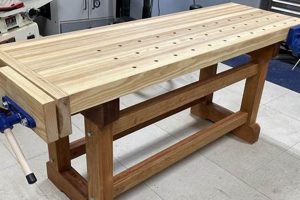
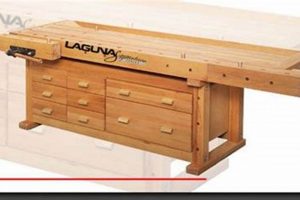
A fundamental component in any woodworking environment, the flat, stable surface provides a dedicated area for executing projects, from initial design to final assembly. These surfaces are typically constructed from hardwoods or engineered materials, chosen for their durability and resistance to wear. As an example, a craftsman might use this surface to carefully join pieces of wood for a cabinet, relying on its flatness for accurate alignment.
The significance of this surface extends beyond mere utility. Historically, it has represented a cornerstone of craftsmanship, enabling precise work and fostering creativity. A robust and well-maintained surface is essential for efficient workflow, reducing the likelihood of errors and improving the quality of the finished product. Its inherent stability enhances safety, providing a secure platform for using hand tools and power equipment.
Given its critical role, selecting the appropriate material, construction method, and size is paramount. Factors influencing the choice include the type of woodworking activities, available workspace, and budget. The following sections will delve into these considerations, offering a detailed examination of various options and best practices for ensuring a long-lasting and effective workspace.
Tips for Optimal Selection and Maintenance
This section provides practical guidance for selecting and maintaining a surface essential for woodworking tasks. Adhering to these recommendations will contribute to a safer, more efficient, and longer-lasting workspace.
Tip 1: Material Selection is Paramount: Hardwoods such as maple or beech provide excellent durability and resistance to denting. Consider the density and grain structure of the wood to withstand repeated use and potential impacts.
Tip 2: Prioritize Surface Flatness: Accurate joinery and assembly rely on a consistently flat surface. Before purchase, inspect the surface for warping or unevenness. Regularly check and correct any deviations to maintain precision.
Tip 3: Consider Bench Height Ergonomics: The appropriate height minimizes strain and maximizes efficiency. The ideal height allows the elbows to be bent at a 90-degree angle when performing tasks. Adjust the height based on individual stature and preferred working style.
Tip 4: Implement a Durable Finish: Applying a finish protects the surface from moisture and chemicals. Oil-based finishes or polyurethane provide resistance to staining and can be reapplied as needed to maintain protection.
Tip 5: Incorporate Vises for Secure Workholding: Vises offer secure clamping for a range of projects. Install at least one face vise and consider a tail vise for added versatility. Ensure the vises are properly aligned to prevent racking or damage.
Tip 6: Regularly Clean and Maintain the Surface: Remove dust and debris after each use to prevent build-up. Periodically flatten the surface with hand planes or specialized tools to maintain accuracy. Address any imperfections promptly to prevent further degradation.
Tip 7: Plan for Adequate Size and Workspace: Select a size that accommodates the majority of projects undertaken. Sufficient surrounding space allows for maneuvering large pieces and storing tools within easy reach.
Following these guidelines ensures that the work surface provides a reliable foundation for woodworking endeavors, ultimately contributing to enhanced precision, safety, and longevity.
The subsequent sections will address specific types, construction techniques, and advanced modifications to further optimize the workspace.
1. Surface Material

The selection of surface material is a primary determinant of a woodworking surface’s overall performance and longevity. The material dictates the ability to withstand impact, resist wear, and maintain dimensional stability under varying environmental conditions.
- Hardwood Density and Durability
Hardwoods such as maple, beech, and oak are commonly employed due to their high density, providing resistance to dents and scratches. A denser surface minimizes surface damage from tool use and accidental impacts, extending the lifespan of the surface. For example, a surface constructed from hard maple can endure heavy use and frequent clamping without significant degradation.
- Engineered Wood Stability
Engineered wood products, like laminated veneer lumber (LVL) or medium-density fiberboard (MDF), offer exceptional dimensional stability, reducing the likelihood of warping or twisting over time. These materials are less susceptible to changes in humidity and temperature, ensuring a consistently flat surface for precise work. A surface made from MDF, for instance, provides a stable platform for intricate joinery.
- Surface Porosity and Finish Compatibility
The porosity of the surface material influences its ability to accept and retain finishes. Denser hardwoods with tighter grain structures typically require less finish and provide a smoother, more durable final surface. Conversely, more porous materials may require multiple coats of finish to achieve adequate protection. The choice of finish, such as oil-based varnish or polyurethane, should be compatible with the surface material to ensure proper adhesion and protection against moisture and chemicals.
- Cost and Availability Considerations
The cost and availability of different surface materials significantly impact the overall project budget. Hardwoods are generally more expensive than softwoods or engineered wood products. However, the long-term durability and performance benefits of hardwoods may justify the higher initial investment. Locally sourced materials can reduce transportation costs and environmental impact, while readily available materials simplify the construction process. Balancing cost considerations with performance requirements is crucial for selecting an appropriate surface material.
In summary, the choice of surface material dictates the physical properties, performance characteristics, and longevity of the woodworking surface. Careful consideration of density, stability, porosity, cost, and availability is essential for creating a functional and durable workspace capable of withstanding the demands of woodworking activities.
2. Dimensional Stability
Dimensional stability, in the context of woodworking bench tops, refers to the material’s ability to maintain its original size and shape despite fluctuations in environmental conditions, particularly temperature and humidity. It is a critical factor influencing the precision and longevity of the surface. Inherent material properties and construction methods significantly affect this characteristic.
- Moisture Content Equilibrium
Wood is hygroscopic, meaning it absorbs and releases moisture until it reaches equilibrium with the surrounding environment. Changes in moisture content cause wood to swell or shrink, leading to dimensional instability. A well-seasoned surface, properly dried to its local equilibrium moisture content, minimizes these changes. For example, a surface constructed from kiln-dried lumber that is allowed to acclimate to the workshop environment before assembly will exhibit greater dimensional stability.
- Wood Grain Orientation
The direction of wood grain influences the extent of dimensional change. Wood expands and contracts more significantly across the grain than along the grain. Quarter-sawn lumber, with grain oriented perpendicular to the surface, exhibits less width change compared to flat-sawn lumber. Incorporating quarter-sawn lumber in surface construction enhances stability and reduces the risk of warping.
- Construction Techniques and Joinery
Joinery methods can either enhance or impede dimensional stability. Allowing for wood movement is crucial to prevent stress and cracking. Traditional joinery techniques like mortise and tenon joints or dovetail joints, when properly executed, provide structural integrity while accommodating seasonal changes. The design should allow the surface to expand and contract without constraint, maintaining flatness.
- Material Selection and Lamination
The choice of wood species and the use of lamination significantly affect stability. Dense, stable hardwoods like maple or beech offer better resistance to dimensional change compared to softer woods. Laminating multiple layers of wood with alternating grain directions further reduces the effects of moisture-induced movement. A laminated surface composed of several thin layers of hardwood is less prone to warping and twisting than a single thick slab of wood.
In conclusion, dimensional stability is a multifaceted characteristic influenced by material properties, construction methods, and environmental factors. A surface exhibiting high dimensional stability provides a consistent and reliable platform for precision woodworking, minimizing errors and ensuring the longevity of the structure. A craftsman’s attention to these factors will result in a superior tool.
3. Workholding Capacity

Workholding capacity is intrinsically linked to the functionality and effectiveness of woodworking bench tops. It defines the ability of the surface to securely restrain workpieces during various woodworking operations, ranging from sawing and planing to joinery and assembly. Inadequate workholding directly results in reduced precision, increased risk of material damage, and potential safety hazards. A robust surface must therefore integrate effective mechanisms for firmly securing wood components.
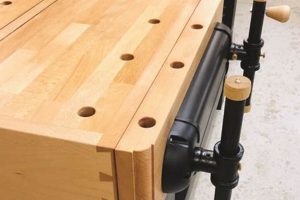
The integration of vises, clamps, and strategically placed dog holes exemplifies practical applications of maximizing workholding. Face vises allow for clamping workpieces along the front edge, while tail vises, often paired with dog holes, enable secure end-to-end clamping. These mechanisms permit controlled force application, preventing slippage and ensuring consistent positioning during critical operations. For instance, when hand-planing a board, reliable workholding ensures a smooth, even surface without unwanted movement. Similarly, accurate joinery relies heavily on the ability to clamp components securely while cutting or assembling intricate connections.
Ultimately, workholding capacity is a defining characteristic of a quality woodworking bench top. The selection and implementation of appropriate workholding methods directly influence the precision, efficiency, and safety of woodworking tasks. Challenges include selecting the right types of vises and clamping systems for specific applications and maintaining the flatness of the surface around workholding fixtures. Understanding the principles of effective workholding is therefore essential for any woodworker seeking to maximize the utility and longevity of their bench.
4. Surface Flatness

Surface flatness constitutes a paramount attribute of woodworking bench tops, fundamentally influencing the accuracy and precision of various woodworking operations. Deviations from true flatness introduce errors, compromise the integrity of joints, and ultimately affect the quality of finished projects. A meticulously flat surface serves as a reliable reference plane, enabling accurate layout, assembly, and finishing processes.
- Impact on Joinery Accuracy
Precise joinery relies on consistent contact between mating surfaces. An uneven surface prevents accurate alignment and clamping, resulting in gaps or misaligned joints. Mortise and tenon, dovetail, and rabbet joints require a perfectly flat surface for proper execution. Deviations in flatness can lead to weak, aesthetically unappealing joints, necessitating rework or compromising structural integrity.
- Influence on Planing and Shaping
Hand planing and shaping operations depend on a stable and flat reference plane. An uneven surface causes the plane to follow contours, resulting in inconsistent material removal and inaccurate shaping. A flat surface allows for uniform planing, ensuring the workpiece achieves the desired dimensions and surface quality. Variations in flatness compromise the ability to create smooth, even surfaces and accurate profiles.
- Effects on Assembly and Gluing
During assembly and gluing, a flat surface ensures consistent pressure distribution across joints. Uneven surfaces create localized pressure points, leading to uneven glue lines and potential joint failure. Clamping pressure must be evenly distributed to achieve optimal bond strength. Surface flatness guarantees that the entire joint is uniformly compressed, maximizing adhesion and structural integrity.
- Maintenance and Restoration Techniques
Maintaining surface flatness necessitates periodic inspection and correction. Hand planing with a jointer plane or the use of specialized flattening tools are common methods for restoring flatness. Regular maintenance prevents deviations from accumulating, ensuring continued accuracy and performance. Neglecting surface flatness leads to progressively increasing errors and necessitates more extensive restoration efforts.
The preceding facets illustrate the integral role of surface flatness in woodworking bench tops. This characteristic is not merely a desirable attribute but rather a foundational requirement for achieving accurate, reliable, and high-quality woodworking results. Meticulous attention to surface flatness is therefore essential for any woodworker seeking to maximize the potential of their bench and produce exceptional work.
5. Overall Rigidity

Overall rigidity, as it pertains to woodworking bench tops, directly influences the precision and efficiency of all operations performed upon the surface. It represents the bench’s resistance to deformation under load, a characteristic crucial for maintaining stability during tasks like planing, sawing, and joinery. Insufficient rigidity introduces unwanted vibrations and movement, leading to inaccuracies and potential safety risks. A solid, unyielding structure ensures that applied forces are effectively directed to the workpiece, rather than being absorbed or dissipated by the bench itself.
The effects of inadequate rigidity are readily apparent in various woodworking scenarios. For instance, attempting to hand-plane a long board on a bench lacking sufficient rigidity will result in noticeable chatter and uneven material removal. The bench’s tendency to flex under the pressure of the plane disrupts the cutting action, producing a surface marred by ripples and inconsistencies. Similarly, sawing operations on a flexible bench yield inaccurate cuts, as the vibrations compromise the saw’s trajectory. In contrast, a rigid bench provides a stable platform, enabling clean, precise cuts that conform to the intended lines. Practical examples include benches constructed with thick, solid wood legs joined to a substantial top via robust joinery, or those incorporating torsion box designs to maximize stiffness while minimizing weight. These designs represent a direct response to the need for unwavering support during demanding woodworking tasks.
In summary, overall rigidity is not merely a desirable attribute of woodworking bench tops, but rather a fundamental prerequisite for achieving accurate and efficient results. Understanding the principles of structural integrity and implementing appropriate design and construction techniques are essential for creating a bench that provides unwavering support and facilitates precise craftsmanship. Addressing the challenge of achieving optimal rigidity often involves a balance between material selection, construction complexity, and cost considerations. The ultimate goal is to create a solid foundation that empowers the woodworker to execute their craft with confidence and precision.
Frequently Asked Questions
The following section addresses common inquiries regarding woodworking bench tops, offering concise and informative answers to assist in selection, maintenance, and optimal utilization.
Question 1: What constitutes the optimal material for woodworking bench tops, considering durability and cost-effectiveness?
Hardwoods such as maple, beech, or birch represent frequently selected materials due to their inherent density and resistance to wear. While offering substantial durability, they typically present a higher initial cost compared to softwoods. Alternatives include engineered wood products like laminated veneer lumber (LVL) or medium-density fiberboard (MDF), which provide stability and a more economical option, though potentially sacrificing long-term durability.
Question 2: How does surface flatness impact the precision of woodworking operations?
Surface flatness serves as a crucial reference plane for accurate layout, joinery, and assembly. Deviations from true flatness introduce errors in measurements and prevent proper alignment of workpieces, leading to inaccurate cuts and compromised joints. A consistently flat surface is essential for achieving precise results in any woodworking endeavor.
Question 3: What is the recommended method for maintaining the flatness of woodworking bench tops over time?
Maintaining flatness typically involves periodic inspection and correction using hand planes, such as a jointer or smoothing plane. Regular flattening ensures that minor deviations are addressed before they accumulate into significant inaccuracies. Specialized flattening tools or services may be employed for more extensive restoration. Routine cleaning to remove debris prevents surface irregularities and preserves flatness.
Question 4: How should workholding mechanisms, such as vises, be integrated into woodworking bench tops to maximize functionality?
Workholding mechanisms should be strategically positioned to provide secure clamping for a variety of woodworking tasks. Face vises are commonly installed on the front edge for general clamping, while tail vises, often used in conjunction with dog holes, enable end-to-end clamping. The selection and placement of vises should align with the specific needs and project types undertaken.
Question 5: What factors contribute to the overall rigidity of woodworking bench tops, and why is rigidity important?
Overall rigidity is influenced by material thickness, leg construction, and joinery methods. A rigid bench resists deformation under load, preventing vibrations and ensuring accurate cuts and stable support. Inadequate rigidity compromises precision and can introduce safety hazards. Solid construction, robust joinery, and sufficient material thickness are crucial for maximizing rigidity.
Question 6: How does moisture content affect the stability and longevity of woodworking bench tops?
Wood is hygroscopic, absorbing and releasing moisture with changes in humidity. Fluctuations in moisture content cause wood to swell or shrink, potentially leading to warping, cracking, or joint failure. Proper seasoning of the wood, maintaining a stable workshop environment, and applying a moisture-resistant finish are essential for minimizing the effects of moisture and ensuring the long-term stability of the surface.
These FAQs address essential considerations for woodworking bench tops. Careful attention to material selection, maintenance, and utilization of workholding mechanisms enhances the precision and efficiency of woodworking activities.
The subsequent sections will delve into advanced construction techniques and customization options for optimizing the workspace.
Conclusion
This exploration of woodworking bench tops has underscored their critical role in facilitating accurate and efficient woodworking. The attributes of material selection, dimensional stability, workholding capacity, surface flatness, and overall rigidity have been identified as fundamental determinants of performance. The importance of adhering to best practices in construction, maintenance, and usage has been emphasized throughout.
The selection and upkeep of woodworking bench tops represent a significant investment in the quality and safety of woodworking endeavors. A well-chosen and maintained surface serves as the cornerstone of a productive workshop. Further investigation into advanced techniques and customized solutions will continue to refine the craft and maximize the potential of this essential tool.

![Top-Rated Best Portable Woodworking Bench [2024 Guide] | Step-by-Step Guides, Tools & Inspiration to Build Beautiful Wooden Decor on a Budget](https://woodfromhome.com/wp-content/uploads/2026/05/th-181-300x200.jpg "Top-Rated Best Portable Woodworking Bench [2024 Guide] Step-by-Step Guides, Tools & Inspiration to Build Beautiful Wooden Decor on a Budget")