



Devices and methods employed to hold wood components securely together during assembly are essential for precise and durable construction. These tools utilize mechanical force to maintain consistent pressure, ensuring accurate alignment and strong adhesive bonds or mechanical fastening.
The application of stable pressure is critical for achieving quality in various projects. Properly securing workpieces prevents shifting during gluing, screwing, or other joining processes, ultimately resulting in improved structural integrity and aesthetic appeal. Historically, simple wedges and hand-screws were the primary means of achieving this, evolving into more sophisticated lever-action, ratcheting, and pneumatic options.
This discussion will address the diverse range of available options, exploring their specific functionalities, optimal applications, and critical considerations for selection based on project needs and workshop environments. Understanding these factors is paramount for maximizing efficiency and achieving desired outcomes in any woodworking endeavor.
Tips on Workholding Solutions
Effective utilization of appropriate workholding solutions is paramount for achieving precision and quality in woodworking projects. The following recommendations are intended to optimize the selection and application of these critical tools.
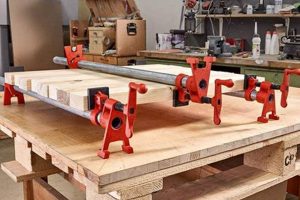
Tip 1: Select the Appropriate Type: Consider the specific requirements of the project. Bar designs are suitable for wide assemblies, while pipe options offer extendable length. Hand-screw designs are ideal for delicate or non-parallel surfaces.
Tip 2: Apply Consistent Pressure: Over-tightening can damage the wood fibers, leading to weakened joints. Use only the necessary force to ensure adequate contact and prevent slippage.
Tip 3: Utilize Cauls and Protective Pads: Employing cauls rigid boards distributes pressure evenly across broad surfaces. Protective pads, such as cork or felt, prevent marring or indentation on delicate materials.
Tip 4: Ensure Parallel Alignment: Verify that jaws are parallel to the work surface to prevent skewed pressure. Misalignment can lead to uneven glue lines and compromised joint strength.
Tip 5: Maintain Cleanliness: Glue residue and sawdust accumulation can impede smooth operation and reduce clamping force. Regularly clean threads, bars, and jaws to ensure optimal performance.
Tip 6: Consider Clamping Order: When assembling multiple components, strategize the order in which pieces are secured. Clamping in a logical sequence minimizes stress and promotes accurate alignment.
Tip 7: Employ Specialized Jigs: For repetitive tasks or intricate joinery, jigs can provide consistent positioning and increased efficiency. Custom jigs can be fabricated to address unique requirements.
Adhering to these guidelines will contribute to improved accuracy, stronger joints, and a more efficient woodworking process. Careful selection and meticulous application of workholding methods are essential for producing high-quality results.
The subsequent sections will delve into specific applications and advanced techniques for maximizing the effectiveness of these tools.
1. Pressure Distribution

In woodworking, effective pressure distribution during adhesive bonding or mechanical fastening is paramount for achieving joint integrity and structural stability. Workholding systems are the instruments by which this pressure is applied and maintained; therefore, understanding the principles of pressure distribution is crucial for their effective utilization.
- Uniform Surface Contact
Uniform pressure ensures consistent contact between mating surfaces, crucial for optimal adhesive transfer and bond strength. Uneven pressure can lead to voids in the glue line, compromising the joint’s integrity. For example, when edge-gluing wide panels, uneven pressure distribution can result in warped or bowed assemblies.
- Caul Application
Cauls rigid or flexible boards serve to distribute pressure evenly across broad surfaces, mitigating localized stress concentrations. They are particularly useful when clamping large panels or assemblies with irregular shapes. In the absence of cauls, high pressure points can create indentations or damage the workpiece.
- Adaptive Jaw Design
Some advanced designs incorporate adaptive jaws that conform to the shape of the workpiece, ensuring even pressure distribution across the entire contact area. These designs are particularly beneficial when clamping non-parallel surfaces or components with complex geometries. Standard jaws can concentrate pressure on specific points, potentially leading to localized deformation.
- Material Compliance
The compliance or deformability of the material being joined significantly impacts the effectiveness of pressure distribution. Softer materials require lower clamping pressure to prevent crushing, while denser materials can withstand higher forces. Over-tightening devices on softer woods can lead to fiber compression and weakened joints, whereas insufficient pressure on denser materials may result in incomplete adhesive bonds.
Therefore, the careful selection and application of workholding solutions, considering material properties and the geometry of the components, are essential for achieving uniform pressure distribution and maximizing joint strength. Understanding the interplay between these factors is critical for producing high-quality woodworking projects.
2. Joint Alignment

Precise joint alignment is a prerequisite for structural integrity and aesthetic quality in woodworking. The fundamental role of woodworking clamping systems is to maintain this alignment during the assembly process, whether through adhesive bonding, mechanical fastening, or a combination thereof. Misalignment, even marginal, introduces stress concentrations within the joint, weakening its overall strength and potentially leading to premature failure. For example, in frame construction, misalignment of mortise and tenon joints will compromise the frame’s squareness and stability, necessitating corrective action that may compromise the final product.
Effective workholding systems counteract inherent material stresses and dimensional variations that can disrupt joint alignment. Cam-action clamps, bar designs, and specialized jigs are all employed to counteract these forces. Consider the assembly of a dovetailed drawer. A properly designed jig, combined with appropriately sized clamps, ensures that the dovetails are fully seated and that the drawer remains square during glue-up. Without such a system, the dovetails may not seat properly, resulting in a weak and unsightly joint. Furthermore, angled or complex joints require workholding systems that provide multi-axis adjustability to achieve and maintain precise alignment.
In conclusion, the efficacy of woodworking clamping systems is inextricably linked to their ability to maintain precise joint alignment. Deviations from perfect alignment result in compromised joint strength and aesthetic defects. Therefore, the selection and application of these systems must prioritize alignment, with consideration given to the specific joint type, material properties, and applied forces. The challenge lies in choosing the appropriate workholding solution for each task, ensuring that the system possesses sufficient rigidity and adjustability to counteract inherent material stresses and maintain the desired alignment throughout the assembly process.
3. Material Compatibility
The interaction between workholding devices and various wood species dictates the success of woodworking projects. Selecting clamping systems without considering the properties of the wood can lead to damage, compromised joints, and inaccurate assemblies. Material compatibility is therefore a critical factor in the overall effectiveness of these systems.
- Jaws and Surface Hardness
The durometer of the jaws directly influences the potential for marring or indentation. Hardwoods like maple and oak are less susceptible to damage from rigid jaws, while softer woods like pine and cedar require softer materials such as cork, felt, or specialized plastic to prevent surface imperfections. Inappropriate jaw selection can result in irreversible damage to the workpiece, necessitating rework or material replacement.
- Clamping Pressure and Wood Density
The force exerted by devices must be carefully calibrated to match the density of the material. Applying excessive pressure to low-density woods can crush the fibers, weakening the joint. Conversely, insufficient pressure on high-density woods can lead to inadequate adhesive contact and a compromised bond. Adjustable clamping systems allow for precise force control, accommodating a wider range of wood species.
- Chemical Reactivity
Certain clamping pad materials can react with specific wood finishes or adhesives, leading to discoloration or adhesion problems. For example, some rubber compounds can leave stains on light-colored woods or inhibit the curing of certain adhesives. Thorough testing of clamping pads and finishes is advisable to prevent adverse chemical reactions. Selecting inert clamping pad materials, such as polyethylene, mitigates the risk of chemical incompatibility.
- Moisture Content Considerations
Wood expands and contracts with changes in moisture content. During assembly, devices should accommodate these dimensional changes to prevent stress fractures or joint failure. Applying excessive force to dry wood during a period of high humidity, for instance, can lead to cracking as the wood expands. Workholding setups should allow for some degree of movement to account for fluctuations in moisture content, particularly in large assemblies.
The preceding considerations underscore the importance of assessing material properties and chemical interactions when selecting clamping systems. Optimizing the compatibility between clamping materials, force application, and wood characteristics is essential for achieving durable and aesthetically pleasing woodworking results. Understanding these relationships enables woodworkers to avoid common pitfalls and maximize the efficacy of their workholding strategies.
4. Clamping Force
Clamping force, the pressure exerted by a device to hold workpieces together, is a critical parameter in woodworking. The appropriate application of clamping force within woodworking clamping systems directly influences joint strength, alignment accuracy, and overall structural integrity.
- Optimal Pressure Range
Each wood species and adhesive type requires a specific pressure range for optimal bonding. Exceeding this range can lead to fiber compression and weakened joints, while insufficient force results in incomplete adhesive transfer and compromised bond strength. Proper selection of clamping systems necessitates consideration of the material properties and adhesive requirements to ensure adequate pressure is applied without causing damage. For example, softwood typically requires less force than hardwood.
- Force Distribution Mechanisms
Various systems employ different mechanisms to distribute force across the joint. Bar designs apply force along a linear axis, while hand-screw designs distribute force across a broader surface area. Uneven force distribution can lead to localized stress concentrations and joint failure. Therefore, selecting a clamping system that provides uniform force distribution is essential, particularly when working with large or irregularly shaped workpieces. Cauls can aid in distributing force evenly.
- Clamping System Design and Force Output
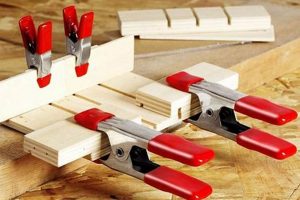
The design of the system directly determines its maximum force output and adjustability. Heavy-duty bar options are capable of generating substantial force, suitable for large-scale assemblies or dense hardwoods. Conversely, spring clamps offer lower force, appropriate for delicate tasks or thinner materials. Selecting a clamping system with an appropriate force range and adjustable settings allows for precise control over the clamping process and minimizes the risk of damage to the workpiece.
- Long-Term Force Retention
Certain adhesives require sustained clamping force during the curing process. A clamping systems ability to maintain consistent pressure over an extended period is crucial for achieving optimal bond strength. Devices prone to slippage or pressure loss can compromise the joint integrity. Regularly inspecting and tightening devices during the curing period ensures that the required clamping force is maintained throughout the bonding process.
In summary, clamping force is a pivotal factor in the successful application of woodworking clamping systems. Understanding the optimal pressure range for specific materials and adhesives, the force distribution mechanisms, the design characteristics of different clamping systems, and the importance of long-term force retention are all critical considerations for achieving strong, accurate, and durable woodworking joints. Proper utilization of these principles maximizes the effectiveness of woodworking endeavors.
5. Application Specificity
The effectiveness of woodworking clamping systems is intrinsically linked to application specificity. A single clamping solution cannot universally address the diverse requirements of all woodworking tasks. Consequently, selecting a system without regard for the specific needs of a given application will invariably result in suboptimal performance or even project failure. For example, attempting to edge-glue a wide tabletop using only small spring clamps will likely result in an uneven surface due to insufficient pressure and inadequate distribution. Similarly, using heavy-duty bar designs on delicate moldings will likely crush the wood fibers, damaging the workpiece. Therefore, understanding the specific demands of each application is paramount to choosing the appropriate workholding solution.
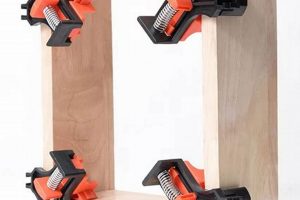
Application specificity manifests in several key areas: joint type, material thickness, assembly size, and material properties. Different joint types, such as mortise and tenon, dovetail, or butt joints, require varying degrees of pressure and alignment accuracy. Thicker materials necessitate systems with greater reach and force capacity. Larger assemblies demand solutions capable of distributing pressure evenly across extended surfaces. Softer woods necessitate clamping systems with adjustable pressure to prevent marring, while denser hardwoods require devices capable of exerting significant force. A mitered corner, for instance, demands specialized corner designs to ensure precise alignment and even pressure across the angled joint. Failure to consider these factors results in compromised joint strength and diminished aesthetic quality.
In conclusion, application specificity is not merely a peripheral consideration but a fundamental determinant of success in woodworking. The selection of woodworking clamping systems must be guided by a thorough understanding of the task at hand, accounting for the unique demands of the joint type, material characteristics, and assembly dimensions. Recognizing and addressing these specific needs will lead to improved joint strength, enhanced accuracy, and ultimately, a higher quality finished product. The challenge lies in developing a comprehensive understanding of available options and their suitability for specific applications, transforming theoretical knowledge into practical proficiency.
Frequently Asked Questions about Woodworking Clamping Systems
This section addresses common inquiries regarding the selection, application, and maintenance of devices used for securing workpieces during woodworking operations. The information provided is intended to enhance understanding and promote best practices.
Question 1: What factors dictate the appropriate type of clamping device for a given project?
The selection of a particular device hinges on several variables: the size and geometry of the components, the type of joint being formed, the material properties of the wood, and the required clamping force. Bar designs are suitable for large panels, while hand-screw options offer greater control for intricate joinery.
Question 2: How can excessive clamping force be avoided?
Over-tightening can damage wood fibers and compromise joint integrity. Apply only the necessary force to ensure adequate contact and prevent slippage. Distributing pressure evenly with cauls and protective pads mitigates the risk of localized stress.
Question 3: What is the purpose of cauls in woodworking applications?
Cauls are rigid or flexible boards employed to distribute pressure uniformly across broad surfaces, preventing indentations and ensuring even glue lines. They are particularly useful when clamping large panels or assemblies with irregular shapes.
Question 4: How frequently should woodworking clamping systems be inspected and maintained?
Regular inspection and maintenance are essential for optimal performance and longevity. Threads, bars, and jaws should be cleaned regularly to remove glue residue and sawdust. Damaged or worn components should be replaced promptly to prevent slippage or misalignment.
Question 5: What are the potential consequences of using incompatible clamping materials?
Certain pad materials can react with wood finishes or adhesives, leading to discoloration or adhesion problems. Testing pad materials and finishes is advisable to prevent adverse chemical reactions. Inert materials, such as polyethylene, mitigate the risk of incompatibility.
Question 6: How can clamping strategies accommodate wood movement due to changes in moisture content?
Wood expands and contracts with fluctuations in humidity. Workholding setups should allow for some degree of movement to prevent stress fractures or joint failure. Avoid applying excessive force to dry wood during periods of high humidity.
This overview addresses common concerns regarding the application of woodworking clamping systems. Careful consideration of these factors contributes to improved accuracy, stronger joints, and more efficient woodworking processes.
The subsequent section will delve into advanced techniques and specialized applications.
Conclusion
The preceding discussion has examined the critical role of woodworking clamping systems in achieving precision and structural integrity within woodworking projects. Key considerations include pressure distribution, joint alignment, material compatibility, clamping force optimization, and application specificity. Effective implementation of these principles directly influences the quality and longevity of finished products.
Continued research and development in this field will undoubtedly yield further advancements in workholding technology, enabling woodworkers to achieve increasingly complex and precise results. Adherence to established best practices remains paramount for maximizing the potential of woodworking clamping systems and ensuring the enduring quality of woodworking endeavors.
![Top-Rated: Best Quick Clamps for Woodworking Projects [2024] | Step-by-Step Guides, Tools & Inspiration to Build Beautiful Wooden Decor on a Budget](https://woodfromhome.com/wp-content/uploads/2026/04/th-264-300x200.jpg "Top-Rated: Best Quick Clamps for Woodworking Projects [2024] Step-by-Step Guides, Tools & Inspiration to Build Beautiful Wooden Decor on a Budget")