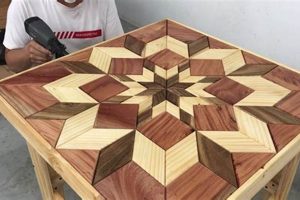
Simple woodworking projects represent approachable endeavors within the craft, characterized by their relatively low complexity and requirement for minimal specialized skills or tools. An example is the construction of a basic birdhouse or a small, unadorned bookshelf, tasks manageable for individuals with limited prior experience.
The significance of initiating woodworking with simpler projects lies in their capacity to cultivate foundational skills and foster confidence. Successfully completing these undertakings provides a positive learning experience, reducing the likelihood of discouragement and promoting continued engagement with the craft. Historically, novice artisans began with uncomplicated pieces to develop technique and familiarize themselves with material properties.
The subsequent sections will delve into specific project types appropriate for beginners, outlining essential tools and safety considerations, and providing guidance on material selection to facilitate a successful and enjoyable introduction to woodworking.
Guidance for Straightforward Woodworking Projects
The following guidelines aim to facilitate the successful completion of uncomplicated woodworking tasks, ensuring safety and promoting optimal results.
Tip 1: Prioritize Project Planning. Before commencing any build, develop a detailed plan outlining dimensions, materials, and assembly steps. A well-defined plan minimizes errors and streamlines the construction process. A simple sketch with measurements is often sufficient.
Tip 2: Select Appropriate Materials. Opt for softwoods like pine or fir for initial projects. These materials are more forgiving and easier to work with than hardwoods. Ensure lumber is straight, free from excessive knots, and properly dried.
Tip 3: Master Basic Joinery. Focus on fundamental joints such as butt joints, lap joints, and rabbet joints. These joints are relatively simple to execute and provide adequate strength for many basic projects. Utilize clamps to secure joints during gluing and fastening.
Tip 4: Emphasize Accurate Measurement and Cutting. Precision is crucial for achieving desired outcomes. Employ a quality measuring tape, square, and marking tools. Cut materials accurately using a hand saw or power saw, following the marked lines carefully. A miter saw is highly recommended for accurate angle cuts.
Tip 5: Implement Proper Sanding Techniques. Sanding is essential for achieving a smooth, professional finish. Begin with coarser grit sandpaper to remove imperfections, then progress to finer grits to refine the surface. Sand with the grain to avoid scratching.
Tip 6: Apply Finishes Correctly. Select a suitable finish based on the project’s intended use and desired aesthetic. Apply finishes in thin, even coats, allowing adequate drying time between coats. Consider using a brush, roller, or spray gun for application. Ensure proper ventilation during the finishing process.
Tip 7: Prioritize Safety. Always wear safety glasses to protect eyes from flying debris. Use hearing protection when operating power tools. Ensure adequate ventilation when working with finishes and adhesives. Familiarize oneself with the safe operation of all tools before use.
Adhering to these recommendations will contribute to a more efficient, safer, and ultimately more rewarding experience with simple woodworking projects. Success breeds confidence, fostering further skill development.
The subsequent sections will discuss specific project examples and advanced techniques for individuals seeking to expand their woodworking capabilities.
1. Minimal Tool Investment

The principle of minimal tool investment plays a pivotal role in defining accessible woodworking projects. Lowering the barrier to entry through reduced equipment requirements expands participation and enhances the appeal of introductory woodworking endeavors.
- Reduced Upfront Costs
Entry-level woodworking often necessitates a limited set of tools, such as a hand saw, measuring tape, square, sandpaper, and basic fastening implements. This contrasts with advanced woodworking, which may demand specialized power tools, thereby reducing the initial financial commitment and making the craft more accessible to beginners.
- Simplified Project Scope
Projects designed for minimal tool investment tend to have simpler designs and fewer intricate joinery methods. This allows the construction of functional items like small shelves, birdhouses, or cutting boards, which can be completed using only a few hand tools, eliminating the need for extensive power tool training or acquisition.
- Emphasis on Fundamental Skills
Restricting tool usage encourages the development of foundational woodworking skills. Novices learn to appreciate the precision of hand tools, the importance of accurate measurement, and the impact of material properties. These skills establish a strong basis for future woodworking pursuits, even with advanced tools.
- Portability and Space Efficiency
A small set of hand tools allows for greater portability and reduced storage space. This is especially beneficial for individuals with limited workshop facilities or those who prefer to work in various locations. Hand tools can be easily transported and utilized in a variety of settings without specialized power sources.
The correlation between minimal tool investment and accessible woodworking is evident in the simplification of project scope, emphasis on fundamental skills, and reduction of upfront costs. This approach enables greater participation and promotes a sustainable introduction to the craft.
2. Simple Joint Construction

Simple joint construction represents a cornerstone of accessible woodworking projects, directly influencing the feasibility and success of beginner endeavors. The selection and execution of joinery techniques significantly impact project complexity, stability, and aesthetic appeal, particularly in the context of “woodworking ideas easy.”
- Butt Joints and Their Application
The butt joint, the most basic of woodworking joints, involves directly joining two pieces of wood end-to-end or edge-to-edge. While inherently weak, butt joints are easily reinforced with fasteners such as screws or nails, or by using adhesives. In introductory woodworking, butt joints are frequently employed in constructing simple boxes, frames, or carcasses where minimal stress is anticipated. Their ease of execution makes them ideal for novices learning basic assembly techniques.
- Lap Joints and Increased Surface Area
Lap joints involve overlapping two pieces of wood, increasing the surface area for adhesive bonding and providing enhanced mechanical strength compared to butt joints. Simple half-lap joints can be achieved with minimal tools and skill, making them suitable for constructing stable frames or joining components that require moderate support. This joint is commonly found in basic shelving units and table aprons, providing a balance between simplicity and durability.
- Rabbet Joints and Enclosed Edges
Rabbet joints feature a recess cut into the edge of one piece of wood to accommodate another piece, creating a strong and visually appealing corner. This joint is particularly useful in constructing box-like structures, such as drawers or cabinets, as it provides a clean, enclosed edge and enhances structural integrity. The relative ease of cutting rabbets, either with hand tools or power tools, makes it a viable option for beginner-level projects.
- Pocket Hole Joinery and Hidden Fasteners
Pocket hole joinery involves drilling angled holes into one piece of wood, allowing screws to be driven into an adjacent piece from a concealed location. This method offers a combination of strength and aesthetic appeal, as the fasteners are hidden from view. While requiring a specialized jig, pocket hole joinery is relatively straightforward to execute and provides a strong, stable connection, particularly useful in constructing face frames or attaching table tops. It is often favored in projects where a clean, professional appearance is desired without advanced joinery skills.
The employment of simple joint construction techniques directly facilitates the completion of “woodworking ideas easy”. By prioritizing ease of execution and minimizing the need for specialized tools or advanced skills, these joints enable beginners to create functional and aesthetically pleasing projects while building confidence and foundational woodworking abilities. Further, the success achieved with simple joinery encourages continued exploration of more complex techniques and projects as skill levels increase.
3. Small Project Dimensions

The correlation between reduced project size and accessibility in woodworking is significant. Diminutive dimensions translate to decreased material requirements, simplified construction processes, and a corresponding reduction in the margin for error. As a consequence, projects of limited scale inherently align with the core tenets of simplified woodworking. Smaller projects, such as coasters, picture frames, or small boxes, require less wood, reducing material costs and waste. The physical handling of smaller pieces is easier, particularly for individuals with limited strength or dexterity. Joinery, sanding, and finishing are less time-consuming, allowing for quicker project completion and a more immediate sense of accomplishment.
The practical significance of adhering to small project dimensions is evidenced by its prevalence in introductory woodworking classes and instructional materials. Workshops frequently feature projects like cutting boards or small trays because these options are manageable within the constraints of limited class time and varying skill levels. Similarly, online tutorials and woodworking books often prioritize small-scale projects to cater to beginner woodworkers seeking easily achievable goals. Examples of successful beginner projects due to their small size include wooden spoons, small jewelry boxes, or even simple toys. The reduced size makes the project less intimidating and more likely to be finished.
In summary, the relationship between project size and accessibility is inversely proportional; smaller dimensions directly contribute to simplification and increased feasibility for novice woodworkers. While not a singular determinant of project difficulty, adherence to small dimensions facilitates manageability, promotes skill development, and fosters a positive initial experience, thereby establishing a solid foundation for future woodworking endeavors. The primary challenge is ensuring structural integrity and design aesthetics are maintained despite dimensional constraints.
4. Pre-Cut Lumber Option
The availability of pre-cut lumber directly influences the accessibility and feasibility of woodworking projects, particularly within the scope of beginner-friendly endeavors. The utilization of pre-cut materials mitigates several challenges typically encountered by novice woodworkers, thereby streamlining the construction process and fostering a more positive initial experience.
- Dimensional Accuracy and Reduced Error
Pre-cut lumber, sourced from reputable suppliers, offers a degree of dimensional accuracy often difficult to achieve with basic hand tools or entry-level power saws. This precision minimizes the potential for errors in cutting, fitting, and assembly, which is critical for achieving successful project outcomes, especially where tight tolerances are required. As an example, pre-cut components for a simple bookshelf ensure shelves fit squarely and uniformly within the frame.
- Time Savings and Streamlined Workflow
The elimination of the measuring and cutting phases significantly reduces the time required to complete a woodworking project. For beginners, these initial steps can be particularly daunting and time-consuming. By opting for pre-cut materials, the focus shifts to assembly, joining, and finishing, allowing for a more efficient and streamlined workflow. Constructing a small end table from pre-cut lumber can be accomplished in a fraction of the time compared to starting with raw lumber.
- Reduced Tool Requirements and Capital Investment
The reliance on pre-cut lumber minimizes the need for specialized cutting tools, such as table saws or miter saws. This reduces the initial capital investment required to embark on woodworking projects, making the craft more accessible to individuals with limited resources or space. A novice woodworker can construct a basic picture frame or decorative box using pre-cut components and a minimal set of hand tools.
- Material Waste Reduction and Resource Efficiency
Using pre-cut lumber can contribute to a reduction in material waste, particularly for beginners who may be prone to making errors during the cutting process. Pre-cut options are often available in sizes that closely match project requirements, minimizing offcuts and maximizing the utilization of raw materials. This resource efficiency is not only cost-effective but also aligns with sustainable practices in woodworking.
The integration of pre-cut lumber options significantly lowers the barrier to entry for aspiring woodworkers by simplifying construction, reducing tool requirements, and minimizing the potential for errors. This approach enables beginners to focus on developing essential skills in assembly and finishing, ultimately fostering a more rewarding and accessible introduction to the craft.
5. Clear Instruction Availability
The accessibility of explicit and well-structured guidance directly correlates with the successful execution of rudimentary woodworking projects. The presence of readily available, comprehensible instructions mitigates potential confusion, reduces error margins, and bolsters the likelihood of project completion for individuals with limited prior experience. Complex woodworking endeavors frequently necessitate specialized knowledge and advanced skills; conversely, simplified projects thrive when accompanied by clear, concise directives that demystify the construction process.
The absence of lucid instructions can lead to frustration, material waste, and ultimately, project abandonment. In contrast, access to meticulously detailed plans, diagrams, and step-by-step explanations empowers novice woodworkers to confidently navigate each stage of the construction process. Examples include online tutorials that visually demonstrate joinery techniques, detailed plans available for purchase or free download for simple furniture projects, and community workshops where experienced instructors provide hands-on guidance. The implementation of clear instructions transforms a potentially overwhelming task into a manageable and rewarding experience.
In conclusion, the ready availability of clear instructions forms an indispensable component of accessible woodworking. While other factors such as material selection and tool access also contribute, the absence of comprehensible guidance remains a significant barrier to entry. Addressing this need through the creation and dissemination of high-quality instructional resources is paramount to fostering widespread participation in this craft.
6. Soft Wood Selection

The selection of softwood species directly impacts the feasibility and accessibility of elementary woodworking projects. This selection is a critical component of realizing simplified woodworking endeavors, as the inherent properties of these materials facilitate ease of manipulation and construction for individuals with limited experience. The softer density of woods like pine, fir, and cedar translates to easier cutting, shaping, and fastening, all factors that significantly reduce the complexity of beginner projects. For example, constructing a simple birdhouse from pine is far less strenuous than attempting the same project with a dense hardwood like oak or maple.
The practical significance of softwood selection extends beyond ease of manipulation. Softwoods generally exhibit a consistent grain pattern, minimizing the risk of tear-out during machining and sanding, issues often encountered by novice woodworkers. Furthermore, softwoods typically accept stains and finishes more readily than hardwoods, simplifying the finishing process and enhancing the aesthetic appeal of completed projects. As an illustration, a softwood shelf will absorb paint or varnish more evenly than a hardwood counterpart, resulting in a more professional-looking finish with less effort. The cost-effectiveness of softwoods relative to hardwoods also renders them a more accessible material for initial woodworking experiments, reducing the financial risk associated with potential errors or material waste.
In summary, the strategic selection of softwood species is essential for realizing accessible and uncomplicated woodworking projects. This choice simplifies construction, enhances finishability, and minimizes material costs, contributing to a more positive and successful learning experience for beginner woodworkers. Though hardwoods offer distinct advantages in terms of durability and aesthetic appeal, their inherent properties make them less suitable for introductory projects where ease of manipulation and cost-effectiveness are paramount. The success of “woodworking ideas easy” hinges, in part, on this judicious material selection.
7. Limited Finishing Required

The reduced need for extensive finishing processes directly enhances the accessibility of woodworking projects targeted at beginners. Minimizing the complexities associated with staining, varnishing, or painting lowers the barrier to entry and promotes a more immediate sense of accomplishment, aligning with the core principles of simplified woodworking.
- Reduced Time Investment
Elaborate finishing protocols often necessitate multiple coats of product, extended drying periods, and meticulous sanding between applications. Limiting these requirements significantly reduces the overall project timeline. A simple project requiring only a single coat of sealant or a naturally appealing wood that necessitates no finish altogether offers a faster path to completion, catering to beginners who may lack the patience or time for more involved processes.
- Minimized Skill Requirements
Achieving a professional-quality finish often demands specialized knowledge and techniques, such as proper spray gun operation or the art of creating a flawless, mirror-like surface with multiple coats of varnish. Reducing the need for intricate finishing processes allows novices to sidestep these complexities and focus on developing fundamental woodworking skills, like accurate cutting and joinery. Leaving a project unfinished or applying a simple coat of wax requires minimal expertise.
- Lower Material Costs
Finishing products, including stains, sealers, varnishes, paints, and associated supplies like brushes, sandpaper, and respirators, can contribute significantly to the overall cost of a woodworking project. By minimizing the finishing requirements, the financial burden is reduced, making the craft more accessible to individuals on a budget. Opting for a naturally attractive wood that requires minimal sealant can substantially lower material expenses.
- Reduced Environmental Impact
Many traditional wood finishes contain volatile organic compounds (VOCs) that can be harmful to human health and the environment. Choosing projects that require minimal finishing or utilizing eco-friendly, low-VOC finishes reduces exposure to these potentially hazardous chemicals. The use of natural oils or waxes, or simply leaving the wood unfinished, offers a more sustainable approach.
The confluence of reduced time investment, minimized skill requirements, lower material costs, and decreased environmental impact underscores the critical connection between limited finishing requirements and accessible woodworking projects. Embracing designs that inherently minimize the need for elaborate finishing allows beginners to focus on the core elements of the craft, fostering a more positive and sustainable engagement with woodworking.
Frequently Asked Questions About Simple Woodworking
The following section addresses common inquiries regarding projects suitable for beginner woodworkers, focusing on accessibility, skill development, and project outcomes.
Question 1: What defines a woodworking project as “easy?”
Projects categorized as “easy” typically involve straightforward designs, minimal tool requirements, and uncomplicated joinery techniques. Projects should be completed with basic hand tools and inexpensive wood.
Question 2: Is specialized equipment necessary to undertake beginner woodworking?
Specialized equipment is not a prerequisite for simple woodworking. Many projects can be completed effectively with hand tools such as a saw, chisel, measuring tape, and sandpaper. Power tools, while convenient, are not essential for initial projects.
Question 3: What are some suitable wood types for novice woodworkers?
Softwoods such as pine, fir, and cedar are recommended for beginners due to their relative softness and ease of workability. These materials are more forgiving and less prone to splintering than hardwoods, facilitating easier cutting, shaping, and fastening.
Question 4: How critical is prior woodworking experience for attempting simplified projects?
Prior experience is not mandatory for undertaking basic woodworking. Projects designed for beginners typically include detailed instructions and diagrams, enabling individuals with limited or no prior experience to complete them successfully.
Question 5: What are some common mistakes made by beginner woodworkers, and how can they be avoided?
Common errors include inaccurate measurements, improper joinery, and inadequate sanding. These mistakes can be mitigated through careful planning, precise execution, and thorough attention to detail. Practice on scrap wood is advisable.
Question 6: What safety precautions should be observed when engaging in woodworking activities?
Safety is paramount. Protective eyewear must be worn at all times. Hearing protection is recommended when operating power tools. Adequate ventilation is crucial when working with finishes and adhesives. Familiarization with tool operation is mandatory prior to use.
The key takeaways emphasize the importance of careful planning, proper material selection, and adherence to safety protocols. While the scope of “easy” woodworking projects is limited, the foundational skills acquired are transferable to more complex endeavors.
The following sections will explore advanced woodworking techniques and project ideas for those seeking to expand their capabilities.
Conclusion
The preceding discourse has explored the characteristics defining accessible woodworking projects. Key elements contributing to simplification include minimal tool investment, basic joint construction, small project dimensions, the availability of pre-cut lumber, clear instructional resources, soft wood selection, and reduced finishing requirements. These factors collectively lower the barrier to entry for novice woodworkers, fostering skill development and encouraging engagement with the craft.
The successful implementation of these principles can lead to a greater appreciation for the art of woodworking, promoting its continued practice and innovation. As the craft evolves, further exploration into simplified techniques and accessible resources will be critical to ensuring its sustained accessibility for future generations of artisans. The continued advancement in simple, accessible designs is imperative for a craft accessible to all.