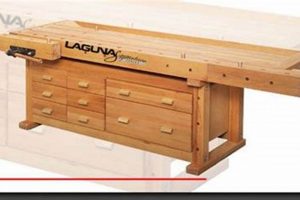
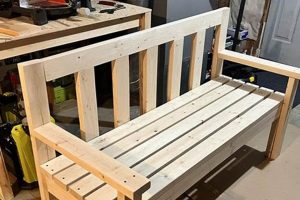
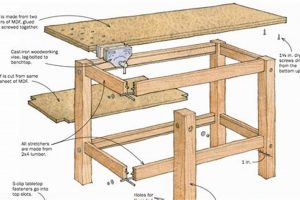
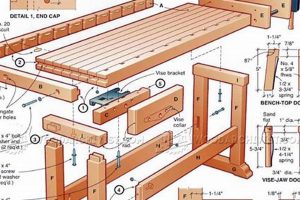
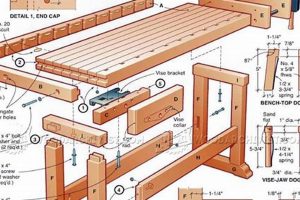
The central workspace in a woodworking environment is a sturdy, often customized, platform designed to support a variety of tasks. This foundational piece of equipment provides a stable surface for cutting, shaping, assembling, and finishing wooden components. A common example is a heavy, solid wood table equipped with vises and dog holes, facilitating secure clamping and manipulation of workpieces.
The utility of such a structure cannot be overstated, as it forms the bedrock of accurate and efficient craftsmanship. A well-constructed and properly equipped area allows for greater precision, reduces the risk of errors, and enhances overall workflow. Historically, these dedicated spaces have evolved from simple tables to highly specialized stations, reflecting advancements in tools and techniques and allowing for better ergonomics and workflow. This historical evolution mirrors the development of woodworking as a whole.
Subsequent sections will delve into specific design considerations, material choices, essential features, and customization options for this vital piece of equipment, enabling woodworkers of all skill levels to create a productive and comfortable workspace.
Essential Construction Guidance
The following recommendations aim to improve the design, construction, and utilization of a core woodworking asset. Implementation of these tips contributes to a more efficient and safer workshop environment.
Tip 1: Prioritize Stability: The structural integrity is paramount. Select dense hardwoods like maple or beech for the frame and legs to minimize movement during demanding tasks. A solid foundation reduces vibration and enhances precision.
Tip 2: Optimize Surface Flatness: A level surface is crucial for accurate assembly and finishing. Use a jointer and planer to ensure the top is perfectly flat, or employ a torsion box design for dimensional stability over time.
Tip 3: Integrate Versatile Vises: Front and end vises provide essential clamping capabilities. Consider quick-release mechanisms for efficiency and ensure the jaws are flush with the surface to avoid workpiece damage.
Tip 4: Implement a Dog Hole System: Strategically placed dog holes allow for secure clamping of irregularly shaped objects. Align the holes precisely and use high-quality metal or wooden dogs for reliable holding power.
Tip 5: Incorporate Integrated Storage: Maximize space utilization by including drawers, shelves, or cabinets beneath the work surface. Organize tools and supplies for easy access and to maintain a clutter-free environment.
Tip 6: Consider Ergonomics: The optimal height promotes comfort and reduces strain. Tailor the height to the user’s stature, taking into account the typical tasks performed. An adjustable height option provides added flexibility.
Tip 7: Apply a Durable Finish: Protect the surface from spills and wear with a resilient finish such as polyurethane or a blend of oil and varnish. Regular maintenance extends its lifespan and preserves its functionality.
Adhering to these principles results in a stable, functional, and enduring woodworking asset, conducive to producing high-quality work.
The subsequent sections will explore advanced design elements and specialized configurations, catering to specific woodworking disciplines and project requirements.
1. Stability
Stability is a fundamental requirement for any woodworking structure. The absence of stability directly impacts precision and safety during woodworking operations. A workbench that wobbles, shifts, or vibrates compromises the accuracy of cuts, joinery, and assembly. Cause-and-effect is evident: inadequate structural integrity of the bench leads directly to inaccuracies in the finished piece. This can manifest as misaligned joints, uneven surfaces, or compromised structural integrity of the project itself. Real-world examples include failed glue joints due to inconsistent clamping pressure on an unstable surface, or inaccurate cuts resulting from vibration when using power tools. Proper design and construction, with attention to sturdy joinery and sufficient mass, are essential for mitigating these problems. A stable bench allows the woodworker to focus on the task at hand, increasing both efficiency and quality.
The practical significance of this understanding extends beyond individual projects. In a professional setting, unstable benches can lead to increased production time, material waste, and potential safety hazards. The initial investment in a well-built, stable woodworking structure is recouped through improved efficiency, reduced errors, and a safer work environment. For instance, a cabinet shop reliant on precise measurements and tight tolerances necessitates multiple stable workbenches to ensure the accuracy of each component. Similarly, in a hobbyist workshop, a stable bench enables consistent results and minimizes frustration, fostering a more enjoyable and productive woodworking experience.
In conclusion, stability is not merely a desirable feature, but a non-negotiable attribute of any functional woodworking structure. Its absence negatively affects precision, safety, and overall efficiency. Understanding the crucial relationship between stability and the quality of woodworking outcomes allows for informed decisions regarding design, construction, and maintenance. The challenges associated with instability can be effectively addressed through careful planning, robust construction techniques, and a commitment to creating a solid foundation for all woodworking activities.
2. Flatness

Flatness of a woodworking structure is a pivotal characteristic that directly influences the accuracy and quality of woodworking operations. A non-planar surface introduces inaccuracies that propagate through all subsequent stages of a project, leading to misaligned assemblies, dimensional errors, and compromised structural integrity. The following facets detail the significance of surface planarity in relation to woodworking project execution.
- Reference Surface for Measurement
The flatness of the surface serves as a reliable reference point for accurate measurements. When transferring dimensions from a plan to the workpiece or checking the squareness of components, a flat surface ensures that the measurements are true and consistent. Any deviation from flatness introduces parallax errors and skews the dimensions, leading to inaccuracies in the final product. This is especially crucial in projects requiring tight tolerances, such as cabinetmaking or fine furniture construction.
- Assembly and Glue-Up Platform
During assembly and glue-up, a flat surface guarantees even distribution of clamping pressure across the joints. If the surface is uneven, some areas will receive excessive pressure while others receive insufficient pressure, leading to weak or misaligned joints. Furthermore, a non-flat surface can cause the workpiece to warp or twist during the glue-up process as it conforms to the underlying irregularities. This necessitates additional corrective measures and can compromise the overall strength and appearance of the finished piece.
- Tool Setup and Calibration
The surface facilitates the accurate setup and calibration of woodworking tools, such as hand planes, saws, and marking gauges. A flat surface allows the tool to register correctly against the workpiece, ensuring consistent depth of cut, accurate angles, and precise markings. If the surface is not flat, the tool will rock or wobble, leading to inconsistent results and potential damage to the workpiece. This is especially critical for achieving fine details and intricate joinery.
- Finishing Application
A flat surface aids in the uniform application of finishes, such as varnish, lacquer, or paint. An uneven surface can cause the finish to pool in low spots and thin out on high spots, resulting in an inconsistent appearance. Furthermore, any imperfections in the surface will be magnified by the finish, making them more noticeable. A flat surface ensures that the finish flows evenly and cures properly, resulting in a smooth, professional-looking final product.
These considerations underscore the necessity of establishing and maintaining flatness on woodworking platforms. Utilizing appropriate construction methods, employing precision measuring tools, and implementing regular surface maintenance protocols are all essential for maximizing accuracy and efficiency in woodworking endeavors.
3. Clamping
Clamping is an integral function of any woodworking structure, facilitating secure and precise assembly of wooden components. Without adequate clamping capabilities, achieving tight joints, accurate alignment, and proper adhesive bonding becomes significantly more challenging.
- Vise Integration and Application
Woodworking structures often incorporate vises as primary clamping mechanisms. These vises, typically mounted on the front or end of the bench, provide substantial clamping force for securing workpieces during shaping, planing, or joinery operations. The vise’s capacity, jaw width, and clamping action directly impact the types and sizes of projects that can be accommodated. A robust vise ensures the workpiece remains stable, allowing for accurate and efficient material removal.
- Dog Hole Systems and Bench Dogs
Dog holes, strategically placed across the surface, in conjunction with bench dogs (metal or wooden pegs), create a versatile clamping system. This system allows for securing irregular shapes or large panels that cannot be easily accommodated by traditional vises. By positioning dogs appropriately, pressure can be applied to specific areas of the workpiece, ensuring even clamping force and preventing distortion. The precision and spacing of dog holes are critical for maximizing the system’s effectiveness.
- Surface Clamping Techniques
The flat, stable surface provides an ideal platform for utilizing various auxiliary clamping devices, such as bar clamps, pipe clamps, and hand screws. These clamps are essential for assembling larger projects, applying even pressure across wide joints, and securing mitered corners. The surface must be robust enough to withstand the clamping forces without deflecting or distorting, ensuring the assembly remains square and true. In this case, a sturdy woodworking bench with a flat surface makes the clamping process precise and accurate, improving the quality of the final product
- Specialized Clamping Jigs and Fixtures
The woodworking structure serves as a foundation for specialized clamping jigs and fixtures tailored to specific tasks or joinery techniques. These jigs can range from simple right-angle clamping blocks to complex dovetail clamping fixtures. A stable and versatile structure allows for easy integration and customization of these jigs, enabling precise and repeatable clamping for intricate projects. Therefore, the woodworking bench is not just a surface but an adaptive tool.
The effectiveness of clamping directly influences the quality and longevity of woodworking projects. Integrating appropriate clamping mechanisms and techniques into the design and utilization of a woodworking structure is crucial for achieving professional results and maximizing efficiency. The interplay between the surface, the clamping systems, and the clamping techniques ensures the integrity of any woodworking venture.
4. Durability
The longevity and reliability of a woodworking platform are directly correlated with its inherent durability. A woodworking structure subjected to constant use, impacts from tools and materials, and exposure to environmental factors must possess robust construction and material properties to withstand these stresses. The cause-and-effect relationship is clear: insufficient durability leads to premature wear, structural failure, and a diminished functional lifespan. The importance of durability is paramount; it underpins the workbench’s ability to consistently provide a stable and reliable work surface. A real-life example is a workbench constructed from softwood exhibiting rapid degradation under heavy use, while one built with hardwood and reinforced joinery maintains its integrity for decades. The practical significance of this understanding lies in the economic benefits of reduced replacement costs and the increased efficiency derived from a consistently reliable work surface.
Material selection plays a crucial role in determining overall durability. Dense hardwoods like maple, beech, or oak offer superior resistance to abrasion, impact, and deformation compared to softwoods. Furthermore, joinery methods significantly influence structural integrity. Dovetail joints, mortise-and-tenon joints, and robust screw connections provide greater strength and resistance to racking than simple butt joints or nail connections. Surface finishes also contribute to durability by protecting the wood from moisture, chemicals, and scratches. A durable finish, such as polyurethane or epoxy, can extend the lifespan of the workbench and minimize maintenance requirements. Consideration must also be given to protecting the bench from corrosive materials such as glue and some finishing products. Proper treatment is thus essential for improving longevity.
In summary, durability is an indispensable attribute of a functional woodworking platform. Its presence ensures a reliable and long-lasting work surface, while its absence leads to premature failure and diminished productivity. Through careful material selection, robust construction techniques, and protective surface treatments, woodworkers can create structures that withstand the rigors of daily use and provide decades of service. Neglecting durability presents challenges in maintaining accuracy and stability. Conversely, prioritizing durability is central to building a sound working environment.
5. Ergonomics

The ergonomic design of a woodworking platform directly affects a woodworker’s physical well-being and productivity. The interconnectedness between workbench design and human physiology is evident: a poorly designed workbench causes strain, fatigue, and potential musculoskeletal disorders, while an ergonomically optimized bench promotes comfort, efficiency, and long-term health. Examples range from back pain resulting from working at an inappropriately low workbench to carpal tunnel syndrome caused by repetitive motions performed on a poorly configured surface. The practical significance lies in reduced worker absenteeism, improved accuracy, and increased overall work quality. Therefore, proper attention to the design of a workbench is necessary.
Workbench height is a primary ergonomic consideration. A height that forces the woodworker to stoop or reach excessively causes back and shoulder strain. Conversely, a height that is too high results in elevated shoulders and neck tension. Optimal height varies depending on the tasks performed and the individual’s stature, but typically falls between knuckle height and elbow height. Legroom beneath the bench is also critical, allowing the woodworker to stand close to the work without obstruction. Furthermore, the placement of vises, tool holders, and other accessories should be strategically arranged to minimize reaching and twisting motions. Accessible tool storage is also required for maximum efficiency and comfort.
In conclusion, ergonomic design is not merely a superficial consideration but an essential aspect of any functional woodworking structure. By addressing the relationship between the workbench and the human body, woodworkers can create a workspace that promotes comfort, reduces fatigue, and prevents injuries. Prioritizing ergonomics is thus not just a matter of personal well-being but a key factor in achieving professional results and sustaining a long and productive career. The challenges associated with poor ergonomic design can be avoided by investing in an adjustable or custom-made workbench, carefully considering layout, and taking frequent breaks to stretch and move around. Attention to ergonomic considerations is thus integral to a sound working method.
6. Storage

The integration of storage within a woodworking structure enhances efficiency and organization, addressing the inherent need to manage tools, materials, and work-in-progress items within a confined workspace. Effective storage solutions minimize clutter, improve workflow, and contribute to a safer work environment. The connection between a woodworking project platform and organized storage is critical to the operation’s success.
- Tool Organization and Accessibility
Integrated storage, such as drawers, shelves, and cabinets, provides dedicated spaces for tools, enabling quick access and preventing damage. Tools are segregated by type and frequency of use, with frequently accessed items located within easy reach. A systematic approach to tool storage reduces time wasted searching for misplaced implements and minimizes the risk of accidents caused by clutter. Well-organized tool storage in a woodworking bench is essential for the project completion.
- Material Management and Inventory Control
Designated storage areas for lumber, hardware, fasteners, and finishing supplies facilitate efficient material management. Categorizing and labeling materials allows for easy inventory tracking and prevents the accumulation of excess stock. Proper material storage protects wood from moisture, warping, and insect damage, ensuring its usability. This efficient inventory control is essential for professional woodworking endeavors.
- Work-in-Progress Containment
Dedicated storage, such as trays or cubbies, provides temporary holding areas for work-in-progress components, preventing them from being damaged or misplaced. This facilitates sequential project stages, allowing for continuous workflow without interruption. Managing the progression of current projects is crucial for an organized woodworking bench and project.
- Dust and Debris Control
Enclosed storage compartments help contain dust and debris generated during woodworking operations, minimizing airborne particles and simplifying cleanup. Dedicated spaces for waste disposal, such as integrated trash cans or dust collection ports, further contribute to a cleaner and safer workspace. The minimization of workplace hazards has a direct correlation with a woodworking bench with proper storage.
The incorporation of effective storage solutions within a woodworking structure transforms the workspace from a chaotic jumble into a well-organized and efficient environment. The integration of these different aspects of storage is critical to a properly-managed woodworking bench. Prioritizing storage design enhances productivity, improves safety, and contributes to the overall quality of woodworking projects.
7. Customization

The inherent adaptability of a woodworking platform allows for tailoring its features and functionality to meet specific user needs and project requirements. Customization enhances usability, optimizes workflow, and maximizes the value of the structure as a core woodworking asset. The capacity for personalization transforms a standard woodworking project platform into a tailored tool, increasing efficiency and improving the quality of completed work.
- Dimensional Adaptation for Workflow Optimization
Workbench dimensions can be adjusted to suit the user’s physical stature and preferred working methods. Height, length, and depth are modified to optimize ergonomics and accommodate specific project sizes. A taller user might require a higher workbench to minimize back strain, while a woodworker specializing in large-scale furniture might need a longer surface area. Dimensional customization ensures a comfortable and efficient work environment, minimizing fatigue and maximizing precision. For example, the bench height, length, width can be customized based on user’s workflow.
- Specialized Vise and Clamping System Integration
The selection and placement of vises and clamping systems can be tailored to accommodate specific joinery techniques and workpiece geometries. A cabinetmaker might opt for a quick-release vise for efficient stock preparation, while a luthier might require a specialized vise for delicate instrument construction. The integration of dog holes, holdfasts, and other clamping accessories further enhances the workbench’s versatility, allowing for secure and precise workpiece manipulation. The integration of different vices, clamping, and workpiece is essential for optimal functionality.
- Modular Component Addition and Configuration
Modular components, such as drawers, shelves, cabinets, and tool racks, can be added or removed to adapt the workbench to evolving storage needs and tool collections. A woodworker might initially opt for a minimalist design and gradually add storage modules as their tool collection expands. The ability to reconfigure these components allows for continuous optimization of the workspace, ensuring that tools and materials are always readily accessible. The utilization of modular woodworking projects allows for different storage needs.
- Surface Material and Finish Selection Tailoring
The choice of surface material and finish can be tailored to withstand specific project demands and environmental conditions. A butcher block surface provides exceptional durability for heavy-duty tasks, while a resin-coated surface offers superior resistance to chemicals and stains. The application of a durable finish, such as polyurethane or epoxy, protects the surface from wear and tear, extending the workbench’s lifespan. Selecting a durable finish for a woodworking bench allows for long-term woodworking projects.
These customization options exemplify the inherent adaptability of a woodworking platform, transforming it from a generic structure into a personalized tool that enhances productivity and optimizes workflow. Customization ensures that the workbench meets the specific needs of the user, promoting comfort, efficiency, and long-term satisfaction. Customization is therefore essential to creating a great woodworking bench.
Frequently Asked Questions About Woodworking Projects Benches
This section addresses common inquiries and misconceptions regarding the design, construction, and utilization of structures central to woodworking activities. The information provided aims to clarify best practices and dispel inaccurate assumptions.
Question 1: What constitutes an adequate material for a woodworking surface?
Dense hardwoods such as maple, beech, and birch are often selected due to their resistance to abrasion, indentation, and warping. Softwoods are less suitable, though can be used if properly reinforced. Laminated surfaces, like those made from butcher block, also offer acceptable durability and stability.
Question 2: What dimensions are optimal for a versatile woodworking platform?
While dimensions vary based on user height and project scope, a common size is between 60 and 72 inches in length, 24 and 36 inches in width, and 34 and 38 inches in height. These dimensions provide ample surface area for most tasks while maintaining ergonomic accessibility.
Question 3: How should the surface be maintained to ensure longevity?
Regular cleaning with a damp cloth and mild detergent removes accumulated dust and debris. Periodic application of a protective finish, such as paste wax or oil, helps to prevent moisture absorption and surface damage. Avoid harsh chemicals and abrasive cleaners.
Question 4: What features are essential for a secure clamping system?
A front vise and tail vise (or end vise) are primary clamping components. Dog holes, strategically placed across the surface, allow for versatile clamping configurations when used with bench dogs. Quick-release mechanisms on vises enhance efficiency.
Question 5: How can a woodworking structure be customized to specific project needs?
Customization options include adjustable height mechanisms, integrated tool storage solutions, specialized jigs and fixtures, and surface modifications to accommodate specific joinery techniques. The modularity of the design allows for future adaptations.
Question 6: What safety precautions should be observed when using it?
Always wear appropriate personal protective equipment, including eye protection and hearing protection. Ensure the structure is stable and well-lit. Properly secure workpieces before commencing any cutting, shaping, or assembly operations. Avoid clutter and maintain a clean work area.
Understanding these fundamental principles enables woodworkers to make informed decisions regarding the design, construction, and utilization of their core work area.
Subsequent sections will explore advanced techniques and specialized applications.
Concluding Remarks on Woodworking Projects Bench
This exploration has underscored the multifaceted importance of a woodworking projects bench as a foundational element in any woodworking endeavor. From its structural integrity and surface flatness to integrated clamping systems and customizable features, each aspect contributes significantly to the accuracy, efficiency, and safety of woodworking processes. The appropriate construction and utilization of such a structure enhance project outcomes and elevate the quality of craftsmanship.
As woodworking techniques and technologies evolve, the fundamental role of a well-designed and maintained woodworking projects bench remains constant. Continued attention to ergonomic principles, innovative storage solutions, and adaptive customization will ensure its enduring relevance in facilitating both professional and amateur woodworking pursuits. The future of woodworking rests, in part, on this essential structure, its design and construction a reflection of the craftsman’s commitment to precision and quality.