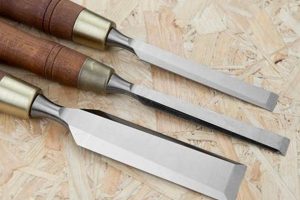
The implements employed to hone and refine the cutting edges of woodworking instruments are a crucial aspect of the craft. These items, ranging from coarse abrasives used for reshaping damaged blades to ultra-fine stones for achieving a polished, razor-sharp finish, are essential for maintaining optimal tool performance. As an example, a dull chisel necessitates significantly more force, increasing the risk of error and potentially damaging the workpiece, whereas a keen edge allows for precise and controlled cuts.
Effective edge maintenance ensures safety, efficiency, and superior results in woodworking projects. Historically, artisans relied on natural materials such as river stones to achieve sharp edges. The evolution of materials science has led to the development of synthetic sharpening media, offering greater consistency and control. Investing in quality implements and mastering sharpening techniques are critical for prolonging the lifespan of tools, reducing material waste, and achieving cleaner, more accurate cuts. Sharp tools require less force, minimizing user fatigue and the risk of injury.
The following sections will delve into the diverse array of devices available, examining the properties of different abrasive materials, discussing optimal sharpening methods, and providing guidance on selecting the appropriate equipment for various woodworking needs. The subsequent discussion will also cover the maintenance of these devices to ensure their continued effectiveness and longevity.
Tips for Effective Edge Maintenance
Maintaining the sharpness of woodworking implements is paramount for safety, precision, and quality of work. The following guidelines offer practical advice for achieving and preserving optimal tool edges.
Tip 1: Select Appropriate Abrasives: Choose sharpening media based on the tool steel and the desired level of refinement. Coarse grit stones are suitable for repairing damaged edges, while finer grits are ideal for honing and polishing.
Tip 2: Maintain a Consistent Angle: Precision in maintaining a consistent bevel angle during sharpening is critical. Jigs and guides can assist in achieving and maintaining the desired angle for repeatable results.
Tip 3: Employ a Lubricant: Use a lubricant, such as honing oil or water, during the sharpening process. Lubrication reduces friction, prevents the abrasive surface from clogging, and facilitates a smoother, more consistent sharpening action.
Tip 4: Apply Light Pressure: Excessive pressure can damage the tool’s edge and cause uneven wear on the sharpening stone. Use light, controlled pressure and allow the abrasive to do the work.
Tip 5: Deburr the Edge: After sharpening, a fine burr may form on the edge. Remove this burr by stropping the tool on a leather strop or a very fine honing stone. Stropping aligns the edge and creates a razor-sharp finish.
Tip 6: Regularly Inspect Tool Edges: Routinely examine tool edges for signs of dullness or damage. Early detection of these issues allows for timely sharpening, preventing more extensive repairs later.
Tip 7: Store Tools Properly: Store woodworking tools in a way that protects their cutting edges from damage. Dedicated tool racks or sheaths can prevent accidental contact with other objects, preserving the sharpness of the edges.
Adhering to these practices enhances the performance and extends the life of woodworking tools, resulting in improved accuracy, efficiency, and safety. Consistent edge maintenance is a hallmark of skilled craftsmanship.
The subsequent section will explore specific sharpening techniques and the selection of appropriate sharpening systems for various woodworking applications.
1. Abrasive Selection

Abrasive selection constitutes a fundamental consideration within the realm of woodworking edge maintenance. The choice of abrasive directly influences the speed, precision, and ultimate quality of the sharpening process. Varying materials and grit sizes cater to distinct sharpening stages and types of tool steel.
- Natural Abrasives: Water Stones
Natural water stones, derived from sedimentary rock, offer a traditional approach to sharpening. Characterized by their relatively soft composition, they release abrasive particles during use, creating a slurry that facilitates the cutting action. Water stones are well-suited for high-carbon steel tools but may require frequent flattening to maintain a level surface. An example includes Japanese natural water stones, prized for their ability to produce exceptionally keen edges.
- Synthetic Abrasives: Aluminum Oxide
Synthetic abrasives, such as aluminum oxide, provide a consistent and predictable sharpening experience. Manufactured to precise grit sizes, they offer greater uniformity compared to natural stones. Aluminum oxide stones are relatively hard and durable, making them suitable for sharpening a variety of tool steels. These are commonly available in oil stones and water stones form, providing versatility for the user.
- Superior Hardness: Diamond Abrasives
Diamond abrasives, bonded to a steel or other substrate, exhibit exceptional hardness. This property makes them effective for sharpening tools made from hardened tool steels, including those containing vanadium or chromium. Diamond stones cut rapidly and maintain their flatness over extended use. These abrasives are particularly useful for initial shaping or repairing damaged edges.
- Precision Finishing: Ceramic Abrasives
Ceramic abrasives are engineered for creating exceptionally fine edges. Characterized by their uniform particle size and ability to fracture cleanly, they produce a highly polished finish. Ceramic stones are often used as a final honing step after sharpening with coarser abrasives. These are well-suited for achieving a razor-sharp edge on chisels and plane irons.
The selection of an appropriate abrasive necessitates an understanding of the tool steel being sharpened, the desired level of sharpness, and the specific tasks for which the tool will be used. Matching the abrasive to the application is crucial for achieving optimal results and prolonging the lifespan of both the sharpening implements and the woodworking tools themselves. Furthermore, proper maintenance of these sharpening mediums is essential for preserving their efficacy and ensuring consistent performance across multiple uses.
2. Angle Consistency

Maintaining a consistent bevel angle is a critical component of effective edge maintenance in woodworking. The angle at which a tool’s edge is sharpened directly influences its cutting performance, durability, and the quality of the resulting work. Deviation from the intended angle can result in a weak or inefficient cutting edge. For example, if the angle is too acute, the edge becomes fragile and prone to chipping; conversely, an excessively obtuse angle produces a dull edge requiring greater force to cut, reducing precision and increasing user fatigue. Therefore, the implementation of appropriate implements capable of establishing and preserving a precise angle is crucial.
The implements designed to aid in maintaining angle consistency range from simple honing guides to more sophisticated powered sharpening systems. Honing guides, typically used with sharpening stones, provide a stable platform that holds the tool at a predetermined angle. This allows the user to focus on the sharpening motion without the distraction of maintaining the angle manually. An example is the use of a honing guide to maintain a 30-degree bevel on a bench plane iron, resulting in consistent shaving thickness and a smooth surface finish. Powered systems, while offering greater speed and convenience, often require careful setup and calibration to ensure accuracy in angle replication. Neglecting this calibration can lead to inconsistencies, negating the benefits of the powered system.
In summary, angle consistency is inextricably linked to the selection and proper application of various sharpening devices. The ability to establish and maintain a precise bevel angle is a determining factor in the effectiveness of any sharpening system. Challenges in achieving consistent angles can stem from improper technique, worn or inaccurate tools, or a lack of understanding of the tool’s intended use. Therefore, mastering angle control, in conjunction with appropriate implements, is essential for achieving and maintaining sharp, durable, and effective cutting edges on woodworking tools.
3. Lubrication Use
The application of lubrication is integral to the effective utilization of woodworking sharpening tools. Its function extends beyond merely facilitating the sharpening process; it directly impacts the quality of the resulting edge, the longevity of the sharpening implements, and the overall efficiency of the sharpening procedure.
- Friction Reduction
Lubrication’s primary role is to minimize friction between the tool and the abrasive surface. This reduction in friction lowers the heat generated during sharpening. Excessive heat can detrimentally affect the temper of the tool steel, softening the edge and diminishing its ability to hold an edge. Examples of suitable lubricants include honing oil, mineral oil, and water, each possessing varying degrees of lubricity and cooling properties. The use of lubrication, therefore, safeguards the structural integrity of the cutting edge.
- Swarf Suspension
Sharpening generates metallic particles, known as swarf, which can clog the abrasive surface and impede its cutting efficiency. Lubrication serves to suspend this swarf, preventing it from embedding in the sharpening stone and reducing its abrasive capacity. A consistent flow of lubricant, whether oil or water, carries away these particles, maintaining a clean and effective cutting surface. This, in turn, leads to faster and more uniform material removal.
- Corrosion Inhibition
Certain sharpening stones, particularly water stones, require the use of water as a lubricant. While water is an effective coolant and swarf-suspending agent, it can also promote corrosion of the tool steel. The addition of a rust inhibitor to the water or the application of a light oil after sharpening helps to prevent oxidation and maintain the tool’s surface condition. This is particularly crucial for high-carbon steel tools, which are more susceptible to rust.
- Abrasive Performance Enhancement
The type of lubricant used can also influence the performance of the abrasive. For example, some honing oils contain additives that further enhance the cutting action of the stone. Similarly, the use of a slurry stone with water stones can increase the rate of material removal during the initial stages of sharpening. The selection of an appropriate lubricant, therefore, contributes to both the speed and effectiveness of the sharpening process.
The application of lubrication within the context of woodworking sharpening tools represents a multifaceted consideration, influencing both the properties of the sharpened tool and the functional longevity of the sharpening implements. The proper selection and utilization of lubricants is an essential component of maintaining an optimal edge and ensuring the long-term performance of woodworking tools.
4. Pressure Control
Pressure control, in the context of woodworking sharpening implements, directly influences the efficiency and outcome of the sharpening process. Excessive force can lead to several detrimental effects: the rapid wear of abrasive surfaces, the generation of excessive heat that can alter the temper of the tool steel, and the potential for uneven sharpening resulting in a skewed or damaged cutting edge. Conversely, insufficient pressure may prove ineffective, prolonging the sharpening process without achieving the desired sharpness. The optimal pressure is a balance that allows the abrasive to efficiently remove material without compromising the tool’s integrity or the abrasive’s lifespan. For example, when using a water stone, applying excessive downward pressure will cause the stone to dish out more quickly, requiring more frequent flattening. Light pressure, while taking longer, allows for more controlled material removal and a flatter stone surface over time.
The application of appropriate pressure varies depending on the type of sharpening implement used, the type of steel being sharpened, and the stage of the sharpening process. Coarser abrasives, intended for rapid material removal in the initial stages of sharpening, may require moderately firm pressure. Finer abrasives, utilized for honing and polishing, necessitate significantly lighter pressure to achieve a refined edge without creating micro-bevels or rounding the edge. Similarly, harder steels require more controlled and consistent pressure to prevent the abrasive from glazing over. One practical application is observing the slurry when sharpening with water stones; consistent, light pressure ensures a continuous and even slurry formation, indicating efficient and controlled material removal. If the slurry dries quickly or becomes uneven, it suggests inconsistent or excessive pressure.
In summary, pressure control is a fundamental skill in effective tool sharpening, requiring a nuanced understanding of both the implements and the materials involved. Mastering pressure control minimizes the risks of damage, ensures optimal abrasive performance, and ultimately leads to the creation of sharper, more durable cutting edges. Difficulties in achieving appropriate pressure often stem from a lack of experience or feedback, necessitating deliberate practice and keen observation of the sharpening process. This skill, when honed, significantly contributes to the overall quality and efficiency of woodworking endeavors.
5. Deburring Technique
The removal of the wire edge, or burr, formed during the sharpening process is a critical final step in achieving optimal sharpness on woodworking implements. This technique, often overlooked, directly impacts the tool’s cutting performance and edge retention. The presence of a burr weakens the cutting edge, making it prone to premature dulling and affecting the precision of cuts. Effective deburring, therefore, is an essential adjunct to the sharpening process itself.
- Stropping with Leather
Stropping, the act of drawing the sharpened edge across a piece of leather, is a common deburring method. The leather, often charged with a polishing compound, aligns and refines the edge, removing the burr and creating a highly polished surface. For example, after sharpening a chisel on a fine water stone, stropping on a leather strop will remove any remaining burr and leave a razor-sharp edge. The absence of stropping can result in a ragged edge that tears wood fibers rather than cleanly severing them.
- Use of Fine Honing Stones
Extremely fine honing stones, such as those with a grit rating of 8000 or higher, can also be used for deburring. By lightly drawing the tool across the stone at a very shallow angle, the burr can be carefully removed without rounding the primary bevel. This technique is particularly useful for small tools or intricate edges where stropping may be difficult. A common application is the deburring of carving gouges on a fine ceramic stone, ensuring a clean and precise cutting action.
- Controlled Light Pressure
Regardless of the method employed, the application of extremely light pressure is critical during deburring. Excessive pressure can fold the burr over, making it more difficult to remove or, worse, damage the cutting edge. The goal is to gently shear off the burr without altering the geometry of the sharpened bevel. For instance, when using a fine honing stone, applying only the weight of the tool itself is often sufficient for effective deburring.
- Visual Inspection
Visual inspection, aided by magnification if necessary, is crucial to ensure complete burr removal. A remaining burr can often be detected as a faint reflection along the cutting edge. Careful inspection ensures that the deburring process has been successful and that the tool is ready for use. The use of a magnifying glass can reveal even minute burrs that would otherwise be missed, allowing for further refinement of the edge.
In conclusion, deburring is an indispensable step in the sharpening process, significantly impacting the performance and longevity of woodworking implements. Whether through stropping, the use of fine honing stones, or other specialized techniques, the objective remains the same: to remove the wire edge and create a clean, precise cutting edge. Proper deburring enhances the tool’s cutting ability, reduces the effort required for woodworking tasks, and contributes to the overall quality of the finished product.
6. Storage Methods

The manner in which implements for edge maintenance are stored significantly impacts their longevity, effectiveness, and safety. Proper storage prevents damage, contamination, and degradation of abrasive surfaces, thereby ensuring consistent performance and prolonging the lifespan of these critical woodworking tools.
- Protection from Contamination
Abrasive surfaces are susceptible to contamination from dust, debris, and moisture. Contamination can clog the abrasive, reducing its cutting efficiency and altering its surface characteristics. Enclosed storage containers, such as fitted boxes or cabinets, shield implements from environmental contaminants. Desiccants may be employed to mitigate the effects of humidity. For instance, oilstones should be stored in a container with a few drops of oil to prevent drying and cracking, while water stones should be allowed to air dry completely before being stored to inhibit mold growth.
- Prevention of Physical Damage
Impact or abrasion during storage can chip, crack, or otherwise damage sharpening stones and related implements. Individual compartments or padded linings within storage units protect surfaces from physical harm. Diamond stones, in particular, are vulnerable to damage if they come into contact with hard surfaces. Dedicated storage racks for honing guides prevent bending or misalignment, ensuring their continued accuracy.
- Organization and Accessibility
Organized storage systems facilitate efficient workflow and minimize the risk of accidental damage during retrieval. Clearly labeled compartments or drawers allow for quick identification and selection of the appropriate abrasive for a given task. Storing implements in a logical sequence, such as by grit size, streamlines the sharpening process and reduces the likelihood of using the wrong tool. Wall-mounted racks can save space and provide easy access to frequently used items.
- Mitigation of Environmental Exposure
Exposure to extreme temperatures or humidity can degrade the performance of certain sharpening implements. High humidity can cause water stones to crumble or promote rust on steel components, while prolonged exposure to sunlight can fade or warp plastic components. Storing implements in a climate-controlled environment, away from direct sunlight and excessive moisture, helps to maintain their integrity. For example, waterstones should ideally be stored in a cool, dry place after being allowed to air dry completely.
The application of appropriate storage methods is a fundamental aspect of maintaining a comprehensive and effective edge maintenance system. Proper storage not only protects the investment in these specialized implements but also ensures their consistent performance, contributing to the overall quality and precision of woodworking endeavors. The selection of storage solutions should consider the specific requirements of each implement, as well as the working environment and frequency of use.
Frequently Asked Questions
This section addresses common inquiries regarding the selection, usage, and maintenance of devices employed for edge refinement in woodworking, providing clarity and practical guidance.
Question 1: What distinguishes natural sharpening stones from synthetic alternatives?
Natural sharpening stones, sourced from geological formations, offer a unique sharpening experience characterized by a gradual breakdown of abrasive particles during use. This creates a slurry that aids in polishing. Synthetic stones, manufactured with controlled grit sizes, provide consistency and durability. The choice depends on the desired outcome and material being sharpened.
Question 2: How critical is maintaining a consistent bevel angle during sharpening?
Maintaining a consistent bevel angle is paramount. Variance in the angle alters the tool’s cutting geometry, leading to inefficiencies and potential damage. Jigs and guides are available to aid in the accurate maintenance of a consistent bevel angle.
Question 3: Why is lubrication recommended during the sharpening process?
Lubrication reduces friction between the tool and the abrasive surface, minimizing heat generation that can alter the temper of the steel. It also suspends metallic particles, preventing them from clogging the abrasive surface and reducing its effectiveness.
Question 4: What level of pressure is appropriate when sharpening woodworking tools?
Moderate pressure is typically sufficient for initial shaping and material removal. Finer abrasives require lighter pressure to achieve a refined edge. Excessive pressure can damage both the tool and the sharpening implement.
Question 5: What is the purpose of deburring, and how should it be executed?
Deburring removes the fine wire edge (burr) that forms during sharpening, weakening the edge. Stropping on leather or using extremely fine honing stones, with minimal pressure, effectively removes the burr, resulting in a cleaner, more durable cutting edge.
Question 6: How should sharpening tools be stored to ensure their longevity and performance?
Storage methods should protect against contamination, physical damage, and extreme environmental conditions. Enclosed containers, individual compartments, and climate-controlled environments are recommended.
Mastering the principles outlined above enhances the performance, extends the life of woodworking implements, and ultimately leads to superior woodworking results.
The subsequent section transitions to a discussion of common mistakes in edge maintenance and strategies for avoiding them.
Conclusion
The preceding discussion has illuminated the critical role of implements employed for refining the cutting edges of woodworking instruments. The informed selection, meticulous application, and proper maintenance of these devices are paramount to achieving optimal results in woodworking endeavors. Key considerations include abrasive selection, angle consistency, lubrication, pressure control, deburring techniques, and storage methods. Understanding and implementing these principles maximizes tool performance, extends tool life, and enhances the quality of finished projects.
Proficient utilization of implements employed for edge refinement represents a fundamental aspect of skilled craftsmanship. Continuous refinement of sharpening techniques, coupled with a commitment to consistent maintenance, enables woodworkers to achieve superior precision, safety, and efficiency in their work. The mastery of edge maintenance represents a critical investment in both the tools and the craft itself, yielding lasting benefits for those who pursue excellence in woodworking.
![Buy Woodworking Tools Sales Online - [Your Brand] | Step-by-Step Guides, Tools & Inspiration to Build Beautiful Wooden Decor on a Budget](https://woodfromhome.com/wp-content/uploads/2026/05/th-213-300x200.jpg "Buy Woodworking Tools Sales Online - [Your Brand] Step-by-Step Guides, Tools & Inspiration to Build Beautiful Wooden Decor on a Budget")