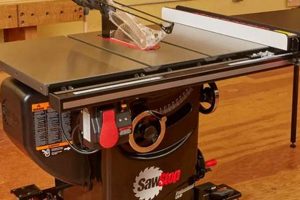
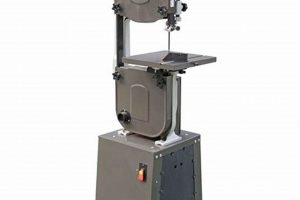
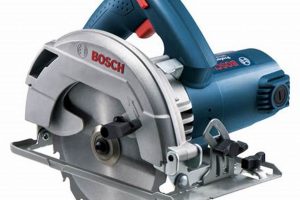
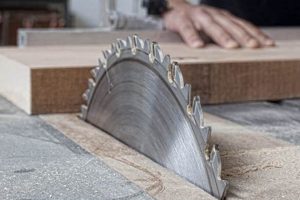
A circular cutting tool designed for use on a stationary power tool is essential for accurately and efficiently processing lumber and sheet goods. This component, characterized by its toothed periphery, is engineered to make precise cuts in a variety of wood types, from softwoods like pine to hardwoods such as oak. Different configurations of teeth and blade materials exist, each optimized for specific applications, such as ripping (cutting with the grain) or crosscutting (cutting against the grain).
The effectiveness and safety of a woodworking shop often hinge on the selection of the appropriate cutting tool. Proper blade choice directly influences the quality of the cut, minimizing splintering and ensuring a smooth edge. Historically, advancements in metallurgy and manufacturing techniques have led to the development of more durable and precise cutting implements, thereby improving the overall efficiency and safety of woodworking operations.
The following sections will delve into the various types available, focusing on their design features, applications, and maintenance requirements. Detailed attention will also be given to safe operating procedures and best practices for maximizing the lifespan of these critical tools.
Essential Guidelines for Optimal Performance
This section outlines crucial considerations for ensuring the longevity, accuracy, and safe utilization of the specified cutting implement.
Tip 1: Select the Appropriate Type. The design, tooth configuration, and material composition should align with the intended task. Using a ripping configuration for crosscutting, or vice versa, will result in suboptimal performance and potential workpiece damage.
Tip 2: Inspect for Damage. Before each use, thoroughly examine the entire surface. Look for missing or damaged teeth, cracks, or warping. A compromised implement can lead to dangerous kickback and inaccurate cuts.
Tip 3: Ensure Proper Mounting. Securely mount the cutting device to the arbor, ensuring it is square and true. Improper mounting will cause vibration, inaccurate cuts, and accelerated wear.
Tip 4: Utilize Appropriate Stabilizers. Featherboards and push sticks are imperative for maintaining consistent material contact and preventing hand proximity to the cutting edge. Implement these safety accessories to mitigate the risk of injury.
Tip 5: Control Feed Rate. Do not force the material through the tool. A steady and controlled feed rate produces cleaner cuts and minimizes strain on the motor and cutting edge. Adjust feed rate according to wood density and blade configuration.
Tip 6: Maintain Cleanliness. Regular cleaning with a specialized resin remover will prevent buildup that can reduce cutting efficiency and increase friction. Clean after each use to prolong implement life.
Tip 7: Sharpen Regularly. Maintaining a sharp edge is critical for both performance and safety. Dull edges require more force, increasing the risk of kickback and motor strain. Have it professionally sharpened when needed.
Tip 8: Store Properly. When not in use, store in a dry environment to prevent corrosion and warping. Use a protective case or blade guard to protect the teeth from damage during storage.
Adhering to these guidelines will maximize cutting precision, extend the tool’s service life, and contribute to a safer woodworking environment.
The subsequent section will explore common issues encountered and troubleshooting techniques.
1. Tooth Geometry

Tooth geometry plays a pivotal role in the performance of any cutting tool designed for a stationary woodworking power tool. The shape, angle, and arrangement of teeth directly influence cut quality, efficiency, and safety. Variations in tooth geometry cater to specific woodworking tasks and material types, requiring a thorough understanding for optimal tool selection.
- Hook Angle
The hook angle, the angle at which the tooth face meets the material, aggressively pulls the material into the tool. A steeper hook angle is suitable for ripping softwoods, while a less aggressive angle is preferred for hardwoods and delicate materials to prevent splintering. The hook angle directly impacts feed rate and the power required to make the cut.
- Top Bevel Angle (Alternate Top Bevel – ATB)
The top bevel angle, found in Alternate Top Bevel (ATB) designs, alternates the bevel on each tooth. This configuration is commonly used for crosscutting and sheet goods, creating a cleaner, more polished edge by slicing the wood fibers rather than tearing them. The ATB design is particularly effective in minimizing tear-out on the underside of the material.
- Rake Angle (Clearance Angle)
The rake angle, also known as the clearance angle, affects the efficiency of chip removal. A larger rake angle allows for easier chip ejection, preventing clogging and overheating. The appropriate rake angle depends on the type of wood being cut; softer woods require a larger rake angle, while harder woods require a smaller angle for control.
- Tooth Count and Gullet Size
Tooth count and gullet size are interrelated factors. A higher tooth count generally produces a smoother cut but reduces the gullet size (the space between the teeth for chip removal). Lower tooth counts and larger gullets are optimal for ripping, allowing for efficient chip ejection when cutting along the grain. Selecting the appropriate tooth count and gullet size balances cut quality with chip clearing capacity.
In conclusion, tooth geometry is a critical determinant of performance. Understanding the interplay between hook angle, top bevel angle, rake angle, tooth count, and gullet size enables informed selection, maximizing cut quality and minimizing the risk of kickback. Proper tool selection, based on these geometrical attributes, is essential for successful and safe woodworking.
2. Blade Material
The selection of material is paramount to the functionality and longevity of a cutting tool intended for use with a stationary woodworking power tool. The interaction between the blade’s composition and the wood dictates the cutting performance, resistance to wear, and overall safety of the operation. Inadequate material selection leads to premature dulling, increased risk of breakage, and compromised cut quality. For example, using a high-speed steel (HSS) blade on hardwoods such as maple or oak results in rapid wear and a rough, splintered edge.
Tungsten carbide-tipped (TCT) blades represent a significant advancement in cutting tool technology. By brazing tungsten carbide teeth onto a steel body, manufacturers create a product exhibiting exceptional hardness and wear resistance. This allows TCT blades to maintain their sharpness for significantly longer periods when processing abrasive materials like plywood and particleboard. Moreover, the steel body provides the necessary tensile strength and flexibility to withstand the stresses generated during operation. The choice of steel alloy also plays a role; higher quality alloys offer improved resistance to deformation and fatigue.
Diamond-tipped blades are employed in specialized applications requiring extreme durability and precision. These are particularly useful for cutting composite materials, laminates, and other abrasive substances that rapidly dull conventional blades. While the initial investment is higher, the extended lifespan and consistent performance of diamond-tipped blades often justify the cost in high-volume production environments. The blade material directly impacts the efficiency, cost-effectiveness, and safety of woodworking processes. Informed selection is, therefore, crucial for optimizing performance and minimizing risks.
3. Arbor Size

Arbor size represents a critical specification directly influencing the compatibility of a cutting tool with a stationary woodworking power tool. This dimension, defining the diameter of the central mounting hole, dictates whether a specific cutting tool can be securely and accurately installed on a particular power tool. A mismatch in arbor size renders the tool unusable and may present a safety hazard.
- Standardization and Variations
While some degree of standardization exists, variations in arbor size are present across different power tool manufacturers and models. In North America, a 5/8-inch arbor is a common standard for many 10-inch power tools. However, other sizes, such as 1 inch or 20mm, are prevalent in industrial applications or with tools manufactured outside of North America. Correctly identifying the tool’s arbor size is paramount to ensure compatibility with available cutting implements.
- Adaptation Methods and Their Limitations
Adapter rings, designed to bridge minor size discrepancies, are sometimes employed to mount a cutting tool with a slightly larger arbor onto a smaller tool arbor. However, the use of adapters is generally discouraged due to potential vibration and instability. Adapters introduce an additional point of potential failure and can compromise the precision and safety of the cutting operation. It is advisable to select cutting tools that directly match the arbor size rather than relying on adapters.
- Impact on Cutting Tool Stability and Accuracy
A precise fit between the cutting tool’s arbor and the power tool’s arbor is essential for maintaining stability during operation. Any looseness or play can lead to vibration, resulting in inaccurate cuts and increased wear on both the cutting tool and the power tool. Furthermore, excessive vibration can create a dangerous working environment. Tightening the arbor nut to the manufacturer’s specified torque is crucial for securing the tool and minimizing vibration.
- Considerations for Purchasing
Prior to purchasing a cutting tool for a stationary woodworking power tool, verify the machine’s arbor size by consulting the manufacturer’s documentation or measuring the arbor directly. When ordering online, carefully review the product specifications to ensure compatibility. Failing to verify arbor size can result in the acquisition of an unusable cutting implement and potentially costly returns.
In summation, a thorough understanding of arbor size is indispensable for safe and effective woodworking. Matching the cutting tool’s arbor to the power tool’s specifications ensures stability, accuracy, and optimal performance. Ignoring this critical parameter can lead to compromised cut quality, equipment damage, and potential safety hazards.
4. Kerf Width
Kerf width, the amount of material removed by a cutting tool designed for use on a stationary woodworking power tool during a cut, is a fundamental characteristic dictating material yield and precision in woodworking projects. A wider kerf necessitates greater material removal, directly reducing the usable portion of a workpiece. The interaction between kerf width and blade design significantly influences the efficiency and cost-effectiveness of woodworking operations. For example, in cabinetmaking, where precise dimensions are paramount, selecting a blade with a minimal kerf is crucial for maximizing the number of usable parts from a given sheet of plywood.
The relationship between kerf width and blade stability also warrants consideration. Thin-kerf blades, designed to minimize material waste, may exhibit greater susceptibility to deflection, particularly when cutting dense hardwoods. This deflection can result in inaccurate cuts and potentially dangerous kickback. Conversely, blades with a wider kerf, often thicker in cross-section, provide enhanced stability but at the expense of increased material removal. The choice between a thin-kerf and standard-kerf blade necessitates a careful evaluation of the material being processed, the desired level of precision, and the capabilities of the woodworking power tool.
Understanding kerf width is essential for accurate project planning and execution. Failure to account for material loss due to kerf can lead to undersized components and project failure. A woodworking table equipped with a digital readout enhances the precision of cuts, but even the most advanced tools are rendered ineffective if the user disregards the material removed by the blade. Accurate measurement and accounting for kerf width is a fundamental skill in woodworking, ensuring both material optimization and project success.
5. Plate Thickness

Plate thickness, a critical parameter in woodworking table saw blades, profoundly influences blade stability, vibration damping, and overall cutting performance. The measure, typically expressed in inches or millimeters, represents the thickness of the steel disc to which the cutting teeth are affixed. Variations in plate thickness cater to diverse woodworking applications and material types, necessitating informed selection based on project requirements.
- Impact on Blade Stability
Increased plate thickness contributes to enhanced blade rigidity, minimizing deflection and wobble during operation. This stability is particularly crucial when processing dense hardwoods or thick stock, where cutting forces are substantial. A thicker plate reduces the likelihood of the blade deviating from the intended cut line, ensuring accuracy and minimizing the risk of kickback. Conversely, excessively thick plates may generate increased friction and require more power to operate effectively.
- Damping of Vibration
Plate thickness also plays a significant role in damping vibration, a phenomenon that can negatively impact cut quality and generate undesirable noise. A thicker plate effectively absorbs and dissipates vibrational energy, resulting in smoother cuts and reduced resonance. This is particularly important when using blades with a large diameter or when cutting materials prone to vibration, such as thin plywood sheets. Dampening vibrations leads to improved surface finish and reduced operator fatigue.
- Heat Dissipation Capabilities
The plate acts as a heat sink, drawing heat away from the cutting teeth and dissipating it into the surrounding environment. A thicker plate offers a greater surface area for heat transfer, helping to prevent the teeth from overheating and losing their temper. This is especially relevant when cutting hardwoods or plastics, which generate significant frictional heat. Effective heat dissipation extends blade life and maintains cutting performance.
- Relationship to Kerf Width
Plate thickness is directly related to kerf width, the amount of material removed by the blade during a cut. Thicker plates necessitate wider kerfs, resulting in greater material waste. Thin-kerf blades, characterized by thinner plates, minimize material removal but may compromise stability. Selecting the optimal balance between plate thickness and kerf width involves considering the material being processed, the desired precision, and the power capabilities of the saw.
In summary, plate thickness is a pivotal factor influencing the performance and lifespan of woodworking table saw blades. Its influence on blade stability, vibration damping, heat dissipation, and kerf width necessitates careful consideration when selecting a blade for specific woodworking tasks. Choosing an appropriate plate thickness optimizes cutting accuracy, reduces material waste, and contributes to a safer and more efficient woodworking experience.
6. Sharpening Frequency
Maintaining an appropriate sharpening frequency is a crucial aspect of woodworking with a table saw. A sharp blade ensures clean cuts, reduces strain on the saw’s motor, and enhances user safety. Conversely, a dull blade can lead to splintering, burning, and increased risk of kickback.
- Material Type and Blade Wear
The type of material being cut significantly impacts blade wear and, consequently, sharpening frequency. Abrasive materials like particleboard, MDF, and certain hardwoods accelerate blade dulling compared to softer woods like pine or poplar. Consistent use on abrasive materials necessitates more frequent sharpening intervals to maintain optimal cutting performance. For example, a blade used primarily for cutting plywood may require sharpening every 20-30 hours of use, while a blade used exclusively for softwoods could last significantly longer.
- Signs of a Dull Blade
Recognizing the signs of a dull cutting tool is essential for determining the appropriate sharpening schedule. Common indicators include increased feed force required to make a cut, burning or scorching of the wood, excessive vibration, and splintering or tear-out along the cut edges. If any of these symptoms are present, immediate inspection and potential sharpening are warranted. Neglecting these signs can lead to compromised cut quality and increased risk of accidents.
- Blade Material and Sharpening Intervals
The material composition of the cutting implement influences sharpening frequency. High-speed steel (HSS) blades typically require more frequent sharpening than carbide-tipped blades. Tungsten carbide retains its edge longer due to its superior hardness and wear resistance. However, carbide-tipped blades necessitate specialized sharpening equipment and techniques. While the initial investment in a carbide-tipped blade may be higher, the extended intervals between sharpenings can offset the cost in high-volume applications.
- Professional vs. DIY Sharpening
The decision to sharpen in-house or outsource to a professional sharpening service affects maintenance protocols. Professional sharpening services utilize specialized equipment and expertise to ensure precise and consistent sharpening. DIY sharpening, while potentially more cost-effective, requires specialized tools and skills. Improper sharpening can damage the blade and compromise its performance. The choice depends on the volume of sharpening required, the available resources, and the desired level of precision.
In conclusion, establishing an appropriate sharpening schedule is integral to maximizing the performance and lifespan of any table saw blade. By considering the material being cut, recognizing the signs of a dull blade, accounting for blade material composition, and making informed decisions about sharpening methods, woodworkers can maintain optimal cutting performance and ensure safe operation of their equipment.
Frequently Asked Questions
This section addresses common inquiries regarding the selection, maintenance, and safe operation of cutting tools designed for stationary woodworking power tools. Accurate information is critical for optimizing performance and minimizing risks.
Question 1: What factors determine the optimal tooth count for a woodworking table saw blade?
Tooth count is contingent upon the material being cut and the desired finish quality. Higher tooth counts are preferable for crosscutting and achieving smooth edges, while lower tooth counts are suitable for ripping operations.
Question 2: How does kerf width impact material yield in woodworking projects?
Kerf width directly influences material yield. A thinner kerf removes less material during a cut, thereby maximizing the number of usable pieces obtained from a given workpiece.
Question 3: What is the recommended method for cleaning resin buildup from a woodworking table saw blade?
Specialized resin removers, formulated to dissolve adhesive residues without damaging the blade’s metal, are recommended. Avoid abrasive cleaning agents, which can scratch or dull the cutting edges.
Question 4: How frequently should a woodworking table saw blade be sharpened?
Sharpening frequency depends on usage intensity, material type, and blade material. Indications of a dull blade include increased feed force, burning, and splintering. Regular inspection and sharpening are essential.
Question 5: What safety precautions should be observed when operating a table saw with a woodworking table saw blade?
Safety precautions include wearing appropriate personal protective equipment (PPE), such as safety glasses and hearing protection; utilizing push sticks and featherboards; and ensuring proper blade alignment and fence settings.
Question 6: Can adapter rings be safely used to mount a woodworking table saw blade with an incorrect arbor size?
The use of adapter rings is generally discouraged due to potential vibration and instability. Selecting blades with a direct match to the saw’s arbor size is the recommended practice.
Understanding these key aspects ensures the effective and safe utilization of cutting tools in woodworking applications. Prioritizing safety and adhering to recommended maintenance practices prolongs implement life and improves project outcomes.
The subsequent section will provide a glossary of common terms associated with woodworking table saw blades.
Conclusion
This discourse has illuminated the multifaceted nature of the woodworking table saw blade, encompassing considerations from material selection and tooth geometry to arbor size, kerf width, plate thickness, and sharpening frequency. Optimal utilization hinges on a comprehensive understanding of these parameters, enabling informed decisions aligned with specific project demands and safety imperatives.
The responsible and knowledgeable application of a woodworking table saw blade is paramount. Continuous education and adherence to best practices will ensure both high-quality results and a safe working environment. Further research and engagement with the woodworking community are encouraged to stay abreast of evolving technologies and techniques within this critical domain.