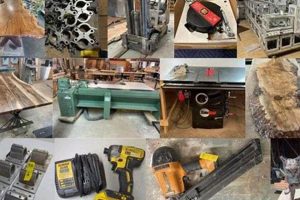
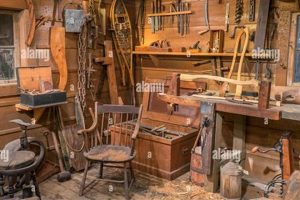
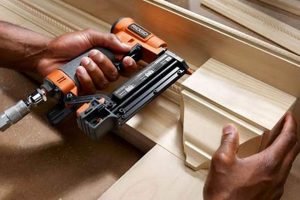
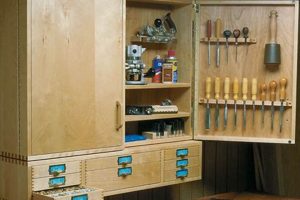
An organized system for storing implements and instruments used in crafting objects from timber, typically involving a vertical surface. This setup maximizes spatial efficiency in workshops, enabling clear visibility and accessibility of often-used hand tools, power tools, and related accessories. For example, a series of French cleats affixed to a plywood panel can support shelves, hooks, and custom-built holders designed to accommodate a variety of instruments.
The implementation of such an arrangement offers several advantages. It promotes a safer and more productive workspace by reducing clutter and minimizing the risk of injury associated with disorganized tool storage. Furthermore, it allows practitioners to quickly locate and retrieve the necessary implements, leading to increased efficiency and reduced downtime. Historically, the concept has evolved from simple pegboard configurations to more sophisticated and personalized systems incorporating diverse materials and design principles.
The subsequent sections will delve into specific design considerations, material selection, installation techniques, and customization options for creating effective and aesthetically pleasing solutions. This exploration will cover aspects such as spatial planning, load-bearing capacity, ergonomic design, and the integration of lighting and electrical components.
Tips for Optimized Tool Wall Organization
Effective organization contributes significantly to workflow efficiency and safety. The following guidelines assist in establishing and maintaining a functional arrangement.
Tip 1: Prioritize Frequently Used Instruments. Place implements required daily within easy reach. Less frequently used tools can be stored at higher or lower locations.
Tip 2: Implement a Shadow Board Technique. Painting or outlining the tool’s shape on the wall facilitates quick inventory checks and identifies missing items.
Tip 3: Utilize Standardized Mounting Systems. French cleats or pegboards offer flexibility and allow for easy rearrangement of tool holders as needs evolve.
Tip 4: Employ Magnetic Strips for Small Metal Items. Securing screws, drill bits, and other small metallic components with magnetic strips prevents loss and ensures easy access.
Tip 5: Group Tools by Function. Arranging implements according to their usage typee.g., measuring tools, cutting tools, fastening toolsstreamlines the selection process.
Tip 6: Label Everything Clearly. Clearly labeling shelves, drawers, and tool holders minimizes confusion and improves the speed of tool retrieval.
Tip 7: Periodically Re-evaluate the Configuration. Tool usage patterns change over time. Regularly assessing the current layout ensures it continues to meet the user’s needs.
These guidelines facilitate efficient operation, minimize wasted time, and contribute to a more organized and safer workspace. Regularly reviewing and adapting the organization system maximizes its effectiveness.
The subsequent section will address potential challenges and troubleshooting techniques associated with maintaining an optimal configuration.
1. Spatial Efficiency

Spatial efficiency, in the context of a woodworking environment, directly correlates with the intelligent use of available area. A tool wall represents a prime strategy for achieving this efficiency. By utilizing vertical space, a tool wall minimizes the footprint required for tool storage compared to horizontal alternatives like toolboxes or rolling cabinets. The cause-and-effect relationship is straightforward: an effective tool wall design yields a significant reduction in floor space consumption. Consider a small workshop where floor space is limited; implementing a tool wall allows for the unobstructed movement of the craftsman and the accommodation of larger workpieces, where a standard workshop might cause crowding.
The importance of spatial efficiency as a component of tool wall design lies in its ability to enhance productivity and safety. A well-organized tool wall, employing techniques like shadow boards and customized holders, ensures that tools are readily accessible, minimizing time spent searching for the correct implement. Furthermore, decluttering the workspace reduces the risk of trips and falls, contributing to a safer working environment. A practical example involves a woodworker specializing in intricate joinery; easy access to chisels, saws, and measuring devices allows for precise and efficient work, whereas a disorganized system could lead to errors and delays, which can be costly.
Ultimately, the understanding and implementation of spatial efficiency principles within the construction of a tool wall translate to a more productive and safer woodworking operation. Challenges may arise in adapting pre-existing storage solutions to a vertical format or in accounting for the weight and dimensions of various tools. However, careful planning and the selection of appropriate materials can overcome these obstacles. The benefits extend beyond the immediate workspace, promoting a mindset of organization and efficient resource management within the broader context of woodworking projects.
2. Accessibility

Accessibility, in the domain of woodworking, pertains to the ease and rapidity with which tools can be located, retrieved, and returned to their designated storage locations. This element is critically influenced by the design and implementation of storage solutions, particularly tool walls. A properly configured tool wall directly enhances workflow efficiency and reduces non-productive time spent searching for necessary implements.
- Visual Clarity and Tool Identification
The physical layout of a tool wall should facilitate immediate visual identification of each implement. Utilizing techniques such as shadow boards, color-coding, or clear labeling of tool positions ensures that the craftsman can quickly ascertain the location of the desired tool. In contrast, a cluttered or poorly organized storage system necessitates time-consuming searches and potentially contributes to frustration and errors. An example includes a wall where each tool’s outline is painted, enabling an instant inventory and indicating missing items.
- Ergonomic Placement and Reach
Ergonomics dictates that frequently used tools should be positioned within easy reach, minimizing the need for excessive bending, stretching, or climbing. The vertical organization of a tool wall permits strategic placement based on frequency of use and tool weight. Heavy or frequently accessed tools should be situated at waist level, while less frequently used items can be stored higher or lower. An example being that commonly used saws and planes are situated at the craftsman’s chest height for ease of access.
- Single-Handed Retrieval and Return
An optimally designed tool wall allows for the retrieval and return of tools with a single hand, leaving the other hand free to manipulate workpieces or make adjustments. This requirement necessitates secure and easily operable holding mechanisms, such as spring clips, magnetic strips, or custom-fitted cradles. Designs that require two hands to remove or replace a tool are inherently less accessible and can hinder workflow. For instance, a magnetic strip securely holding chisels allows one-handed removal and replacement, compared to a tight-fitting drawer.
- Adaptability and Reconfiguration
Woodworking projects and skill sets evolve over time, requiring corresponding adaptations in tool storage. A highly accessible system should be easily reconfigurable, allowing for the rearrangement of tool positions to accommodate new acquisitions or changes in usage patterns. Modular systems, such as those based on French cleats or pegboards, provide this flexibility. For example, as the craftsman’s repertoire grows to include new types of planes, the storage solution should accommodate these implements without requiring a complete overhaul.
The aforementioned aspects of visual clarity, ergonomic placement, ease of retrieval, and system adaptability collectively define the accessibility of a tool wall. A woodworking shop incorporating these principles promotes a more efficient, safer, and ultimately more enjoyable working environment. Furthermore, the careful consideration of accessibility contributes to a more organized and professional workspace, reflecting a commitment to quality craftsmanship.
3. Customization

Customization, within the framework of workshop implementation, refers to the tailoring of storage and organizational systems to meet the specific needs and preferences of the individual craftsman. This adaptability is critical for maximizing efficiency, promoting safety, and fostering a productive working environment. A standardized, off-the-shelf solution often fails to address the nuances of individual tool collections, project requirements, and ergonomic considerations.
- Tool-Specific Holders and Fixtures
Customized storage solutions can be designed to precisely accommodate the unique shapes and sizes of individual tools. This may involve creating custom-molded cradles for hand planes, precisely dimensioned racks for chisels, or specialized clamps for securing power tools. A general-purpose pegboard, while versatile, may not provide the optimal support or security for irregularly shaped or heavy tools, whereas a customized holder minimizes the risk of damage or accidental dislodgement. For instance, a bespoke French cleat system might include a dedicated shelf for a specific type of hand saw, ensuring it is readily accessible and securely stored.
- Adaptation to Available Space
The dimensions and configuration of a workspace invariably influence the design of storage systems. Customization allows for the optimization of space utilization, particularly in workshops with limited square footage or irregular layouts. A customized design may incorporate angled shelves, narrow profiles, or vertical extensions to maximize storage capacity without compromising access or maneuverability. Consider a small shop where a standard tool cabinet would obstruct movement; a customized tool wall could utilize a narrow strip of unused wall space, providing ample storage without impeding traffic flow.
- Ergonomic Considerations and User Preferences
Individual physical characteristics and working habits should inform the design of the tool wall. Customization allows for the adjustment of tool heights, angles, and orientations to minimize strain and maximize comfort during prolonged use. This may involve accommodating the user’s reach, height, or dominant hand. For example, a craftsman with back issues might benefit from a tool wall designed to minimize bending and lifting, placing frequently used tools at waist level for easy access.
- Integration of Task-Specific Organization
Certain woodworking projects necessitate the organization of tools and materials based on specific tasks or sequences. Customization allows for the grouping of related implements and supplies within designated zones on the tool wall. This approach streamlines workflow and minimizes the time spent searching for necessary items. For instance, a carving station on the tool wall might include a collection of gouges, mallets, sharpening stones, and finishing materials, all readily available for carving tasks.
These varied facets of customization collectively underscore the importance of tailoring organizational systems to the individual needs of the woodworker. By adapting storage solutions to accommodate specific tools, space constraints, ergonomic considerations, and project requirements, customization fosters a more efficient, safer, and ultimately more rewarding woodworking experience. A customized wall is not simply a storage location but an active component of the workshop.
4. Safety Considerations

Safety considerations are paramount in any woodworking environment, and the design and implementation of storage solutions, including tool walls, directly impact overall workshop safety. A well-planned tool wall minimizes hazards associated with disorganized tool storage and promotes a safer working environment. Neglecting these considerations can lead to injuries, damage to tools, and reduced productivity.
- Secure Mounting and Load-Bearing Capacity
The structural integrity of the tool wall is critical. Adequate load-bearing capacity must be ensured to support the combined weight of all stored implements. Wall mounting hardware should be appropriately sized and installed to prevent detachment or collapse. Failure to adhere to these guidelines can result in tools falling, causing injury or damage. For example, improperly anchored French cleats can shear under excessive weight, leading to a sudden and dangerous failure. Woodworking projects require adequate material to use a quality support system.
- Tool Retention and Prevention of Accidental Falls
Tool holders must securely retain implements to prevent accidental dislodgement or falls. The design should account for the size, shape, and weight distribution of each tool. Implements with sharp edges or points should be stored in a manner that minimizes the risk of accidental contact. For instance, chisels and saws should be oriented with their cutting edges facing away from the user or protected by covers. A scenario can be found where using a magnetic strip on a poorly built system would not hold tools securely, causing sharp objects to fall.
- Ergonomic Considerations and Accessibility
The ergonomic placement of tools on the wall impacts user safety. Implements should be positioned within easy reach to minimize the need for excessive bending, stretching, or climbing. Heavy tools should be located at waist level to reduce strain on the back. A properly designed layout minimizes the risk of musculoskeletal injuries associated with repetitive movements or awkward postures. Tool wall woodworking often means a worker will be facing it for extended periods.
- Clear Visibility and Hazard Awareness
A well-organized tool wall promotes clear visibility of all stored implements, reducing the risk of accidentally grabbing the wrong tool. This is especially important when dealing with potentially hazardous implements such as sharp-edged tools or power tools. Clearly labeling each tool and its designated location further enhances safety by minimizing confusion. For example, the shadow board will increase visibility of tools and hazards in the storage area.
These interwoven safety components highlight the necessity of a thorough and proactive approach to tool wall design and implementation. By addressing structural integrity, tool retention, ergonomics, and visibility, the likelihood of accidents is substantially reduced, contributing to a safer and more productive woodworking environment. Careful attention to these details mitigates the risks and ensures a safer working location for tool wall woodworking.
5. Material Durability

Material durability is a critical determinant of the longevity and safety of a tool wall in woodworking. The selection of robust materials directly impacts the structure’s ability to withstand the weight of tools, resist wear and tear from repeated use, and maintain its integrity over extended periods. A lack of durable materials in tool wall woodworking results in premature failure, potentially causing damage to tools and posing safety risks to the user. The cause-and-effect relationship is evident: inferior materials yield structural instability and increased maintenance requirements, while high-quality materials ensure a stable and reliable storage solution. For example, utilizing thin, low-grade plywood for the wall backing can lead to warping or cracking under the weight of heavy tools, necessitating costly repairs or replacement.
The significance of material durability extends beyond simple structural integrity. It directly influences the long-term cost-effectiveness and the overall productivity of the woodworking operation. A well-constructed tool wall, employing durable materials such as hardwood plywood, solid wood framing, and heavy-duty hardware, minimizes the need for frequent repairs and replacements. This reduces downtime and allows the craftsman to focus on woodworking tasks rather than maintenance. Furthermore, durable materials offer increased resistance to moisture, impact, and chemical exposure, ensuring that the tool wall maintains its functionality and appearance in demanding workshop environments. A real-world instance would involve a tool wall constructed from moisture-resistant medium-density fiberboard (MDF) in a humid climate. The MDF would prevent swelling and delamination, preserving the wall’s structural integrity over years of use.
Understanding the connection between material durability and tool wall woodworking is of practical significance for both amateur and professional woodworkers. Careful material selection, informed by a clear understanding of load-bearing requirements, environmental conditions, and usage patterns, is essential for creating a safe, efficient, and long-lasting storage solution. Challenges may arise in balancing the cost of materials with the desired level of durability. However, prioritizing quality materials ultimately represents a sound investment that yields significant long-term benefits in terms of reduced maintenance, enhanced safety, and improved productivity. This concept of durable materials relates to organization. Thus, a well-organized area reduces risk, and a more durable wall improves structure.
Frequently Asked Questions Regarding Tool Wall Woodworking
This section addresses common inquiries and misconceptions related to tool wall construction and implementation within woodworking environments. The information presented aims to provide clarity and guidance based on established best practices and material science principles.
Question 1: What is the minimum recommended thickness for a plywood backing board used in a tool wall?
The minimum recommended thickness for a plywood backing board is 3/4 inch. This thickness provides adequate structural rigidity and load-bearing capacity to support the weight of most hand tools and power tools. Thinner plywood may exhibit unacceptable warping or deflection, compromising the stability and safety of the system.
Question 2: Are pegboards a viable alternative to French cleats for tool wall construction?
Pegboards offer a degree of versatility and cost-effectiveness; however, French cleats generally provide superior load-bearing capacity and adaptability. Pegboards may be suitable for storing lighter tools and accessories, but French cleats are recommended for heavier implements and complex storage configurations.
Question 3: How should power tools be secured to a tool wall to prevent accidental falls?
Power tools should be secured using custom-fitted cradles, heavy-duty hooks, or locking mechanisms designed to accommodate their specific size and weight. The securing method should prevent the tool from accidentally falling due to vibration, accidental bumps, or gravity. Safety straps or chains may provide an additional layer of security.
Question 4: What types of fasteners are recommended for attaching tool holders to a tool wall?
The selection of fasteners depends on the type of material used for the tool wall and the weight of the tools being supported. Screws should be of sufficient length and gauge to penetrate deeply into the backing board and provide a secure hold. Lag screws or bolts may be necessary for supporting heavier items. Adhesive alone is generally insufficient for secure attachment.
Question 5: How can the risk of moisture damage to a tool wall be mitigated?
In humid environments, a moisture-resistant material, such as marine-grade plywood or medium-density fiberboard (MDF) treated with a moisture-resistant sealant, should be used for the tool wall construction. Adequate ventilation in the workshop can further reduce the risk of moisture damage. Regular inspection and maintenance are essential for identifying and addressing any signs of moisture infiltration.
Question 6: What is the recommended spacing between tools on a tool wall to ensure easy access and prevent overcrowding?
A minimum spacing of 2 to 3 inches should be maintained between tools on a tool wall to ensure easy access and prevent overcrowding. This spacing allows for comfortable gripping and removal of implements without disturbing adjacent tools. The spacing should be adjusted based on the size and shape of the individual tools.
These FAQs address fundamental considerations related to tool wall construction and safety. Adherence to these recommendations promotes a more efficient and secure woodworking environment.
The subsequent section will explore advanced design concepts and customization options for optimizing tool wall functionality.
Conclusion
This exposition provided a comprehensive overview of tool wall woodworking, elucidating its multifaceted benefits and considerations. From spatial efficiency and accessibility to customization, safety, and material durability, the principles outlined aim to assist in constructing a functional and organized workspace. The information underscored the importance of adapting the design to suit specific tool collections and workshop environments.
Effective implementation of tool wall woodworking requires careful planning and attention to detail. A properly executed design not only enhances productivity but also promotes a safer and more enjoyable woodworking experience. Continued refinement and adaptation of the tool wall over time will ensure its sustained effectiveness in supporting the craftsman’s evolving needs.