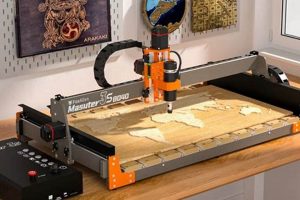
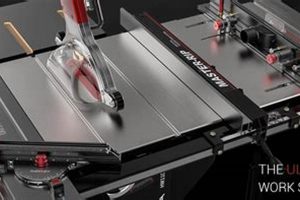
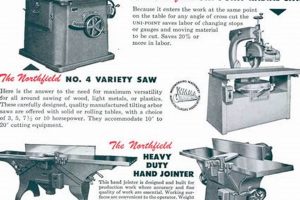
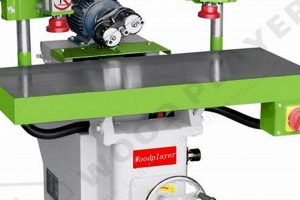
These tools represent a synthesis of multiple stationary woodworking machines into a single unit. A common configuration integrates a jointer, planer, table saw, shaper, and mortiser, offering space efficiency for workshops with limited square footage. For example, a model may allow a user to flatten a board face on the jointer, then immediately plane it to the desired thickness without moving to a separate machine.
The significance of such multi-functionality lies in its ability to reduce capital investment and spatial demands, making advanced woodworking capabilities accessible to hobbyists and small professional shops. Historically, individual machines were the standard, requiring substantial floor space and potentially higher initial costs. The advent of these integrated systems democratized access to a wider range of woodworking processes.
This article will explore the various configurations available, delve into the operational characteristics of each integrated function, discuss factors influencing purchase decisions, and address maintenance considerations crucial for ensuring longevity and optimal performance of these versatile systems.
Operating Combination Woodworking Machinery
Effective and safe use requires a thorough understanding of operational procedures and safety protocols. The following tips aim to optimize workflow and minimize potential hazards.
Tip 1: Prioritize safety measures. Always wear appropriate personal protective equipment, including safety glasses, hearing protection, and dust masks, during operation.
Tip 2: Conduct a pre-operation check. Before starting any function, inspect blades, fences, and guards for proper alignment and condition. Damaged components should be addressed immediately.
Tip 3: Adhere to feed rate recommendations. Overly aggressive feed rates can overload the motor, compromise cut quality, and increase the risk of kickback. Maintain a consistent and manageable pace.
Tip 4: Securely clamp or hold workpieces. Utilize appropriate clamping devices or push sticks to maintain control of the material, particularly when working with small or irregularly shaped items.
Tip 5: Understand function transition procedures. Changing between functions requires careful attention. Ensure all relevant locks and adjustments are correctly set before powering on the machine.
Tip 6: Regularly clean and maintain the machinery. Dust and debris accumulation can impede performance and contribute to wear. Follow the manufacturer’s recommended maintenance schedule.
Tip 7: Familiarize yourself with the machine’s limitations. Each function has specific capacity limits. Avoid attempting cuts or operations beyond the machine’s designed capabilities.
Adhering to these guidelines ensures efficient operation, minimizes safety risks, and extends the lifespan of this versatile equipment. Proper technique leads to higher quality output and a safer woodworking environment.
The following sections will delve into specific aspects of maintenance and troubleshooting common issues, providing a comprehensive guide for owners and operators.
1. Space efficiency

Space efficiency is a paramount concern for woodworkers, particularly those operating in environments with limited square footage. The inherent design of woodworking combination machines directly addresses this challenge, offering a consolidated solution for multiple woodworking processes.
- Reduced Footprint
Combination machines integrate several functionssuch as sawing, jointing, planing, and shapinginto a single unit. This consolidation drastically reduces the overall footprint required compared to owning individual machines for each process. For instance, a five-function machine might occupy the space of one or two dedicated machines, freeing up valuable workshop area for material storage or assembly.
- Optimized Workflow
Efficient workflows are crucial in woodworking. With a combination machine, the proximity of different functions streamlines the transition between operations. A user can joint a board and immediately plane it without moving to another part of the shop, saving time and reducing the risk of damaging the workpiece. This optimization is particularly beneficial in confined spaces where maneuvering large boards between machines can be cumbersome.
- Vertical Integration
Combination machines often utilize vertical integration to further maximize space. Functions like the shaper and mortiser might share the same spindle, allowing for a compact design. By stacking functions or utilizing shared components, these machines minimize horizontal sprawl and make efficient use of the available vertical space.
- Adaptability to Small Workshops
Small workshops, often found in garages or basements, typically struggle with limited space. Combination machines are specifically advantageous in these environments. The ability to perform multiple functions within a small area allows hobbyists and small-scale professionals to engage in a wider range of woodworking projects without the need for a large dedicated workspace. This adaptability contributes to the democratization of woodworking, making advanced techniques accessible to a broader audience.
The space-saving design inherent in woodworking combination machines significantly enhances workshop efficiency and practicality, especially in environments where spatial limitations are a primary concern. This advantage not only optimizes workflow but also broadens the range of woodworking possibilities for users working within constrained spaces.
2. Cost-effectiveness

The economic advantages inherent in acquiring woodworking combination machines stem from several interrelated factors. The primary driver is the reduction in capital expenditure compared to purchasing individual stationary machines. A single multi-function unit, despite its higher initial price compared to a basic tool, invariably costs less than acquiring separate jointer, planer, table saw, shaper, and mortiser machines. This initial saving directly impacts the overall cost-effectiveness of equipping a workshop.
Beyond the initial purchase, further savings accrue through reduced operational and maintenance costs. A single motor drives multiple functions, lowering electricity consumption relative to running several individual machines concurrently. Maintenance is simplified, as there is only one unit to service, reducing both the time and expense associated with upkeep. For example, lubricating one set of bearings and aligning a single fence impacts multiple functions, streamlining the maintenance process.
However, the cost-effectiveness equation is not without caveats. Combination machines often represent a compromise in performance compared to dedicated machines, particularly in terms of robustness and specialized capabilities. In demanding professional environments requiring continuous, high-precision operation, the limitations of a combination unit may outweigh the initial cost savings. Nonetheless, for hobbyists and small-scale professional shops where space is at a premium and diverse woodworking tasks are required, the cost-effectiveness of woodworking combination machines remains a significant and practical advantage, enabling a broader range of capabilities within a constrained budget.
3. Versatile functionality

Versatile functionality is a defining characteristic of woodworking combination machines, enabling a range of woodworking operations to be performed using a single unit. This multi-faceted capability significantly expands the potential applications and project diversity achievable within a limited workshop space.
- Integrated Operations
The primary embodiment of versatile functionality lies in the integration of multiple distinct woodworking processes into a single machine. Commonly, these include jointing, planing, sawing, shaping, and sometimes mortising. This integration allows for seamless workflow transitions between different stages of a woodworking project. For example, a user can flatten one face of a board using the jointer, then immediately plane the opposite face to a specific thickness, all without moving to a separate machine.
- Material Processing Range
Versatile functionality extends to the variety of materials that can be processed. Woodworking combination machines can handle hardwoods, softwoods, and engineered wood products such as plywood and MDF. This adaptability makes them suitable for a wide array of projects, from constructing furniture to creating intricate moldings and trim. The ability to work with different materials enhances the machine’s overall utility and expands the creative possibilities for the woodworker.
- Adaptability to Project Scale
Woodworking combination machines accommodate projects of varying scales. While larger, more complex projects might benefit from the use of dedicated, industrial-grade machines, these integrated units are well-suited for smaller to medium-sized projects often undertaken by hobbyists and small professional workshops. The ability to perform multiple operations without requiring extensive setup changes makes them efficient for producing individual pieces or small batches of components.
- Compound Operations
Beyond basic woodworking operations, some combination machines offer the ability to perform compound cuts and operations. This can include angled cuts on the table saw, complex shaping profiles, and specialized joinery techniques. The inclusion of these advanced capabilities further enhances the machine’s versatility, allowing for the creation of intricate designs and complex structural elements. The potential for compound operations increases the creative range and precision achievable with a single machine.
The versatile functionality of woodworking combination machines provides a distinct advantage in workshops where space, budget, and project diversity are key considerations. By integrating multiple operations into a single unit, these machines offer a practical and efficient solution for a wide range of woodworking tasks, enabling both hobbyists and professionals to maximize their creative potential within their operational constraints. The machine’s ability to adapt to different materials, project scales, and complex operations makes it a versatile and valuable asset in any woodworking setting.
4. Operational complexity
The inherent integration of multiple functions within woodworking combination machines introduces a degree of operational complexity absent in single-purpose tools. This complexity arises from several factors, including the need to master multiple machining processes, understand interdependent adjustments, and adhere to intricate safety protocols applicable across different operations. For example, transitioning from jointing to planing often requires recalibrating the fence and adjusting blade heights, demanding precision and familiarity with the machine’s mechanics. Failure to properly execute these adjustments can lead to inaccuracies and potentially hazardous situations.
This operational complexity directly impacts the learning curve for new users. Unlike dedicated machines where focus is concentrated on a single process, operators of combination machines must develop proficiency in jointing, planing, sawing, shaping, and potentially mortising. The interdependence of adjustments further complicates the process; a slight misalignment in one function can propagate errors to subsequent operations. Safety protocols also become more nuanced, requiring a comprehensive understanding of safe practices for each individual function integrated within the machine. In a professional setting, this necessitates thorough training and adherence to strict operational guidelines.
Addressing this complexity requires a structured approach to learning and operation. Manufacturers typically provide detailed manuals outlining step-by-step procedures for each function. Hands-on training and mentorship from experienced users can further accelerate the learning process. Furthermore, consistent adherence to safety checklists and pre-operation inspections is crucial for mitigating risks associated with the machine’s multifaceted nature. While operational complexity represents a significant consideration, the benefits of space efficiency and versatile functionality often outweigh this challenge for users willing to invest the time and effort required to master the intricacies of woodworking combination machines.
5. Maintenance requirements

The longevity and accuracy of woodworking combination machines are inextricably linked to diligent adherence to maintenance protocols. Unlike single-function equipment, these integrated systems require comprehensive maintenance encompassing all constituent processes jointing, planing, sawing, shaping, and potentially mortising. Neglecting maintenance on any one function can compromise the overall performance of the entire unit, leading to inaccuracies, decreased efficiency, and accelerated wear. For instance, a dull blade on the table saw component not only produces inferior cuts but also places undue stress on the motor, potentially affecting the other integrated functions.
Specific maintenance tasks include regular cleaning to remove sawdust and debris accumulation, lubrication of moving parts to minimize friction and prevent corrosion, and periodic inspection and adjustment of blades, fences, and bearings to ensure proper alignment and functionality. Real-world examples illustrate the practical significance of these tasks. A jointer with misaligned knives will produce uneven surfaces, impacting subsequent planing operations. Similarly, a shaper with worn bearings will generate vibrations that compromise cut quality and potentially damage the workpiece. A neglected mortising attachment can lead to inaccurate joinery and structural instability in finished projects. The interconnected nature of these functions necessitates a holistic maintenance approach.
In summary, the maintenance requirements of woodworking combination machines are not merely procedural but are integral to their sustained performance and reliability. By implementing a proactive maintenance schedule encompassing all functions, operators can mitigate potential problems, ensure accurate and efficient operation, and extend the lifespan of these complex and versatile tools. Recognizing the interconnectedness of each function and the corresponding maintenance needs is crucial for maximizing the investment in woodworking combination machinery and achieving consistent, high-quality results. The machine’s maintenance requirements must be fulfilled to avoid its degradation, and it is a critical aspect to consider during any procurement process.
Frequently Asked Questions
The following section addresses common inquiries regarding woodworking combination machines, providing factual information to assist potential buyers and current owners.
Question 1: What is the typical lifespan of woodworking combination machines?
Lifespan is heavily influenced by usage frequency, maintenance practices, and the overall quality of the machine. With proper care and moderate use, a well-constructed unit can provide reliable service for ten years or more. Neglecting maintenance or subjecting the machine to excessive workloads will significantly shorten its operational life.
Question 2: Can woodworking combination machines achieve the same level of precision as dedicated machines?
While capable of producing accurate results, combination machines generally do not reach the same level of precision and robustness as specialized, single-function machines. The inherent design compromises necessary to integrate multiple functions can limit their ability to handle demanding tasks requiring extremely tight tolerances. Factors that influence woodworking combination machine precision include the quality of its components, its age, and its condition.
Question 3: What is the recommended power supply for woodworking combination machines?
Power requirements vary depending on the machine’s size and the number of integrated functions. Smaller units may operate on standard 120V circuits, while larger, more powerful machines typically require 220V or 240V connections. Consult the manufacturer’s specifications to determine the appropriate power supply and ensure compliance with local electrical codes.
Question 4: How frequently should woodworking combination machines be serviced?
Servicing frequency depends on usage intensity. For moderate use, a thorough inspection and lubrication should be performed at least every six months. Heavy users should consider quarterly servicing. This includes checking blade sharpness, belt tension, bearing condition, and overall alignment. Regular maintenance is important for optimal performance.
Question 5: What are the most common problems encountered with woodworking combination machines?
Common issues include motor overheating, belt slippage, blade misalignment, and fence instability. These problems often stem from overloading the machine, inadequate maintenance, or component wear. Timely diagnosis and repair are essential to prevent further damage and maintain safe operating conditions.
Question 6: Are woodworking combination machines suitable for professional woodworking shops?
Suitability depends on the shop’s specific needs and workflow. Combination machines can be a viable option for small professional shops where space is limited and project demands are diverse. However, larger, high-volume operations may find dedicated machines more efficient and robust for specialized tasks. Professional environments often look for machines that offer efficiency. High-precision is also important.
This FAQ section provides fundamental guidance regarding woodworking combination machines. Further research and consultation with experienced users are recommended for making informed decisions.
The following sections delve into specific considerations for selecting the appropriate combination machine based on individual needs and budget constraints.
Conclusion
This exploration of woodworking combination machines has illuminated their multifaceted nature. The analysis has encompassed their space-saving attributes, cost-effectiveness, versatile functionality, operational complexities, and essential maintenance requirements. These attributes collectively define their utility within the woodworking landscape. Understanding these aspects is crucial for potential owners and current operators alike.
Ultimately, the decision to invest in woodworking combination machines hinges on a careful evaluation of individual needs, spatial constraints, budgetary limitations, and technical expertise. While these machines offer a compelling solution for maximizing efficiency in smaller shops, their inherent compromises necessitate a thorough understanding of their capabilities and limitations. Continued adherence to best practices and diligent maintenance will ensure longevity and optimal performance. The future of woodworking combination machines lies in the continuous refinement of their design and the incorporation of technological advancements to further enhance their precision, ease of use, and overall value proposition.