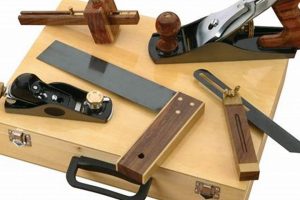
The convergence of additive manufacturing and traditional crafting yields customized aids designed to enhance precision and efficiency in shaping lumber. These digitally fabricated items, often composed of durable polymers, extend the capabilities of both hobbyist and professional woodworkers. Examples include specialized jigs, templates, and replacement parts tailored to specific project needs.
The adoption of these digitally created assists offers numerous advantages. It allows for the rapid prototyping of designs, enabling iterative improvements before committing to final versions. Furthermore, it facilitates the creation of tools that might be unavailable commercially, particularly for intricate or uncommon woodworking tasks. Historically, tool creation required significant metalworking skills; this process democratizes tool production, making it more accessible to individuals with limited machining experience.
Subsequent sections will delve into the diverse applications, material considerations, design principles, and future trends associated with this evolving intersection of digital fabrication and the time-honored art of shaping wood.
Tips for Utilizing Digitally Fabricated Aids in Woodworking
Optimizing the integration of additive manufacturing outputs into woodworking practices requires careful consideration of material properties, design constraints, and application-specific requirements. The following tips offer guidance on maximizing the effectiveness of these tools.
Tip 1: Material Selection is Paramount. Not all filaments are created equal. PLA is suitable for low-stress applications, while PETG offers greater durability and chemical resistance. ABS provides increased heat resistance, but requires specialized printing equipment. Consider the environmental factors and forces the tool will encounter.
Tip 2: Prioritize Design for Printability. Overhangs exceeding 45 degrees often require support structures, which can be difficult to remove cleanly. Orient parts to minimize support material and maximize layer adhesion along critical stress points.
Tip 3: Calibrate Printer Settings for Dimensional Accuracy. Precise calibration ensures that the finished component conforms to the intended design. This is crucial for jigs and fixtures that require tight tolerances. Print test pieces and measure their dimensions before committing to a final print.
Tip 4: Implement Infill Strategies for Strength. While 100% infill yields the strongest parts, it consumes significantly more material and time. Explore various infill patterns (e.g., gyroid, honeycomb) and densities to optimize the strength-to-weight ratio.
Tip 5: Post-Processing Enhances Durability. Sanding, painting, or coating digitally manufactured items can improve their surface finish, wear resistance, and aesthetic appeal. Consider applying a sealant to prevent moisture absorption, particularly for tools used outdoors.
Tip 6: Reinforce Critical Areas. For components subjected to high stress, consider incorporating metal inserts or reinforcing fibers during the design process. This can significantly enhance the tool’s load-bearing capacity and longevity.
Tip 7: Design with Ergonomics in Mind. Consider the user’s comfort and safety when designing handles, grips, and other contact points. A well-designed tool reduces fatigue and improves precision.
By adhering to these recommendations, woodworkers can effectively leverage the benefits of digitally manufactured aids, enhancing their workflow and expanding their creative possibilities. Careful planning and execution are essential to achieving optimal results.
The subsequent section will explore specific project examples, illustrating the practical application of these tips in various woodworking scenarios.
1. Material Durability

Material durability is a primary determinant of the utility and longevity of digitally fabricated woodworking instruments. The physical properties of the polymer used in the printing process directly influence the tool’s resistance to wear, impact, and environmental degradation, all critical factors in a woodworking environment. Lower durability translates to premature failure, necessitating frequent replacements and undermining the cost-effectiveness of additive manufacturing. Conversely, selecting materials with appropriate strength, hardness, and resistance to solvents or moisture ensures the tools can withstand repeated use and maintain their dimensional accuracy over time. For example, a jig printed with PLA may deform or break under the pressure of repeated clamping, while a PETG or ABS alternative could provide sufficient structural integrity for the same application.
The selection of material also affects the design considerations of woodworking 3D-printed tools. A more durable material allows for thinner profiles and lighter designs, while a less durable material may require increased wall thickness and internal support structures to compensate for its weaknesses. Real-world applications demonstrate the significance of this connection. A 3D printed plane handle made of high-impact nylon can endure the rigors of daily use, whereas a similar handle made of standard PLA would likely crack or break under the same stress. Similarly, jigs and fixtures that are exposed to moisture or solvents, such as those used in finishing processes, should be manufactured from materials resistant to chemical degradation.
In summary, material durability represents a critical aspect of successfully incorporating 3D-printed tools into woodworking practices. Neglecting this consideration can lead to ineffective tools that compromise safety, efficiency, and project outcomes. By carefully evaluating material properties and aligning them with the intended application, woodworkers can maximize the benefits of additive manufacturing and create durable, reliable tools that enhance their craft.
2. Design Precision

Design precision constitutes a critical element in the efficacy of woodworking 3d printed tools. The dimensional accuracy and geometric fidelity of the digital model directly translate into the functionality and usability of the physical object. Inaccurate designs can lead to improperly fitting jigs, templates, or fixtures, compromising the accuracy of cuts, joints, and assemblies. Consequently, adherence to precise design principles is paramount for achieving reliable and repeatable results in woodworking applications.
The capabilities of additive manufacturing enable the creation of intricate geometries and complex internal structures that would be challenging or impossible to produce using traditional methods. However, this potential is only realized when the design process prioritizes precision. For instance, a 3D-printed dovetail jig requires extreme accuracy in the angles and dimensions of the dovetail pins and sockets. Even slight deviations from the intended design can result in loose-fitting or overly tight joints, diminishing the structural integrity and aesthetic appeal of the finished piece. Similarly, custom-designed clamps and work-holding devices necessitate precise tolerances to securely grip workpieces without causing damage. Sophisticated CAD/CAM software and careful attention to detail during the design phase are therefore essential for maximizing the benefits of 3D-printed tools in woodworking.
In conclusion, design precision forms the foundation upon which successful woodworking 3d printed tools are built. By prioritizing accuracy and meticulous attention to detail in the design process, woodworkers can leverage the capabilities of additive manufacturing to create high-performance aids that enhance their craftsmanship and improve the quality of their projects. The inherent challenges associated with achieving and maintaining design precision underscore the importance of employing appropriate tools, techniques, and quality control measures throughout the entire workflow.
3. Functional Adaptability
Functional Adaptability, in the context of woodworking and 3D-printed tools, refers to the capacity of these tools to be modified, customized, and repurposed to suit a wide range of woodworking tasks and project-specific requirements. This adaptability is a key advantage of leveraging additive manufacturing in the realm of woodworking, enabling artisans and craftsmen to overcome limitations imposed by conventional, fixed-function implements.
- Customization for Unique Projects
The primary facet of Functional Adaptability lies in the ability to tailor tools to specific projects. Unlike standardized tools, 3D-printed solutions can be designed to accommodate unusual shapes, dimensions, or joinery techniques. For example, a custom-designed jig can be created to precisely cut a specific angle for a one-off architectural trim, or a specialized clamp can be produced to hold an oddly shaped workpiece during gluing. This level of customization reduces the need for improvisational workarounds and enhances precision in complex woodworking endeavors.
- Modification of Existing Tools
Another aspect of this adaptability involves the modification and augmentation of existing tools. 3D-printed components can be used to improve the ergonomics of a hand plane, create a custom fence for a miter saw, or add dust collection capabilities to a power tool. By integrating 3D-printed elements, woodworkers can enhance the functionality and versatility of their existing equipment, extending its lifespan and reducing the need for costly replacements. Furthermore, broken or missing parts can often be replicated, avoiding costly downtime or equipment replacement.
- Rapid Prototyping and Iteration
Functional Adaptability also encompasses the ease with which 3D-printed tools can be prototyped and iterated upon. Designs can be quickly tested, refined, and modified based on real-world performance, allowing woodworkers to optimize their tools for specific tasks. This iterative process facilitates the development of highly specialized tools that are perfectly suited to the user’s individual needs and preferences. Traditional methods of tool design and fabrication often involve significant time and expense, making rapid prototyping impractical. Additive manufacturing removes these barriers, enabling a more agile and responsive approach to tool development.
- Multi-Functionality and Reconfigurability
The ability to design tools with multiple functions or to easily reconfigure them for different tasks represents another dimension of Functional Adaptability. A 3D-printed jig could be designed with interchangeable inserts to accommodate different sizes of lumber or varying joint types. Similarly, a clamping system could be designed with modular components that can be rearranged to suit a wide range of workpiece geometries. This multi-functionality reduces the overall number of tools required and streamlines the woodworking process by minimizing the need for tool changes and adjustments.
These facets collectively underscore the significant impact of Functional Adaptability on the realm of woodworking. By leveraging the capabilities of 3D printing, woodworkers can transcend the limitations of traditional tools and create customized solutions that enhance precision, efficiency, and creativity in their craft. The ongoing development of new materials and additive manufacturing techniques further expands the possibilities for Functional Adaptability, ensuring that 3D-printed tools will continue to play an increasingly important role in the future of woodworking.
4. Cost Effectiveness
The relationship between additive manufacturing and woodworking hinges significantly on cost-effectiveness. While the initial investment in a 3D printer and associated materials may represent a barrier to entry, the potential for long-term savings and enhanced efficiency can offset these upfront costs. Custom jigs, templates, and replacement parts can be produced on demand, potentially eliminating the need to purchase expensive specialized tools or wait for lengthy shipping times. For instance, a complex molding profile bit for a router, which might cost hundreds of dollars commercially, can be replicated for a fraction of that cost using appropriate materials and a well-calibrated printer. Furthermore, the capacity to rapidly prototype designs allows for iterative improvements before committing to final production, minimizing material waste and reducing the likelihood of costly errors in the woodworking process.
However, a comprehensive cost analysis requires consideration of several factors beyond material expenses. Print time, electricity consumption, and the labor involved in designing, printing, and finishing the tools must also be factored into the equation. The lifespan of 3D-printed tools, influenced by the material chosen and the application, is another critical variable. A tool that requires frequent replacement diminishes its cost-effectiveness, necessitating the use of more durable but potentially more expensive materials. Moreover, the cost savings are most pronounced when producing custom or specialized tools that are difficult or impossible to acquire commercially. For standardized tools readily available at reasonable prices, additive manufacturing may not offer a significant cost advantage. A real-world example of woodworking 3d printed tools’s cost effectiveness would be the frequent breakage of small plastic parts of a vintage woodworking machine. Replacement parts are not generally available and if you can find it it would be expensive. With 3d printed parts its a few dollars on material.
In conclusion, the cost-effectiveness of additive manufacturing in woodworking is not a given but rather a nuanced assessment dependent on specific applications and a thorough understanding of the associated costs and benefits. The technology offers the potential to reduce expenses, enhance efficiency, and enable customization. Careful consideration of material selection, design optimization, and production volume is crucial for realizing the economic advantages of this approach. While not a universal solution, 3D-printed tools represent a viable and increasingly compelling option for woodworkers seeking to improve their workflow and reduce their overall costs.
5. Workflow Integration
The seamless incorporation of woodworking 3d printed tools into existing workshop practices is paramount to realizing their full potential. Effective workflow integration dictates how easily these tools can be adopted, used, and maintained within the context of established procedures. Disruptions to workflow, caused by inefficient tool design or cumbersome implementation, can negate the benefits of customization and cost savings. Therefore, the design and selection of digitally fabricated aids should prioritize compatibility with current equipment, familiar techniques, and the overall organizational structure of the workspace.
Several factors contribute to successful workflow integration. Tool designs should minimize the learning curve required for operation. For example, a 3D-printed jig designed to replace a traditional hand-cut method should offer comparable or improved ease of use and accuracy. Material selection should also align with existing shop practices; choosing filaments that require specialized handling or disposal procedures can introduce unnecessary complexity. Real-world applications showcase the importance of this consideration. A custom clamp designed for intricate joinery, while offering superior precision, may prove impractical if its assembly and adjustment processes are overly complex, thereby slowing down the overall project timeline. Conversely, a well-designed 3D-printed template that simplifies a repetitive cutting task can significantly accelerate production, leading to tangible improvements in efficiency. A simple example is a replacement fence for an old bandsaw, 3d printed instead of fabricated out of metal allows it to be attached and ready to go quicker.
In conclusion, the successful integration of woodworking 3d printed tools into a workshop environment depends on careful planning and execution. By prioritizing compatibility with existing processes, minimizing the learning curve, and selecting materials that align with established practices, woodworkers can unlock the full potential of additive manufacturing and realize tangible gains in efficiency, accuracy, and cost-effectiveness. Addressing the challenges of workflow integration is crucial for transforming digitally fabricated aids from novelties into indispensable components of the modern woodworking shop.
Frequently Asked Questions
This section addresses common inquiries and concerns regarding the application of additive manufacturing in woodworking, offering concise and informative responses.
Question 1: What is the typical lifespan of a 3D-printed woodworking tool?
The lifespan varies significantly based on the material, design, and application. Tools made from durable filaments like PETG or nylon, and used within their design parameters, can last for extended periods. However, tools subjected to high stress or made from less robust materials may require more frequent replacement.
Question 2: Are woodworking 3d printed tools as strong as their metal counterparts?
Generally, no. Polymers possess lower tensile strength and hardness compared to metals. However, strategic design, material selection, and reinforcement techniques can enhance the strength and durability of 3D-printed tools, making them suitable for a wide range of woodworking tasks.
Question 3: What types of 3D printers are best suited for creating woodworking tools?
Fused Deposition Modeling (FDM) printers are the most common and cost-effective option. Printers with heated beds and enclosed build chambers offer greater material compatibility and dimensional accuracy.
Question 4: Are there safety considerations specific to using 3D-printed tools in woodworking?
Yes. Ensure the tool’s design is robust and appropriate for the intended task. Avoid using 3D-printed tools in situations where failure could pose a significant safety risk. Regularly inspect the tool for signs of wear or damage, and replace it as needed. Consider using eye protection during operation.
Question 5: Can 3D-printed tools be used with power tools?
Yes, but with caution. Exercise extreme care when using 3D-printed components with power tools. Ensure the tool is securely attached and can withstand the forces generated by the power tool. Regularly inspect the component for any signs of damage or deformation. The material used must withstand the heat generated from the power tool.
Question 6: Where can one find designs for woodworking 3D printed tools?
Numerous online repositories, such as Thingiverse and MyMiniFactory, offer a wide selection of free and paid designs. Additionally, CAD software allows for the creation of custom designs tailored to specific needs.
In summary, woodworking 3D printed tools present a viable and adaptable solution for enhancing various aspects of the craft. Thoughtful design, material selection, and careful implementation are essential for maximizing their effectiveness and ensuring user safety.
The following section explores advanced design considerations and emerging trends in this rapidly evolving field.
Conclusion
This exploration has illuminated the multifaceted utility of woodworking 3d printed tools. From material selection and design precision to functional adaptability, cost-effectiveness, and workflow integration, each facet plays a critical role in determining the suitability and success of additive manufacturing in this craft. The capacity to customize tools, create intricate geometries, and rapidly prototype designs offers significant advantages over traditional methods, empowering woodworkers to achieve new levels of precision, efficiency, and creativity.
As additive manufacturing technology continues to advance and new materials become available, the potential of woodworking 3d printed tools will only expand. Further research and development are necessary to optimize material properties, improve design methodologies, and address safety concerns. Woodworkers are encouraged to critically evaluate the benefits and limitations of this technology and to contribute to its ongoing evolution through experimentation and innovation. The thoughtful and informed adoption of woodworking 3d printed tools promises to shape the future of woodworking, fostering a more dynamic and adaptable craft.