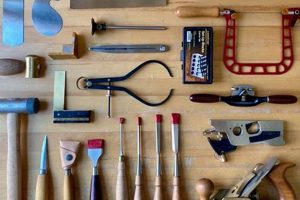
Implements utilized in the craft of shaping wood within Japan are known for their distinctive design and functionality. An example is a pull saw, engineered to cut on the pull stroke, allowing for thinner blades and cleaner cuts compared to Western counterparts. These implements are often crafted with laminated steel, resulting in a hard, durable cutting edge with a softer, more flexible backing.
Their significance lies in their precision and efficiency, contributing to the creation of intricate joinery and aesthetically pleasing wooden structures. The tools reflect a long history of woodworking tradition, emphasizing harmony with nature and the inherent qualities of the material. This approach results in minimal waste and maximizes the wood’s natural beauty.
The following sections will delve into specific types of these implements, exploring their unique characteristics and applications within traditional and contemporary woodworking practices. The discussion will also cover maintenance techniques and considerations for selecting appropriate implements for various projects.
Tips on Using Japanese Woodworking Implements
The effective utilization of Japanese woodworking implements requires an understanding of their unique design and application. The following tips aim to improve efficiency and precision when working with these tools.
Tip 1: Sharpen Regularly: Frequent honing is crucial. The performance of Japanese woodworking implements depends heavily on maintaining a keen edge. Use appropriate sharpening stones and angles for each tool.
Tip 2: Master the Pull Stroke: Most are designed to cut on the pull stroke. This technique minimizes bending of the blade and provides better control. Avoid excessive force; let the sharpness of the blade do the work.
Tip 3: Use Proper Stance and Grip: Maintain a stable stance and grip the tool firmly but comfortably. A relaxed grip allows for more natural movement and reduces fatigue.
Tip 4: Prepare the Wood Properly: Ensure the wood is adequately seasoned and free from excessive knots or defects. Proper preparation enhances the effectiveness of the tool and reduces the risk of damage.
Tip 5: Avoid Forcing the Cut: If resistance is encountered, reassess the angle and pressure. Forcing the cut can lead to inaccurate results, blade damage, or injury.
Tip 6: Protect Blades During Storage: When not in use, protect the blades with appropriate sheaths or storage solutions to prevent rust and damage. A well-maintained tool lasts longer and performs better.
Tip 7: Learn About Different Tool Types: Understand the specific purpose of each. Using the correct tool for a task improves efficiency and prevents damage to the tool or the workpiece. Research different saw types, planes, and chisels to select the best implement for each job.
Effective application relies on consistent practice and a dedication to understanding the intricacies of each implement. Proper technique, meticulous maintenance, and a deep appreciation for the craft will lead to superior results.
The subsequent sections will explore advanced techniques and applications within specific woodworking projects. Continue reading to expand your understanding and proficiency with Japanese woodworking implements.
1. Blade Steel Composition

The composition of steel in Japanese woodworking tools is a critical factor determining their performance characteristics, durability, and overall quality. The methods employed in creating and combining different steels reflect centuries of refinement and contribute significantly to the tool’s effectiveness.
- Lamination Techniques
Japanese blades often utilize lamination, combining a hard, high-carbon steel for the cutting edge with a softer, more flexible steel for the body. This approach allows for a blade that maintains a keen edge while resisting breakage. Examples include using Shirogami (white paper steel) or Aogami (blue paper steel) for the cutting edge and softer iron for the blade’s body. The lamination process directly impacts the tool’s ability to withstand stress and maintain sharpness during use.
- Hardness and Wear Resistance
The hardness of the steel directly influences the tool’s ability to cut through wood efficiently and resist wear over time. Harder steels, like those used in chisels and plane blades, maintain a sharp edge longer but are also more brittle. Achieving an optimal balance between hardness and toughness is a primary objective in selecting and treating the steel. Real-world examples include choosing Yasugi Hagane steel for its exceptional hardness and edge retention.
- Alloy Elements
The presence of specific alloy elements within the steel matrix can significantly alter its properties. Elements like chromium and tungsten contribute to increased wear resistance and toughness. Conversely, excessive amounts of certain elements can lead to brittleness. The choice of alloy elements reflects a deliberate attempt to tailor the steel’s characteristics to the specific requirements of the tool and its intended application. An example is the addition of tungsten to create high-speed steel for improved performance at higher temperatures.
- Heat Treatment Processes
The heat treatment processes applied to the steel, such as hardening and tempering, are crucial for achieving the desired mechanical properties. Precise control over temperature and timing is essential to optimize hardness, toughness, and resistance to deformation. Improper heat treatment can render even the finest steel useless. An example is the careful quenching and tempering of a chisel blade to achieve the correct balance of hardness and durability. This is a critical step to prevent brittleness or deformation during heavy use.
The interplay between lamination techniques, hardness, alloy elements, and heat treatment defines the suitability of the blade steel composition for specific Japanese woodworking tools. These factors, considered together, dictate the overall performance, longevity, and ultimately, the value of the tool in the hands of a skilled craftsman. The steel affects the overall result and the work that can be achieved.
2. Pull-cut mechanism

The pull-cut mechanism is a defining characteristic of many Japanese woodworking tools, particularly saws, differentiating them significantly from their Western counterparts. This design principle profoundly impacts the tool’s performance, accuracy, and the resulting quality of the woodworking.
- Blade Tension and Thickness
Cutting on the pull stroke places the blade in tension, rather than compression. This allows for the use of thinner blades compared to Western saws, reducing material waste and enabling finer, more precise cuts. An example is the kataba saw, used for general purpose cutting, where its thin blade allows for a narrow kerf, conserving valuable wood. This technique results in more efficient use of materials.
- Control and Accuracy
The pull stroke allows the user to maintain greater control over the cutting action. Because the user is pulling the blade towards themselves, they have a direct line of sight and tactile feedback, enabling more accurate cuts, particularly in intricate joinery. The dozuki saw, specifically designed for cutting dovetails, exemplifies this advantage, allowing for precise and clean cuts required for tight-fitting joints. User control is significantly enhanced.
- Reduced Blade Buckling
As the blade is under tension during the cut, the risk of buckling or bending is minimized. This enhances the stability of the blade and contributes to straighter, more consistent cuts, especially over longer distances. The ryoba saw, with its blades for both ripping and crosscutting, demonstrates this stability, as its design resists deflection, facilitating long, straight cuts along the grain of the wood. Blade integrity is maintained due to the tension.
- Ergonomics and User Experience
The pull-cut mechanism often leads to a more ergonomic and less fatiguing experience for the user. The natural pulling motion engages larger muscle groups, distributing the effort and reducing strain on the wrist and forearm. This allows for longer periods of continuous work with reduced discomfort. The reduced physical exertion contributes to improved work satisfaction.
The pull-cut mechanism, therefore, is not merely a design choice but a fundamental element shaping the overall performance and user experience associated with many Japanese woodworking tools. Its influence extends to blade thickness, cutting accuracy, blade stability, and user ergonomics, collectively contributing to the precision and efficiency that characterize Japanese woodworking techniques. These elements enhance the results of woodworking projects.
3. Ergonomic Handle Design

Handle design significantly influences the usability and efficiency of Japanese woodworking tools. The ergonomic considerations inherent in these designs reflect a deep understanding of human biomechanics and the demands of woodworking tasks. Handle design contributes directly to precision, control, and reduced user fatigue.
- Material Selection and Texture
The selection of materials, such as Japanese white oak (Shiro Kashi) or red oak, influences grip and vibration dampening. Textured surfaces or carefully applied finishes enhance grip security, particularly during prolonged use. Smooth, rounded edges prevent discomfort and hotspots. These material choices support both control and comfort during operation of the woodworking tool.
- Shape and Contouring
Handle shapes are often contoured to fit the natural curves of the hand, distributing pressure evenly and reducing strain. Tapered designs, for example, can provide a secure grip while allowing for subtle adjustments in hand position. The shape contributes to efficient force transmission and minimizes the risk of slippage. These shapes, therefore, facilitate a secure hold for the user.
- Balance and Weight Distribution
The distribution of weight between the handle and the tool’s working end is carefully considered to optimize balance and control. A well-balanced tool requires less effort to maneuver and reduces the risk of accidental movements. This is particularly crucial for tools used in precision tasks, such as joinery. This balance enhances user experience and accuracy.
- Length and Orientation
Handle length is often determined by the tool’s intended use and the range of motion required. Longer handles may provide increased leverage, while shorter handles offer greater maneuverability in confined spaces. The orientation of the handle relative to the blade or cutting edge also influences the tool’s ergonomics. Optimal length and orientation facilitates various woodworking tasks.
These considerations underscore the importance of ergonomic handle design in optimizing the performance of Japanese woodworking tools. The combination of material selection, shape, balance, and orientation contributes to tools that are not only effective but also comfortable and safe to use, enhancing the overall woodworking experience. Ergonomics is critical to the functionality of these tools.
4. Specialized tool types

The diversity of Japanese woodworking tools stems from a focus on highly specialized implements designed for specific tasks. This specialization arises from a tradition emphasizing precision and efficiency in woodworking, where each tool is engineered to perform a limited set of operations with unparalleled accuracy. Consequently, understanding the nuances of these specialized tools is paramount to appreciating the broader category of Japanese woodworking implements. An example of this is the Dozuki saw, designed specifically for cutting dovetails. The thin blade and stiff spine allow for exceptionally fine and precise cuts, essential for tight-fitting joinery. The Dozuki‘s design is not suited for general purpose sawing, highlighting its focused application. The impact is efficient, and accurate working process.
Another illustration is the Kanna, or Japanese hand plane. Variations of the Kanna exist for different purposes, such as smoothing, flattening, or creating decorative moldings. Each variant possesses distinct blade angles, body shapes, and adjustment mechanisms optimized for its intended task. A smoothing plane ( Tsuyakesenn) will have a steeper blade angle than a roughing plane ( Ara Kanna), demonstrating the tailored design approach. This is a clear indicator of the importance given to the specialization that creates best tool for the job. This specialization is an important component that contribute to the development of Japanese Woodworking Tool.
In summary, the concept of specialized tool types is integral to understanding implements used in Japan to shape wood. Each tool is carefully engineered for a specific purpose, optimizing performance for that particular task. This dedication to specialization reflects a broader philosophy of precision and efficiency within the craft, contributing to the quality and beauty of Japanese woodworking. The challenges of mastering these tools are counterbalanced by the enhanced capabilities they offer. Recognizing the specialized nature of these tools is crucial to effectively utilizing and appreciating the broader range of implements.
5. Sharpening methodology

The sharpening methodology applied to implements used for shaping wood in Japan is inextricably linked to their design and performance. The high-carbon steel often utilized requires precise sharpening techniques to achieve and maintain optimal cutting edges. Failure to adhere to specific sharpening protocols can negate the benefits of the tool’s design and materials. For instance, the laminated construction of many blades necessitates careful attention to avoid uneven wear on the hard steel cutting edge relative to the softer steel body. This care is essential to maintaining performance and tool integrity.
The process typically involves a progression through a series of water stones of increasing grit, culminating in a polished edge of exceptional sharpness. The use of water as a lubricant is critical, preventing heat buildup and facilitating the removal of minute particles during abrasion. Specialized jigs and honing guides may be employed to ensure consistent angles and minimize the risk of over-sharpening or rounding the edge. The practical application is evident in the consistently clean and precise cuts achieved by skilled artisans. Maintaining the edge ensures the intended cuts as well as preventing damage and unnecessary tool wear.
In summary, understanding the appropriate sharpening methodology is not merely an ancillary skill but a fundamental component of effectively using Japanese woodworking tools. The unique steel composition and blade geometry demand meticulous attention to detail during the sharpening process. While challenging to master, the resulting sharpness and cutting performance justify the effort, contributing significantly to the overall quality and precision of woodworking projects. Neglecting or misunderstanding the sharpening process can result in suboptimal tool performance, premature wear, and ultimately, a diminished woodworking experience. Master the sharpening, master the tool.
Frequently Asked Questions
The following questions address common inquiries regarding Japanese woodworking tools, providing concise answers to assist in understanding their characteristics and usage.
Question 1: What distinguishes Japanese woodworking tools from their Western counterparts?
The primary distinction lies in the pull-cut mechanism, thinner blades, and specialized designs optimized for precision tasks. Western tools often utilize a push-cut and heavier construction.
Question 2: What is the purpose of laminated steel in Japanese blades?
Lamination combines a hard, high-carbon steel for the cutting edge with a softer steel body for flexibility and shock absorption, maximizing durability and sharpness.
Question 3: How should Japanese woodworking tools be sharpened?
Sharpening requires a progression through increasingly fine water stones, maintaining a consistent angle, and employing techniques to prevent overheating and edge rounding.
Question 4: Are Japanese woodworking tools suitable for all types of wood?
While effective on a wide variety of woods, optimal performance is achieved with properly seasoned hardwoods. Softer woods may require adjustments in technique to prevent tearing or splintering.
Question 5: What are some essential safety precautions when using Japanese woodworking tools?
Maintaining sharp blades, securing the workpiece, and using proper hand and body positioning are crucial for preventing injuries. Protective eyewear is also recommended.
Question 6: Where can authentic Japanese woodworking tools be purchased?
Reputable woodworking supply stores specializing in Japanese tools or directly from Japanese manufacturers or their authorized distributors are recommended sources.
These frequently asked questions aim to clarify key aspects. Careful consideration of these factors will contribute to a more informed approach to selecting and utilizing these tools.
The subsequent section will explore practical applications and project ideas using Japanese woodworking tools.
Conclusion
The preceding discussion has explored various facets of the implements used in Japan to shape wood. The examination included blade composition, the pull-cut mechanism, ergonomic handle design, tool specialization, and sharpening methodologies. Each aspect contributes to the performance and precision that characterizes these implements.
Mastery of requires dedicated study and practice. The commitment to understanding these unique features allows for efficient and high-quality woodworking. Continued innovation and preservation of traditional techniques will ensure that the implements remain relevant and valuable for future generations of woodworkers.