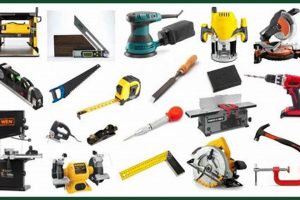
The fundamental implements required for commencing the craft of shaping wood are essential for achieving desired results and ensuring safety. These implements represent a basic collection of items that allow an individual to perform core woodworking tasks, such as cutting, shaping, joining, and finishing wood. A handsaw, for example, facilitates the initial cutting of lumber to size, while chisels enable the precise removal of material for joinery.
Possessing the correct instruments from the outset enhances the learning experience, promotes efficiency, and contributes to the production of high-quality projects. Historically, the availability of suitable instruments has been a defining factor in the evolution of woodworking techniques and the creation of intricate woodcraft. A well-equipped workspace, even a modest one, empowers the woodworker to explore their creativity and master fundamental skills.
Subsequent sections will detail the specific instruments typically included in a beginner’s inventory, focusing on their function, proper usage, and considerations for selection based on budget and project requirements. This will cover essential cutting tools, measuring and marking devices, fastening implements, and safety equipment.
Essential Advice for Acquiring Initial Woodworking Instruments
Prudent selection and usage of basic woodworking instruments are critical for successful project outcomes and personal safety. Consider the following recommendations when building a foundational tool collection.
Tip 1: Prioritize Quality over Quantity: It is generally more advantageous to acquire fewer, higher-quality tools initially, rather than a large assortment of inexpensive ones. Superior tools typically offer improved performance, durability, and accuracy.
Tip 2: Invest in Essential Safety Equipment: Protective eyewear, hearing protection, and a dust mask are indispensable. Ensure these items meet relevant safety standards and are consistently used during woodworking activities.
Tip 3: Learn Proper Sharpening Techniques: Sharp tools are safer and more efficient. Acquire the knowledge and equipment necessary to maintain a keen edge on cutting implements such as chisels and plane irons.
Tip 4: Understand Tool Functionality: Before use, thoroughly familiarize oneself with the intended purpose and operation of each tool. Incorrect usage can result in damage to the tool, the workpiece, or personal injury.
Tip 5: Start with Hand Tools: While power tools offer speed and convenience, mastering fundamental hand tool techniques provides a deeper understanding of woodworking principles and enhances precision.
Tip 6: Consider Ergonomics: Choose tools with comfortable grips and appropriate weight to minimize fatigue and strain during prolonged use. Evaluate handle materials and design for optimal handling.
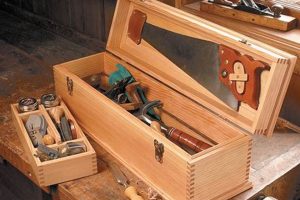
Tip 7: Develop a System for Tool Storage and Organization: A well-organized workspace promotes efficiency and safety. Implement a system for storing tools in a secure and accessible manner.
Adhering to these guidelines will facilitate a more productive and enjoyable woodworking experience. Emphasizing quality, safety, and proper technique are paramount when establishing a fundamental tool collection.
The subsequent section will explore specific tool recommendations based on common woodworking tasks, providing further guidance for building a versatile and effective set of instruments.
1. Cutting

The ability to precisely sever and shape wood fibers is fundamental to woodworking, rendering appropriate cutting implements indispensable. Therefore, a core consideration when assembling a collection of fundamental woodworking tools is the selection of effective cutting instruments. Inadequate or poorly maintained cutting tools not only impede progress but also elevate the risk of injury and compromise the quality of the final product. For example, attempting to create a tenon joint with a dull saw results in a ragged cut, necessitating excessive material removal and potentially weakening the joint. Sharp, well-chosen cutting instruments are thus a causal prerequisite for successful woodworking.
A variety of tools facilitate cutting, each suited for specific tasks. Handsaws, including crosscut saws for cutting against the grain and rip saws for cutting with the grain, offer versatility in initial stock preparation. Chisels, employed both for cutting and paring, enable the creation of precise joinery and the removal of small amounts of material. Specialized saws, such as dovetail saws and coping saws, further enhance the ability to execute intricate cuts. A beginner’s collection should include at least one general-purpose saw and a set of chisels in varying sizes to address a range of cutting needs.
In summary, cutting forms an integral element of the fundamental woodworking tool collection. The careful selection and diligent maintenance of cutting tools are vital for ensuring safety, promoting efficiency, and achieving accurate results. The challenge lies in identifying the specific cutting requirements of anticipated projects and acquiring tools that effectively address those needs while remaining within budgetary constraints. These tools form the basis of an ability to cut and work material and are the basis of woodworking as a practice.
2. Measuring
Accurate measurement constitutes a cornerstone of woodworking, without which precision and consistent results are unattainable. The selection of appropriate measuring instruments is therefore integral to the establishment of a foundational set of woodworking tools.
- Rules and Measuring Tapes
These instruments provide linear measurements for determining stock dimensions and marking cut lines. Their role is fundamental in ensuring workpieces are sized correctly prior to cutting or assembly. For instance, a rule is used to determine the length of a table leg, thereby ensuring all legs are of equal length. Inaccurate rules lead to uneven or mismatched components.
- Squares
Squares, including try squares and combination squares, facilitate the creation of right angles and the verification of squareness. These are critical for constructing square frames, ensuring drawers fit properly, and verifying the accuracy of joints. An out-of-square frame will result in structural instability and visual imperfections.
- Marking Gauges
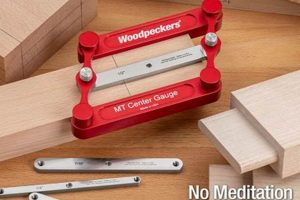
Marking gauges are used to scribe consistent parallel lines, essential for creating accurate mortise and tenon joints, rabbets, and other joinery details. These tools ensure uniformity and precision, especially in repetitive tasks. Inaccurate marking renders joints weak and prone to failure.
- Bevel Gauges
Bevel gauges are instrumental in transferring angles, whether for creating angled cuts on moldings or matching existing angles in restoration projects. Without accurate angle transfer, joinery will be misaligned and aesthetically displeasing.
The selection of appropriate measuring instruments directly influences the quality and precision of woodworking projects. Inadequate or imprecise measurement renders even the most skilled craftsmanship ineffective. The integration of accurate measuring tools within a core woodworking set is thus indispensable.
3. Fastening

The act of securing wood components to form a cohesive structure necessitates appropriate fastening implements, thereby establishing “fastening” as a critical component within “must have tools to start woodworking.” Improper or inadequate fastening jeopardizes the structural integrity of a project, potentially leading to failure. For example, a poorly secured table leg, attached with insufficient screws, is prone to instability and eventual collapse under normal use. Similarly, weakly joined cabinet components compromise the overall strength and longevity of the piece. The effectiveness of fastening directly influences the durability and functionality of the finished product. A foundation in woodworking mandates tools and techniques dedicated to reliable joining methods.
Various methods exist for securely joining wood, each requiring specific implements. Screws, driven with screwdrivers or power drills, offer a strong and relatively simple method for connecting pieces, particularly where disassembly may be required. Clamps, available in numerous styles, provide temporary holding pressure during glue-up, ensuring tight joints and preventing slippage. Nails, driven with a hammer or nail gun, offer a quick and economical fastening solution for certain applications. Wood glue, used in conjunction with mechanical fasteners or clamps, creates a powerful bond between wood surfaces. Dowels and biscuits, inserted into pre-drilled holes or slots, reinforce joints and increase surface area for glue adhesion. The specific fastening method chosen depends on the type of joint, the wood species, the intended use of the project, and aesthetic considerations. For instance, screws might be chosen for attaching a tabletop to its base, while dowels could reinforce a mortise and tenon joint in a chair leg.
In conclusion, fastening represents an indispensable aspect of woodworking. The selection of appropriate fastening methods, coupled with the possession and skillful utilization of necessary implements, determines the structural soundness and longevity of woodworking creations. Mastery of fastening techniques is thus essential for any individual seeking to engage in the craft of woodworking successfully. A well-equipped set of core instruments must incorporate appropriate options for holding, connecting, and securing pieces through all phases of production.
4. Shaping

The manipulation of wood to achieve a desired form is a fundamental aspect of woodworking, thus shaping tools constitute an integral component of any essential woodworking set. The ability to refine the profile of a workpiece, create curves, or smooth surfaces directly impacts the aesthetic appeal and functionality of the final product. Inadequate shaping tools or improper technique can result in inaccurate profiles, uneven surfaces, and compromised joinery.
- Planes
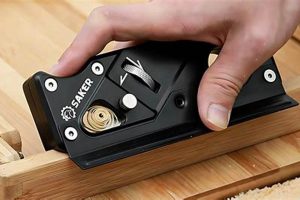
Hand planes, including block planes, smoothing planes, and jack planes, are employed to flatten surfaces, reduce thickness, and create precise profiles. These instruments allow for controlled material removal, enabling the woodworker to achieve desired dimensions and surface quality. For instance, a smoothing plane ensures a table top is uniformly flat and free of imperfections prior to finishing. A poorly tuned or misused plane results in tear-out or uneven surfaces, necessitating further remediation.
- Rasps and Files
Rasps and files are utilized for shaping curved surfaces, refining edges, and removing material in areas inaccessible to larger tools. These instruments offer a more aggressive material removal rate than sandpaper and are particularly useful for sculpting complex shapes. Shaping the armrest of a chair requires rasps and files to create a comfortable and ergonomic profile. The use of dull or inappropriate rasps and files can lead to a coarse, uneven surface requiring extensive sanding.
- Spokeshaves
Spokeshaves are specialized planes designed for shaping curved surfaces, such as chair spindles or the inside curves of a cabriole leg. These tools allow for precise and controlled material removal along curved profiles. Creating the curved legs of a Windsor chair demands skillful use of a spokeshave to achieve the desired shape and smooth finish. Improper adjustment or technique can result in faceted surfaces or uneven curves.
- Carving Tools
Carving tools, including chisels, gouges, and knives, are employed for creating decorative details and intricate designs. These instruments enable the woodworker to add aesthetic flourishes and personalize their projects. Carving a decorative element on a cabinet door requires a set of specialized carving tools and a high degree of skill. Dull or improperly sharpened carving tools pose a significant safety risk and impede the creation of fine details.
Effective shaping directly influences the aesthetic value, ergonomic properties, and overall quality of woodworking projects. The careful selection and skillful application of shaping tools are essential for achieving refined results. The tools utilized to shape can further be implemented to expand creative expressions.
5. Finishing

The application of a final protective or decorative layer, termed “finishing,” represents a crucial stage in woodworking. While often considered separate from the core construction process, finishing necessitates a specific collection of instruments and materials that, when considered holistically, form an integral part of the “must have tools to start woodworking.” Proper finishing enhances the aesthetic appeal of a project, protects the wood from environmental damage, and extends its longevity.
- Sandpaper and Abrasives
Surface preparation through sanding is essential for achieving a smooth and uniform finish. A range of sandpaper grits, from coarse to fine, is required to remove imperfections, scratches, and mill marks. The selection of appropriate grits and sanding techniques directly impacts the adhesion and appearance of subsequent finishing coats. Failure to adequately sand results in a rough, uneven finish that detracts from the overall quality of the project. The sanding block is also part of abrasives.
- Application Tools
The application of finishes, such as varnish, lacquer, or stain, necessitates brushes, spray guns, or rags. The choice of application tool depends on the type of finish being applied and the desired level of control. High-quality brushes or spray guns ensure an even and consistent coating, minimizing brush strokes or orange peel texture. A low-quality brush will shed bristles and result in an inferior result.
- Safety Gear
Many finishing products contain volatile organic compounds (VOCs) that can be harmful if inhaled. Therefore, adequate ventilation and the use of respirators or masks are critical for protecting the woodworker’s health. Furthermore, protective gloves prevent skin contact with potentially irritating or toxic chemicals. The absence of appropriate safety gear poses significant health risks during the finishing process.
- Clean-up Supplies
Solvents, rags, and containers for waste disposal are essential for cleaning brushes, spray guns, and work surfaces after finishing. Proper cleanup prevents the buildup of dried finish, which can damage equipment and contaminate future projects. The careless disposal of solvent-soaked rags poses a fire hazard.
Integrating finishing tools and supplies into the foundational woodworking inventory ensures a comprehensive approach to project completion. The effectiveness of the finishing stage directly reflects upon the overall craftsmanship and durability of the finished piece. Neglecting this phase of the project significantly diminishes the overall quality, and in some instances reduces the lifespan.
6. Safety

The incorporation of safety equipment into a core set of woodworking instruments transcends mere suggestion; it is a fundamental requirement. The inherent risks associated with woodworking, including lacerations, projectile debris, and inhalation of particulate matter, necessitate proactive measures to mitigate potential harm. This is why Safety is part of “must have tools to start woodworking”. The absence of appropriate safety tools transforms a productive activity into a hazardous undertaking. For example, operating a power saw without eye protection dramatically increases the likelihood of corneal injury from flying wood chips or debris. Failure to use hearing protection exposes the woodworker to sustained noise levels that can result in permanent hearing damage. The integration of safety tools directly reduces the probability of workplace incidents.
A foundational safety ensemble comprises, at minimum, certified safety glasses or a face shield, hearing protection (earplugs or earmuffs), and a dust mask or respirator. The specific type of respiratory protection should be selected based on the materials being worked and the level of exposure. Gloves offer protection against splinters, abrasions, and chemical irritants encountered during finishing processes. Push sticks and feather boards provide a means of guiding workpieces past cutting tools while maintaining a safe distance from the blade. Proper machine guarding, in accordance with manufacturer specifications, further reduces the risk of contact with moving parts. Furthermore, maintaining a clean and well-lit workspace minimizes the potential for slips, trips, and falls.
Prioritizing safety in woodworking extends beyond the mere acquisition of protective equipment. It entails a commitment to safe work practices, thorough tool maintenance, and a comprehensive understanding of potential hazards. The failure to recognize the inherent risks and implement appropriate preventative measures can have severe and lasting consequences. This includes eye protection, hearing, respirator and well ventilated working space. Therefore, safety represents not merely an adjunct to woodworking, but an indispensable element within the foundational tool set and the operational mindset of any woodworker.
Frequently Asked Questions
The following questions address common inquiries regarding the selection and utilization of implements for individuals commencing woodworking endeavors. Answers provided are intended to offer clarity and guidance in establishing a foundational set of tools.
Question 1: Is it possible to begin woodworking without acquiring a comprehensive collection of tools immediately?
Yes, an incremental approach is advisable. Start with a limited selection of essential implements and expand the collection as project needs and skill levels evolve. Prioritize quality over quantity in initial acquisitions.
Question 2: What constitutes the most crucial safety equipment for a beginner woodworker?
Protective eyewear, hearing protection, and a dust mask are indispensable. These items safeguard against potential hazards such as flying debris, excessive noise, and inhalation of particulate matter.
Question 3: Are power tools necessary for all woodworking projects?
No, many fundamental woodworking tasks can be accomplished effectively with hand tools. Mastering hand tool techniques provides a deeper understanding of woodworking principles and enhances precision.
Question 4: How does one determine the appropriate size and type of chisel for a specific task?
Chisel selection depends on the size and shape of the cut being made. Smaller chisels are suitable for detail work, while larger chisels are employed for removing larger amounts of material. The chisel type should match the type of work; for example, mortise chisels are specialized for creating mortises.
Question 5: What are the key considerations when selecting a hand saw?
Consider the type of cut being made (rip cut or crosscut), the thickness of the material, and the desired level of precision. A saw with finer teeth is generally preferable for precision work. A saw with larger teeth is preferable for cutting large material.
Question 6: Is it necessary to sharpen new woodworking tools before using them?
In many cases, yes. Factory edges on new tools may not be sufficiently sharp for optimal performance. Sharpening new tools ensures clean cuts and reduces the risk of injury.
The information provided addresses common concerns related to acquiring and using implements for woodworking. By focusing on safety, quality, and the gradual expansion of skills, individuals can embark on a rewarding woodworking journey.
Subsequent sections will delve into specific techniques for using these instruments to complete woodworking projects.
Conclusion
“Must have tools to start woodworking” encompass more than a mere collection of implements; they represent the foundation upon which skill and craftsmanship are built. The preceding discussion has underscored the crucial role these instruments play in safety, precision, and the overall quality of finished pieces. From cutting and measuring to fastening, shaping, and finishing, each category requires careful consideration and investment to ensure success. Prioritizing safety through the acquisition and consistent use of protective equipment is paramount. Mastery of these tools, along with the associated techniques, permits woodworkers to transform raw materials into functional and aesthetically pleasing creations.
As such, the pursuit of woodworking excellence necessitates a dedicated approach to tool selection, maintenance, and usage. The acquisition of knowledge and the refinement of skills are continuous processes that ultimately lead to a deeper appreciation for the craft. The proper execution of these practices and their dedication ensure results that last longer, and are constructed safely. Further education and a persistent pursuit of safety are encouraged.