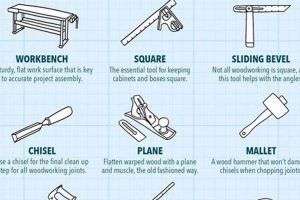
This introductory overview provides fundamental knowledge regarding implements employed in the craft of shaping wood. It encompasses a range of essential hand tools and power tools, alongside basic safety procedures, offering newcomers a starting point for understanding the core equipment used in woodworking projects. This knowledge serves as a base for further learning and practical application.
A foundational understanding of these instruments is crucial for both safety and efficiency in woodworking. It allows individuals to perform tasks accurately, minimize risks of injury, and appreciate the historical development of the craft. This base understanding supports the development of skill, leading to successful projects and an informed approach to working with wood.
Subsequent sections will delve into specific categories of implements. Details regarding hand tools, including chisels, saws, and planes, will be presented. Following this, the examination will shift to power tools, such as routers, sanders, and drills, highlighting their applications and proper usage. Safety protocols relevant to each tool type will be thoroughly addressed.
Woodworking Tools
The following recommendations offer direction for individuals beginning their journey in woodworking, ensuring safety, efficiency, and optimal outcomes in their projects.
Tip 1: Prioritize Safety Equipment: Eye protection, hearing protection, and dust masks are non-negotiable. Consistent use minimizes the risk of injury and long-term health problems associated with woodworking.
Tip 2: Master Hand Tools First: Developing proficiency with hand saws, chisels, and hand planes provides a deeper understanding of wood behavior and strengthens fundamental skills applicable to power tools.
Tip 3: Invest in Quality Tools Gradually: Purchasing fewer high-quality tools initially offers better performance and longevity compared to acquiring numerous inferior-grade options. Expand the collection as skills and project needs evolve.
Tip 4: Learn Sharpening Techniques: Sharp tools are safer and more efficient. Consistent sharpening ensures clean cuts, reduces the force required for operations, and minimizes the likelihood of mistakes.
Tip 5: Practice Proper Maintenance: Regularly clean and lubricate tools according to manufacturer instructions. Proper maintenance extends tool life, maintains performance, and prevents corrosion.
Tip 6: Understand Wood Grain Direction: Cutting against the grain can lead to tear-out and uneven surfaces. Learning to identify grain direction and adapt cutting techniques accordingly is essential for achieving smooth, professional results.
Tip 7: Dry-Fit Assemblies Before Gluing: Assembling components without adhesive first ensures proper alignment, identifies potential issues, and allows for necessary adjustments before committing to a permanent bond.
Adhering to these recommendations promotes a safer, more effective, and ultimately more rewarding woodworking experience. A foundation in fundamental knowledge and practices builds confidence and skill.
The subsequent segment provides actionable insights into selecting appropriate materials for woodworking projects. Careful material selection directly impacts project durability, aesthetic appeal, and overall success.
1. Tool Identification

In the context of foundational woodworking knowledge, the accurate identification of tools is paramount. This ability forms the basis for safe operation, efficient task execution, and informed decision-making throughout the woodworking process. Without proper identification, selection of the correct tool for a given task becomes arbitrary, potentially leading to substandard results or hazardous situations.
- Categorization by Function
Woodworking implements are broadly categorized by their primary function: cutting, shaping, joining, and finishing. Saws, chisels, and planes are classified as cutting tools. Routers and sanders fall under the shaping category. Clamps and joinery tools facilitate joining, and brushes and sprayers are used for finishing. Accurately classifying a tool based on its function informs its appropriate application and expected performance.
- Distinguishing by Type within Category
Within each functional category, further distinctions exist based on tool type. For instance, saws include handsaws, backsaws, and various power saws like circular saws and jigsaws. Chisels can be differentiated by their blade shape (e.g., mortise, paring, bevel-edge) and intended use. Recognizing these sub-categories allows for selecting the most precise tool for the specific cut or shaping operation.
- Recognizing Tool Anatomy
Understanding the individual components of a tool is crucial for effective operation and maintenance. For a hand plane, this includes identifying the blade, frog, sole, and adjustment mechanisms. For a power drill, it involves recognizing the chuck, motor housing, speed control, and trigger. This knowledge facilitates proper adjustments, troubleshooting, and ensures safe and efficient use.
- Differentiating by Manufacturer and Quality
While functionality remains consistent, the manufacturer and quality of a tool can significantly impact its performance and longevity. Established brands often have reputations for superior materials, precision engineering, and durability. Recognizing these distinctions allows for informed investment decisions, balancing cost with expected performance and lifespan.
The ability to accurately identify woodworking implements by function, type, anatomy, and manufacturer is fundamental to a successful woodworking practice. It fosters efficiency, enhances safety, and enables the informed selection of the right tool for each task, contributing directly to project quality and overall woodworking expertise.
2. Safety Protocols

Safety protocols are integral to woodworking and constitute a fundamental component of introductory woodworking knowledge. Understanding and adhering to these protocols mitigates risks associated with tool operation and workshop environment, ensuring a safe and productive woodworking experience.
- Personal Protective Equipment (PPE)
The consistent use of appropriate PPE is essential. This includes eye protection to prevent injuries from flying debris, hearing protection to mitigate noise-induced hearing loss, and respiratory protection to minimize inhalation of sawdust and fumes. Failure to utilize PPE can result in immediate injury and long-term health issues.
- Tool-Specific Safety Procedures
Each woodworking implement necessitates adherence to specific safety procedures. For example, operating a table saw requires the use of push sticks and blade guards to prevent contact with the blade. Power drills mandate secure workpiece clamping to avoid uncontrolled movement. Disregarding these procedures increases the likelihood of accidents.
- Workshop Environment Management
Maintaining a clean and organized workshop environment is crucial for safety. This involves regular removal of sawdust and debris, proper storage of tools, and adequate lighting. A cluttered or poorly maintained workshop increases the risk of trips, falls, and other accidents.
- Emergency Procedures and First Aid
Knowledge of basic first aid and emergency procedures is essential. This includes understanding how to treat common woodworking injuries, such as cuts and splinters, and knowing the location of first aid supplies. In the event of a serious accident, the ability to respond effectively can be life-saving.
These safety protocols, while seemingly straightforward, are non-negotiable for anyone engaging with woodworking implements. Their consistent application minimizes risk and promotes a sustainable and enjoyable woodworking practice. Disregarding these protocols exposes individuals to unnecessary hazards, potentially resulting in severe consequences.
3. Basic Operation

The correct manipulation of woodworking implements is foundational to woodworking knowledge. Understanding basic operation ensures efficiency, precision, and safe tool usage, directly contributing to successful project outcomes.
- Power Tool Activation and Control
Power tools, such as drills, saws, and routers, require specific activation sequences and control techniques. Understanding the on/off switch location, speed settings, and feed rate control is crucial. Inefficient or incorrect activation and control can lead to inaccurate cuts, material damage, or potential injury.
- Hand Tool Grip and Motion
Hand tools, including chisels, hand planes, and saws, rely on proper grip and controlled motion. A secure grip maximizes control and minimizes slippage. Utilizing the full range of motion for each tool, while maintaining control, optimizes efficiency and reduces strain. Incorrect grip or motion can result in imprecise cuts, increased effort, and higher risk of injury.
- Workpiece Securing Methods
Securely clamping or holding the workpiece is paramount before operating any woodworking tool. Unsecured workpieces can shift during cutting or shaping, leading to inaccurate results or dangerous situations. Various clamping methods and holding devices exist, each appropriate for specific tasks and workpiece sizes. Implementing appropriate securing methods is an integral aspect of basic tool operation.
- Adjustment and Calibration Procedures
Many woodworking implements require adjustment and calibration to ensure accurate performance. Table saws require blade alignment and fence calibration. Hand planes necessitate blade depth and lateral adjustment. Ignoring these procedures can result in inaccurate cuts, uneven surfaces, and reduced tool effectiveness. Regular adjustment and calibration are essential components of basic tool operation.
The principles of basic operation directly affect the quality and safety of woodworking projects. Efficient manipulation of tools, secure workpiece handling, and proper adjustment procedures enable accurate results and minimize the risk of accidents. Mastery of these basic operational skills is a cornerstone of woodworking proficiency.
4. Maintenance Procedures

Maintenance procedures constitute a critical, often overlooked, element within foundational woodworking knowledge. Neglecting systematic care diminishes the lifespan and performance of implements, impacting project quality and potentially creating hazardous conditions. The cause-and-effect relationship is direct: insufficient maintenance leads to tool degradation, resulting in reduced accuracy, increased effort, and elevated risk of injury. Understanding maintenance as an integral component of basic woodworking is paramount for maximizing investment and ensuring safety.
The practical significance is readily apparent in various scenarios. A dull saw, resulting from lack of sharpening, requires excessive force, leading to inaccurate cuts and increased user fatigue. Rust accumulation on plane soles hinders smooth gliding, affecting surface finish. A poorly lubricated drill motor overheats, reducing power and potentially causing premature failure. Consistent cleaning, sharpening, lubrication, and proper storage prevent these issues, maintaining implements in optimal working condition. For example, applying a thin coat of oil to metal surfaces after each use prevents rust, while regular sharpening of chisels ensures clean, precise cuts with minimal effort.
In summary, incorporating maintenance procedures into fundamental woodworking practices is not merely an optional addendum but an essential component. While challenges such as time constraints or lack of knowledge may exist, the long-term benefits of proper care outweigh the initial effort. Integrating these practices into a structured routine ensures that implements remain reliable and effective, directly supporting successful woodworking projects and promoting a safer working environment, thus linking maintenance inextricably to the core tenets of introductory woodworking.
5. Material Compatibility

Material compatibility, in the context of foundational woodworking knowledge, underscores the critical relationship between the properties of wood and the appropriate selection and application of tools. This facet addresses how different wood species react to cutting, shaping, and joining processes, and how these reactions influence tool choice and technique. A lack of understanding regarding material compatibility can lead to tool damage, substandard results, and potential safety hazards. For example, attempting to cut dense hardwoods with a fine-toothed saw designed for softwoods can result in blade binding, breakage, or inaccurate cuts. This demonstrates the cause-and-effect relationship: incompatible materials and tools yield undesirable outcomes.
The practical significance is further illustrated by the use of specific tools for specific tasks involving different wood types. Using a dull chisel on hardwood can cause the wood to split or crush, rather than creating a clean cut. Similarly, employing a high-speed router on softwood without adjusting the feed rate can lead to burning or tear-out. Conversely, matching the tool to the material, such as using a low-angle plane on figured hardwoods, minimizes tear-out and produces a smooth surface. Selecting appropriate fasteners, such as screws or nails, based on wood density and intended joint strength is also crucial for long-term project integrity. A well-chosen combination of material and tool enables efficient and predictable outcomes, thereby reducing waste and improving the quality of the finished product.
In summary, material compatibility represents a vital component of introductory woodworking knowledge. While complexities such as wood grain direction, moisture content, and species variability present challenges, mastering the principles of material compatibility significantly enhances woodworking efficiency, safety, and quality. This understanding directly connects tool choice and technique to the characteristics of the wood being worked, optimizing results and minimizing potential problems.
6. Sharpening Techniques

The ability to sharpen woodworking implements constitutes a fundamental skill within the broader context of introductory woodworking knowledge. A sharp tool is not merely desirable but essential for safety, precision, and efficiency. Dull tools require increased force, leading to reduced control and a higher risk of injury, while also producing substandard results. This foundational skill enables efficient and controlled woodworking.
- The Importance of Angle Consistency
Maintaining a consistent sharpening angle is critical for creating and preserving a sharp cutting edge. Varying the angle alters the bevel, weakening the edge and affecting the tool’s performance. Jigs and honing guides are employed to ensure angle consistency. For instance, a chisel sharpened with an inconsistent angle will not cut cleanly and requires more frequent re-sharpening.
- Selection of Abrasive Materials
Sharpening involves the use of various abrasive materials, each suited to different stages of the sharpening process. Coarse abrasives are used for initial shaping or removing damage, while finer abrasives are used for refining the edge. Examples include whetstones, diamond stones, and sandpaper. Selecting the appropriate abrasive material for each step is essential for achieving a sharp and durable edge.
- Honing and Stropping
Honing and stropping are final steps in the sharpening process, used to remove the burr created during sharpening and to polish the cutting edge. Honing involves using a very fine abrasive, while stropping utilizes a leather strop. These techniques refine the edge to its sharpest possible state. A properly honed and stropped tool cuts cleanly and efficiently, requiring less force.
- Assessment of Sharpness
The ability to assess the sharpness of a tool is vital for determining when sharpening is required and for evaluating the effectiveness of sharpening techniques. Visual inspection, tactile assessment, and test cuts on scrap wood are used to evaluate sharpness. A sharp tool should cleanly slice through wood fibers without tearing or crushing.
Mastery of these sharpening techniques ensures that woodworking implements maintain their optimal performance, reducing the effort required for each task, enhancing the quality of the finished product, and promoting a safer working environment. Sharpening proficiency is thus an indispensable element of foundational woodworking skill.
7. Project Planning

Effective project planning is integral to woodworking and serves as a crucial precursor to the practical application of woodworking implements. Detailed planning facilitates informed decision-making, optimizes resource allocation, and minimizes potential errors, directly impacting the efficiency and success of any woodworking endeavor. A well-defined plan is essential for maximizing the utility of basic woodworking knowledge.
- Material Estimation and Procurement
Accurate material estimation is paramount for avoiding material shortages or waste. Detailed project plans specify the required dimensions and quantities of lumber, hardware, and finishing materials. This process informs the selection of appropriate woodworking tools for cutting, shaping, and joining these materials. For example, a project requiring thick hardwood necessitates a more powerful saw than one involving thin softwood. Inaccurate material estimation can lead to project delays, increased costs, and improper tool selection.
- Tool Selection and Sequencing
A comprehensive project plan outlines the specific woodworking operations required, thereby dictating the necessary tools. The plan identifies the sequence of cuts, joints, and finishing steps, allowing for the selection and organization of tools in a logical order. For instance, a plan involving dovetail joints necessitates chisels, saws, and a marking gauge. A well-sequenced plan optimizes workflow and reduces the risk of errors caused by using the wrong tool at the wrong time. Improper tool sequencing can lead to inefficiencies and compromised project quality.
- Risk Assessment and Safety Planning
Project planning includes a thorough risk assessment to identify potential hazards associated with each woodworking operation. This assessment informs the selection of appropriate safety equipment and the implementation of safety procedures. For example, a project involving routing requires eye and ear protection. A well-defined safety plan minimizes the risk of injury and ensures a safe working environment. Inadequate safety planning can lead to accidents and long-term health problems.
- Time Management and Scheduling
Realistic time management and scheduling are critical for project completion. The plan estimates the time required for each woodworking operation, accounting for material preparation, tool setup, and finishing. This information informs the allocation of time and resources. A well-managed schedule ensures timely project completion and reduces the risk of rushing, which can lead to errors and safety hazards. Poor time management can result in missed deadlines and compromised project quality.
These facets of project planning are intrinsically linked to woodworking implements. Accurate material estimation, informed tool selection, proactive risk assessment, and realistic time management collectively optimize the application of basic woodworking knowledge, maximizing project efficiency and minimizing potential problems. The interconnectedness between the plan and the process emphasizes the importance of thorough preparation in woodworking.
Woodworking Tools 101
This section addresses common inquiries regarding fundamental woodworking implements, providing clarity on essential concepts and dispelling misconceptions.
Question 1: What constitutes a “starter set” of woodworking implements?
A typical starter set comprises a hand saw, a set of chisels, a hand plane, a measuring tape, a combination square, a marking gauge, a mallet, and a sharpening stone. This collection facilitates basic cutting, shaping, and joining operations.
Question 2: Are power tools essential for beginning woodworking?
Power tools are not strictly essential for initial woodworking endeavors. Developing proficiency with hand tools first fosters a deeper understanding of wood behavior and promotes skill development that translates to power tool usage. However, power tools can increase efficiency for certain tasks.
Question 3: How frequently should woodworking implements be sharpened?
Sharpening frequency depends on tool usage and wood type. As a general guideline, tools should be sharpened whenever they require excessive force or produce rough cuts. Regular honing maintains sharpness between sharpening sessions.
Question 4: What are the most common safety hazards associated with woodworking implements?
Common hazards include lacerations from sharp edges, eye injuries from flying debris, respiratory issues from sawdust inhalation, and hearing damage from prolonged exposure to loud noise. Implementing appropriate safety measures, such as wearing personal protective equipment, mitigates these risks.
Question 5: Is it necessary to invest in expensive woodworking implements initially?
Investing in a few high-quality tools initially is generally preferable to acquiring numerous inferior-grade options. Quality tools offer better performance, durability, and safety. A gradual expansion of the tool collection is recommended as skills and project needs evolve.
Question 6: How does wood type impact the selection of woodworking implements?
Wood type significantly influences tool selection. Hardwoods necessitate sharper, more robust tools than softwoods. Denser woods require more frequent sharpening. Understanding the properties of different wood species enables informed tool choices and optimal results.
Understanding these frequently asked questions provides a solid foundation for navigating the world of woodworking implements. Applying these principles enhances safety, efficiency, and project quality.
The subsequent section explores resources for further learning and skill development in woodworking, providing guidance for continued growth and expertise.
Woodworking Tools 101
This exploration of “woodworking tools 101” has underscored the fundamental knowledge required for safe, efficient, and successful woodworking. The examination encompassed tool identification, safety protocols, operational basics, maintenance procedures, material compatibility, sharpening techniques, and project planning. Mastery of these core elements forms the bedrock of woodworking proficiency.
The information presented provides a basis for continued learning and skill development. Practical application of these principles, combined with ongoing education and experience, will advance capabilities in woodworking. A commitment to safety, precision, and continuous improvement will yield increasingly sophisticated and rewarding results in this craft.


![Best Multi Tool Woodworking Station [Guide] | Step-by-Step Guides, Tools & Inspiration to Build Beautiful Wooden Decor on a Budget](https://woodfromhome.com/wp-content/uploads/2026/04/th-259-300x200.jpg "Best Multi Tool Woodworking Station [Guide] Step-by-Step Guides, Tools & Inspiration to Build Beautiful Wooden Decor on a Budget")