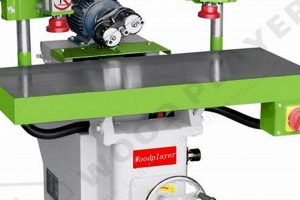
This equipment utilizes heat and pressure to bond materials, typically wood-based panels, with adhesives. Operations often include veneer application, lamination, and panel flattening. For instance, a manufacturer might use this type of machinery to apply decorative laminates to cabinet doors, ensuring a strong and consistent bond across the entire surface.
The use of such technology improves production efficiency and product quality. The application of consistent, controlled pressure and heat significantly reduces bonding time compared to traditional clamping methods. Historically, these processes relied heavily on manual labor and extended curing periods; this mechanized approach represents a considerable advancement, resulting in higher output and reduced labor costs, alongside improvements in bond strength and dimensional stability of the finished product.
The following sections will delve into the specific components, operational parameters, maintenance considerations, and selection criteria associated with this class of industrial apparatus. Furthermore, distinct types of models and their appropriate applications within various woodworking contexts will be explored.
Operational Tips for Optimal Performance
Maximizing the effectiveness and longevity of this machinery requires adherence to specific operating procedures and maintenance protocols. The following tips provide guidance for achieving consistent results and preventing costly downtime.
Tip 1: Material Preparation: Ensure substrates are clean, dry, and free from contaminants prior to adhesive application. Inconsistent surface preparation can lead to weak bonds and delamination.
Tip 2: Adhesive Selection: Choose an adhesive specifically formulated for hot press applications, considering factors such as open time, cure time, and bond strength requirements. Using an inappropriate adhesive can compromise the structural integrity of the finished product.
Tip 3: Temperature Control: Precisely regulate platen temperature according to adhesive manufacturer specifications. Overheating can damage the adhesive or substrate, while insufficient heat can result in incomplete curing.
Tip 4: Pressure Calibration: Verify that the pressure settings are uniformly distributed across the platen surface. Uneven pressure can lead to inconsistent bond quality and panel warping.
Tip 5: Cycle Time Optimization: Experiment with varying cycle times to determine the minimum duration required for complete adhesive curing. Excessive cycle times waste energy, while insufficient times result in inadequate bonding.
Tip 6: Regular Maintenance: Implement a routine maintenance schedule, including cleaning the platens, lubricating moving parts, and inspecting hydraulic systems. Preventive maintenance minimizes the risk of mechanical failures and extends the lifespan of the equipment.
Tip 7: Monitoring and adjustment: Continuously monitor pressure and temperature. Periodic adjustment to these elements guarantees consistent bond performance by adapting to environmental changes or material variability.
Adherence to these recommendations will contribute to enhanced operational efficiency, improved product quality, and reduced maintenance expenses.
The subsequent discussion will address troubleshooting common issues encountered during operation and explore advanced techniques for optimizing its performance in specialized applications.
1. Adhesive Bonding

Adhesive bonding is a critical process enabled and enhanced by the use of woodworking hot press machines. The machine provides the controlled heat and pressure necessary to create strong and durable bonds between wood components and other materials, significantly impacting the final product’s quality and structural integrity.
- Adhesive Selection and Compatibility
The choice of adhesive is paramount. Woodworking hot press machines are compatible with a range of adhesives, including urea-formaldehyde (UF), polyvinyl acetate (PVA), and epoxy resins. The selected adhesive must possess appropriate viscosity, open time, and curing temperature characteristics that align with the machine’s capabilities and the substrate materials. Incorrect adhesive selection can lead to bond failure or compromised structural performance.
- Heat Activation and Curing Mechanism
The machine’s heating platens provide the thermal energy required to activate and cure the adhesive. Heat accelerates the chemical reactions within the adhesive, promoting cross-linking and the formation of a robust bond. Precise temperature control is essential to prevent overheating, which can degrade the adhesive, or insufficient heating, which can result in incomplete curing and weak bonds. The curing process permanently crosslinks the material, making it stronger and more resistant to degradation.
- Pressure Application and Uniformity
The machine applies uniform pressure across the bonding surfaces, ensuring intimate contact between the adhesive and the substrates. Consistent pressure distribution is crucial for achieving optimal bond strength and preventing voids or air pockets within the adhesive layer. Inadequate pressure can lead to weak points and increased susceptibility to delamination.
- Bond Strength and Durability
The combination of heat and pressure during the bonding process significantly enhances bond strength and durability. Properly executed adhesive bonding in a hot press machine yields joints that exhibit high resistance to shear, tensile, and peel forces. This results in products that can withstand rigorous use and environmental conditions, extending the lifespan and reliability of the wood products. The pressure and heat ensure a tight molecular bond in the materials.
In summary, adhesive bonding, as facilitated by woodworking hot press machines, is a fundamental aspect of modern woodworking practices. The process significantly enhances the quality, durability, and structural integrity of wood products by creating strong and reliable bonds between various materials. The interplay between adhesive selection, heat activation, pressure application, and the resulting bond strength underscores the importance of this technology in producing high-quality wood-based products.
2. Temperature Control

Temperature control is a pivotal parameter in the operation of woodworking hot press machines. Maintaining precise and consistent temperature is essential for achieving optimal adhesive curing, preventing material degradation, and ensuring the production of high-quality, durable wood products. Temperature management directly impacts the adhesive’s viscosity, reactivity, and ultimate bond strength.
- Platen Temperature Uniformity
Uniform temperature distribution across the entire platen surface is critical. Variations in temperature can lead to inconsistent adhesive curing, resulting in weak spots or delamination. Modern hot press machines often employ sophisticated heating systems with multiple heating zones and feedback loops to maintain temperature uniformity within a narrow tolerance range. Disparities can compromise the structural integrity of the finished product.
- Adhesive Curing Profile
Each adhesive formulation has a specific temperature profile that dictates the optimal curing rate and bond strength. Exceeding the recommended temperature can cause premature curing or degradation of the adhesive, while insufficient temperature can result in incomplete curing and reduced bond strength. Operators must adhere to the adhesive manufacturer’s specifications to ensure proper curing within the press. For example, some phenolic resins require elevated temperatures to fully polymerize and achieve their specified mechanical properties.
- Material Compatibility and Thermal Stability
The temperature settings must be compatible with the thermal stability of the wood species or composite materials being processed. Excessive heat can cause warping, cracking, or discoloration of certain wood types. Similarly, some laminates or veneers may exhibit undesirable changes at elevated temperatures. Careful consideration must be given to the thermal properties of all materials involved to prevent damage during the pressing cycle. Material density and moisture content also will contribute to temperature control.
- Heating System Calibration and Maintenance
Regular calibration and maintenance of the heating system are essential for maintaining accurate temperature control. Temperature sensors, heating elements, and control systems should be periodically inspected and calibrated to ensure they are functioning correctly. A malfunctioning heating system can lead to temperature fluctuations and inconsistent product quality. Some machines include alarm systems to alert the technician of temperature variances or deviations.
Effective temperature control within woodworking hot press machines is not merely a matter of setting a target temperature; it requires a holistic approach that considers platen uniformity, adhesive curing profiles, material compatibility, and system calibration. Meticulous temperature management directly translates to enhanced product quality, reduced waste, and optimized operational efficiency. Temperature control influences the consistency and structural stability of laminated materials.
3. Pressure Uniformity

Pressure uniformity within a woodworking hot press machine is paramount for achieving consistent and reliable bonding across the entire surface area of the workpiece. Uneven pressure distribution can lead to localized areas of insufficient contact between the adhesive and the substrate, resulting in weak or incomplete bonds. Conversely, excessive pressure in certain areas can cause material deformation, crushing of the core, or adhesive squeeze-out, compromising the structural integrity and aesthetic quality of the finished product. For example, when laminating a large panel, variations in pressure can manifest as visible waves or undulations in the surface, rendering the panel unusable for high-end applications.
Achieving pressure uniformity relies on several factors, including the design and construction of the press platens, the hydraulic system’s ability to deliver consistent force, and the presence of any debris or obstructions between the platens and the workpiece. Platens must be precisely machined and maintained to ensure flatness and parallelism. Hydraulic systems must be calibrated to deliver equal pressure to all points on the platen surface. Even small particles of dust or wood shavings can create pressure points, leading to localized bonding defects. In furniture manufacturing, ensuring consistent pressure distribution is critical when bonding veneers to complex curved surfaces, as variations in pressure can lead to veneer cracking or delamination.
In summary, pressure uniformity is not merely a desirable attribute but an essential requirement for the proper functioning of a woodworking hot press machine. Addressing challenges related to platen flatness, hydraulic system calibration, and cleanliness of the working environment is crucial for maintaining consistent pressure distribution and producing high-quality, structurally sound wood products. Failure to prioritize pressure uniformity can lead to significant material waste, increased production costs, and compromised product performance.
4. Platen Parallelism

Platen parallelism is a critical geometric attribute in woodworking hot press machines, influencing the quality and consistency of bonded materials. Deviations from parallelism can lead to non-uniform pressure distribution, resulting in compromised bond strength and potential product defects. Accurate platen alignment is therefore paramount for optimal machine performance.
- Impact on Pressure Distribution
Non-parallel platens create a variable pressure gradient across the workpiece. Areas with narrower gaps experience higher pressure, potentially crushing the core material or causing adhesive squeeze-out. Conversely, wider gaps receive insufficient pressure, leading to weak or incomplete bonding. This pressure differential directly affects the structural integrity and surface finish of the laminated product. Consider the case of applying a thin veneer to a substrate; a lack of parallelism can result in the veneer adhering unevenly, leading to visible blemishes and reduced product lifespan.
- Influence on Bond Strength
Consistent bond strength relies on uniform adhesive contact between the substrate and the overlay material. Platen misalignment compromises this contact, reducing the overall bond strength and increasing the likelihood of delamination. This is particularly important in applications requiring high structural performance, such as the production of engineered wood products. If the platens aren’t parallel, the adhesive may not cure completely, weakening the entire bonding area.
- Effect on Product Dimensional Accuracy
Misaligned platens can introduce dimensional inaccuracies in the finished product. Uneven pressure can cause the workpiece to deform or warp during the bonding process, leading to deviations from specified dimensions. This is particularly problematic in applications requiring tight tolerances, such as the manufacture of furniture components or architectural panels. In high-end cabinetry, even minor dimensional inaccuracies can cause assembly problems or affect the overall aesthetic appeal.
- Measurement and Adjustment Procedures
Ensuring platen parallelism requires periodic measurement and adjustment. Techniques such as laser alignment or precision shimming are employed to verify and correct any deviations. These procedures are typically performed during machine installation and as part of routine maintenance schedules. The accuracy of these adjustments directly impacts the long-term performance and reliability of the woodworking hot press machine. Proper maintenance routines will measure and correct any deviations.
In essence, platen parallelism is not simply a mechanical specification, but a fundamental requirement for achieving consistent and high-quality results in woodworking hot press operations. Regular inspection, measurement, and adjustment are essential to maintain optimal machine performance and prevent costly product defects.
5. Cycle Time

Cycle time, in the context of a woodworking hot press machine, denotes the total duration required to complete a single pressing operation, from the initial loading of materials to the removal of the finished product. Minimizing cycle time while maintaining product quality is a primary objective in optimizing production efficiency.
- Adhesive Curing Time
A significant component of the cycle time is the adhesive curing time. This duration is dictated by the adhesive formulation, the temperature of the platens, and the pressure applied. Insufficient curing time results in a weak bond, while excessive time wastes energy and reduces throughput. For instance, a urea-formaldehyde adhesive may require 5 minutes at 120C to achieve full cure, whereas a polyurethane adhesive may cure in 2 minutes at a lower temperature. The selection of adhesive and the machine’s temperature control capabilities directly impact this aspect of the cycle.
- Loading and Unloading Time
The efficiency of loading and unloading materials into and out of the hot press directly affects the overall cycle time. Manual loading and unloading are inherently slower than automated systems. For example, a machine equipped with an automated loading system can reduce the loading/unloading time from several minutes to a matter of seconds, significantly decreasing the overall cycle time. The physical size and weight of the materials being processed also influence this component of the cycle. Palletization, material handling systems, and automatic feeders affect loading time.
- Heating and Cooling Time
The time required for the platens to reach the desired temperature and for the bonded materials to cool sufficiently for safe handling contributes to the overall cycle time. Machines with rapid heating and cooling systems can significantly reduce this component. For example, some modern hot presses utilize oil or water-based heating and cooling systems that offer faster thermal response compared to traditional electric resistance heating. Pre-heating materials can lower heating time in the machine.
- Press Closing and Opening Time
The time taken for the press to close and apply pressure, and subsequently open and release the finished product, is also a factor in the cycle time. Hydraulic systems with faster actuation speeds can reduce this time. The press ram speed, valve response time, and the overall design of the hydraulic system all contribute to the closing and opening time. Moreover, the stroke length impacts time: shorter strokes reduce cycle time.
The optimization of cycle time in woodworking hot press machines requires a holistic approach that considers adhesive selection, material handling, heating/cooling systems, and hydraulic system performance. Balancing these factors is essential for maximizing production output while maintaining the required quality standards for the finished wood products. Minimizing cycle time directly contributes to increased profitability and competitiveness in the woodworking industry.
6. Hydraulic system
The hydraulic system is a fundamental component of woodworking hot press machines, providing the force necessary for clamping and pressing materials. It generates and transmits pressure to the press platens, enabling the bonding of wood veneers, laminates, and other materials. The system’s efficiency and reliability directly impact the machine’s overall performance, cycle time, and the quality of the finished product. A malfunctioning hydraulic system can result in inconsistent pressure, leading to delamination or warping of the materials being processed. For example, if the hydraulic pump fails to maintain adequate pressure, the adhesive may not bond properly, requiring the rejection of the entire workpiece. The components of the system also can affect the control of the press, thereby causing problems with alignment, causing errors and potentially damaging the components and materials.
Hydraulic systems in these machines typically consist of a hydraulic pump, reservoir, control valves, cylinders, and associated piping. The pump draws hydraulic fluid from the reservoir and delivers it under pressure to the cylinders, which extend to apply force to the platens. Control valves regulate the flow of fluid, enabling precise control over the pressure and speed of the press. Advanced systems incorporate proportional valves and programmable logic controllers (PLCs) for automated pressure control and cycle sequencing. Proper maintenance of the hydraulic system, including regular fluid changes and inspection of hoses and fittings, is crucial for preventing leaks and ensuring reliable operation. Hydraulic systems must be able to respond quickly and predictably to changing loads; otherwise, the press won’t work optimally. The consistency of the hydraulic system is critical for consistent bond strength.
In conclusion, the hydraulic system is integral to the function of a woodworking hot press machine. Its ability to deliver controlled and consistent pressure is essential for achieving high-quality bonding. Effective maintenance, precise calibration, and proper system design are paramount for maximizing machine performance and minimizing downtime. Challenges include ensuring leak-free operation, maintaining fluid cleanliness, and selecting components that can withstand the demanding operating conditions of a production environment. It is necessary to check the systems and their constituent components periodically.
Frequently Asked Questions About Woodworking Hot Press Machines
This section addresses common inquiries regarding the operation, maintenance, and selection of woodworking hot press machines. The information presented aims to provide clarity and guidance for users and prospective buyers.
Question 1: What is the typical lifespan of a woodworking hot press machine?
The lifespan of a hot press machine is contingent upon several factors, including the quality of construction, the intensity of usage, and the adherence to recommended maintenance schedules. Under normal operating conditions and with proper maintenance, a well-built machine can provide reliable service for 15 to 20 years. Regular inspection, lubrication, and timely replacement of worn components are essential for extending the machine’s operational life.
Question 2: What types of adhesives are compatible with a woodworking hot press machine?
Woodworking hot press machines can accommodate a variety of adhesives, including urea-formaldehyde (UF), polyvinyl acetate (PVA), epoxy resins, and phenolic resins. The choice of adhesive depends on the specific application, the materials being bonded, and the desired bond strength and durability. It is imperative to consult the adhesive manufacturer’s specifications to ensure compatibility with the machine’s temperature and pressure capabilities.
Question 3: How often should the hydraulic fluid be changed in a woodworking hot press machine?
The hydraulic fluid should be changed periodically to maintain optimal system performance and prevent component wear. The recommended interval depends on the operating environment and the fluid type. Typically, a fluid change is recommended every 2,000 to 4,000 hours of operation, or annually, whichever comes first. Regular fluid analysis can provide insights into the fluid’s condition and inform the appropriate change interval.
Question 4: What safety precautions should be observed when operating a woodworking hot press machine?
Operating a hot press machine requires strict adherence to safety protocols. Personnel must wear appropriate personal protective equipment (PPE), including safety glasses, gloves, and hearing protection. The machine should be equipped with safety interlocks to prevent operation with open guards. Emergency stop buttons must be readily accessible. Regular training and adherence to established safety procedures are essential for preventing accidents.
Question 5: What are the primary causes of uneven pressure distribution in a woodworking hot press machine?
Uneven pressure distribution can result from several factors, including platen misalignment, hydraulic system imbalances, and the presence of debris between the platens and the workpiece. Worn or damaged platens can also contribute to pressure variations. Regular inspection and maintenance of the platens and hydraulic system are necessary to ensure uniform pressure distribution.
Question 6: How can I troubleshoot temperature fluctuations in a woodworking hot press machine?
Temperature fluctuations can stem from faulty heating elements, malfunctioning temperature sensors, or issues with the control system. Start by verifying the integrity of the heating elements and sensors. Check the control system settings and wiring connections. Consult the machine’s service manual for diagnostic procedures. If the problem persists, contact a qualified technician for assistance.
In summary, the successful operation of a woodworking hot press machine hinges on a thorough understanding of its capabilities, limitations, and maintenance requirements. Adherence to recommended procedures and proactive troubleshooting are crucial for maximizing its performance and longevity.
The subsequent section will delve into advanced techniques for optimizing the performance of woodworking hot press machines in specialized applications.
Conclusion
This examination has underscored the critical role of the woodworking hot press machine in modern manufacturing. From adhesive bonding and temperature management to pressure uniformity and cycle time optimization, each element contributes to the production of high-quality, durable wood-based products. A comprehensive understanding of these factors is essential for achieving consistent results and maximizing operational efficiency.
Continued advancements in hot press technology promise further enhancements in precision, automation, and energy efficiency. As demands for sustainable and high-performance wood products increase, the strategic implementation and diligent maintenance of these machines will remain paramount for success in the woodworking industry. Investing in operator training and adhering to rigorous quality control measures are therefore crucial for realizing the full potential of this essential equipment.